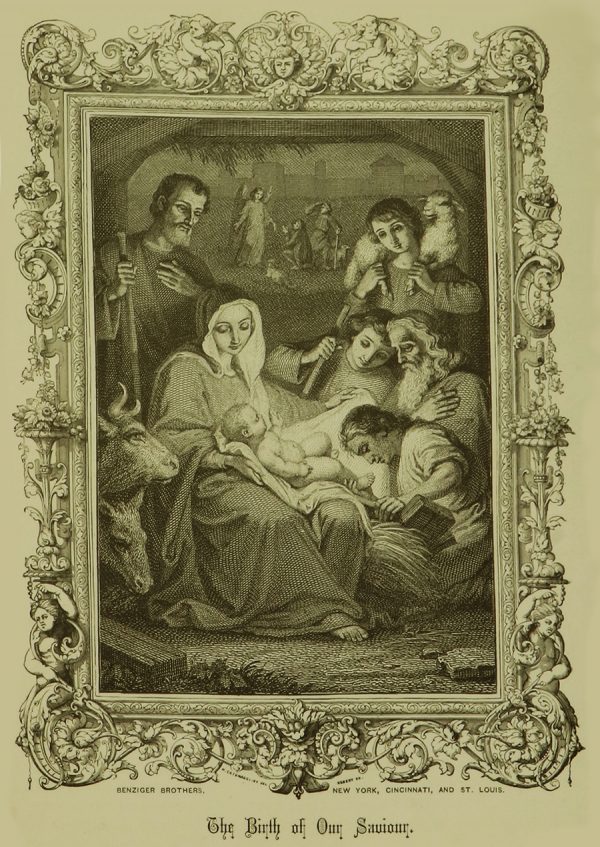
Hercule Louis Catenacci The Birth of Our Saviour In The Life of Our Lord and Savior Jesus Christ and of the Blessed Virgin Mary engraving
1879, published by the Benzinger Brothers
Courtesy of Archives and Special Collections
MERRY CHRISTMAS
“We desire to be able to welcome Jesus at Christmas-time, not in a cold manger of our heart, but in a heart full of love and humility, in a heart so pure, so immaculate, so warm with love for one another.” – St. Teresa of Calcutta
This engraved image depicting the birth of Jesus is from one of many bibles in the university’s Rare Book Library, which is cared for by the Department of Archives and Special Collections. This volume, entitled The Life of Our Lord and Saviour Jesus Christ and of his Virgin Mother Mary, was published in 1879 by Benzinger Brothers Publishing.[1] The illustration shown here was engraved by Hercule Louis Catenacci, a French painter and illustrator.
Catenacci was born in Ferrara, a province in present-day Italy, in 1816. He later moved to France, illustrating numerous books and journals on a variety of subjects. Cantenacci’s versatility was demonstrated thematically as well in his ability to adopt numerous illustrative styles depending upon the commission. His illustrations included Moorish architecture in Spain, sarcophagus designs from a French exposition, the art and architecture of India, liturgical objects, garden landscapes, Italian piazzas, Cambodian ruins and images of protestors.[2]
Benzinger Brothers Publishing was founded in Switzerland in 1792 with the express purpose of functioning as a Catholic publishing house. In the late 19th century, the publisher expanded its operations to the United States, opening offices in Chicago and Cincinnati.[3] It has been through many iterations since then, being bought, sold and consolidated several times. Still in existence today, Benzinger Brothers has been operating under the name RCL Benzinger since 2016, when it became a subsidiary of Kendall Hunt Publishing of Dubuque, Iowa.[4] RCL Benzinger still has offices in Cincinnati and primarily serves religious education programs for Catholic dioceses, parishes, schools, families, and individuals, including bilingual students and students with disabilities.[5]
The images and materials shown here are but a small part of the vast patrimony available to students, faculty and researchers. For access to this or other objects in our collections, complete a research request form to set up an appointment or contact us at 973-761-9476.
[1]The Life Of Our Lord And Saviour Jesus Christ And Of His Virgin 1 Mother Mary. New York: Benzinger Brothers, 1879. p.298.
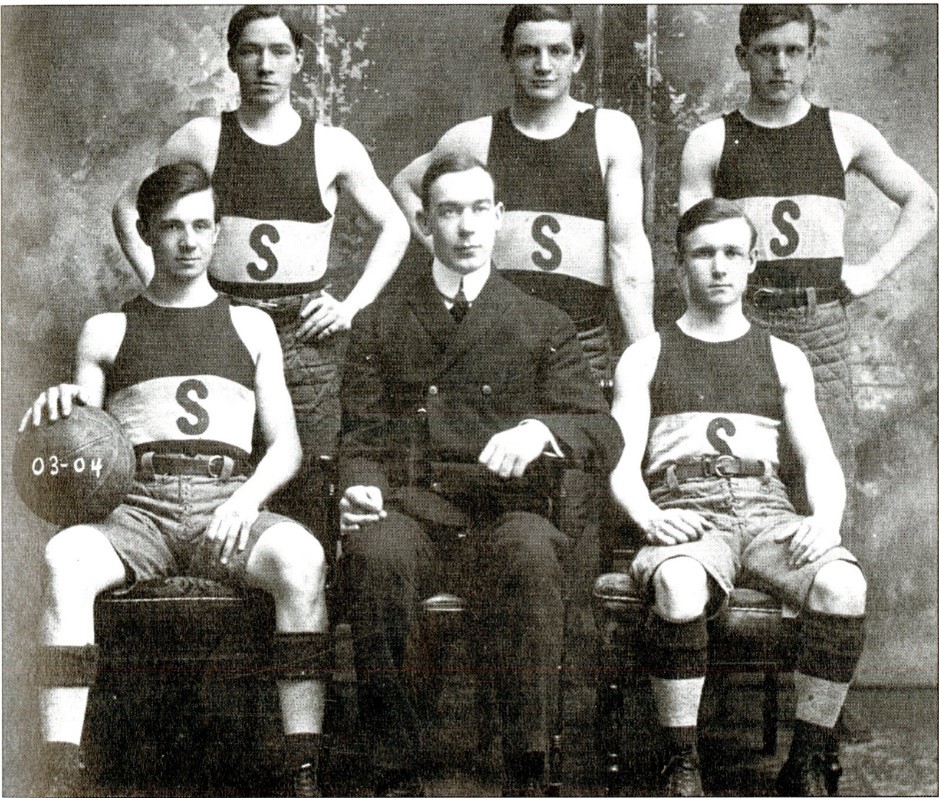
Members of the 1903 – 1904 Inaugural Seton Hall Men’s Basketball Team Courtesy of Archives and Special Collections, SHU 0031
Seton Hall University Athletics & Recreation Collection
Top, left to right: William Baird, Henry McDonough (team captain), Robert Barrett Bottom, left to right: Martin Reynolds, John Holton (manager), Bernard Barrett Not pictured: Charles O’Neill, Francis Reilly, John Stafford, Charles Tichler.
SETON HALL MEN’S BASKETBALL TEAM WINS FIRST GAME EVER –DECEMBER 19, 1903
Basketball has a long and storied history at Seton Hall University. The 1903 – 1904 season was the first time a men’s team was organized at the university to play the sport which had been developed in the late 19th century by Dr. James Naismith at Springfield College in Massachusetts.[1] Naismith sought a way to keep student athletes physically active during the winter months when sports could not be played out-of-doors.[2] The inaugural men’s basketball team at Seton Hall consisted of 9 players and their manager. Their first game was against the Mohawk Club of Newark which ended in a draw (15 – 15) on December 9, 1903. Just ten days later, on December 19, the team would win their first game ever against Brooklyn High School (28 – 12). At the time, it was not uncommon for college teams to compete against local YMCA’s, club teams and high schools as well as other colleges. The first basketball season was a short one, ending after six games on January 16, 1904 with a record of two wins, three losses and one tie.[3]
Matchbook cover from WNJR Radio advertising Seton Hall basketball 1949 2020.07.0001 Courtesy of Archives and Special Collections
From the 1890s through the 1900s, Seton Hall’s sports teams were known as the Villagers. Shortly after the turn of the 20th century, the teams were known as The White and Blue, a reference to the school colors. In was not until 1931 that the University’s sports teams took the familiar name Pirates.[4] The men’s basketball team has come a long way from their humble beginnings playing in attics and assembly halls on campus. The award-winning series The Voyage chronicles their 2019-2020 season that ended in winning the Big East regular season championship. You can find all 22 episodes on Youtube. Today, both the men’s[5] and women’s[6] basketball programs represent Seton Hall University in the Big East Conference. Dozens of former Pirates have played or currently play basketball professionally in the NBA, WNBA and on overseas teams.[7]
The Walsh Gallery has a considerable collection of fine art, artifacts and archeological specimens for use by faculty, students and researchers. For access to this or other objects in our collections, contact us at 973-275-2033 or walshgallery@shu.edu to make a research appointment.
[1] Delozier, Alan Bernard. “1 – Foundation 1903 – 1940” Seton Hall Pirates – A Basketball History, 9 – 11. Charleston, SC: Arcadia Publishing, 2002
“Touchdown for Old Setonia!” was an exclamation that was cheered on by players, cheerleaders, supporters in the grandstands, and all who followed the fortunes of Seton Hall College football throughout its earliest days in action. Joining both Baseball and Basketball as a signature sport during the earliest years of intercollegiate competition at Seton Hall, Football was also included as one of the most prolific and successful athletic teams on campus.
American Football celebrated its Sesquicentennial last year with the game being created in New Jersey in 1869, and as colleges and universities discovered the sport they introduced it to their respective student bodies in turn. This ultimately led to wide-spread popularity of this game which quickly became synonymous with Fall Saturdays and captured the imagination of the overall sporting public. This is especially true during the nineteenth century when Football was developing itself as a unique and unifying force around the country. The attractiveness of this sport especially among the immigrant sons and first generation of college students at Setonia at first and as it became the “American Game” (as a parallel to Baseball as the “American Past-Time) built in popularity over the century plus.
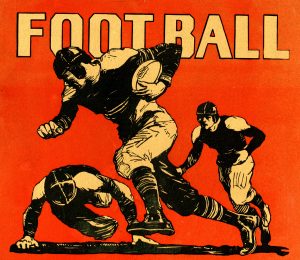
Football Poster Illustration, c. 1923
Seton Hall can share in a chapter of College Football history through the posting of several memorable seasons, players, coaches, and milestones that make this story a memorable on in various ways beyond the “gridiron” alone. In retrospect, the days of Seton Hall Football is a case of fond memories, regular inquires about the research aspects of the sport, and many wistful questions about if it will return as a sport on campus at some point in the future? Time and circumstances will tell if we can kick-off once again, but for now let us reflect on a sport that at one time gripped the imagination of the campus and its fandom.
Seton Hall campus back in the day when the school fielded a competitive football eleven at various junctures from the late nineteenth century through the early 1980s. An auspicious moment came when looking at the “kickoff” of the sport at the college, it is recognized by various scholars that Seton Hall played in the very first football contest between two Catholic institutions of higher education when they matched up against St. John’s (later known as Fordham and not to be confused with St. John’s of Queens) during the Autumn of 1882. Although this seminal moment resulted in a loss, the following December when the Setonia Eleven posted their first victory as a program over St. John’s by a score of 2-0 (This was measured in “goals” as different scoring rules were in vogue during the nineteenth century and would later change as the game expanded and modernized over time) which helped to solidify the sport and show it had the potential to succeed.
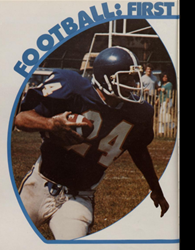
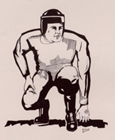
Illustration of Football Player, 1931 White & Blue Yearbook
Between 1885 and 1886, Seton Hall posted undefeated campaigns, had a five game winning streak, and were unscored upon and handily defeated St. John’s in particular by scores of 14-0, 36-0, 12-0, 32-0, and 63-0 before dropping the sport in 1887. The squad resumed play the following season with a new nickname – “The Alerts” (with a Junior Varsity or Freshman team nicknamed – “The Senators” or “Crescents” at various times over the next few years) and boasted a 2-1 record after playing St. John’s three more times before diversifying their scheduling by the end of the 1880s.
By 1889, The Alerts played a more diverse set of opponents when they matched up against a number of independent Northern New Jersey-New York City metropolitan based club teams in particular including the Oritani Field Club and Bedford FC, defeating them both 28-0 and 18-4 respectively that year. Additional athletic organizations and high school contingents were played during the 1890s including such entities as the Newark AC, Palma Club of Jersey City, Varuna Boat Club, Brooklyn Poly, Hoboken HS, Iron Cross of Jersey City, Willet’s Point Engineers Corp , Motor Team of Brooklyn, Crescents of Harlem, and the Morristown Field Club, etc. Conversely, Seton Hall also started to play other collegiate squads aside from St. John’s alone including Hackettstown Institute (later known as Centenary College), St. Francis Xavier, Trenton State Normal School, St. John’s (Queens), College of New Jersey (later known as Princeton) Frosh, City College of New York (CCNY) Juniors, St. Peter’s College (Jersey City), and Manhattan College among others who had campuses around the region.
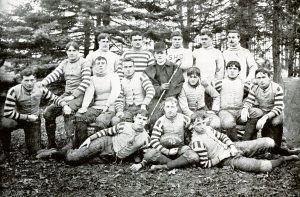
Undefeated Seton Hall College Eleven, 1893
In terms of coach guidance, Seton Hall relied on James P. Lee (Harvard, ’90) who was an All-American selection for the Crimson in 1889 and enrolled at the Columbia Law school earning his LL.B. degree while simultaneously employed by Seton Hall during the 1890s. Counted among the standout players during this era included such “gridders” as Gene Kinkead, John Phelan, Jim Smith, Tom Reilly, Tom Walsh, Richard Kane, Gene McDonald and the first of many members of the McDonough family who donned the White and Blue sweaters of Setonia. Under the guidance of Coach Lee and company, winning seasons were attained in 1892, 1893 (undefeated), 1894, 1895, 1896, 1897, 1898, 1899 were earned and Setonia amassed a combined record between 1883 and 1899 of 63-13- 5 (with various cancelations and forfeits) to end the century on a high note.
Moving into the early twentieth century, more action was in play at different levels for the Setonia Football teams and fans as an Alumni squad was formed to compliment the Varsity and “Frosh” contingents and a more structured scheduling trend emerged as more collegiate elevens and fewer club or prep school teams were played, but not entirely eliminated from the opponent list altogether. Counted among those squads Seton Hall played included such squads as the Seton Hall Alumni, Nassau Club of Princeton, Knickerbocker AC, 5th U.S. Artillery, Dreadnaught AC, Willet’s Point Engineers Corp, Robert Davis Association at St. George Cricket Ground, Hoboken. Fort Hancock (Sandy Hook), Eaton Business College, New Jersey State School, Columbia College of Physicians and Surgeons, New York , University & Bellevue Medical College, and others.
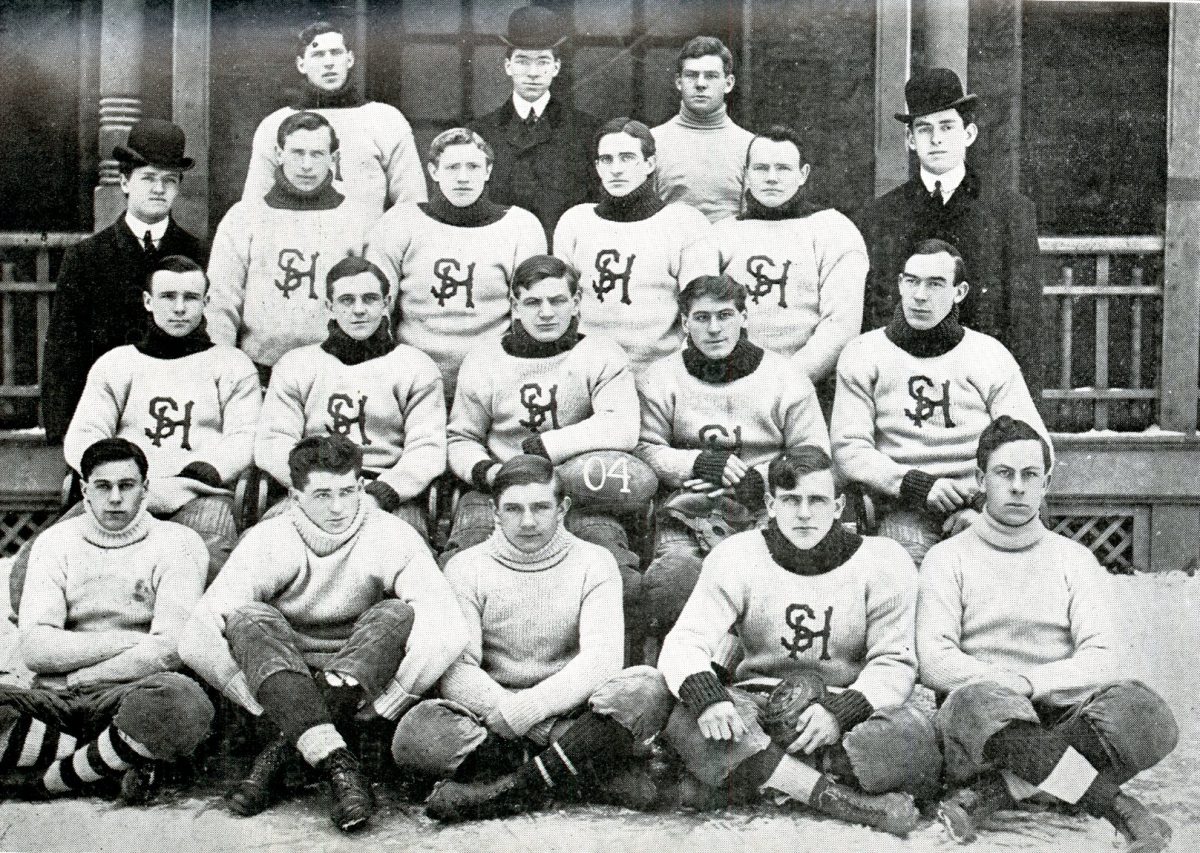
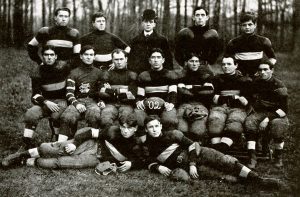
Seton Hall College Football Team, 1902
In 1900, Seton Hall posted a 7-3 record and improved to 9-2 a year later. Perfection came in 1903 when The Alerts went 8-0 and the point total for the year was an amazing 174-2. A majority of home games were scheduled for the first time and through this memorable season Seton Hall defeated such opponents as Philadelphia Dental College, Manhattan College, Villanova, Columbia Law, and Pratt Institute. By 1904, Seton Hall had another winning campaign at 7-2 when they defeated a number of higher profile institutions including the University of Maryland (17-0), Fordham (6-0), and Delaware (26-0). In 1905, The Alerts defeated St. Francis-Brooklyn (71-0) and Rutgers (22-10) which served as a high water mark to cap the first decade of the twentieth century.
Beyond the “Golden Age” of Seton Hall Football, the presence of records become somewhat sketchy as there is no existing log of results from 1906-1912. The last pre-Great War documentation shows that Setonia went 5-1 in 1913 and defeated among others the Fordham “B” team, St. Francis-Brooklyn, and St. Peter’s College by a differential of 212 points for Setonia to 27 for their opponents. By this time, Jack Fish (who later coached Baseball and at Seton Hall Prep) scored 48 points and James “Honey” Dugan 47 of his own which contributed to this successful season and marked the last major success during the “Golden Age” as the college dropped football for the duration of World War I and the administration would not sponsor the sport again until the Fall of 1922 when they registered a 3-2 record.
During the 1920s, football at Setonia was short-lived, but highlights included the renewed emergence of Junior Varsity Football with more prominence among the star players during this period included John J. Dougherty (later an Auxiliary Bishop and President of Seton Hall from 1959-69) who was a guard on the 1926 team which went 5-2-1 and Bud Conlan a starting center and team captain for three years. This era included a mix of highs and lows as they played such schools as Trenton Normal (later Trenton State and presently the College of New Jersey), Upsala, Pennington School, University of Pennsylvania Frosh, Cooper Union, Temple, Albright, CCNY JV and Villanova Frosh among others as Football at Seton Hall was doomed to pause again after 1928.
Seton Hall Football Squad, 1931
A serious move was made to create a successful tradition with the hire of Richard Paul “Red” Smith (1904-1978) an alumnus of the University of Notre Dame and protégé of legendary coach Knute Rockne. After playing for the Irish, Smith also played professional football with the Green Bay Packers, New York Giants, and New York Yankees in the National Football League (NFL) and baseball with the New York Giants of the National League (NL) prior to serving as Head Coach of the Seton Hall eleven during the early 1930s before going back to the professional leagues as an assistant coach for the Packers and Giants in the NFL and also the Chicago Cubs of the NL.
The last appearance of the team during the Great Depression era came from 1930-33 with little success although they did not have any winning records, they did post singular wins over Moravian, Brooklyn College, East Stroudsburg State, Canisius, and others. Nearby Upsala of East Orange was a natural rival and in 1931 they played a benefit game to help aid the destitute during this time in what was billed as the “Championship of the Oranges” in a memorable community encounter. Setonia also played its first documented night game (a rare occurrence during the 1930s) against Davis & Elkins of West Virginia held in Municipal Auditorium, Atlantic City before a crowd of 5,000. Otherwise, Seton Hall played a spotty schedule during the 1940-47 seasons including a gap during World War II, but an undefeated 2-0 campaign where they defeated the 1941 – 2-0 Scranton Frosh and the Marianopolis Club.
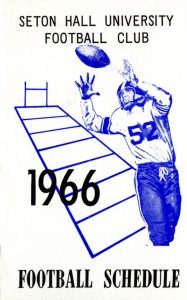
Many Catholic colleges disbanded their long standing football teams including St. Bonaventure, Manhattan, University of San Francisco and others during the late 1940s and early 1950s as a cost saving measure and to invest in their basketball teams for success and Seton Hall was no exception to this trend. However, in moving forward to the mid-1960s and the desire to have Football back on campus once again a vision shared not only in South Orange proper, but also by various Eastern schools in the Newark-metropolitan area in particular who wanted to feature the sport once again. As a result of this promise of fielding Football and linking into the wishes of student and alumni fan based in particular, a new Club league that was structured among higher educational entities that were similar sized, many being peer institutions, and geographically balanced formed in 1965. Seton Hall would eventually play the following schools through the remainder of the decade into the early 1970s including Fordham Iona, St. peter’s, Jersey City Sate, King’s College (PA), Georgetown, Providence, Adelphi, Scranton, Manhattan College, Rutgers-Newark, Fairleigh Dickinson, American University, William Paterson State, St. John’s, Concordia, Pace, Upsala, Army “B” squad, etc.
The first Club-based season of 1965 included the inaugural game, a night contest that led to a victory v. Marist at Newark Stadium by a tally of 28-6 and contributed to a season record of 3-1 wins that included a second win over Marist and St. Peter’s College at Roosevelt Stadium in Jersey City. Subsequent memorable moments followed in 1966 (4-2-1), 1967 (5-2), 1968 (5-3), and 1971 (6-2). The highpoint of the Club-era came in 1972 (9-1) Eastern Club Bowl/Empire Bowl Championship. The Schaeffer Bowl at Jack Coffey Field (Fordham), the Pirates (new nickname adopted by the school in 1931) defeated Marist by a count of 20-18 with 3,000 in attendance. This also aided the selection of Ed Madigan as Coach of the Year honors for head man and success for the team as a whole.
The success of the 1972 squad and the consistency of the program during the 1960s led them to advance a notch upward in the College Football hierarchy when they became a non-scholarship, program within the ranks of NCAA Division III (Division I being the highest) and they would encounter some victories in their first year (3-5) of 1973 including shutout wins over Rutgers-Newark (42-0) and Rochester Tech of New York (24-0). In 1974 7-2. Overall winning records would come in 1978 (5-4) and 1979 (4-4-1 with a forfeit in favor of Seton Hall). However, the rest of their time playing within the NCAA ranks led to consecutive losing seasons.
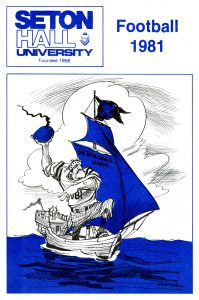
Football Image, 1981
Although a high point in terms of venue came via playing select Saturday home and away games at Giants Stadium in the New Jersey Meadowlands from 1977 through 1981. In addition, Seton Hall played in the annual “Pride Bowl” of 1980 against Cheyney State although in a losing effort (0-26) a benefit contest of note for that time period. The final years included contests played against Catholic University of America, Hofstra, Pace, Montclair State, Coast Guard Academy, Rochester, Wagner, C.W. Post, Kings Point MMA, Kean, and others.
Despite being competitive and hopes of improved records, 1981 marked the last season of Seton Hall Football to date as the school discontinued the sport in 1982. Despite its absence, the legacy of the sport lives on in the heart and memories of Seton Hall alumni and local football fans in particular.
More information on College Football in general and particular can be found within the following Internet links along with many other sources that can be referenced upon request . . .
For more information regarding the History of Football and other Seton Hall Athletics History topics please feel free to contact Alan Delozier, University Archivist via e-mail at: Alan.Delozier@shu.edu or by phone at: (973) 275-2378.
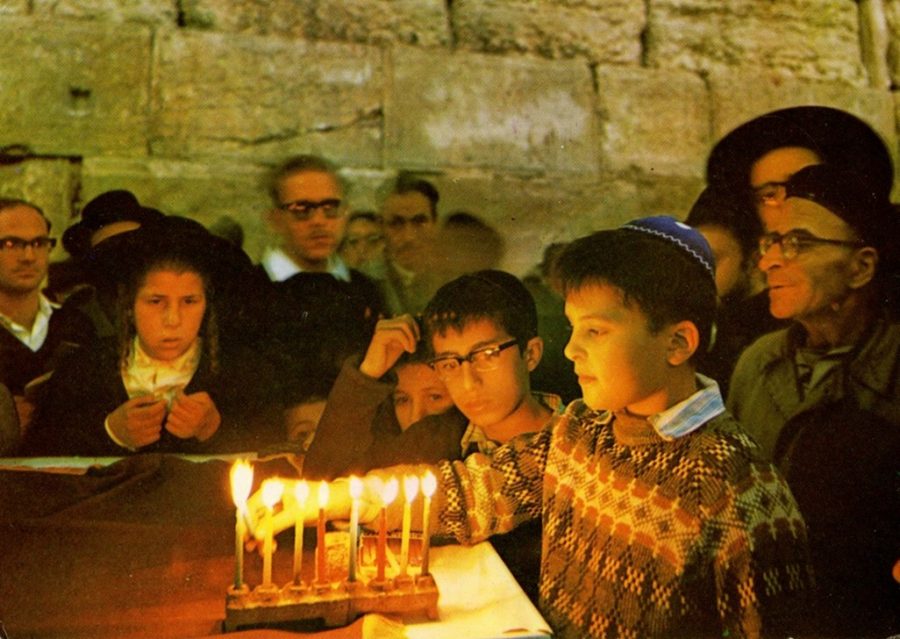
Postcard: Hanukkah observances at Jerusalem’s Western Wall
MSS 0016 – Sister Rose Thering Papers
Courtesy of The Department of Archives and Special Collections
“Hanukkah Sameach!” (Happy Hanukkah)
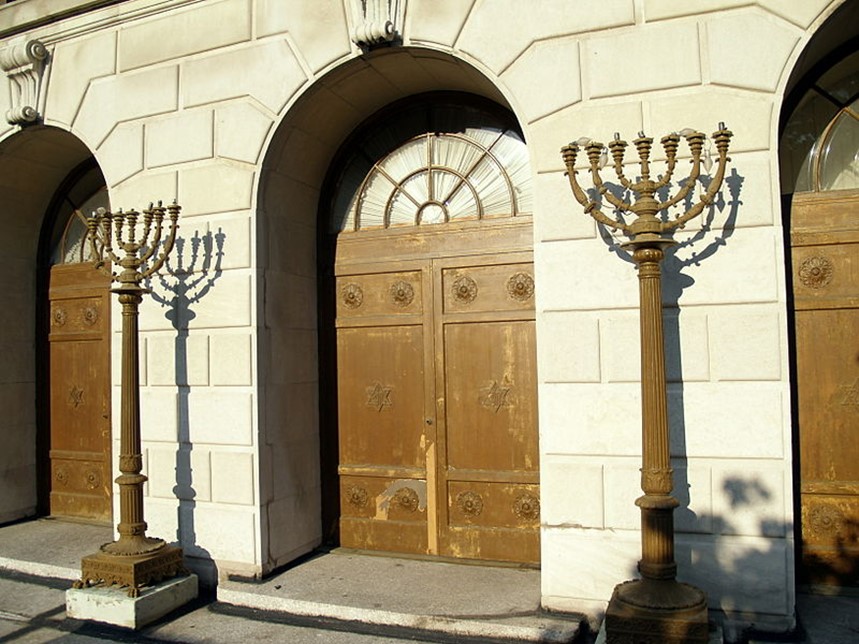
Menorahs flanking entrance to East Midwood Jewish Center in Brooklyn, New York Image: David Shankbone https://commons.wikimedia.org/wiki/File:East_Midwood_Jewish_Center_menorah.JPG
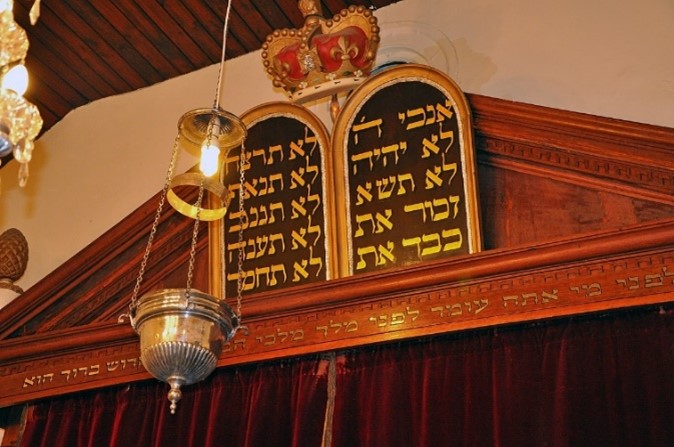
Hanukkah is the Festival of Lights, the holiday that commemorates the rededication of the Jewish temple in Jerusalem in the 2nd century BCE.[1] This historical event memorializes when a small army of Jews, known as the Maccabees, rebelled against the Seleucid Greek King Antiochus IV Epiphanes who had outlawed the Jewish religion and defiled the holy temple by installing an altar to Zeus Olympios and sacrificing pigs within the sacred space, an affront to Jewish law.[2] The king’s soldiers massacred thousands during the uprising.[3] When the Maccabees regained control of the temple, they built a new altar to again offer sacrifices in accordance with, halakha,[4] the collective body of Jewish laws that addresses civil, criminal and religious codes.[5]
An Eternal Light (ner tamid) hangs above or near the ark in every synagogue Image: Moshi Anahory, https://www.flickr.com/photos/mosh70/9447892262/
The postcard image accompanying this post is from the University’s Archives and Special Collections’ Sister Rose Thering Papers, an archive of correspondence, speeches and travel information dating mostly to her time in New Jersey working for the Institute of Judaeo-Christian studies, as well as documents relating to her teaching and scholarly activities.[8] Sister Rose Thering belonged to the Dominican Order which was founded in 1206 in France. She advocated tirelessly in favor of legislation for the teaching of the Holocaust and was an international activist against anti-Semitism.[9] The Sister Rose Thering Fund at Seton Hall University continues her work by fostering understanding and cooperation among Jews, Christians and people of other religious traditions through advocacy and education. Sister Rose Thering founded the fund in 1993 and worked there until her retirement in 2005.[10] Sister Rose said, “To be a better Christian you need to find out where you are rooted. Take a good look at Judaism. Our roots are in Judaism. Jewish people have much to teach us. We must learn from our elder brothers and sisters.”[11]
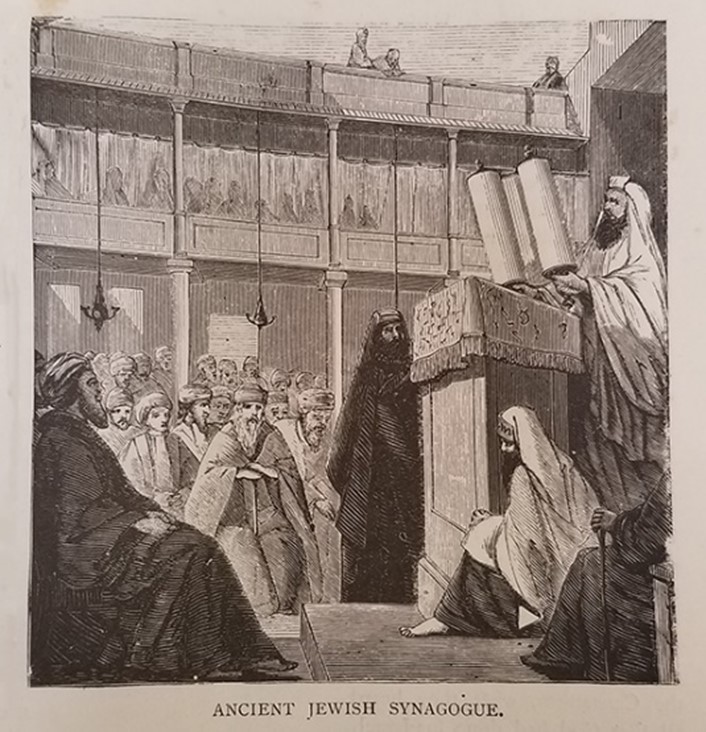
Engraving: “Ancient Jewish Synagogue.” New Devotional and Practical Pictorial Family Bible. Philadelphia, PA: The National Publishing Co. and Jones Brothers & Co., 1879, pg. 17. Courtesy of The Department of Archives and Special Collections
The images and materials shown here are but a small part of the vast patrimony available to students, faculty and researchers. For access to this or other objects in our collections, complete a research request form to set up an appointment or contact us at 973-761-9476.
November is National Black Catholic History Month and the Monsignor William Noé Field Archives & Special Collections Center honors this legacy by preserving long-term holdings and continually acquiring relevant resources in order to provide our research community with valuable primary source materials for consultation purposes year round. With this in mind, our Research Center celebrates the contributions of the three million plus African American Catholics on a national and local level alike in providing depth to this ongoing story that directly reflects upon our main collecting areas and research constituencies especially in this time of celebrating the importance of diversity.
The historical legacy of African Americans who adhere to the teachings of Catholicism within the United States has a proud history despite having to overcome obstacles to establish a respected presence within the Church. With this in mind, our Research Center celebrates the contributions of the three million plus African American Catholics on a national and local level alike in providing depth to this ongoing story that directly reflects upon our main collecting areas and research constituencies especially in this time illustrates the importance of diversity in all its forms.
Coat of Arms Significance – First African American Bishop, Joseph Francis, SVD (1923-1997)
In specifically theological terms, African American faithful typically adhere to conventional Catholic doctrine. However, this often connects with ties to traditional and honored practices dating back to the days of Pre-Emancipation and beyond through the development of various African-based Protestant traditions that celebrated close community ties and sought to worship God while also promoting the need for combating prejudice and establishing wide-spread social justice among their congregants.
Black Catholics went on to attain a higher status with the USCCB pastoral letter of “Brothers and Sisters to Us” in 1978 along with the publication of various historical tracts including the trailblazing: The History of Black Catholics in the United States, by Rev. Cyprian Davis (New York: Crossroad, 1990) [BXZ1407.N4 D38 1990] along with others connected to this subject that can be found within our University Libraries Catalog from the Main Collection and/or Turro Seminary Library in particular. These two milestones combined with academic life and coursework linked to the Black Catholic Movement from the Late 1960s to the present has been beneficial to establishing understanding of the many spiritual and symbolic contributions made by African Americans within the Church as a whole.
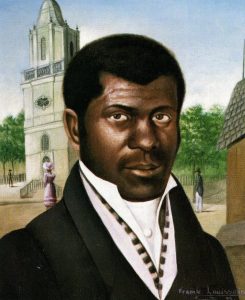
The Venerable Pierre Toussaint (1766-1853)
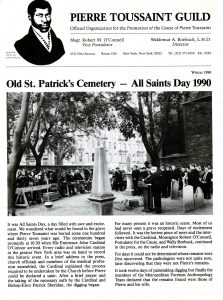
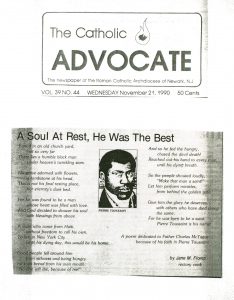
Counted among our most relevant collections include the “Cause for Pierre Toussaint Collection” [MSS 0036] which reflects on one of the earliest and most notable Black Catholics who lived during the Early American Republic and lived by all accounts a holy and selfless life of service. As the abstract to this collection highlights: “Pierre Toussaint was born into slavery in 1766 in what is now Haiti. He moved with his family and master to New York where he lived until his death. He spent his life helping the sick, homeless, and orphaned. He died in 1853 (The year the Diocese of Newark was founded). The Pierre Toussaint Guild was created to advocate his induction into sainthood. His body was exhumed in November of 1990 as part of the investigation into the cause for his sainthood.”
The Collection proper is broken down in the following manner within the Scope and Content Notes section: “This collection primarily consists of newspaper clippings describing the life and cause for sainthood of Pierre Toussaint, as well as photographs, correspondence, and mass cards related to Pierre Toussaint. Many of the news clipping focus on the exhumation of the Pierre Toussaint’s body in 1990. Photographs are generally reproductions of illustrations of Pierre Toussaint or of Jane Flores at places and events related to Pierre Toussaint.” More information on these Papers can be found via the following link: https://archivesspace-library.shu.edu/repositories/2/resources/203
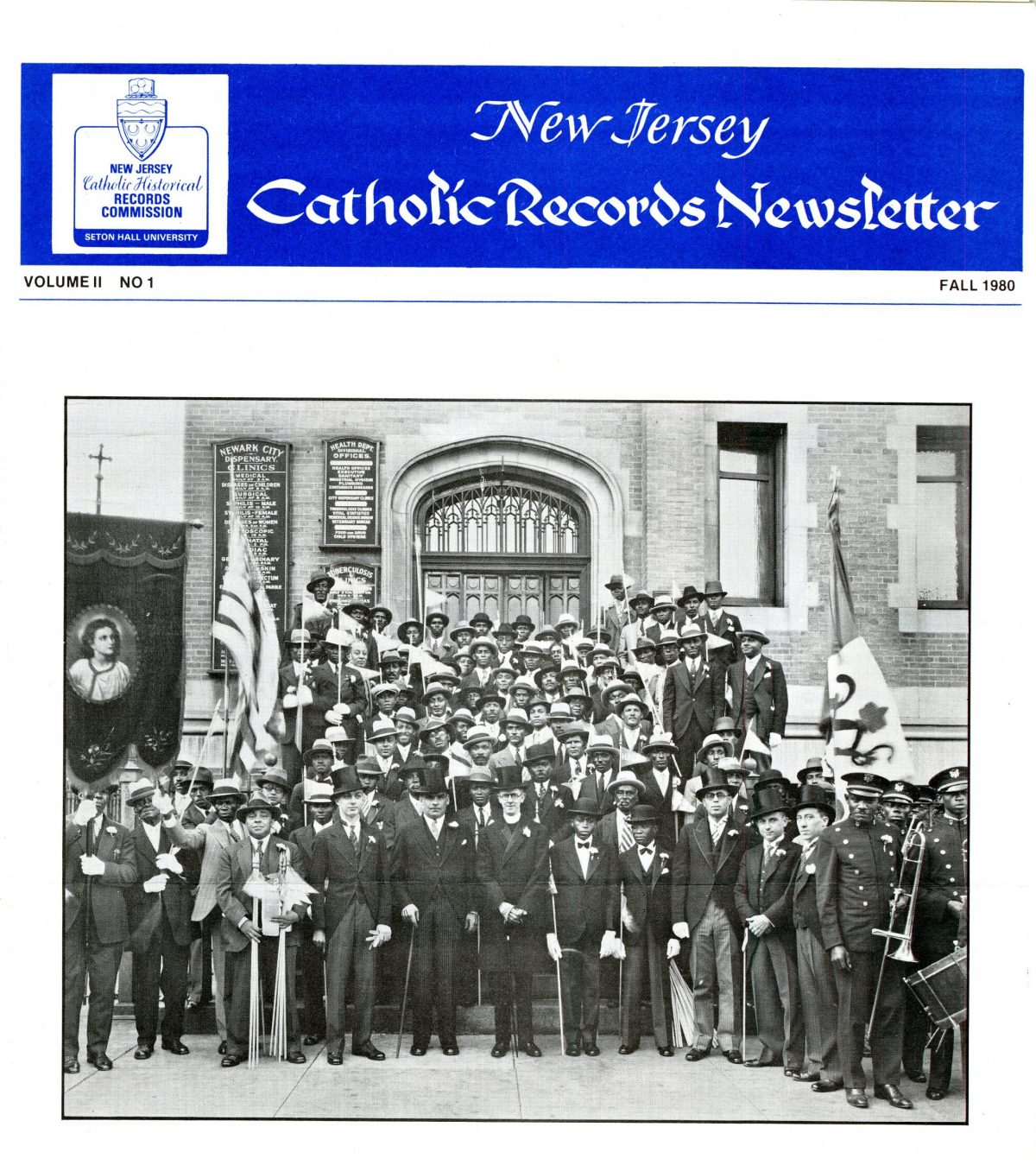
Document Type – Newsletter, Publication Date – Summer 1990
Abstract – The “Birth of Christ The King Parish, Jersey City” looks at some of the first establishments of African-American Catholic parishes in the Diocese of Newark. https://scholarship.shu.edu/njchc/22/
Document Type – Newsletter, Publication Date – Spring 1994
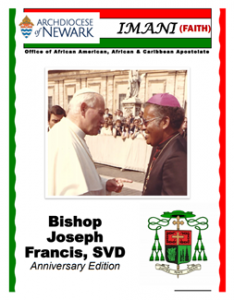
Imani Newsletter of the Office of the African American Apostolate of the Archdiocese of Newark, c. 1996
Another figure connected to the NJCHC, but to the Archdiocese of Newark in particular is the first African American prelate for the See, Most Rev. Joseph Francis, SVD (1923-1997) who was made an Auxiliary for the Archdiocese of Newark in 1976 and retired in 1995 had a lasting impact on the spiritual impact on the Northern New Jersey community and beyond. More information on his life and activities can be found within the following published compilation published by the Archdiocese of Newark . . . https://www.rcan.org/sites/default/files/files/Newsletter%2C%20Bishop%20Francis%20Edition(1).pdf
Other important sources of note include, but are not limited to various Seton Hall-related resources (going back to c. 1912), but other Special Collections (including ones that require permission to review) can be found via the link to our ArchivesSpace site catalog can be found here . . . https://archivesspace-library.shu.edu/
Within the University Libraries Homepage is a Research Guide Section that also ties into key documents that highlight and explain African American Catholic highlights from the Vatican and other important resources in general and particular . . .
For more information related to African American/Black Catholics found within our repository and research resources in general can be requested and research appointments scheduled by reaching out to us via e-mail: Archives@shu.edu or by phone at: (973) 275-2378.
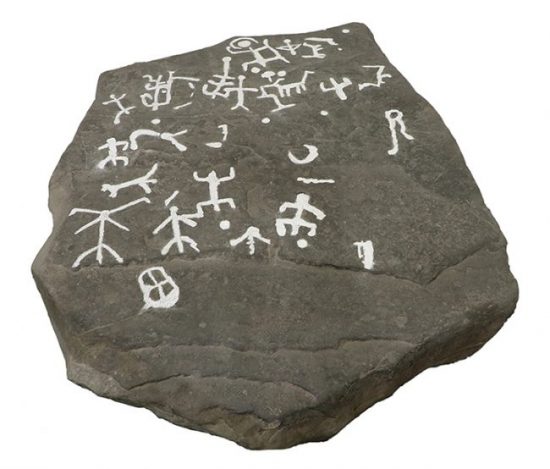
Jennings Petroglyph sandstone
5’ x 4’ x 9.5”
3000-1000 BCE
FIM 610
Seton Hall University Museum of Anthropology and Archaeology
NOVEMBER IS NATIONAL NATIVE AMERICAN HERITAGE MONTH
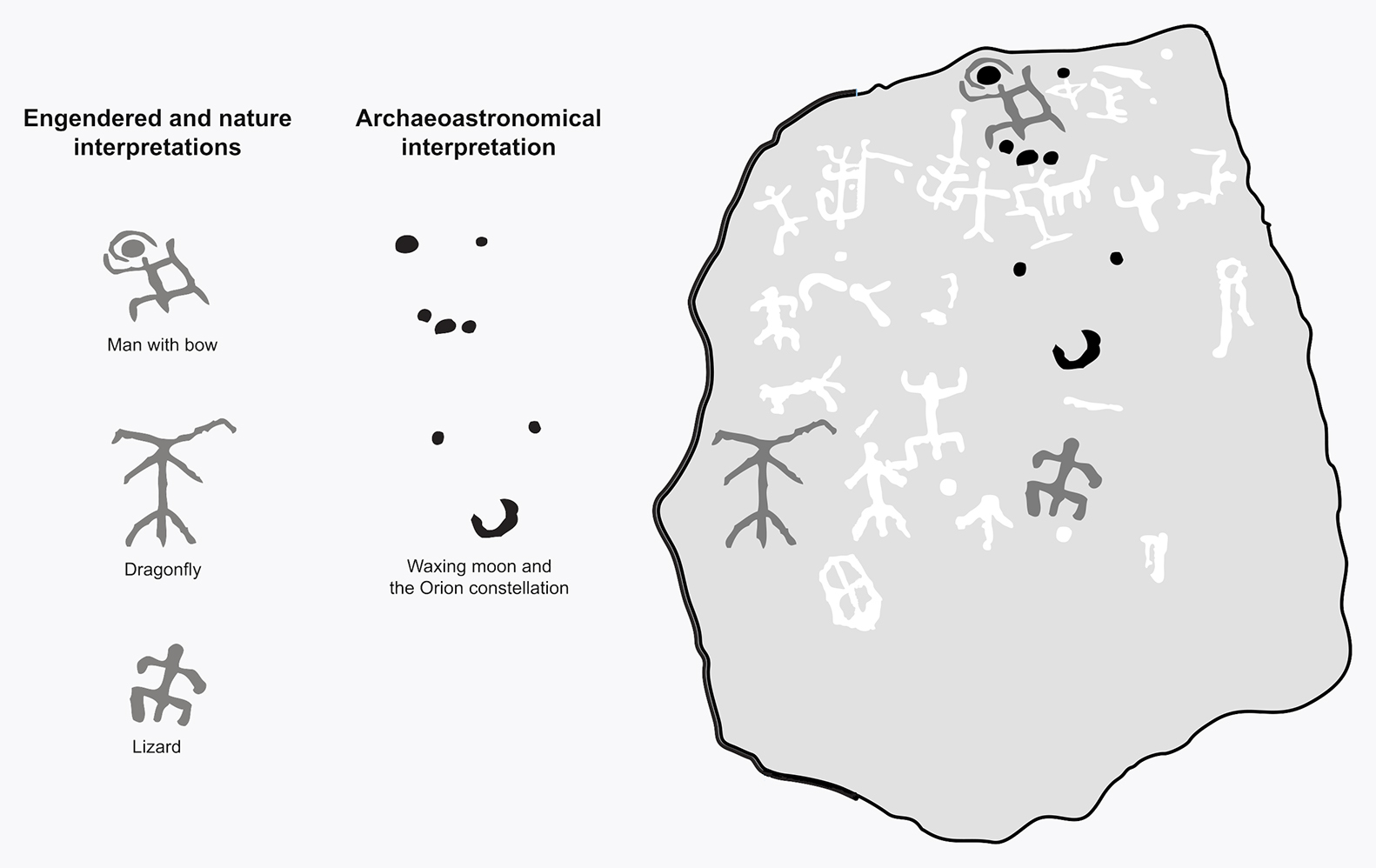
The Jennings Petroglyph, an uncommon example and one of the largest of its kind in New Jersey, was created between 1,000 and 5,000 years ago. It was originally located on the New Jersey side of the Delaware River across from Dingmans Ferry in Pike County, Pennsylvania. Meaning “rock carving,” the word petroglyph combines “petro” meaning “rock” and “glyph” meaning “symbol.” The exact significance of the imagery on the petroglyph has been obscured over time, though it is believed to likely be sacred. The petroglyph’s surface features 21 identifiable figures and 12 non-identifiable forms – including carvings of anthropomorphic and zoomorphic figures as well as dots and circles (cupules). Professor Emeritus of Anthropology at Seton Hall, Herbert Kraft (1927-2000), described the images as “lizard-like figures or men with sexual appendages.”[1]
Interpretations of visuals on the petroglyph
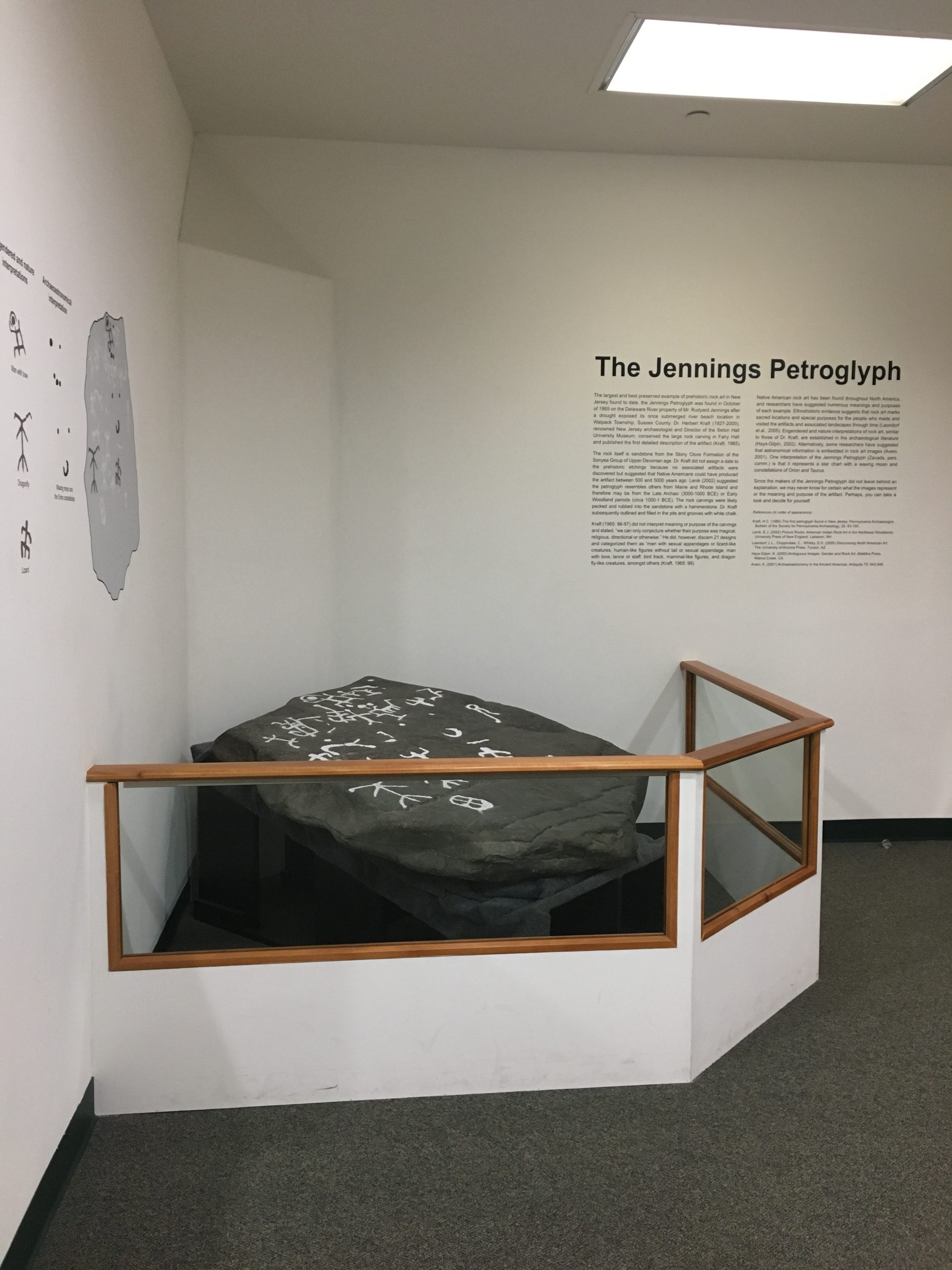
The petroglyph was unearthed by Rudyard Jennings in 1965. It was donated to Seton Hall with the intention of protecting it from flooding caused by the proposed Tocks Island dam on the Delaware River site where the petroglyph was previously located. Ultimately, the dam was never built. The petroglyph’s first home at Seton Hall University was in the lobby of Fahy Hall, but it was moved to the second floor of the Walsh Library in August 2015. This move has allowed for easy viewing access by the university community and the public.
View of the Jennings Petroglyph on the 2nd floor of the Walsh Library
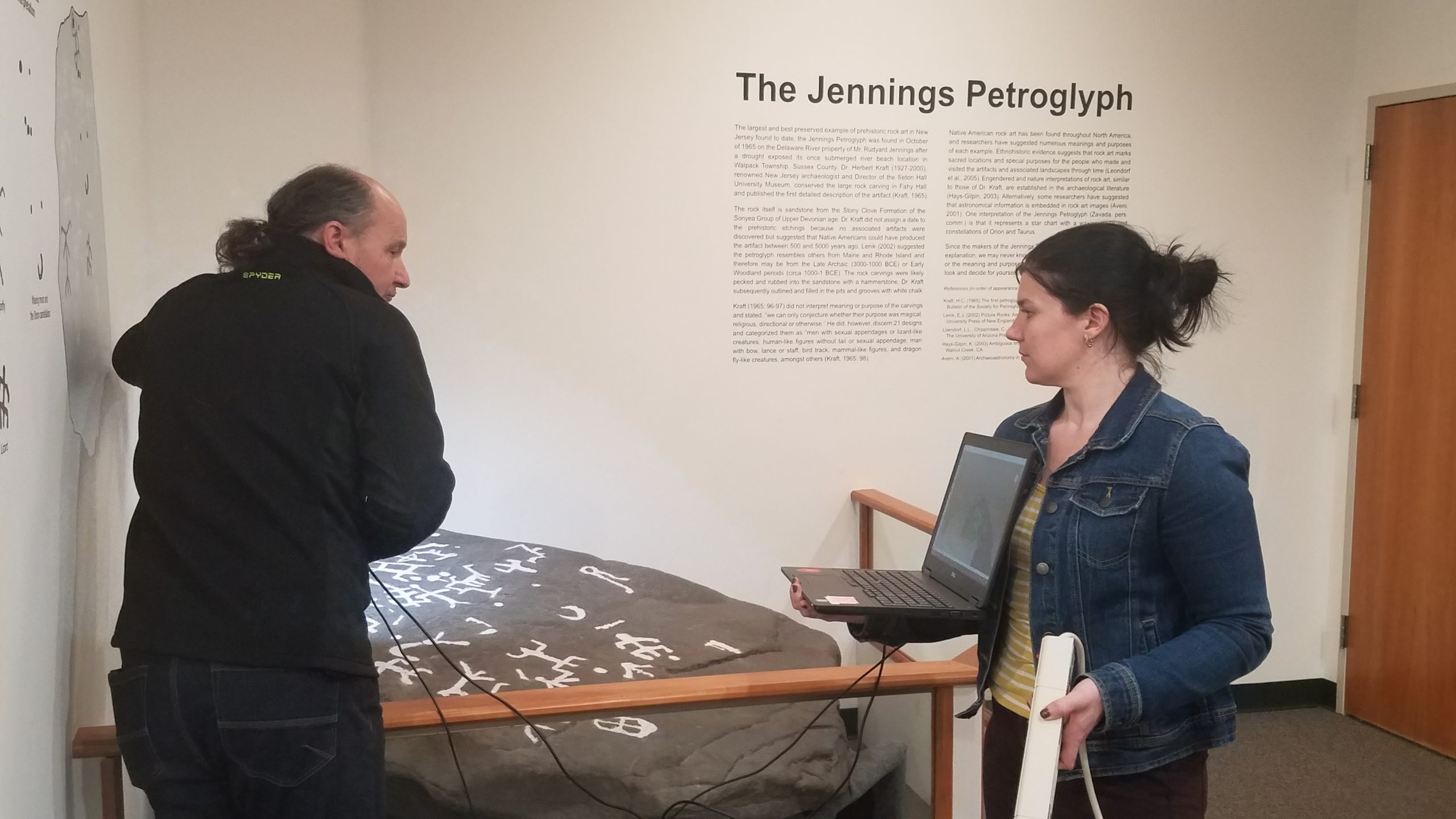
The Jennings Petroglyph will be featured in an exhibit at the National Scenic Visitors Center (NSVC) in Zionsville, Pennsylvania. The NSVC, founded in 2016, has the ultimate 10-year goal of creating Earthwalk USA, a 300-foot-long, 3D relief map of the United States from California to Maine, along with Alaska and Hawaii in correct geospatial orientation.[2] In the meantime, they have planned a traveling exhibit called Earthwalk Explorer featuring a 16’ x 8’ walkable relief map of the Northeast along with two Geoshows. In both Earthwalk USA and the traveling show, visitors will walk over the relief map in socks so that they can feel the topography of the United States for themselves! Our very own Jennings Petroglyph will be highlighted in one of the Geoshows, which centers on petroglyphs in Pennsylvania and how native groups of the region used them to communicate along trails. In early 2020, Michael Bianco of MZB Productions, Inc. came to Seton Hall to make a high-resolution scan of the petroglyph in-situ in order to create a 3D facsimile.
Michael Bianco and Collections Manager Romana Schaeffer scanning the Jennings Petroglyph
The Jennings Petroglyph is part of the Seton Hall University Museum of Anthropology and Archaeology (SHUMAA) collection. It is but a small part of a vast collection of artifacts from the SHUMAA collection, founded by Seton Hall Professor Herbert Kraft (1927-2000), a leading archaeologist and authority on the Leni Lenape tribe which inhabited New Jersey, Delaware, southern New York and eastern Pennsylvania at the time Europeans arrived in the Americas. For almost forty years, Kraft cultivated the collection with artifacts excavated from archaeological digs conducted throughout the region. Kraft was also instrumental in securing donations of artifacts from noted collectors and archaeologists. The SHUMAA collection includes over 26,000 Native American, Asian and African art and artifacts.
The Walsh Gallery has a considerable collection of fine art, artifacts and archeological specimens for use by faculty, students and researchers. For access to this or other objects in our collections, contact us at 973-275-2033 or walshgallery@shu.edu to make a research appointment.
From Friday the 13th and black cats to tossing salt over one’s left shoulder to ward off evil spirits, superstitions and rituals are rooted in a mixture of religion, mythology, and folklore. They have the power to ward off evil, bring good luck, cure sickness, even stop people from performing certain activities on certain days.
However, every culture is different and what is unlucky in one may be lucky in another. Instead of Friday the 13th, it is Tuesday the 13th that is thought to be unlucky in Chile, Colombia, Costa Rica, Cyprus, Ecuador, Greece, Mexico, and Serbia. For Italy, it is Friday the 17th.
Where a black cat can be thought to mean bad luck, in Ireland it may lead to fortune as “several of the great lake serpents and water-cows of our Irish Fairy Mythology are supposed to guard treasurers; in some instances black cats are similarly employed” (Wilde, 98).
Some of Ireland’s other superstitions and rituals revolve around fairies and goblins, stating,
“…if you cast the dust that is under your foot against the whirlwind at the instant that it passes you, “them that’s in it” (that is, if they have any human being along with them) are obliged to be released” (Wilde, 130).
Then there are those that involve fire, most notably on days of celebration such as May Day and St. John’s Eve or Midsummer’s Eve:
“If a man was to perform a long journey, he leaped backwards and forwards three times through the fire to render himself invulnerable” (Wilde, 49).
“When the fire has nearly expired, and the dancing, singing, and carousing are over, each individual present provides himself with a braune, or ember of the fire, to carry home with him, which, if it becomes extinguished before he reaches his house, it is an omen of impending misfortune” (Wilde, 49).
“Walking around a burning flame during St. John’s Eve or Midsummer’s Eve spares one from being sick the whole year” (Putzi, 196).
Other curious Irish rituals include keeping spiders in a bag to be worn as a pendant or necklace to cure fever. However, if the bag is opened it will cause back luck. To remove a sty on one’s eyelid, the person should point to the direction of a gooseberry thorn nine times while chanting “Away, away, away!”.
But if things still go awry, you find your milk has curdled, you can always blame the fairies!
Other superstitions and rituals can be found in:
Putzi, S. (Ed.). (2008). To z world superstitions & folklore : 175 countries – spirit worship, curses, mystical characters, folk tales, burial and the dead, animals, food, marriage, good luck, and more. ProQuest Ebook Central https://ebookcentral.proquest.com
Wilde, W. R. (1852). Irish popular superstitions. J. McGlashan.
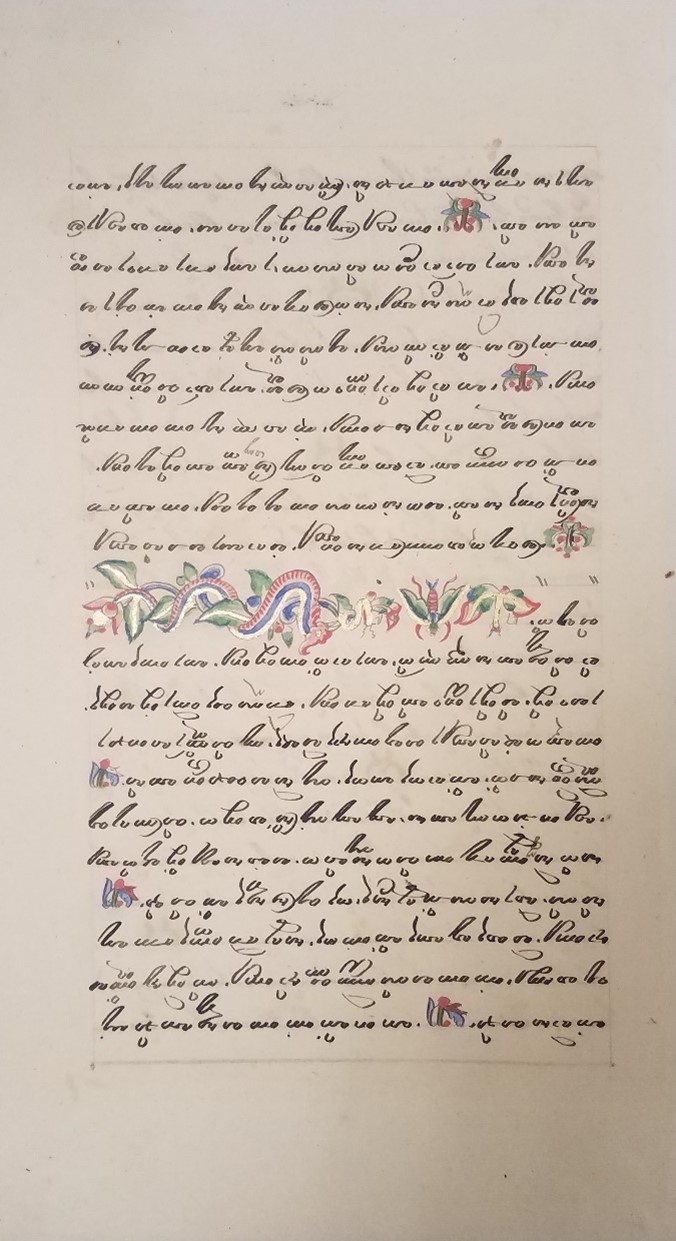
Page from “The History of Rama”
19th century Javanese Manuscript
Ink on Dutch paper
Herbert Kraft Manuscript Collection, MSS 0029
ON THIS AUSPICIOUS FESTIVAL OF LIGHTS, MAY THE GLOW OF JOY, PROSPERITY AND HAPPINESS ILLUMINATE YOUR LIFE AND YOUR HOME.
This hand-written page comes from the Ramayana, one of the most notable ancient epics in world literature. This particular text has been translated from Kawi, an ancient script of the Indonesian island of Java. Kawi borrows considerably from Sanskrit, the classical language of South Asia.[1]
Diwali celebrations Image: Khokarahman, CC BY-SA 4.0 https://creativecommons.org/licenses/by-sa/4.0 via Wikimedia Commons
The Ramayana, from Hindi mythology, recounts how Lord Rama, following 14 years in exile, returned to find his wife Sita had been kidnapped by Ravana, the demon ruler of Lanka.[2] Sita’s kidnapping resulted in a war in which Rama was ultimately victorious over King Ravana and his forces. Rama and Sita then began their long journey home, their way lit by oil lamps set out by people to guide them on their way and welcome them back.[3] Rama was crowned king upon his return and large festivities were held to memorialize his triumph.
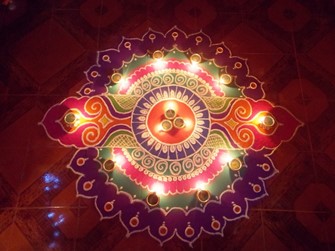
Image of rangoli: Dinesh Korgaokar – Own work, CC BY-SA 4.0, https://commons.wikimedia.org/w/index.php?curid=36581728
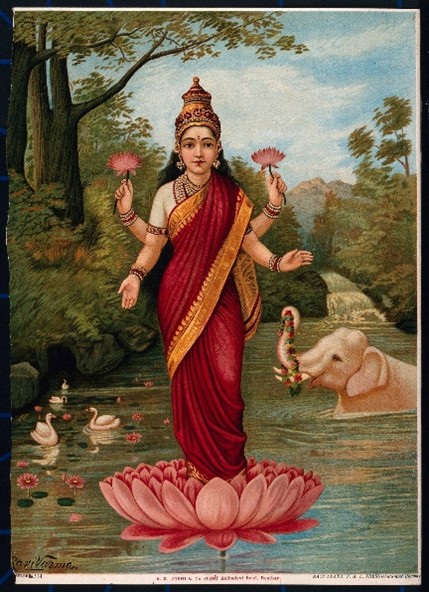
The story of Rama is the basis for Diwali celebrations, a festival observed by millions of Hindus, Sikhs and Jains across the world. It is often called the festival of lights, reflected in the bold displays of color and light symbolizing Rama’s victory of light over darkness and good’s triumph over evil.[4] Diwali is commemorated worldwide with fireworks, light displays, dancing and food. In addition to the larger festivities, people decorate their homes with lights and rangolis – an art form that consists of precise and elaborate geometric patterns that are made from a variety of materials including rice, colored sand and flowers.[5] The holiday is often associated with Lakshmi, the Goddess of prosperity, as this festival is also a time to bring prosperity into one’s life. Prayer, worship and rituals (puja) to Lakshmi are an important part of the celebrations and this deity is worshipped especially during this time.[6]
Image: Lakshmi on her lotus in the water with elephant. Chromolithograph by R. Varma. Copyrighted work available under Creative Commons Attribution only license CC BY 4.0 http://creativecommons.org/licenses/by/4.0/
Hindus, Sikhs and Jains across the United States observe Diwali, including many in New Jersey specifically. Though the Hindu population is considered a minority in America at less than 1% of the country’s total population, New Jersey has the largest concentration of Hindu people in the nation, making up 3% of the total state population. New Jersey is also home to the world’s largest Hindu Temple, the BAPS Shri Swaminarayan Mandir Temple located in Robbinsville. The temple is astonishingly large at 133 feet in length, 87 feet in width, and 42 feet in height – covering 162 acres.[7] Adherents of Jainism first arrived in the United States in the 20th century, with immigration beginning in earnest in the late 1960s and continuing to the present day. Siddhachalam, a mission located in Blairstown, New Jersey is the first pilgrimage site for Jains outside of India to gather in one place for worship, study and reflection. The mission is a religious public charity in special consultative status with the United Nations.[8] In the 1980s, Sikh immigrants from India began arriving in America, with many settling in New Jersey. New Jersey and New York have among the largest populations of Sikhs in the country. Gurbir Grewal, New Jersey’s attorney general, and Ravi Bhalla, the mayor of Hoboken, are some of the most well-known Sikhs in New Jersey politics.[9]
Detail of hand painted imagery from“The History of Rama” 19th century Javanese Manuscript Ink on Dutch paper Herbert Kraft Manuscript Collection, MSS 0029
The Walsh Gallery has a considerable collection of fine art, artifacts and archeological specimens for use by faculty, students and researchers. For access to this or other objects in our collections, contact us at 973-275-2033 or walshgallery@shu.edu to make a research appointment.
VETERANS DAY – HONORING SERVICE IN THE U.S. ARMED FORCES
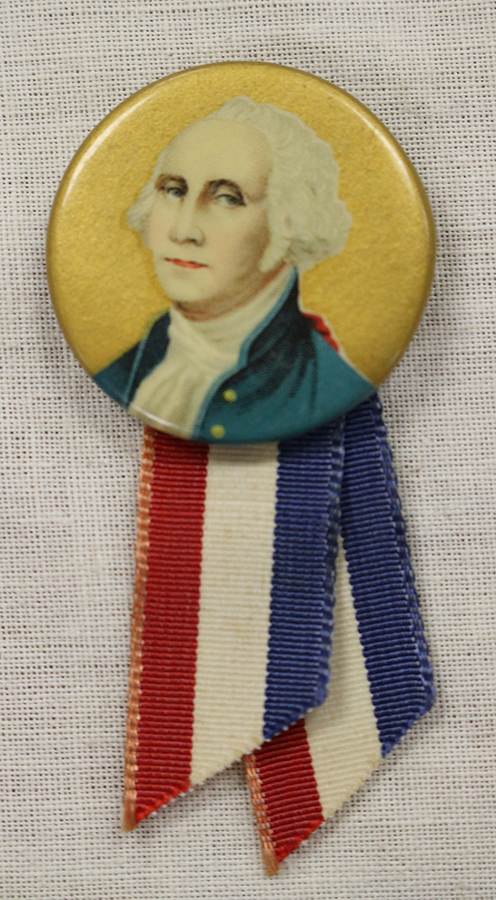
George Washington is remembered as a Founding Father of the United States of America, the first president of the country, as well as a military veteran. He received his military training with the Virginia Regiment, and was later selected as a delegate to the Continental Congress which in turn, appointed him as the Commanding General of the Continental Army in 1775. Washington declined a salary but was reimbursed for his expenses.[1] He ultimately led American forces to victory against the British in the fight for independence before ascending to the presidency. In his newly-defined role as President, Washington was also commander in chief of the nation’s military forces. This political button from the Department of Archives and Special Collections depicts Washington dressed in military gear, demonstrating his astute understanding that effectiveness as a military leader and president was contingent on appearance as well as action.[2]
Image courtesy of Mark Finkenstaedt via www.mountvernon.org
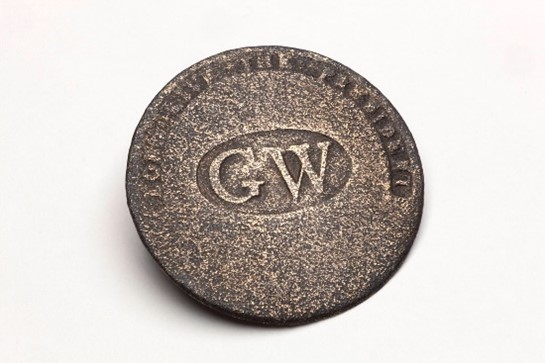
Political buttons are a uniquely American invention that originated with George Washington’s presidential campaign.[3] His candidacy was also the first presidential election in the United States. Washington and his supporters wore a brass button that said “G.W. – Long Live the President“, the phrase proclaimed by Robert Livingston, the Chancellor of New York, after he administered the Oath of Office to George Washington in April 1789 at Federal Hall in New York City.[4] The Electoral College unanimously elected Washington as the first president in 1789, and again 1792. He is the only president in American history to receive the totality of electoral votes.[5] The political pins worn by Washington’s supporters were more like buttons, sewn to lapels and did not include a likeness of the candidates. The first photographic image on a political pin dates to 1860 during Abraham Lincoln’s presidential campaign. Lincoln, and his running mate for Vice President, Hannibal Hamlin, ran on the Republican ticket and used metal buttons with tintype images of each candidate on opposite sides which more palpably demonstrated support of candidates. [6]
The ferrotype and tintype photographic processes that allowed images of candidates to be reproduced widely were invented in the 1850s. The invention of photography enabled widespread dissemination of candidates’ likenesses in a time before widespread media, such as television, the internet and social media allowed voters to see images of political hopefuls. The political button is one of the oldest and most popular ways to indicate support of a particular candidate or issue.
This pin from Seton Hall University’s Department of Archives and Special Collections features the face of George Washington on a gold background with a red, white and blue accent ribbon. It was issued in 1932 to mark the bicentennial of his birth. It is one of many different style buttons issued to commemorate the occasion.
For approximately the past 120 years, slogans, pictures, and names have been widely used to promote candidates and causes. While buttons are still produced today, disposable stickers are more frequently used at rallies and political events, since they can be made cheaply and in larger quantities. This pin is but one of a large collection of political buttons housed in the Archives and Special Collections Center. This collection was cultivated and donated by Monsignor Francis Seymour, former Archivist for the Archdiocese of Newark. The collection contains political buttons from national and state elections, as well as those endorsing particular political causes.
__________________
The images and materials shown here are but a small part of the vast patrimony available to students, faculty and researchers. For access to this or other objects in our collections, complete a research request form to set up an appointment or contact us at 973-761-9476.
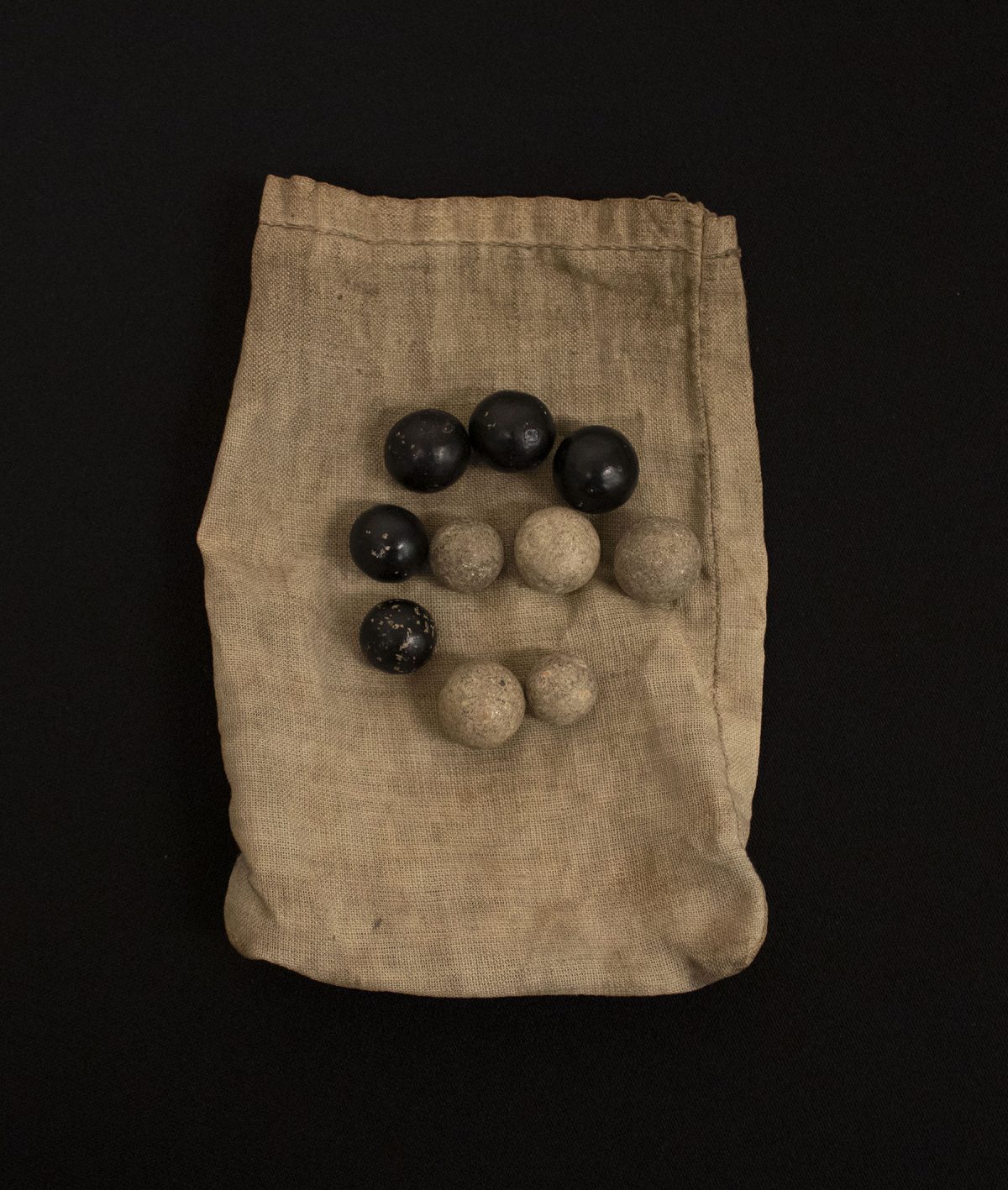
Ballot Balls and Bag from the Order of the Sons of Italy, Umberto Primo Lodge No. 750 (Susquehanna, PA) wood, paint and fiber
undated
2019.12.0004
Gift of the New Jersey Grand Lodge, Order of the Sons of Italy
OCTOBER IS ITALIAN-AMERICAN HERITAGE AND CULTURE MONTH
A BRIEF HISTORY OF THE ORDER SONS OF ITALY AND VOTING
DID YOU KNOW?
The word ballot comes from the Italian ‘ballotta’ – meaning little ball. Before the use of paper ballots or the invention of voting machines, voters used black and white balls such as these. To cast a vote in favor of one candidate or issue, a white ball would be dropped into a wooden box. The black ball would be used to vote against a candidate or a referendum. This method of voting is known to have been used as far back as ancient Athens using clay, instead of wooden balls. Though the use of paper ballots dates to Rome in 139 B.C.E., the paper ballot did not come into use in the United States until the 1880’s. New York and Massachusetts were the first states to adopt paper ballots for elections.[1]
Even now many civic groups, private organizations and social clubs still use this ancient system of voting to settle decisions about programs and membership.[2] This set of voting balls was used at the Umberto Primo Lodge No. 750 of The Order of the Sons of Italy[3] in America in Susquehanna, Pennsylvania. The Order Sons of Italy was founded in New York’s Little Italy neighborhood in 1905. The organization was formed to serve Italian immigrants during the height of the Great Migration (1880 – 1923) when over 4 million Italian men, women and children crossed the Atlantic to settle in the United States.[4] It served as a support system to assist with attaining citizenship, accessing health benefits, locating educational opportunities and assimilating to life in America. Today, the organization focuses on service and advocacy for the nation’s estimated 26 million people of Italian descent through educational programs, medical research, disaster relief and the promotion of Italian culture, among other initiatives.[5] From its inception women shared equal rights in The Order Sons and Daughters of Italy in America, representing the organization at the state and national levels, including high ranking positions such as president, vice-president and trustee.[6]
Though Greece is often noted as the birthplace of democracy, the four Ballot Laws of the Roman Republic, adopted by the government from 139 to 107 B.C.E., codified the system of secret ballots for; the election of magistrates (judges), then juries, followed by the legislature and finally, matters of treason. Prior to the secret ballot, Roman citizens and public officials registered their vote orally. This public procedure of voting often produced social pressure or even public intimidation to vote a certain way on an issue or for a particular candidate.[7]
Historically in the United States, there have been numerous obstacles to voting and the right to do so was, and for many continues to be, a hard-earned struggle. It was not until 1869 when the 15th Amendment to the Constitution was passed that black men could vote. Even with the passage of the amendment, there were many obstructions to voting such as poll taxes and literacy tests.[8] Women were not able to vote until the passage of the 19th Amendment in 1920. It was not until two landmark revisions to the United States Constitution, the passage of the 24th Amendment of 1964, which eliminated poll taxes, and the Voting Rights Act of 1965, which abolished Jim Crow laws[9] – a collection of state and local statutes that legalized racial segregation and marginalized African Americans while denying them equal rights and opportunities – that voting was open to the population at large.[10] The Voting Rights Act, however, is no longer fully intact. The 2013 Supreme Court decision in Shelby County v. Holder undid the provision requiring states with a history of racial bias in voting to get permission before passing new voting laws, which has resulted in stricter voting statutes in some states.[11]
In the last United States presidential election, approximately 55% of eligible voters cast a ballot. This is far behind other developed countries such as Belgium which had a turnout of over 87% in their most recent elections, Sweden at almost 83% and South Korea which came in third at just under 78% on the list of the top 10 countries with the largest voter turnout.[12] For more information on voting, visit PLANYOURVOTE at https://www.planyourvote.org.The website is a clearinghouse of information to promote and empower citizens in the exercise of their voting rights. The site provides a plethora of useful information on voting along with links to register to vote, check your voter registration status, and request an absentee ballot. They also have an excellent database of some great works of art on the subject of voting that are worth a look.[13]
The Walsh Gallery has a considerable collection of fine art, artifacts and archeological specimens for use by faculty, students and researchers. For access to this or other objects in our collections, contact us at 973-275-2033 or walshgallery@shu.edu to make a research appointment

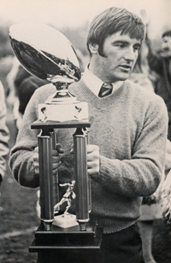 The success of the 1972 squad and the consistency of the program during the 1960s led them to advance a notch upward in the College Football hierarchy when they became a non-scholarship, program within the ranks of NCAA Division III (Division I being the highest) and they would encounter some victories in their first year (3-5) of 1973 including shutout wins over Rutgers-Newark (42-0) and Rochester Tech of New York (24-0). In 1974 7-2. Overall winning records would come in 1978 (5-4) and 1979 (4-4-1 with a forfeit in favor of Seton Hall). However, the rest of their time playing within the NCAA ranks led to consecutive losing seasons.