Object of the Week: “Madonna of the Rosary” by Lucas Vorsterman the Elder

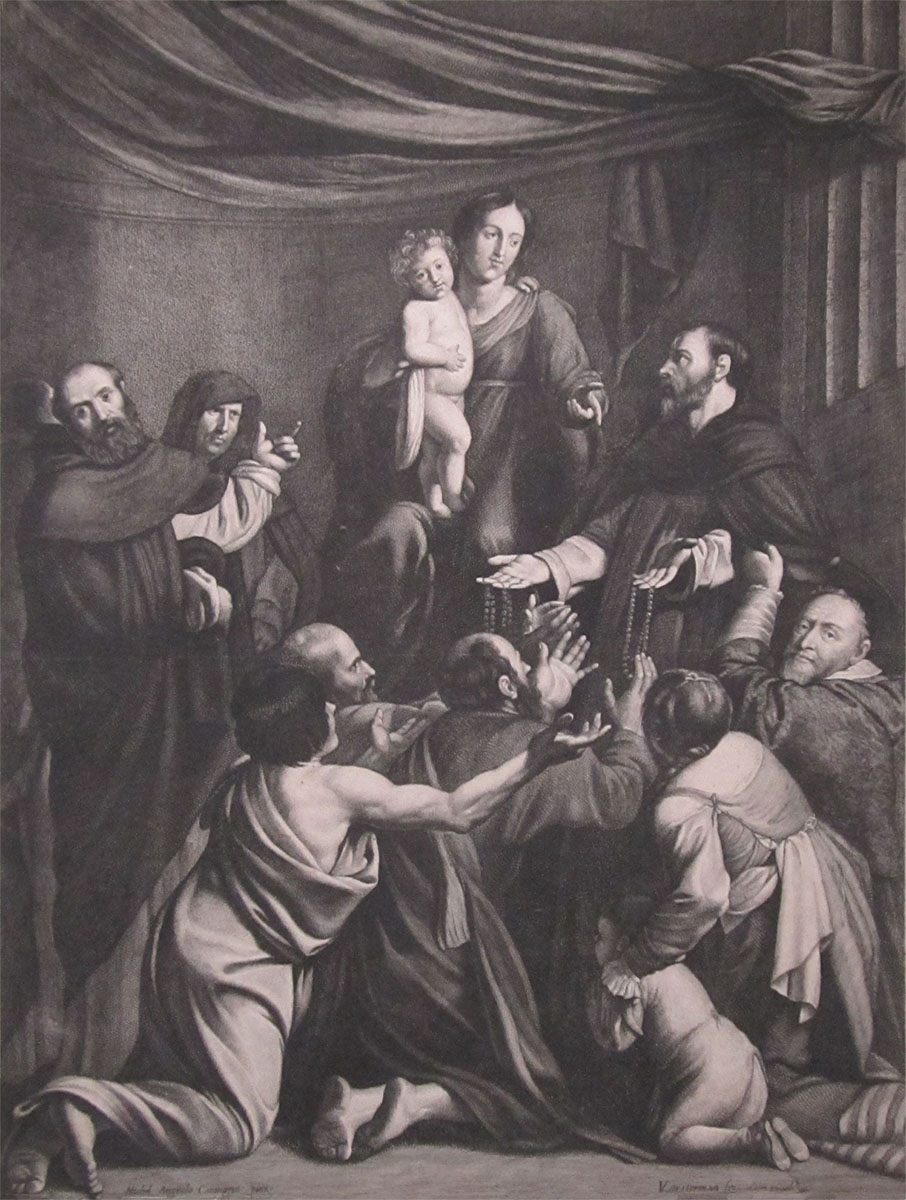
Lucas Vorsterman the Elder
Madonna of the Rosary (after Caravaggio)
engraving
22” H x 16.5” W
early 17th century
2013.00.0009
Image courtesy of the Walsh Gallery


OCTOBER IS THE MONTH OF THE HOLY ROSARY

This engraving by Lucas Vorsterman the Elder is after an original painting by Caravaggio.  Though we do not know the patron of this work, art historians believe Caravaggio’s painting was part of an altarpiece created for a Dominican church – inferred by the presence of Saint Dominic – shown on the right holding rosaries in his outstretched hands.  It is thought the figure peering from beneath Saint Dominic’s robes is the patron who commissioned this work given his eye contact with the viewer and proximity to the saint and the Virgin Mary.[1]

The month of October is dedicated to the Holy Rosary. According to an account by fifteenth-century Dominican, Alan de la Roche, Mary appeared to Saint Dominic in 1206 after praying.  She gave Saint Dominic the Rosary, explained its uses and significance, and told him to preach it to others.[2]  The Rosary consists of prayer and meditations on the life of Christ using rosary beads as an aid.  Catholics pray the rosary to ask God for a special favor, such as helping a loved one recover from an illness, or to thank God for blessings received.[3]

The rosary has 59 beads, a crucifix, and a medal, with certain prayers for each of the pieces. The prayers of the rosary can be divided into three categories: Introductory Prayers, The Decades and Closing Prayers.[4]  The prayers that compose the rosary are arranged in sets of ten “Hail Mary” prayers. Each set of ten, or decade, is preceded by one “Lord’s Prayer” (“Our Father”) and traditionally followed by one “Glory Be.”  During the recitation of each set, thought is given to one of the Mysteries of the Rosary, which recall events in the lives of Jesus and of Mary. Five decades are recited per rosary.[5]

The term rosary is derived from the Latin word rosarium or rose garden and the rose is the symbol of the Virgin Mary.The earliest documented use of the term rosary dates back to 1597[6], though the story of Saint Dominic tells us the word likely appeared much earlier in time.  Rosary beads are made from a variety of materials.  These include ordinary ones such as plastic, rope or wood, or more expensive materials such as gemstones or precious metals.  The tradition of using beads to pray spans across many faiths and cultures.  Hindus, Greeks, Buddhists and numerous other peoples use beads to pray.  Interestingly enough, the word bead in English is derived from an Old English word that means prayer.[7]
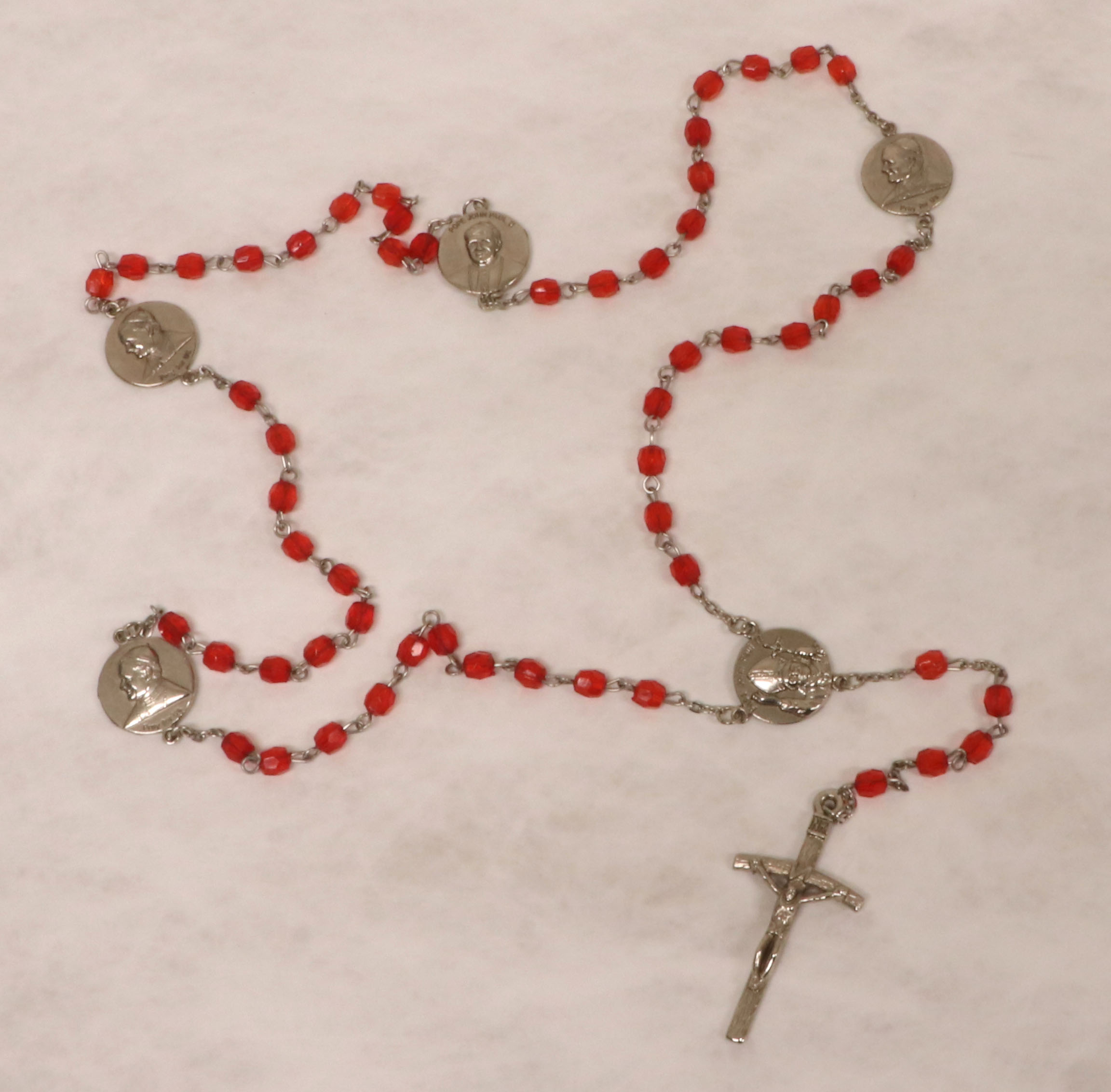
Rosary with made of red plastic beads and a metal chain and crucifix, Collection on Pope John Paul II (MSS 0004)
Rosary, Collection on Pope John Paul II (MSS 0004)


______________

The Walsh Gallery has a considerable collection of fine art, artifacts and archeological specimens. For access to this or objects in our collections, complete this research request form to set up an appointment. 


[1] https://en.wikipedia.org/wiki/Madonna_of_the_Rosary_(Caravaggio)  accessed 10/7/2020

[2] https://www.livingbreadradio.com/2015/09/october-the-month-of-the-holy-rosary/ accessed 10/7/2020

[3] https://m.theholyrosary.org/  accessed 10/7/2020

[4] https://dynamiccatholic.com/rosary/how-to-pray-the-rosary accessed 10/7/2020

[5] https://m.theholyrosary.org/  accessed 10/7/2020

[6] https://dynamiccatholic.com/rosary/history-of-the-rosary accessed 10/7/2020

[7] https://dynamiccatholic.com/rosary/history-of-the-rosary accessed 10/7/2020
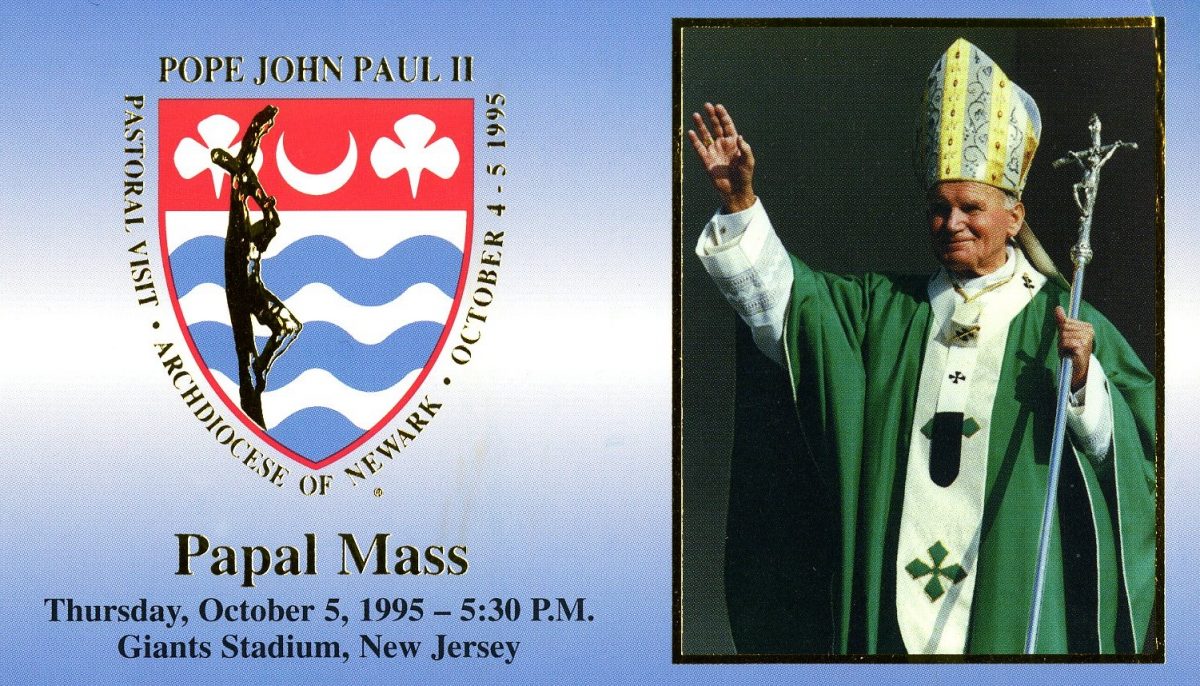
 

Pope Saint John Paul II & The Silver Anniversary of His Journey to Newark

Sto Lat! This was a typical greeting shared by Pope Saint John Paul II whose words and outreach touched millions of individuals around the world during his lifetime and beyond.  This week marks a milestone for the local community when Pope Saint John Paul II visited the Eastern United States between October 4-8, 1995 with a special excursion to Newark and surrounding communities during the first two days of this much anticipated spiritual pilgrimage.

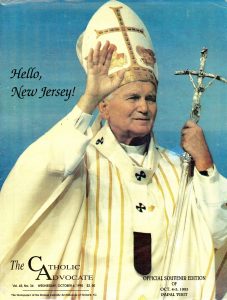
Cover of the Catholic Advocate heralding the arrival of Pope Saint John Paul II – October 4, 1995

The choice to visit Newark was well-summarized by Mr. Jerry Filteau, a columnist for the National Catholic Reporter who offered the following prospectus for those unfamiliar with the deep-rooted diversity found within the city and surrounding communities:

“Newark viewed as place of hope,” In visiting the Newark Archdiocese, Oct. 4 and 5, Pope John Paul II will find a microcosm of the church and the nation . . . the archdiocese has 11 distinct offices just for racial and ethnic apostolates — Hispanics, African-Americans, Chinese, Filipinos, Haitians, Irish, Italians, Koreans, Poles, Portuguese and Vietnamese.  The Newark Archdiocese’s Catholics are the local teachers and retail clerks, police and meat cutters, homemakers and shop owners.  They’re the airline employees, truckers, railroad workers, shippers and dockworkers of Newark, Jersey City, Elizabeth and Bayonne, one of the nation’s busiest transportation hubs. They’re the professionals and corporate executives who live in affluent Bergen County suburbs . . . “

In regard to the first chapter of the journey, Pope Saint John Paul II arrived at the Newark International Airport and met with various dignitaries prior to his first major talk before the United Nations General Assembly as a prelude to his day of activities in the “Brick City’ and environs.

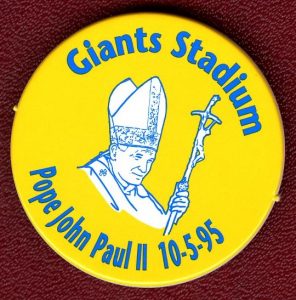
The morning of October 5th Pope Saint John Paul II celebrated Mass at Giants Stadium in East Rutherford before 85,000 individuals where Pope Saint John Paul II in his homily expressed those present and millions watching on television that “Today we are celebrating the Good News of God’s Kingdom here in Giants Stadium, in the Archdiocese of Newark in New Jersey – ‘The Garden State’ . . . “ which was greeted with enthusiastic applause.  Moreover, he reminded the assembly of the ways in which the church has “made a home” in this country, embracing people of many different cultural and ethnic backgrounds. Pope Saint John Paul II delivered his sermon during an unforeseen downpour in which he quipped to the assemblage that: “I see the people of New Jersey know how to praise God in joyful praise and song, even in the rain.” . . . “water drenched faithful that “water is a sign of life, a sign of God’s blessing!”  This provided a graceful note upon which to end the ceremony and inspire the crowd.
That evening, Pope Saint John Paul II celebrated evening prayer at the Cathedral of the Sacred Heart located in downtown Newark. On this occasion, the edifice was elevated to Minor Basilica status to henceforth be known as the Cathedral Basilica of the Sacred Heart.  This marked an enduring monument to the brief, but memorable time that Pope Saint John Paul II spent in our neighborhood.


The New Jersey Catholic Historical Commission (Headquartered within the Monsignor William Noé Field Archives & Special Collections Center) is also celebrating this occasion during early October with commemorative posts that are archived for reference and found on our Facebook Page via the following link: https://www.facebook.com/NJCHC

Screenshots of the New Jersey Catholic Historical Commission Facebook Page & Pope Saint John II, October 2020

In addition, along with our Manuscript Collection on the Visit proper there are more resources related to Pope Saint John II (along with other Pontiffs over the centuries) can be found here via our ArchivesSpace holdings catalog . . .

https://archivesspace-library.shu.edu/search?utf8=%E2%9C%93&op%5B%5D=&q%5B%5D=%22John+Paul+II%22&commit=&field%5B%5D=&from_year%5B%5D=&to_year%5B%5D=

For further information on Papal History and any aspect of Catholic New Jersey please contact us by e-mail at:  Archives@shu.edu or via phone at: (973) 275-2378.

Object of the Week: Melvin Dalton Olympic Qualifying Medal and Certificate

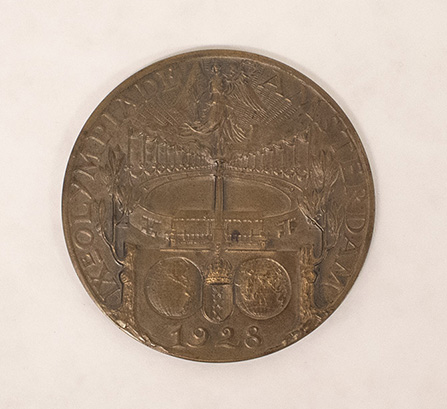
Mel Dalton – Olympic Medal of Merit
medal
2 3/16″ diameter
1928
2020.05.0001
Department of Archives and Special Collections, Seton Hall University


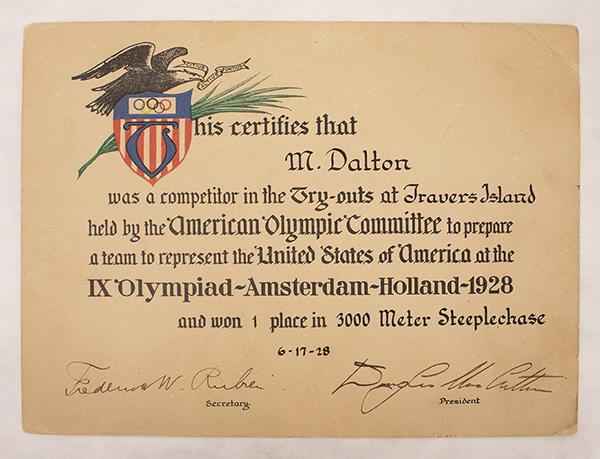
This Olympic qualifying medal and certificate were presented to Seton Hall University alumnus, Melvin Joseph Dalton, a member of the United States Olympic Team for the 1928 Amsterdam Summer Olympics.  Dalton ranked first place at the Olympic trials on Travers Island (Pelham), New York in the steeplechase run, making him eligible to compete in the summer Olympics that same year.  In the 1928 Olympic Games, he came in seventh place in the steeplechase, a grueling 3,000-meter obstacle race in which runners jump over four hurdles and a water pit.  Dalton’s personal best in the Steeplechase event had him clocking in at 9 minutes, 33 seconds.  Three Finnish runners took the gold, silver and bronze medals: Toivo Loukola, Paavo Nurmi and Ove Anderson.  Toivo Loukola set a new world record at 9 minutes 21 seconds – 12 seconds faster than Dalton’s personal best.  The men’s 3000-meter steeplechase event at the 1928 Olympic Games took place on August 1 and August 4.

Mel Dalton – Olympic Certificate of Merit, certificate, 5 11/16” x 7 11/16”, June 17, 1928, 2020.05.0002, Department of Archives and Special Collections

The Amsterdam Olympic Games of 1928 were officially known as the Games of the IX Olympiad.  These games saw the participation of 2883 athletes from 46 countries competing in 109 events.  Athletes from twenty-eight nations won gold medals, a record which would stand for forty years, and it was the first time women were allowed to compete in athletics and gymnastics events. Women would not be allowed to compete in the Olympic steeplechase event until 2008 – 80 years after Dalton’s Olympic competition.  The 1928 games also witnessed the first lighting of the Olympic flame at an opening ceremony, as well as the establishment of the protocol of Greek athletes entering the stadium first, with host nation athletes entering last.

For video footage of the 1928 Steeplechase event in which Dalton ran, click here.

A native of Newark, New Jersey, Dalton attended Seton Hall from 1925 to 1929 and was later inducted into the University’s Athletics Hall of Fame in 1980.  Dalton ran track for Seton Hall as a student, and in 1925 was undefeated in all his college cross-country races and 2-miles track races. Dalton would later become a member of the priest community.

Black and white image of alumnus Melvin Dalton in his Seton Hall track uniform, in a stance so he appears ready to run
Photo of Melvin Dalton in uniform, Galleon Yearbook, Class of 1927, pg. 115


Object of the Week: Illustrated Jerusalem Bible

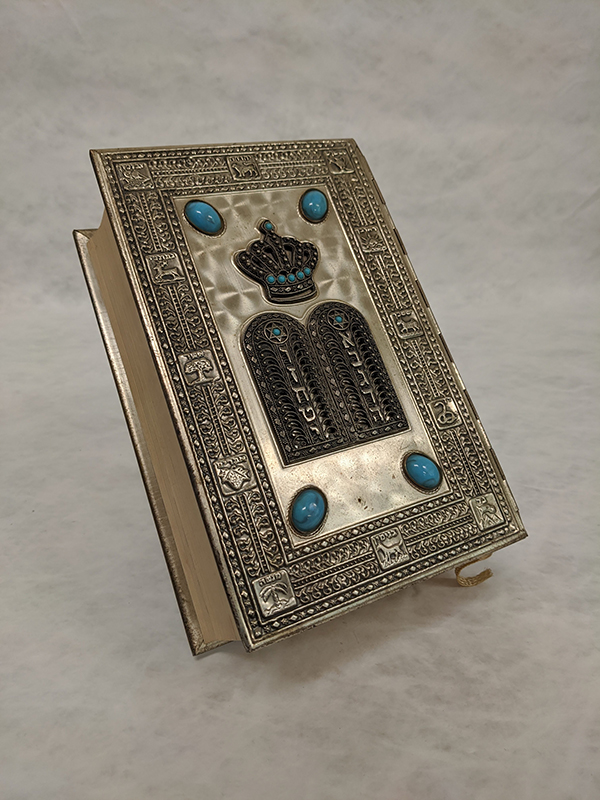
The Illustrated Jerusalem Bible in Hebrew and English
Published by Jerusalem Bible Publishing Co, Inc., 1958
Jerusalem – New York – London
Edited by M. Friedlander
Silver and turquoise binding
1,982 pages
Richard J. Hughes Papers, MSS #3


SHANA TOVA (Happy New Year)

At this time of year, Rosh Hashanah and Yom Kippur, the two the holiest days in the Jewish faith are observed.  The observances are a blend of joy and solemnity, feasting and fasting, and prayer that make up the spiritually inspired head of the Jewish year. Rosh Hashanah, the Jewish New Year, is a time of family gatherings and special meals.   Unlike the secular New Year in the Gregorian calendar (January 1), Rosh Hashanah is a time of judgment and remembrance, on which G-d reviews and judges a person’s deeds in the past year. It is a time of prayer and penitence.  Yom Kippur (The Day of Atonement) is the day of repentance, the most holy day on the Jewish calendar. Described as a Shabbat shabbaton (Shabbat of solemn rest) in the Torah, Yom Kippur is a day of fasting, prayer, and reflection. Yom Kippur is the culmination of a period of time during the month of Elul in which Jews are required to take stock of their lives, to ask forgiveness from friends and family, and to take steps toward self-improvement for the year to come.

Object of the Week: Sketch of Mother Seton Medal

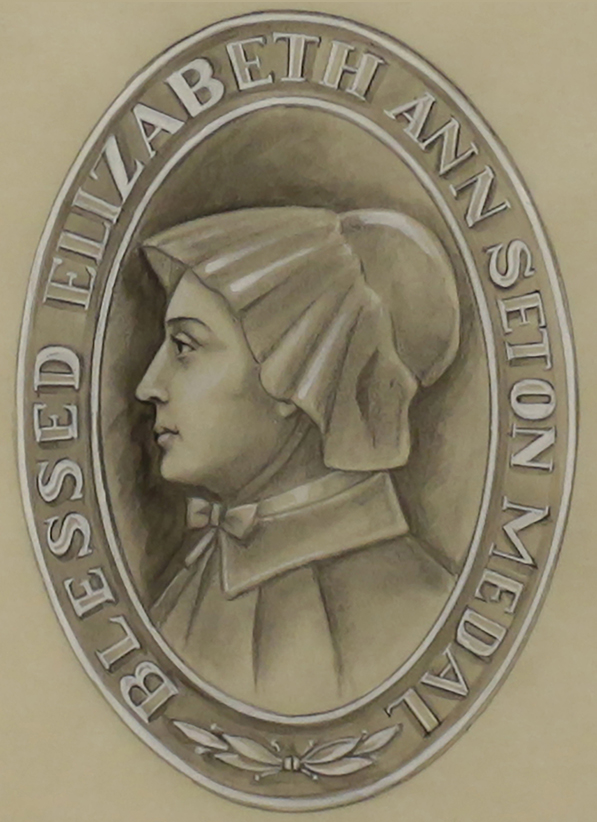
Sketch for Mother Seton medal
designed by Dieges and Clust
paint and pencil on paper
14 1/2″ x 11 1/2″
c. 1969
2018.17.0001a
MSS 0006
Monsignor Noe Field Archives & Special Collections Center


Saint Elizabeth Ann Seton (1774 – 1821) was born in what would later become the United States and was canonized on September 14, 1975, making her the first American born saint.  After the death of her husband while traveling abroad in 1803, she converted to Catholicism and was received into the Catholic Church in March of 1805 at Saint Peter’s Church in New York.  Mother Seton established the first Catholic girls’ school in the United States, and later founded the first American congregation of religious sisters, the Sisters of Charity.  Her profound impact is still evidenced today by the number of institutions inspired by her work throughout the nation, especially in Maryland and New York City where she had resided.  Pope John XXIII noted at her beatification in 1963, “In a house that was very small, but with ample space for charity, she sowed a seed in America which by Divine Grace grew into a large tree.”  That tree still thrives in the continuation of her charitable work in the service of others, especially women and children.

Back To School – Through The Years

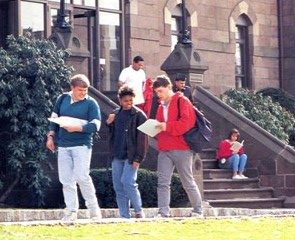
The familiar refrain of “Welcome to Seton Hall” has been shared on many occasions with scores of students who have ventured through the front gates of the school over the last 160 plus years.  Although such a salutation can come at any point in time, early September just before Labor Day (or late August over the last decade in particular) has traditionally been designated as the dawn of an academic year for college bound individuals across the country with Seton Hall being no exception to this traditional rite of passage.  In this time of the COVID pandemic we are starting classes earlier on August 24th of 2020 with various safeguards in place to make the learning environment more safe, but no less interactive.

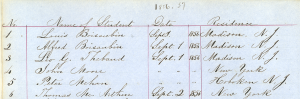
The first day of classes ever at Seton Hall came on September 1, 1856 in Madison, New Jersey (prior to the move of operations to South Orange four year later) when a total of five students enrolled at the fledgling institution after paying their room and board of $200 per annum.  The original attendance roster included the following names – Leo G. Thebaud (Madison), Louis and Alfred Boisaubin (Madison), Peter Meehan (Hoboken), and John Moore (New York City).

First page of the 1856 Seton Hall College Registration Ledger

This number rose to 11 by the end of September and either by on-time registration or those who chose delayed enrollment, the school was now in operation and set the trend for first days to follow thereafter.  For example, attendance figures for registrants to open a fall school term rose to 105 by 1865-66 and fluctuated below or near this number through the remainder of the 1800s.  An upswing figure-wise came during the 20th century as Seton Hall boasted over 200 newcomers for the first time by 1925-26 (259 total) as a prelude to the era of four-figure registrations which came about in 1938-39 when the Urban Division (Extension) Schools of Newark and Jersey City featured 1,025 students (481 at the South Orange campus) on their books.  However, it would not be until 1945-46 when the main campus hosted 1,008 new students (2,109 at the Urban Division) and the year following exploded even further in terms of Setonians who first arrived on site with 2,994 and 3,312 attending classes in South Orange and at the Urban Division respectively.  Thousands more per year and in sum thereafter have also experienced their first day in building a tradition that has endured to the present day.

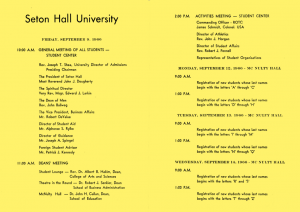
Seton Hall University Orientation Guide – 1966

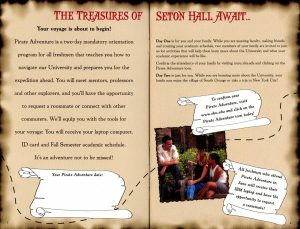
Regardless of year, prior to the moment of entry, plenty of preparation faces the undergraduate student from the Freshman who encounter a number of Orientation Sessions prior to attendance through Seniors who are making their final semester opening appearance on campus.  The fine tuning of course selection, purchase of school supplies, assisting with “Move-In Day” and other time honored and timely rituals are often routinely encountered by young scholars across the board.  Once arriving on site, the student body is busy settling in, meeting roommates, making  friends, selecting activities, studying course syllabi, book purchasing, and balancing meal plans among many other tasks start in earnest and helps to define the semester that lies ahead for each budding Setonian.  Reflection of these moments are often special to those who lived through these new experiences and many alumni have kept enduring memories of their first time on campus.  With this in mind, the literature produced by the school each semester reinforces the structure and substance that goes into planning for a starting term from the first one onward.

2005 Seton Hall University Orientation Guide Introductory Page

Various resources including listings that trace the beginning of each semester through the finish are available for research purposes here in our collection.  In addition, we have some electronic-based resources for off-campus consultation.  Our University History Library Guide can be located via the following link – https://library.shu.edu/University_History and our digital collections for a look at the earliest and most recent College/University catalog(ue)s and bulletins – https://scholarship.shu.edu/archives/

For more information about University History from start to finish please feel free to contact us via e-mail or by phone: (973) 275-2378.  New for this year, you can also use our bookings page to make an appointment for a research consultation or book a desk for quiet study in the reading room.  In the meantime, a perpetual “Welcome to Seton Hall” everyone!

Working with Seton Hall’s Audiovisual Collections

by Kyle Brinster, MS-MLIS candidate at

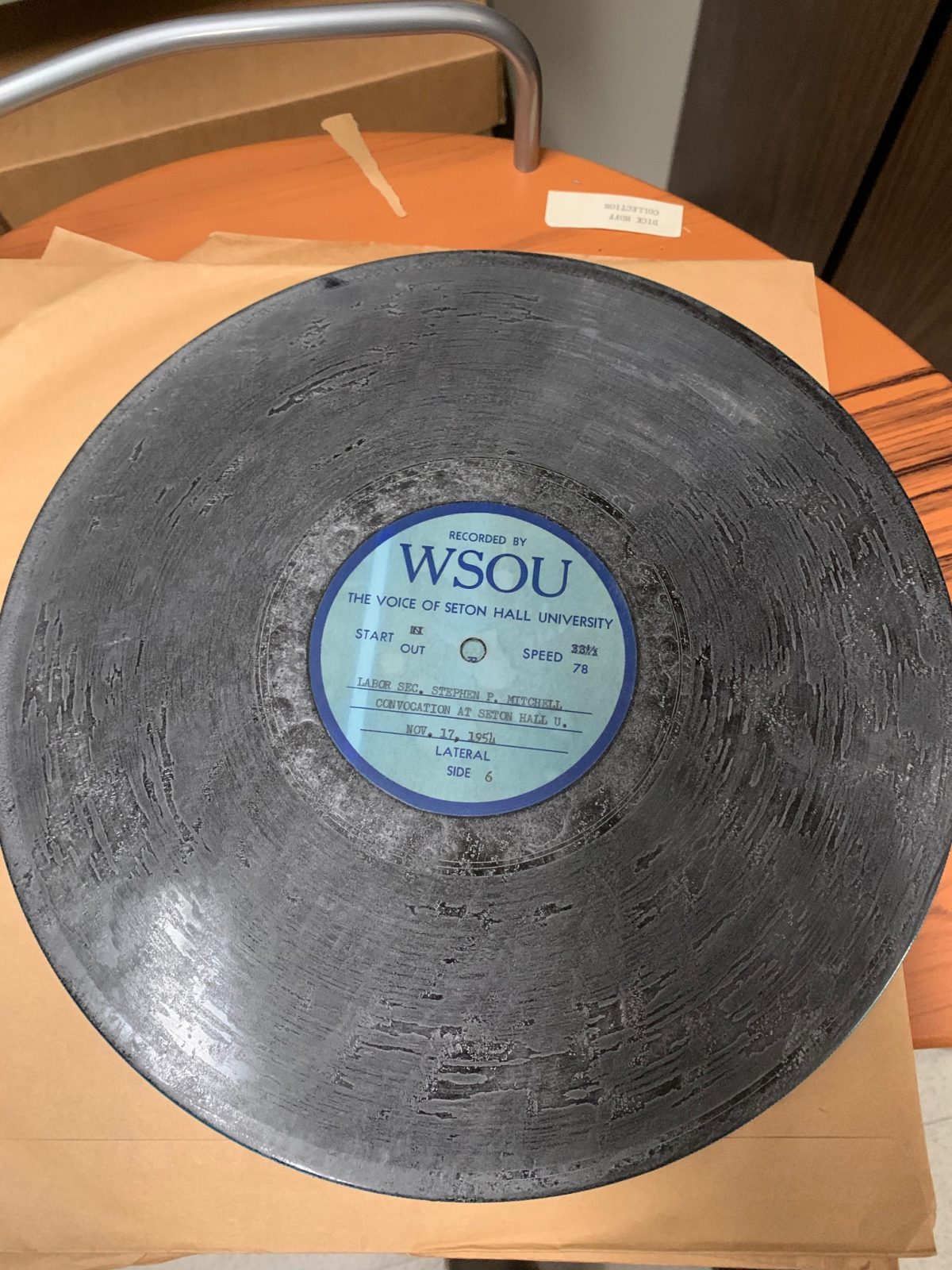
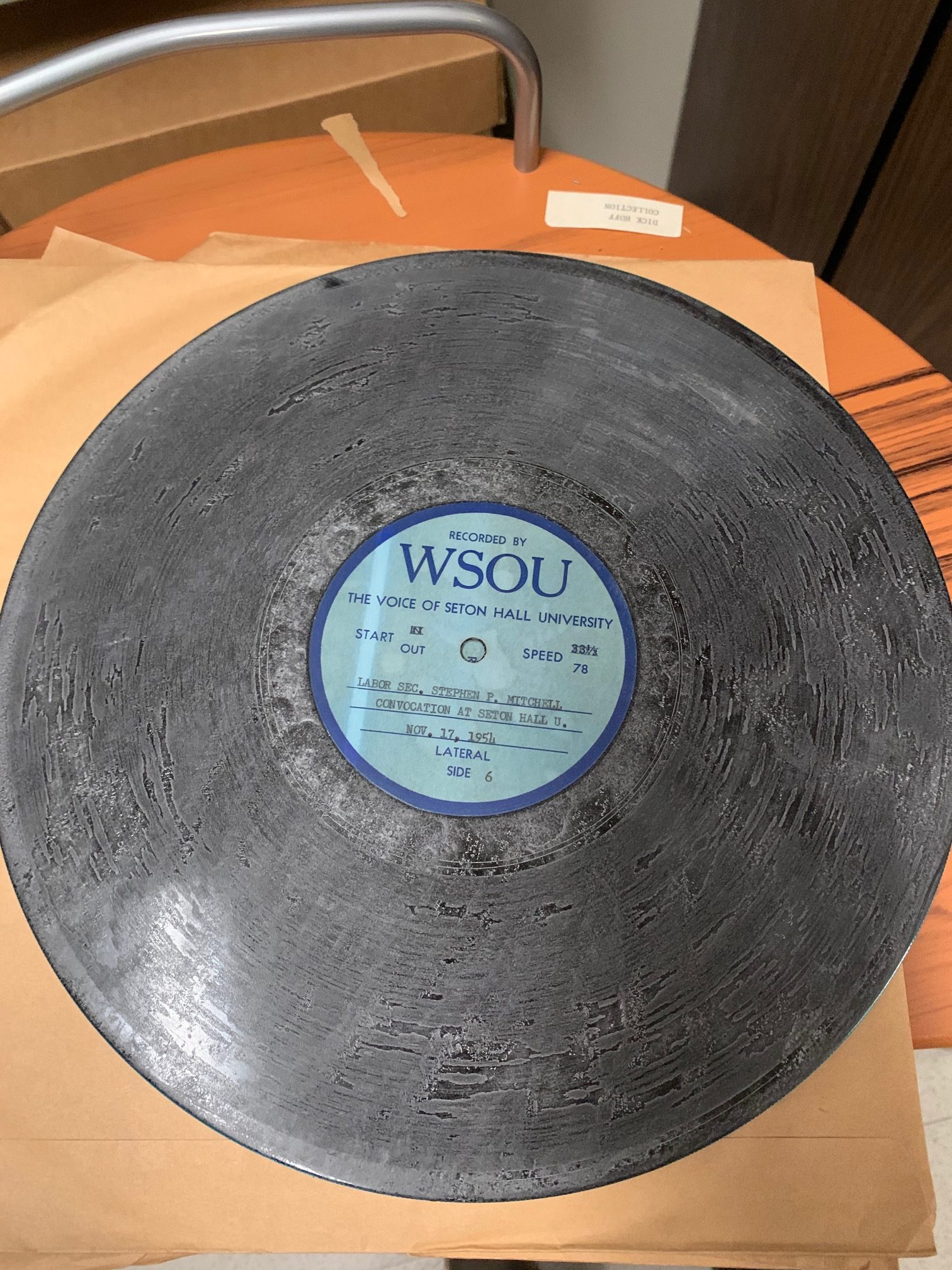
photo of damaged record
A laquer disc with deterioration of the plasticizer

St. John’s University

During the Winter-Spring 2020 semester I served as an intern at Seton Hall where I worked in the Archives and Special Collections Center under Walsh Library. They house a number of collection areas including institutional records, New Jersey history, Irish and Irish-American history, and additionally serve as the repository for records regarding the Archdiocese of Newark. But over the next few months my work was focused on SHU A, or the university’s audio-visual records. 

One thing I have learned during my fledgling archival career is that the real world is very different from coursework. Although this may seem obvious the differences manifest in surprising ways. Often archivists are not part of an organization’s record keeping plan from the outset; they enter the scene well after one or several people have compiled records deemed important. In the past the same has been true of Seton Hall. Books and records were dutifully kept but without full consideration as to whether they fell under the archives’ purview. Similarly, the decision was made to separate out certain record types from their original collection. This is the case with SHU’s photograph collection, and before this semester was true of SHU A. When Technical Archivist Sheridan Sayles pointed out the 3 shelves full of boxes my first day in late January, I thought perhaps I was in over my head. There were boxes full of VHS and cassette tapes, many of which were blank or confusingly labeled. On the shelves beside the boxes were rows of record albums. These came in their commercial boxes and homemade sleeves, with a books of multi-disc albums rounding out the row of records.

I took part in several different AV projects during my semester at SHU. Initially, I consolidated and organized the array of VHS tapes. This consisted of surveying what was in the collection, weeding out commonly produced or off-focus tapes, and rehoming objects with their original existent collection. Separating taped episodes of The Sopranos from the collection was easy, but categorizing the wide range of news clips, Seton Hall TV spots, filmed lectures, and other miscellaneous tapes was something of a challenge. Many were also lacking much or any descriptive information, so they were viewed in order to try and find context so they could be better sorted.

I then set to work capturing the existing collections where the tapes belonged. These areas included the Athletics, College of Business, Poetry in the Round, and WSOU, just to name a few. I created spreadsheets outlining the new additions to the collections, including metadata information like the title, date, and format for easier search and organization in the future.

The process was then repeated with record albums: they were surveyed, weeded, rehoused, and reassigned to their original collections. In this way over the course of a few weeks we transformed SHU A from over a dozen linear feet of shelving into 3 neat boxes.

The archives welcomes undergraduate interns and has a variety of appropriate projects suited to different interests.  Current Seton Hall students interested in working in the archives who are eligible for federal work study, please send an inquiry to sarah.ponichtera@shu.edu.

Monsignor Thomas Fahy – Priest, Scholar, Humanitarian

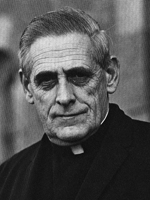
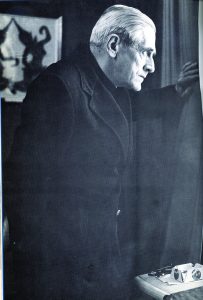
This year marks the 50th anniversary of the inauguration of Monsignor Thomas G. Fahy (1922-76) as the fourteenth president of Seton Hall whose tenure was marked by a major series of initiatives that enhanced the administrative focus, academic infra-structure, and student experience for those connected to the university during his time as chief executive.  His life and example have been fondly remembered by those he touched along with future generations of Setonians who benefited from the forward-thinking initiatives he nurtured and approved between the years of 1970-76 in particular.

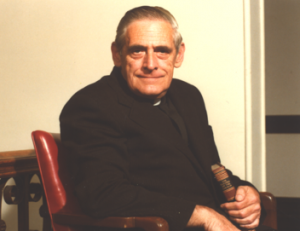
Monsignor Fahy looks over campus during his time as University President, c. early 1970s

A native of Jersey City, Monsignor Fahy graduated from Seton Hall College in 1943 and four years later became an alumnus of the Immaculate Conception Seminary just prior to ordination as a priest for the Archdiocese of Newark. He was later educated at Fordham University where advanced degrees in Theological Studies were earned.  The first educational-based assignments undertaken by Monsignor Fahy came as a Latin and Greek Instructor and Director of Athletics at the Seton Hall Preparatory School before joining the ranks of the university administration in 1955.  Prior to becoming president, Monsignor Fahy served Seton Hall as Athletic Director, Professor of Classical Languages, Dean of Men and Vice President of Instruction.

Upon assuming the presidency, Monsignor Fahy created the Center for Black (later known as African American) Studies was established in 1970. Another key addition to the campus landscape came to the fore when the Puerto Rican Institute was founded four years later. During the time of Monsignor Fahy, Seton Hall became more boarder-oriented when they opened Aquinas Hall, the first residence hall for women in 1971. Within academic circles, the Stillman Business School and Schwartz Nursing College Complex opened in 1973. Governance of Seton Hall originally balanced between a 25-member Board of Regents and 13 trustees, as operational leadership on a daily basis emanated from the office of Monsignor Fahy. In addition, Elizabeth Ann Seton, patroness of the University was canonized in Rome by Pope Paul VI in 1975, making her the first American-born saint. A year later, in response to a great swell in religious-based research, the New Jersey Catholic Historical Records Commission was founded at Seton Hall, where it remains active to this day.  These were just a few of the moves of lasting significance that remain connected to his legacy.

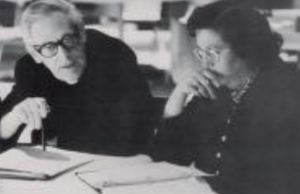
Monsignor Fahy discusses policy with faculty member, c. early 1970s

Monsignor Fahy was not only concerned for the welfare of the campus community, but for all citizens of the world  During his inaugural speech in 1970, he made mention of Catholic Higher education and the state of academic life, but also made the following pronouncement in regard to care for the earth and inhabitants based on the means of handling technology and ecology in a responsible manner:

“ . . . for us the most incredibly sophisticated marvels, the automobile and the jet plane to open up the country and the world; an agriculture whose yield is ten-fold what it was at the beginning of this century: a space program so incredible that we now somehow feel deflated that only two of our first three efforts to land on the moon were successful.  But while successive generations of college students were trained to produce these marvels, these students were apparently not warned to relate their achievements to man’s continued existence on earth.  As a result, we now face an ecological crisis of catastrophic proportions.  We could, we are told, be buried in our garbage, be asphyxiated by the exhaust of cards, or poisoned by the effluvia in our waters.”

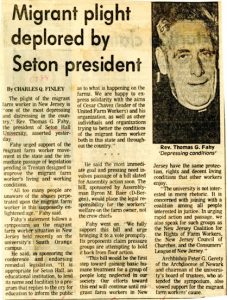
Monsignor Fahy was an advocate for the United Farm Workers cause and other advocacy groups of note. Clipping, c. early 1970s

Beyond the board room, Monsignor Fahy was known as a thoughtful presence on campus who would sit on the steps of Presidents Hall and gladly talk to anyone who happened by about their lives and concerns. This is another side of the man that lives on in memory.  Monsignor Fahy accomplished many important landmarks during his lifetime, but tragically passed away in 1976 at the age of 54.  When the news arrived on campus he was widely mourned and eulogized.

Among the most poignant tributes came from past university president, Bishop John J. Dougherty who articulated that:

“Thomas George Fahy with honor, for his life was an honor to everything of which he was a part.  He was an honor to the family whose name he bore.  His achievement was begotten of what his parents had give him. He was an honor to the priesthood.  His fellow seminarians respected his gifted mind, his unassuming manner, and his manly and unobtrusive piety.  His priestly and professional life served a cause: the cause was Seton Hall. He was an honor to the human community. He was compassionate not only in thought and feeling, but in action.”

Additional postings regarding the life and legacy of Monsignor Fahy will be forthcoming.  In the meantime, please feel to contact us if you need further information on Monsignor Fahy and all aspects of Seton Hall University.  We can be reached via e-mail at:  archives@shu.edu
 

Summer School at Setonia

On most college and university campuses, the voluntary option of attending Summer School between the end of any Spring semester and the beginning of a Fall term is a concept that is commonplace today.  This has traditionally been a time when students could undertake selective coursework in order to repeat classes for added intellectual reinforcement, quicken the pace of their respective graduation timetable, or even for self-knowledge and continuing education purposes.  Seton Hall has systematically followed this trend of student support through most of the twentieth century into the present day.

Historically, the typical Academic Year for a Setonia student during the nineteenth century entailed a regimented ten-month academic experience along with their proscribed vacation time to help rejuvenate themselves in time for an Autumn opening.  General catalog(ue)s of the 1860s-90s highlighted this required modus operandi in the following manner:

“The Academic year, which consists of two terms of five months each, begins on the first Wednesday of September and ends on the third Wednesday of June.  At Christmas there is a vacation of twelve days; and in May students are permitted to be absent for a day or two, to procure Summer clothing.  At no other time are they allowed to leave the College, except for reasons of great importance . . . General examinations are held at the end of each term.”

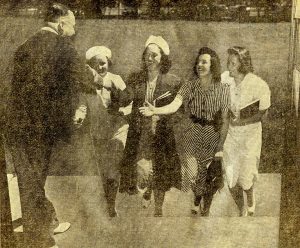
“Welcome to Seton Hall Summer School!” A press clip from the Newark News showing the first class of women to attend the South Orange campus of Seton Hall College in 1937. Dr. Howard E. Merity, Director of the Summer School welcomes from left to right: Sally Webster, Natalie McMahon, Lillian Driscoll, and Rita Smatherust

Over subsequent decades, the number of months that a student at Seton Hall were required to stay on campus had been reduced with final examinations taking place in late or early May with commencement exercises taking place shortly thereafter.  This left around three and a half months worth of vacation time as the twentieth century moved forward.  As enrollment multiplied along with an increased number of course offerings especially when the Urban Division of Seton Hall (Newark and Jersey City) was created in 1937 became a catalyst to encourage co-educational study.  This also led to an opportunity for all students (both Men and Women) to freely attend classes at the South Orange campus.  However, Women could not fully avail themselves of course enrollment at any time during any formal Academic Year until 1968.

From the 1930s forward, especially after World War II a full calendar of Summer-based course offerings were planned and scheduled on an annual basis and representing every individual College, School, and Department on campus along with offerings from the School of Continuing Education and Internet-based learning communities as well.  The evolution of Summer School has undergone various developments over the years and continues onward as the popularity of this program had endured.  The time usually spent taking any course outside of the traditional Academic Year period is usually accelerated and completed within a matter of a week or two on average, but no matter how long, participation was a valuable experience for many individuals as we move forward into the twenty-first century.

For more information on the history of Summer School and other aspects of University History we are glad to assist you.  Inquires can be sent via the following e-mail address: Archives@shu.edu

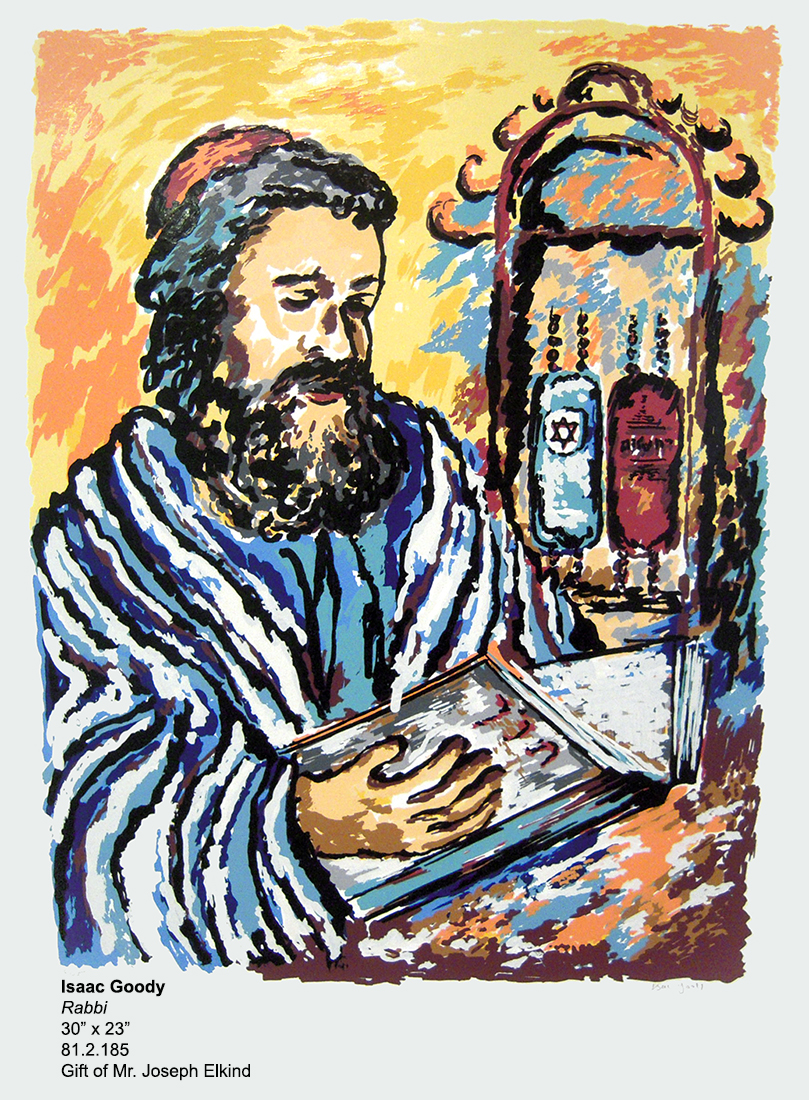
Object of the Week: “Rabbi” by Isaac Goody

Isaac Goody
Rabbi
serigraph
30” x 23”
1970s
81.2.185
Gift of Mr. Joseph Elkind

“Passover affirms the great truth that liberty is the inalienable right of every human being…. Pharaoh enslaved a whole race, and was chastised for his crime by the Divine Hand. But in thus intervening between the slave and his oppressor the Almighty fixed His canon against slavery for all time. He thereby declared that every human being has the right to the freedom which will enable him to develop to the utmost all the powers of body, of mind, of soul, with which God has endowed him; and that slavery, therefore, with its debasing effects upon the intellect and the character, is a sin against the laws of God himself.”  – Morris Joseph, Jewish Theologian, excerpt from his book, Passover: Judaism as Creed and Life

Passover is a week-long festival commemorating the exodus of the Israelites from slavery in ancient Egypt. In Hebrew, it is called Pesach, meaning “to pass over,” as God passed over the homes of Israelites during the tenth plague on the first Passover. This multicolored serigraph print in a graphic style depicts a Rabbi wearing a yarmulke and a tallit, reading from a prayer book. In the background are two rolled Torah scrolls in a Aron Kodesh, or Holy Arc.