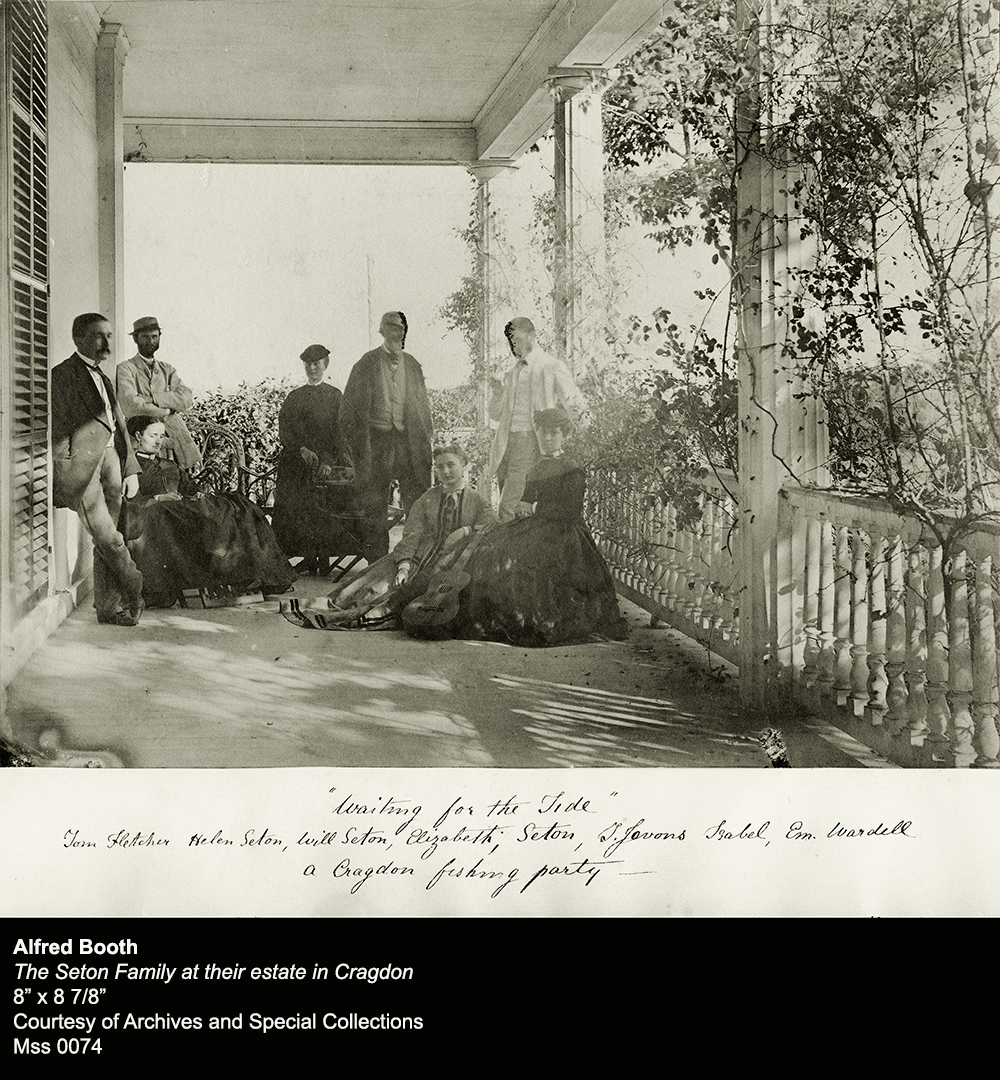
Alfred Booth The Seton Family at their estate in Cragdon Reproduction of an original albumen silver print
8” × 8 ⅞”
1866 – 1867
Courtesy of Archives and Special Collections
Mss 0074
Check out this photo of Seton family members at Cragdon, their estate located in the area tucked between the present-day Bronx neighborhoods of Wakefield and Eastchester. Going through family photos can unearth gems like one and is a great activity for your extra time at home. As you rediscover your own treasured images, there are a few things you can do to increase their longevity. Make sure you have clean, dry hands when handling photos and try not to touch the image directly but hold it from the sides and bottom. When thinking about where to store your photos, areas with temperatures between 65-70 degrees are ideal, as rooms temperature changes common in rooms such as a basement or attic can accelerate deterioration. If your photos are kept in an album, use ones with acid-free pages or polyester, polypropylene, or polyethylene sleeves and use photo corners instead of glue or tape when mounting photos. When displaying your photos, keep them out of direct sunlight to avoid fading, yellowing, and embrittlement.
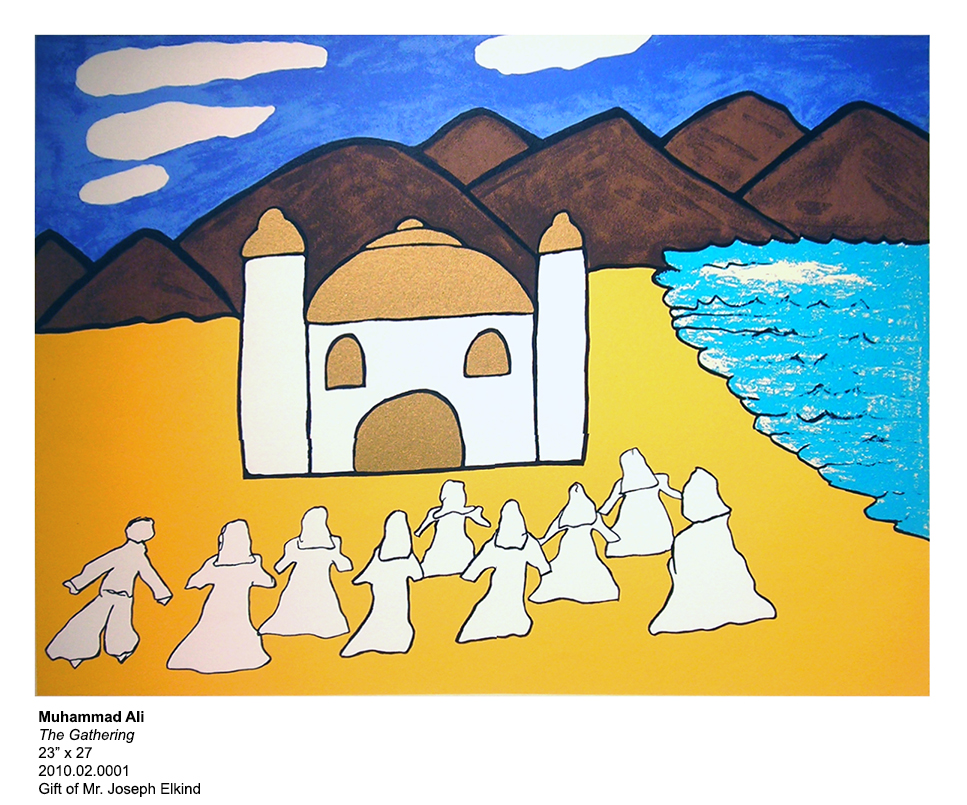
Muhammad Ali The Gathering
Lithographic print
23” x 27”
1980
2010.02.0001
Gift of Mr. Joseph Elkind
Ramadan Mubarak (Blessed Ramadan)! One of the holiest months of the year for Muslims, Ramadan commemorates the month in which the Qur’an, the holy book of Islam, was first revealed to the Prophet Muhammad by Allah (God). Daily fasting is practiced, and it is a time of self-reflection and spiritual improvement. Ramadan is a time to strengthen one’s relationship with Allah through reading the Qur’an and prayer, as well as reinforce communal bonds through shared meals when breaking the fast and giving to the poor. This print depicting figures in white walking towards a mosque with two minarets and a gold dome is by American Muslim, sports figure, celebrity and political activist, Muhammad Ali, who joined the Nation of Islam in 1964 and later converted to Sufi Islam after a pilgrimage to Mecca in the 1970s.
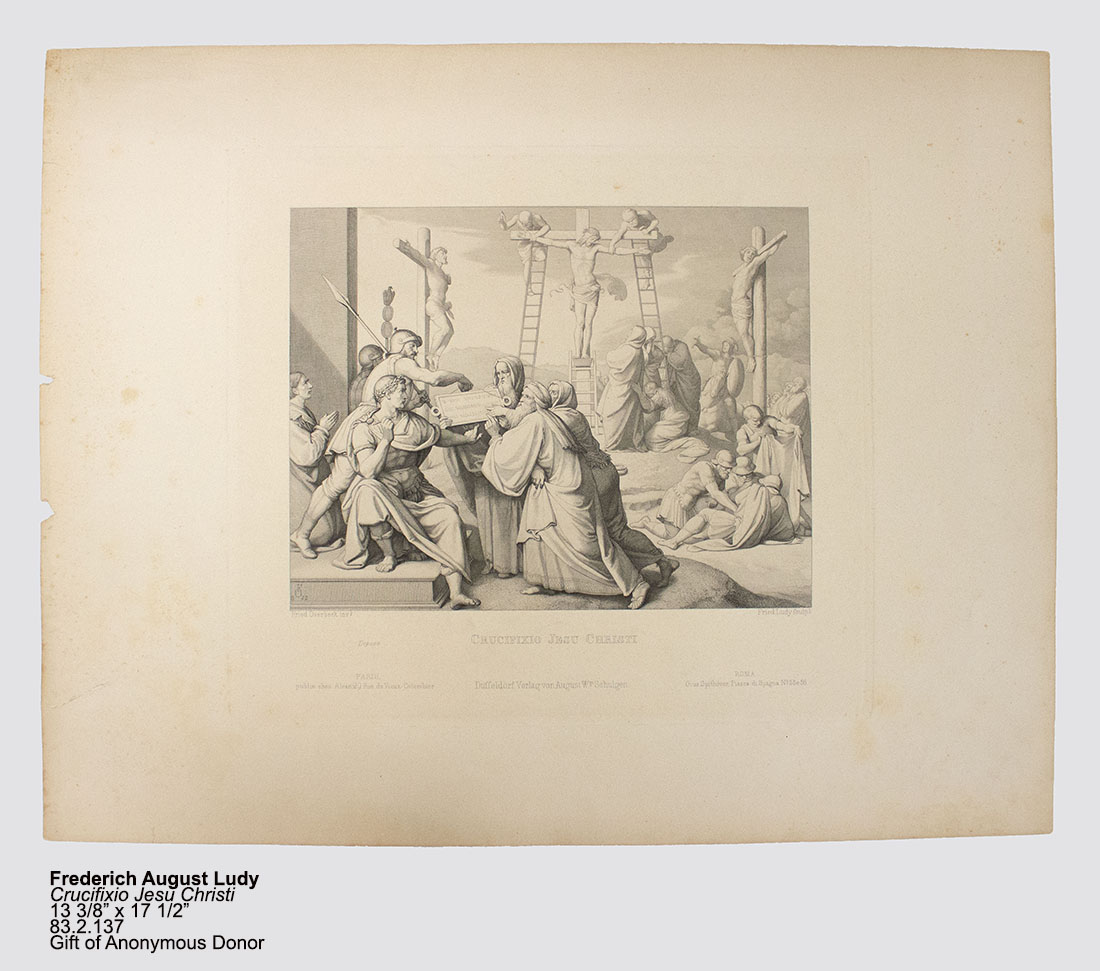
Friedrich August Ludy Crucifixio Jesu Christi Engraving
13.375” x 17.5”
1852
83.2.137
Gift of Anonymous Donor
“Good Friday is much more than reliving the passion of Jesus; it is entering into solidarity with the passion of all people of our planet, whether in the past, the present, or the future.” – Henri Nouwen
Each year on Good Friday, Christians commemorate the crucifixion and death of Jesus Christ at Calvary. Ludy’s engraving depicts these events. Pontius Pilate is shown a plaque which reads, “JESUS OF NAZARETH, THE KING OF THE JEWS” in Hebrew, Greek and Latin, as Jesus is nailed to the cross in the background. The figure depicted on the far-left kneeling in prayer is artist Johann Friedrich Overbeck who painted the original work on which this engraving is based.
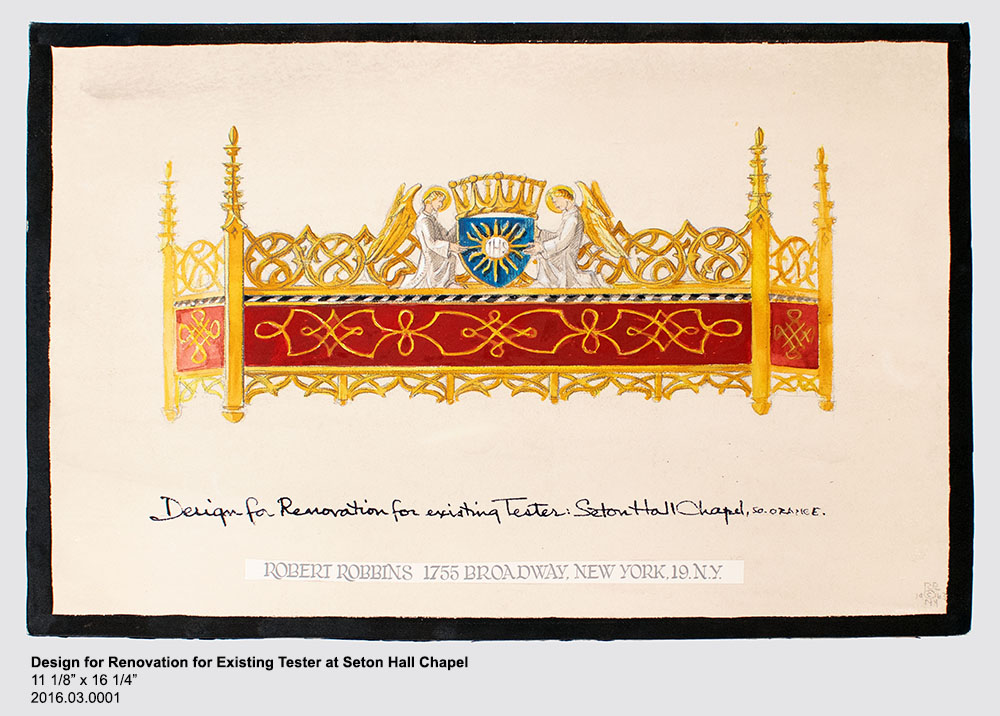
Design for Renovation for Existing Tester at Seton Hall Chapel architectural drawing
11 1/8” x 16 ¼”
1963
2016.03.0001
Department of Archives and Special Collections, Seton Hall University
This design for the renovation of the tester (canopy) in Seton Hall University’s Chapel of the Immaculate Conception was created by Robert Robbins. It is rendered in gold and red with accents of white and blue. The letters “IHS” set into a sun shape are a Christogram, or an abbreviation of Jesus’ name in Greek. The Robert Robbins Studio designed church interiors, mainly in Anglo-Catholic churches. Robbins sketched the actual designs while his brother, Toby, took care of practical matters. A third brother, Bill Robbins, was Rector of Saint Thomas’ Church in New Haven, Connecticut.
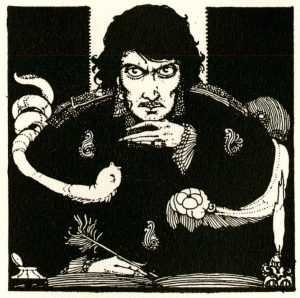
With the calendar pointing to late October, reading trends this time of year often focus on tales of mystery and mayhem connected with the observance of Halloween. Counted among the most famous authors who represent this time of year so vividly is Edgar Allan Poe (1809-49). Among his varied literary accomplishments, Poe is often credited with being the first to create and popularize the genre of science fiction. Many of his stories touched on the darker side of human nature, but his writing style was unique and captured the public imagination. Within an academic context, the short stories penned by Poe are still assigned by many professors as required reading for their students to study and learn from in turn.
Illustration from “Tales of Mystery and Imagination” (New York: Brentano’s, 1923)
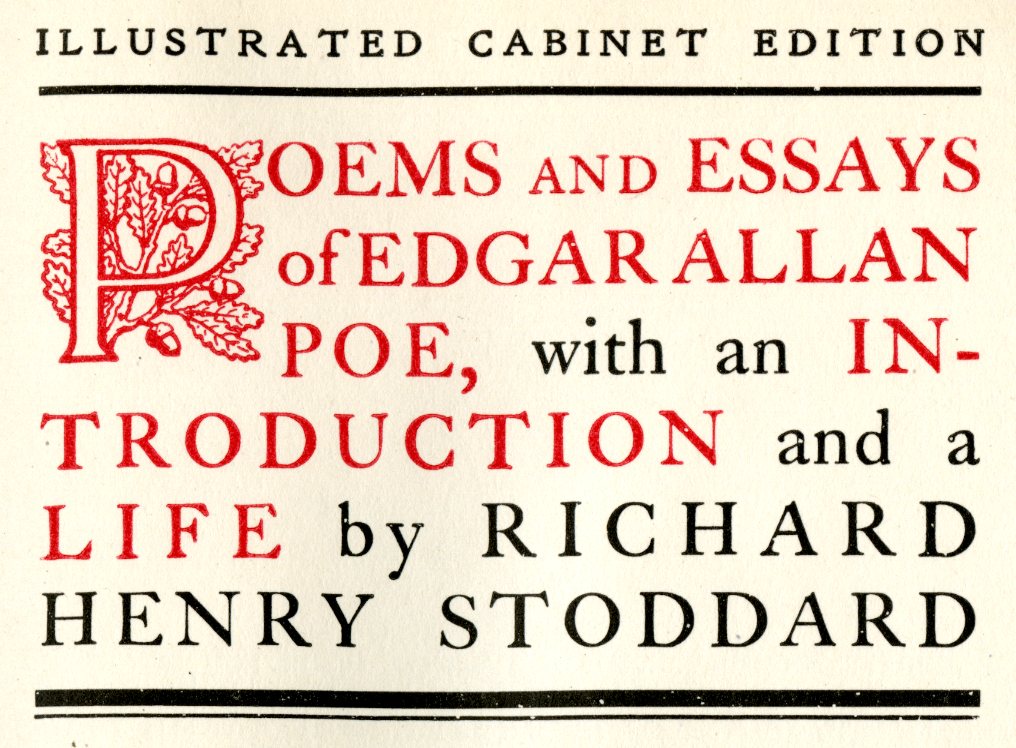
Inside the Archives & Special Collections are different historical anthologies and special edition volumes that capture the written legacy of Poe in greater detail. Included are the following titles under his authorship: Eurkea, Marginalia; A Chapter on Autobiography (Boston: L.C. Page, 1884); Poetical Works With Original Memoir (New York: J.S. Redfield, 1858); Poems and Essays (Boston: L.C. Page, 1884); Prose Tales (Boston: L.C. Page, 1884); and Tales of Mystery and Imagination (New York: Brentano’s, 1923) among other works of scholarship that have endured the test of time.
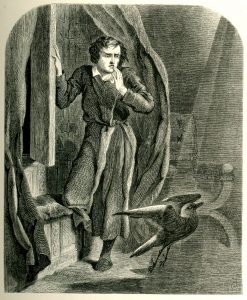
Illustration connected to the Poe short story: “The Raven” from “Poetical Works With Original Memoir”(New York: J.S. Redfield, 1858)
These and other works by Poe and different authors who specialize in suspense and other genres can be found through within our collection. For more information about Edgar Allan Poe, Rare Book holdings, and research opportunities please feel free to contact us to arrange an appointment via e-mail: <archives@shu.edu> or by phone at: (973) 275-2378.
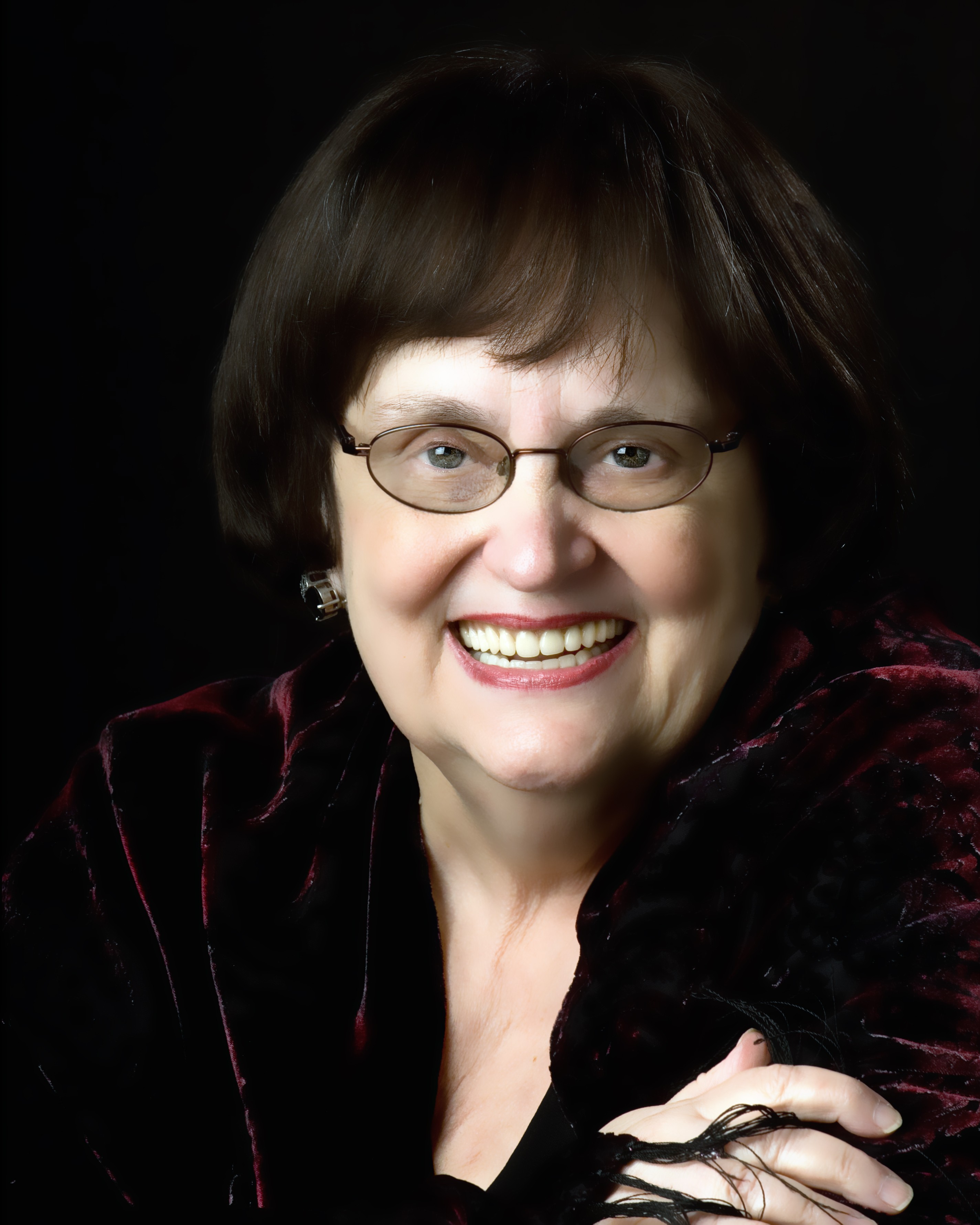
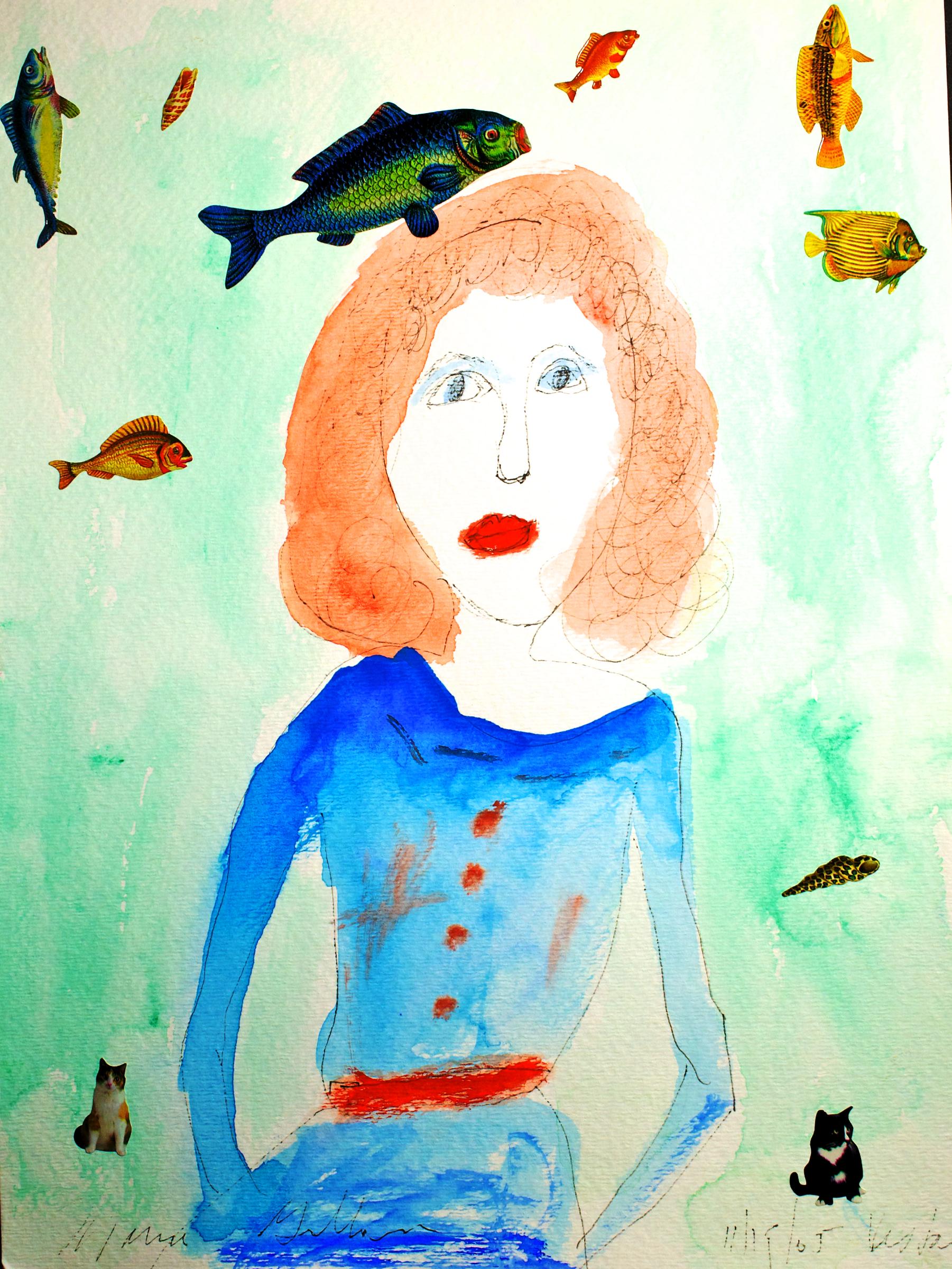
Maria Gillan is a poet who writes about her experience as an Italian-American woman, navigating between the Italian language and culture of her youth and the English language of her adult self. She writes with great attention to detail, in poems such as “Public School No. 18, Paterson, New Jersey,” where she speaks about the alienation she felt in an English language school as a native speaker of Italian. But she also speaks to universal themes, such as her sadness about the growing distance between herself and her son as her son grows up and starts a family of his own in “What I Can’t Face About Someone I Love.” Her work has been translated into Italian, and she now leads workshops in creative writing based in Italy, in addition to branching out into art as well as poetry, with works such as Redhead with Flying Fish and Cat. In addition, she maintains an active blog and website documenting her work.
Redhead with flying fish and cat
Gillan will be speaking at Seton Hall, in the Theater in the Round on the evening of September 24 at 6pm. Her translator, Professor Carla Francellini, from University of Siena, will speak as well. This event honors the 2019 scholarship winners in Italian Studies.
While she is here, Professor Francellini will also be working in the Monsignor William Noe Field Archives, researching in Gillan’s collection here, where not only her physical papers but also Gillan’s blog and website are archived. Explore the finding aid for the collection, and also stop by and see the window featuring Gillan’s work on the bottom floor of Walsh Library, outside Walsh Gallery.
Walsh Gallery Highlights Seton Hall’s Sport History
“Pirates Beyond Play”
Mon June 3 – Thurs Aug 8, 2019
The Walsh Gallery, in conjunction with the Monsignor William Noé Field Archives & Special Collections Center at Seton Hall University, presents “Pirates Beyond Play” (The History and Art of Setonia Athletics, 1856-2006) on display between Monday, June 3 – Thursday, August 8, 2019. The exhibit was created and organized by Jeanne Brasile, Gallery Director and curated by University Archivist Alan Delozier. This show focuses on the symbolic, intellectual and aesthetic importance of sports on the Seton Hall University campus. Objects on display include artifacts such as vintage magazine covers, game programs, photographs, uniforms and other ephemera that give homage to numerous athletic achievements over the years.
University Archivist, Alan Delozier will present a gallery talk on the History of Athletics at Seton Hall and tour of the exhibit on Monday, June 10th from 11:00 a.m. to 12:00 p.m. An optional complimentary lunch is available. To RSVP for the talk and/or lunch, please contact at: alan.delozier@shu.edu or (973) 275-2378. The exhibition and talk are free and open to the public.
The Walsh Gallery is located on the first floor of Walsh Library located on the campus of Seton Hall University. Gallery hours are Monday through Thursday, 10:30am to 4:30pm. Additional information can be found via the Walsh Gallery website – https://library.shu.edu/walshgallery/current-exhibitions or (973) 275-2033.
Flemish Madonna and Child Statue
painted wood statue
71” x 36” x 22”
17th century
73.3.1
Gift of Our Lady of the Holy Rosary – Summit, New Jersey
The Madonna and Child was part of a pair of statues that represented St. Godelieve and were carved for the eponymously named abbey in Bruges, Belgium. The sculpture made its way to the United States sometime in the early 20th century. Documentation shows it was on display in 1933 at the Chicago Progress Exhibition, after which it came into the possession of an art dealer in New York who subsequently donated it to Our Lady of the Holy Rosary, a Dominican Monastery, in 1963. In 1965, the statue was accepted into the Seton Hall University Collections. From 1994 until 2016, the statue was installed in the Art Center until being moved to its present location in the Monsignor William Noé Field Archives and Special Collections Center.
The Archives & Special Collections Center recently acquired a historic diary of a Seton Hall student, which provides interesting glimpses into what it was like to attend Seton Hall College in the 19th century. The diary was written by John Erigena Robinson, who graduated from Seton Hall College in 1874. His diary concerns his everyday life at the college, including worrying about assignments, writing letters to his family and friends, and playing for the college’s baseball team. The campus that Robinson studied at during the mid-1870s was one that centered on a structured, liberal arts education that was emblematic of Catholic higher education during his age. He entered into a world of study at Setonia that consisted of two sessions lasting five months apiece from September through June.
Front cover of John Erigena Robinson’s diary
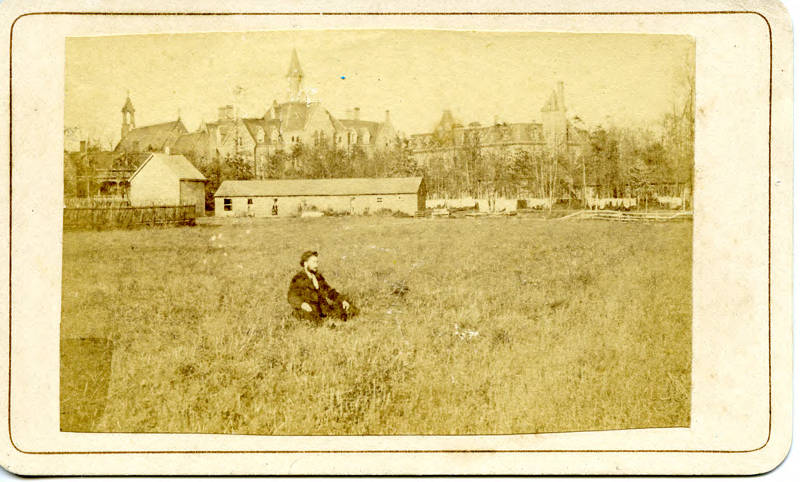
According to his recollections, Robinson primarily lived on campus during the school year, but on many weekends and holidays he would travel the roughly 24 miles from South Orange to Manhattan via the Delaware, Lackawanna & Western Railroad roughly three hours or more round trip to visit family and friends and then reverse his commute prior to the resumption of classes. After walking from the train station to campus he would study on campus in a setting where “The College buildings are of great architectural beauty, large and commodious . . . ” and quite different in setting with the Orange Mountains in the background as opposed to the more congested streets of Brooklyn. Along with the scenery and the structures where he would spend most of his time while at the school, Robinson entered a world that was structured and included a liberal arts curriculum of long standing.
A view of Seton Hall College from 1875
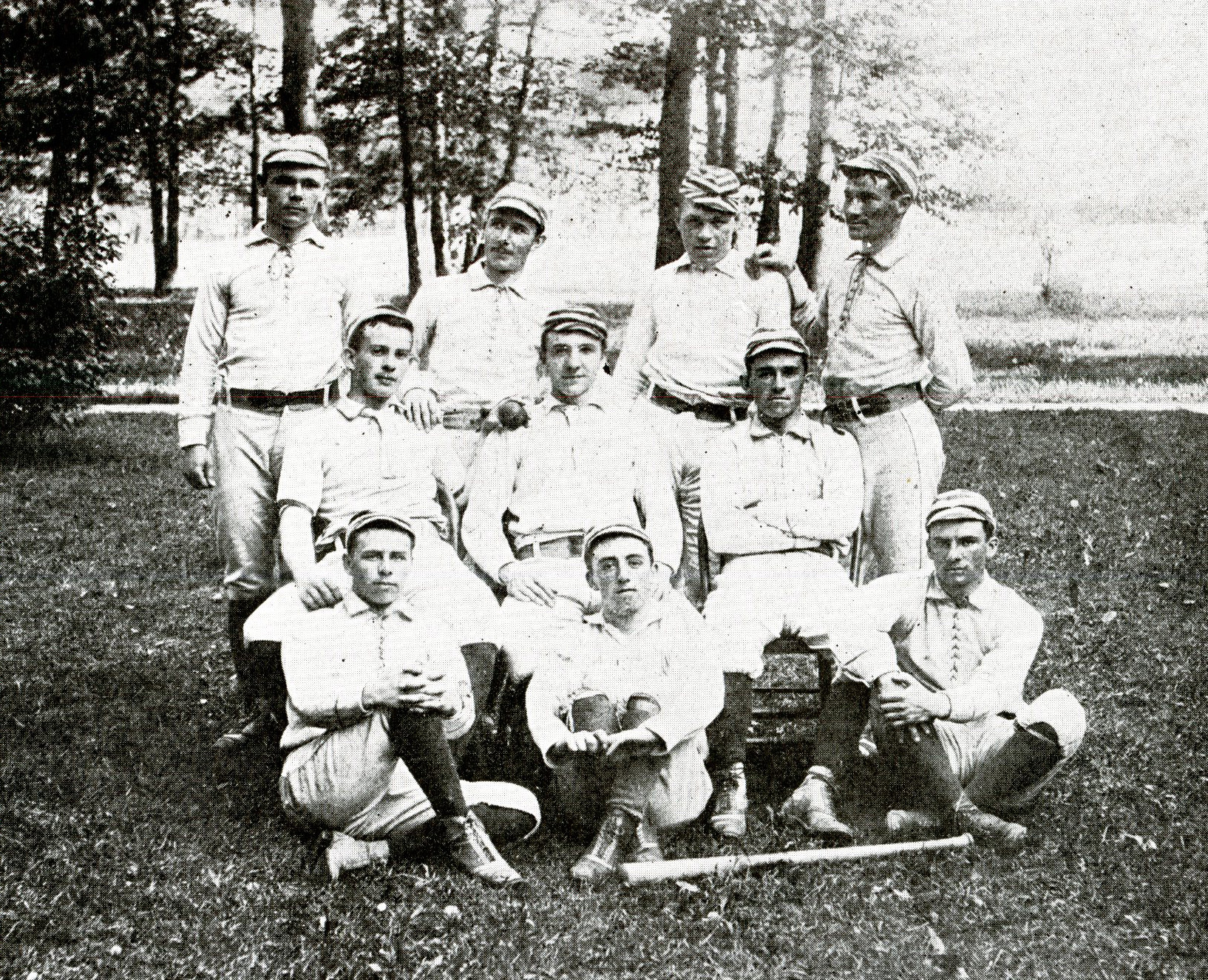
Beyond the classroom, Robinson played baseball for the Seton Hall nine also commonly known in that age as the Alerts which began as a popular sport on campus during the late 1860s and engaged in more formal play the following decade. According to existing documentation they played local teams mainly their arch-rivals St. John’s College (now known as Fordham) of the Bronx during the 1873 season. The main highlight of his time was a defeat of St. John’s 24-13 during October of that year which carried the squad into the following campaign where they would play the same opponent twice more. Robinson would be among the pioneer players for the team that would grow in competitiveness and success over subsequent seasons.
One of the earliest photographs of Seton Hall College’s baseball team, The Alerts, taken in the early 1890s.
John Erigena Robinson was the son of William Erigena Robinson, a congressman and a journalist whose political career is mentioned several times in the diary. Robinson must have been inspired by his father’s journalistic pursuits, because he writes in the diary about his desire to start a student newspaper for Seton Hall College. On January 26, 1873 he wrote:
“To start a paper. How, when, and where? These were the things that occupied me during the day and I may add during the night as I went to bed and fell asleep with visions of shears scraps and papers flying here and there. If we can only get the permission of Malley who owns a press and of Dr. Corrigan who heads the College we are all right. We have fixed the name it is the Setonian. We have got the outline and the matter for each page and now for the permission of the two worthies who at least in this case have a great case in hand!”
Unfortunately, Robinson never realized his dream of starting The Setonian. A full explanation is never given in the diary, but on February 14, 1873 he laments that his plans will not come to fruition:
“George and Bill received a valentine today. I also received one. It had a picture of an editor on it and some ridiculous rhyming lines beneath it. It was sent to me as it had got around that I was going to start a paper in the college. Alas, the poor ‘Setonian’ is but a dream of the past.”
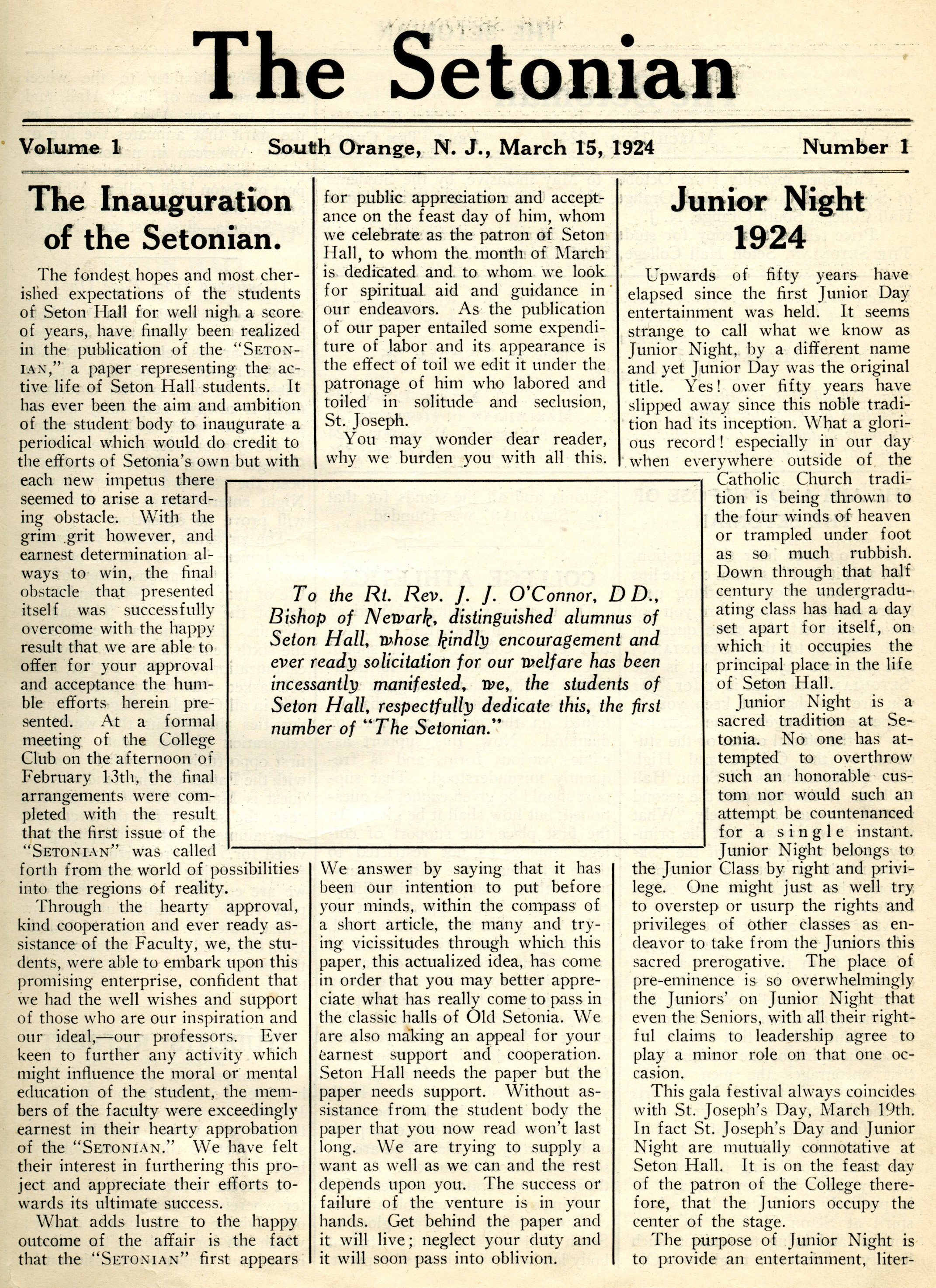
The reasons why Robinson was not able to start a college newspaper are unknown, but fortunately for Seton Hall it was not completely “a dream of the past” but simply deferred. A college newspaper was eventually founded in 1924—51 years after Robinson’s plans and with the same name he proposed, The Setonian.
The first issue of the Setonian was released on March 15, 1924, 51 years after Robinson’s initial attempt to start a newspaper for Seton Hall College.
After graduation, Robinson returned home to Brooklyn and filled his days by playing baseball and meeting with friends. When the school year re-commences and he does not return to Seton Hall, he muses in his diary:
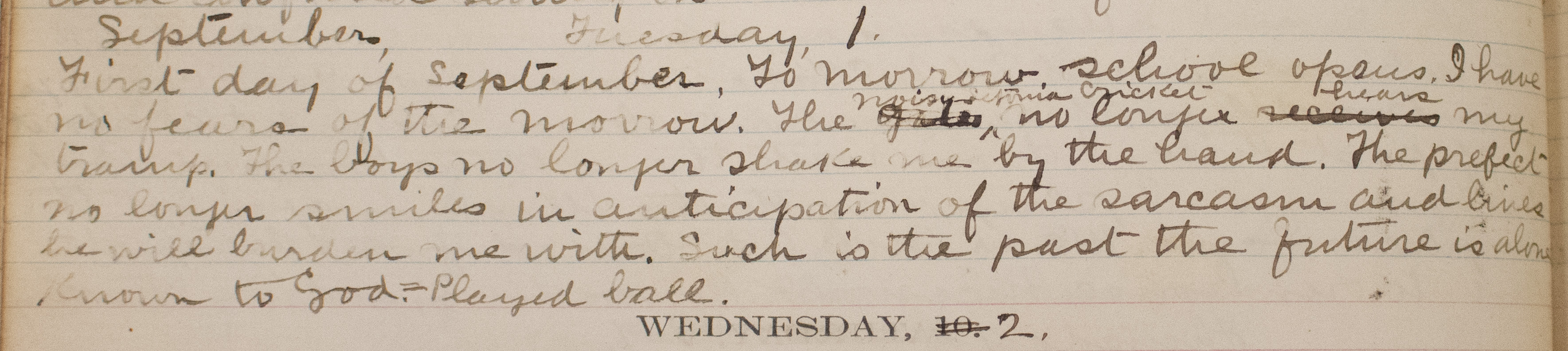
“First day of September. Tomorrow school opens. I have no fears of the morrow. The noisy Setonia cricket no longer hears my tramp. The boys no longer shake me by the hand. The prefect no longer smiles in anticipation of the sarcasm and the lines he will burden me with. Such is the past. The future is alone known to God. Played ball.”
Handwritten entry in Robinson’s diary reflecting on Seton Hall College
Like many Seton Hall students, Robinson felt a connection to the College that extended well beyond his graduation, and further diary entries indicate that he remains aware of what is happening there and stays in touch with friends he met in school. His diary provides insight into the ways that student life has changed over the years, but also ways it has remained the same. To read the whole diary and learn more about the context of Robinson’s life, please visit our digital exhibit. For more information or to view the diary please make an appointment with Brianna LoSardo or Alan Delozier. We can be contacted at archives@shu.edu or (973)-761-9476.
In honor of Women’s History Month, the Archives & Special Collections Center is proud to present an exhibit that honors some pioneering female professionals who made a difference in the building of a stronger administrative and educational institution over the last several decades on campus.
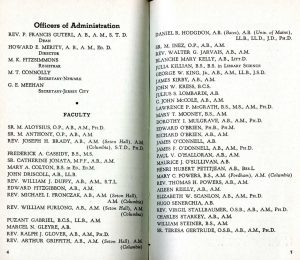
List of First Female Faculty at the Urban Division of Seton Hall College (1937)
The varied contributions made by women in the annals of Setonia have always been significant from her earliest days forward. A portent of success was found when Mme. Chegary, a successful school mistress sold her academy to the Diocese of Newark in 1856 on land in Madison that served as the first home of Seton Hall.
Upon establishment of the school, the work of the Sisters of Charity was enlisted to provide spiritual leadership and nursing care and supervision of the infirmary during the 19th century. The mothers of the all-male Seton Hall student body also provided a strong influence as role models and support for their college-bound sons. The accomplishments of women during the early years of Seton Hall was rarely documented and mostly done in the shadows, but their varied and valuable contributions cannot be denied.
When it came to individual females who began the trend of administrative leadership on campus, Ms. Marie K. Fitzsimmons began her affiliation with Seton Hall as the College Registrar in 1928 and lasted through most of the 1950s. Her work defined who would ultimately attend Setonia and she also oversaw the dawn of co-education when women were first admitted to the Urban Division of Seton Hall (Newark and Jersey City) in 1937.
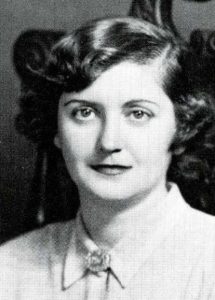
Marie K. Fitzsimmons (Registrar)
This move towards admitting female students also paved the way for the first women faculty (either adjunct or full-time) members. This included a number of subject experts including – Sr. M. Aloysius, O.P., Ph.D. (Psychology); Sr. M. Anthony, O.P., A.M. (Education); Sr. Catherine Jonata, M.P.F. (Modern Languages), A.M.; Mary A. Colton, LL.B. (Law); Sr. M. Ines, O.P., A.M. (English); Blanche Mary Kelly, Litt.D. (English); Julia Killian, B.S. (Library Science); Mary T. Mooney, A.M (Sociology).; Dorothy I. Mulgrave, Ph.D. (English); Mary C. Powers, A.M. (English & History/Social Studies); Aileen Reilly, A.M. (English); Elizabeth Scanlon, Ph.D. (Education); and Sr. Teresa Gertrude, O.S.B., Ph.D. (Education). Complimenting this roster of instructors was Ms. Rita Murphy who became first head of an information center when she became Director of the Urban Division Library during the 1938 academic year.
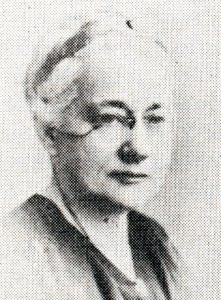
Blanche Mary Kelly, Litt.D. (English)
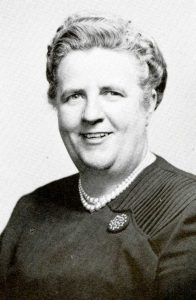
Mary C. Powers, A.M. (English & History/Social Studies)
Leadership opportunities arose shortly afterwards when Professor Anne E. Murphy, B.A., B.S. was named as the first Dean of Nursing. She became the first-ever female department head at Seton Hall in 1940. Her example led the way to the hire of other professional women who continuously led the School of Nursing in succession to the present day. Other milestones initiated across campus included creation of the Dean of Women positon first held by Ms. Ruth Dugan, A.M. during the early 1950s.
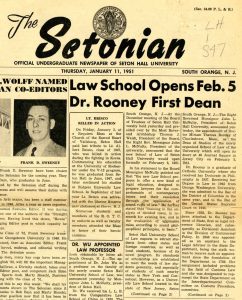
When it came to national recognition, Seton Hall instituted its Law School in 1951 and school administration selected Miriam T. Rooney, LL.B. as the inaugural Dean who served in this capacity until her retirement in 1959.
Eventually more women served as key managers, faculty, vice presidents, deans, trustees, and within the last few years assumed top positions within the administration. Provost and Executive Vice President, Karen Boroff, Ph.D. and Acting University President appointed in 2016 and Mary Meehan, Ph.D. named in 2017 who serve in their respective capacities have made history and continue to blaze trails in the process.
Examples from our collection will be on exhibit from February through May of 2019 in the First Floor foyer of Walsh Library located across from the stairs and elevator.
For additional background and more information on this topic and other aspects of Seton Hall please feel free to contact University Archivist, Alan Delozier at: alan.delozier@shu.edu or by phone: (973) 275-2378.


 List of First Female Faculty at the Urban Division of Seton Hall College (1937)