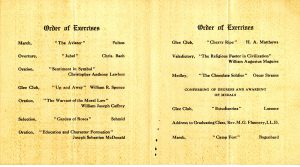
Honoring Humanistic Studies at Setonia

December is recognized as Universal Human Rights Month across the planet and this is a focus of study that has been particularly evident on the Seton Hall campus over the last several decades. Promoting the study of Social Sciences in the name of Humanities has been an intellectual-centered staple of the school curriculum and examples have been preserved within our repository showing its development from founding date to the present day.

During the 1960s under the sponsorship of University President, Bishop John Dougherty, the creation of a specialized Humanistic Studies program was one of the highlights of his tenure. His efforts along with the deans and professors on campus during this time helped to enhance the learning experience with specific course offerings that allowed the student body to explore the wide-ranging accomplishments of human endeavor in a more structured manner than ever before.
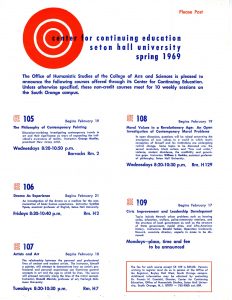
Humanities Program Course Listing – Spring 1969 Semester

The following abstract provides an overview of this seminal program during the 1969-70 academic year. “The purpose of the Office of Humanistic Studies is the development of a contemporary educational vehicle whose chief feature is to probe the humanistic dimension of knowledge and to communicate data whose significance points beyond the narrow confines of the specialist.  As the occasion demands, the Office offers courses in those ‘boundary’ areas which do not fall within the competence of any given department.”

Additionally, the specific course offerings in this area included the following class titles: Humanist Dimension of the Sciences, The Phenomenon of Woman, The Contemporary Dialogue Between Christians and Marxists, The Meaning of Aspiration, Psychotheology, Perspectives in Mind Expansion, The Psychology of Creative Writing, Music in Human Experience, Religion and the American Experience, Films and Their Philosophical Implications: A Revolution in Consciousness, The Revolution of Color in the Afro-Asian World.
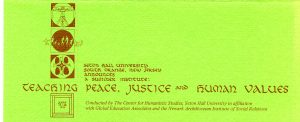
Humanities Promotional Flyer – 1974

For those who qualified for the Humanities Honors Program, this was another high point of educational opportunity that benefited those who engaged in higher level study. This sequence included the following course titles: “The Humanities Honors Program offers the specially qualified student the opportunity to cut across the subject areas of the liberal arts curriculum and to undertake an interdepartmental program of integrated studies in the Western tradition from ancient times to the 20th century as reflected in history, literature (discursive and imaginative), and the arts. The courses are organized on the principle that some sense of the interdependence of the various human disciplines assures the most meaningful command of each of them. While the lecture method is retained to provide the students with the necessary direction, the emphasis in the program is on intensive reading, discussion, independent research, and co-related project work in the humanities.”

The course titles integrated within the Honors sequence included the following: Ancient Studies, Medieval and Renaissance Studies, Modern Studies, Non-Western Humanities, Philosophy and Drama, Contemporary Russian Culture, Literature and Psychology.

Additionally, the University has been active in the promotion of Human Rights and various statements have been drafted and issued over the the years are also retained for posterity.
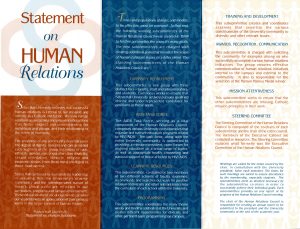
Statement on Human Relations, c. 2000

The tradition of course offerings in the humanities has moved forward as subsequent semesters has yielded courses and students who have learned from the varied classes offered. Programs and course descriptions can be found via our Vertical Files and Catalog(ue)/Bulletins along with specific listings outlined within our ArchivesSpace catalog found via the following link: https://archivesspace-library.shu.edu/search?utf8=%E2%9C%93&op%5B%5D=&q%5B%5D=Humanities&commit=&field%5B%5D=&from_year%5B%5D=&to_year%5B%5D=

For more information on Humanities along with all aspects of Seton Hall University History, please contact via e-mail at: archives@shu.edu or by phone at: (973) 275-2378.
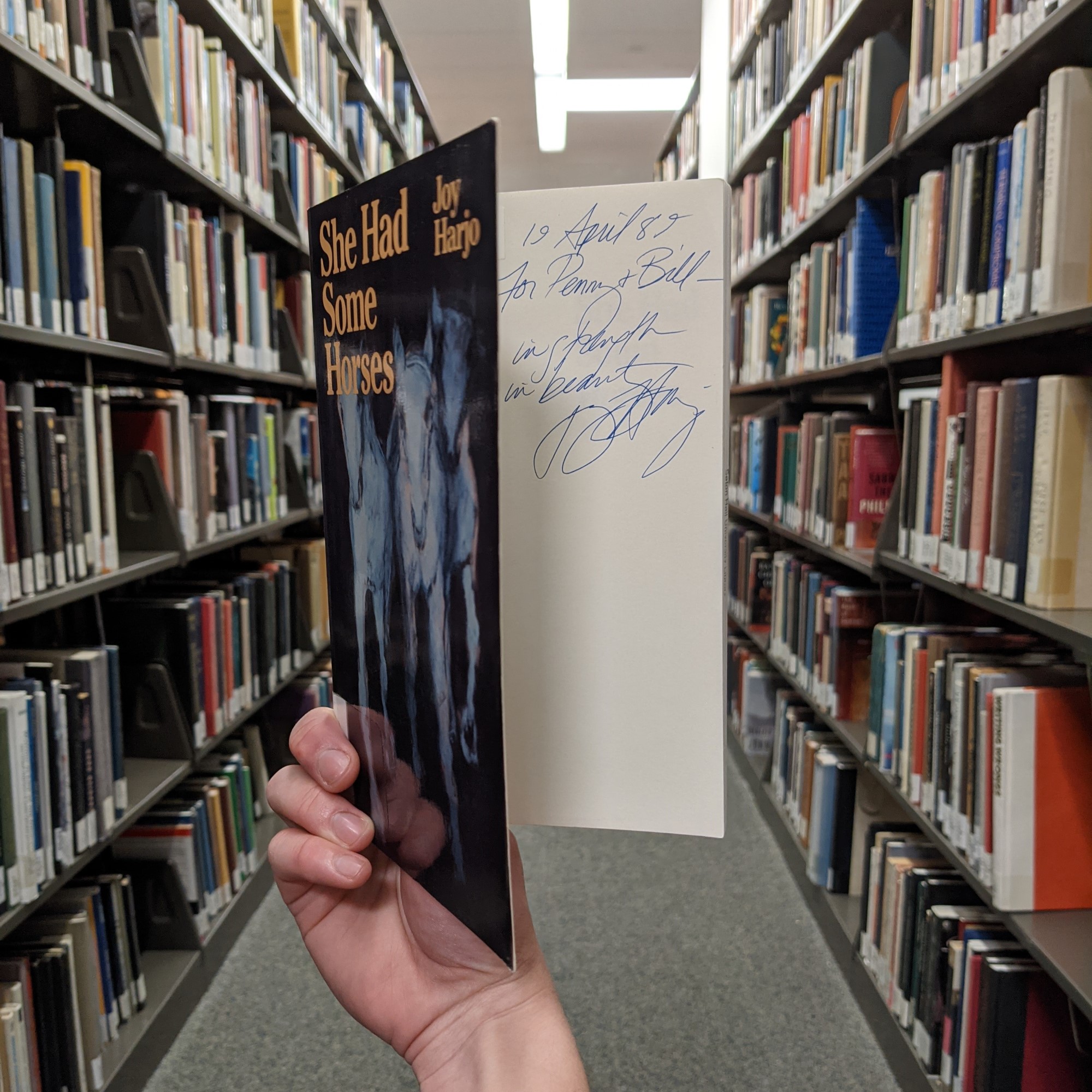
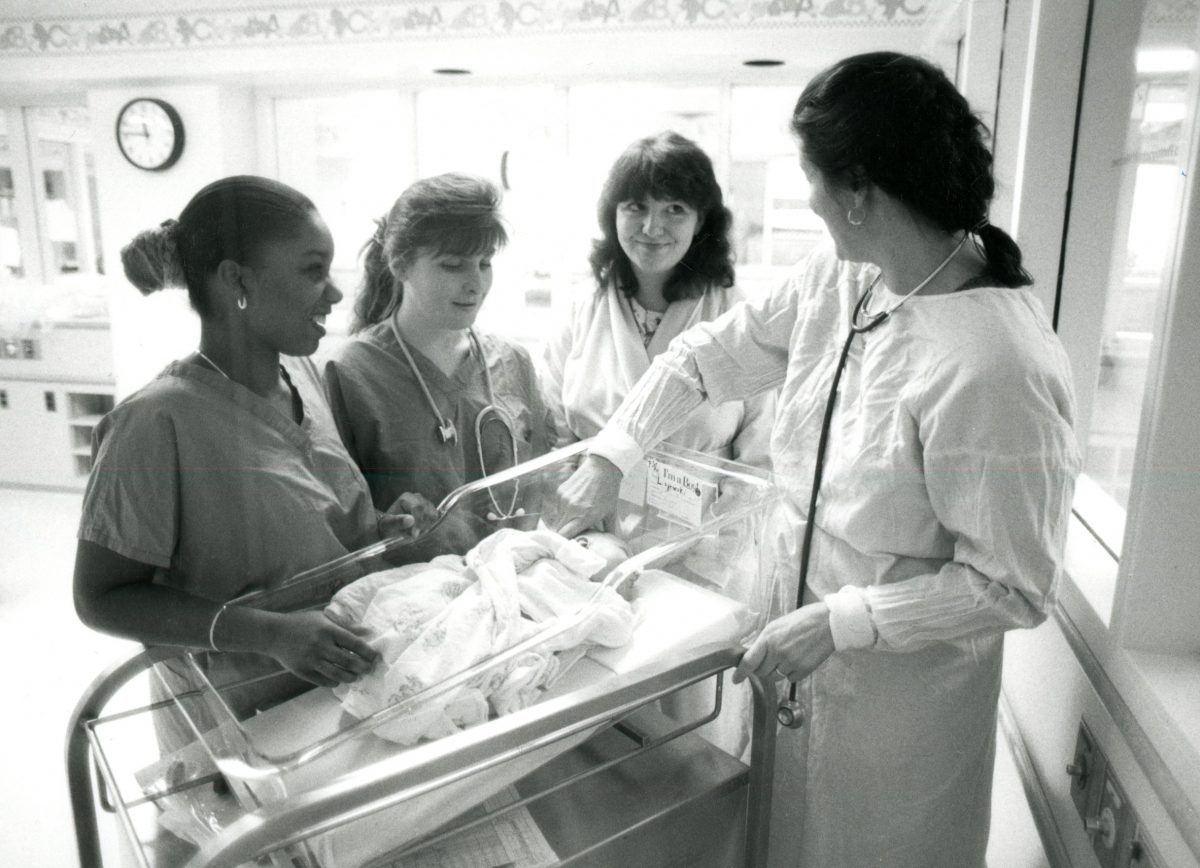
Native American Poet Laureate Joy Harjo

Image of inscribed book by Joy Harjo
Inscribed copy of She Had Some Horses by Joy Harjo in Walsh Library

Did you know that Seton Hall’s rare book collection contains poetry by Native American authors?  There is an inscribed copy of one of the early books of the first Native American Poet Laureate of the United States, Joy Harjo, in Walsh Library’s Rare Book collection.  The inscription reads “for Penny and Bill, in strength and in beauty.”  This refers to William Higginson and his wife, who founded From Here Press in Patterson, New Jersey.  Higginson, a specialist in haiku, donated his incredible collection of poetry books to Seton Hall in 2013.

An alto saxophonist and artist as well as poet, Harjo breaks boundaries in many aspects of her work.  Influenced by jazz and blues as well as by her Cree heritage and poetic predecessors such as Audre Lorde, Harjo’s poetry reflects on loss, survival, and the limitations of language itself.

Learn more about her work and her life.

November Eve in Celtic Lore

November Eve

November Eve, or Samhain, celebrates the Moon, the end of the harvest season, and the beginning of winter. And like other holidays that celebrate the change of the seasons with great bonfires, fairs, and festivals, so does November Eve.

Like many Celtic holidays have a Christian counterpart celebrated on or around the same day, so does November Eve. It is known as All Saints’ Day and All Souls’ Day. All Saints’ Day is a day to celebrate all saints known and unknown while All Souls’ Day is to remember all others that have passed on. Typically, families will visit cemeteries and graves, bringing flowers, candles and prayers or blessings. Just like Halloween and the Day of the Dead, All Saints’ Day and All Souls’ Day remember the dead.

And like Halloween and the Day of the Dead, November Eve is the “one night of the year when the dead can leave their graves and dance in the moonlight on the hill” (Wilde, 80). However, it is said “mortals should stay at home and never dare to look on them” (Wilde, 80).

One such gives caution, states:

“It is esteemed a very wrong thing amongst the islanders to be about on November Eve, minding any business, for the fairies have their flitting then, and do not like to be seen or watched; and all the spirits come to meet them and help them. But mortal people should keep at home, or they will suffer for it; for the souls of the dead have power over all things on that one night of the year; and they hold a festival with the fairies, and drink red wine from the fairy cups, and dance to fairy music till the moon goes down” (Wilde, 78).

Being the 21st century staying home no longer applies! Kids, after carving their Jack-O’-the-Lantern into a frightful face, dress up to trick-or-treat and adults, also in costume, go off to parties to celebrate and bob for apples. Ever wonder how the Jack-O’-the-Lantern came to be? Or how apples and Halloween became a famous couple?

An Irish tale from Irish Fireside Stories contains an explanation for the Legend of the Jack o the Lantern. After having been excluded from heaven and having tricked the devil making Hell refuse to take him, it was decreed that Jack would walk the Earth with a lantern to light him on his nightly way until Judgement Day.

As for apples and Halloween, an old Celtic ritual has an explanation:

“The first day of November was dedicated to the spirit of fruits and seeds, from which, no doubt, originated the custom of eating nuts and apples on Hallow Eve. It was called La-mas-abhal, the day of apple fruit. This word, pronounced Lamabhool, was corrupted by English settlers into lamb’swool, which name was given to a drink made of apples, sugar and ale. So the apples are still eaten on All-Hallow’s Eve by the merry company in the farmhouse kitchen in Ireland, and the young Irish girls will peel one carefully, taking care to keep the skin whole, which, when cast over the shoulder upon the floor, will fall into the form of the initial letter of her future husband’s name. Or she will take nuts piled so plentifully upon the table and burn them on the grate-bar or the hearth and try to read her future in their ashes, while her companions are setting nuts in pairs together in the same place, naming them carefully, and watching to see whether they will burn pleasantly together or jump apart” (Blennerhassett, 233-234).

The article continues to mention further steps to be taken over the course of finding out information about one’s future husband and the role of apples in this process but as with all love fortune telling, spells, and the like, it is a lengthy process that requires far too much effort and too much typing for one blog post on a day of festivities. So, I’ll leave it here and wish you all a Happy Halloween!

Good luck bobbing for apples! And remember all spells cast on November Eve come true.


Reference

Blennerhassett, Sarah (1899 November). All-Hallow’s Eve. The Gael.

Wilde, & Wilde, W. R. (1919). Ancient legends, mystic charms & superstitions of ireland : with sketches of the irish past. Chatto & Windus.

For the online version, click here. Please note they may not be exactly the same.

Honoring Nurses from Setonia & Contributions to Society

The nursing profession has always been among the most respected careers in light of their selfless dedication to the health and welfare of patients in their care.  October 13th has been designated “National Emergency Room Nurses Day” throughout the United States in honor of those who work in situations that require added patience and attention to those in need. Seton Hall has been a proud training ground for many nurses who have chosen to serve society upon graduation from the school.

Seton Hall College Nursing Education Catalog(ue)/Bulletin Cover, 1940

Seton Hall established its College of Nursing in 1940 and from the starting Points of Purpose included the following objectives . . .

The aim of the School of Nursing Education of Seton Hall College is to provide educational opportunities leading to the degree of Bachelor of Science in Nursing education for the following types of students:

  1. Graduate nurses who wish to prepare for positions as teachers, supervisors and administrators in schools of nursing and hospitals.
  2. Nurses particularly interested in Public Health Service.
  3. Properly qualified high school graduates who wish to entre the nursing profession.
  4. Hospital administrators or those preparing for such positions.

From that point forward quality instruction by dedicated professionals too numerous to name here, but whose names and course information can be found within our holdings.  Presently, we have been working with a valued Nursing History Committee which has provided incredible support to the Monsignor William Noé Field Archives & Special Collections Center over the last few years.  This includes Professor Jane Dellert, Professor Eileen Donnelly, Professor Ann Elkas, Professor Gloria Essoka, Professor Margaret Howard, Professor Carolyn Rummel, Professor Mary Ann Scharf, and Professor Mary Ann Whiteman in particular.

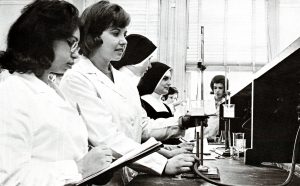
Nursing Students in Biology Laboratory, c. 1966

Each of these scholars has also collaborated to the creation and content management associated with a special Research Guide dedicated to the History of the Nursing Program at Seton Hall University that can be accessed via the following link . . .

https://library.shu.edu/University_History/Nursing

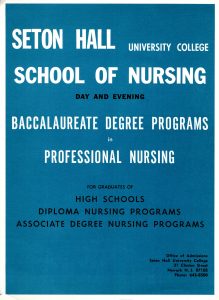
Nursing Program Promotional Booklet Cover, c. 1962

Additionally, the following print resources are presently available for research view by appointment found via our ArchivesSpace holdings site  . . .

https://archivesspace-library.shu.edu/search?utf8=%E2%9C%93&op%5B%5D=&q%5B%5D=Nursing&commit=&field%5B%5D=&from_year%5B%5D=&to_year%5B%5D=

For more information about the College of Nursing and other aspects of University History please feel free to contact us via e-mail: archives@shu.edu or by phone at: (973) 761-9476

“We Remember” Seton Hall & 9-11

As we reflect on the twentieth anniversary of the tragic events that occurred on September 11, 2001, the historical record is deep and reflects upon the many ranges of emotion for those who lived through that day and subsequent generations who are just now learning about its prevailing effects both past and present.  When it comes to the legacy of 9-11 and learning more about the varied issues in published form that connect to this period, the educational benefit is considerable.

The Front page of The Setonian, 13 September 2001

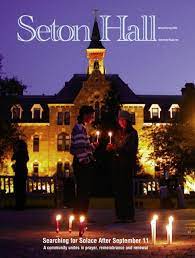
Resources preserved inside the Monsignor William Noé Field Archives & Special Collections Center, the resources found mainly reflect on the student, alumni, and administrative perspective.  For example, within the pages of The Setonian published right after 9-11 there are several articles that explore not only the basics of the attack on the World Trade Center, but also on a local level in salute to both the victims and heroes who had connections to the school.  Additional articles appeared in the Seton Hall University Magazine and other communiqués produced campus-wide during this time and in subsequent years to mark the occasion.

Additional information can also be referenced within the many articles and books that have been penned about the subject found in our Rare Book and the University Libraries Main Collections.  Special copies of the Thomas L. Friedman volume entitled: Longitudes and Attitudes: Exploring the World After September 11. (New York: Farrar, Strauss, and Giroux, 2002) and Superpower Syndrome: America’s Apocalyptic Confrontation With the World. (New York: Thunder’s Mouth Press/Nation Books, 2003) are found in our Special Collections Center.  Other volumes include a work by former Writer-In-Residence Anthony De Palma whose work” City of Dust: Illness, Arrogance, and 9/11. (Upper Saddle River, NJ: FT Press, 2011) is included with many other titles found via our SetonCat bibliographical system.  Various print materials under the Library of Congress subject heading: “September 11 Terrorist Attacks, 2001” can be referenced via our homepage found within this site – https://library.shu.edu/home

When it comes to our Manuscript Collections, the Honorable Donald M. Payne Papers features a detailed file on September 11th from a U.S. Congressional standpoint. More information on the collection proper can be found via the following link – https://archivesspace-library.shu.edu/repositories/2/archival_objects/34116  Other documentation and resources from different entities and Catholic New Jersey-centered outlets in particular are also available to our research community on many levels.

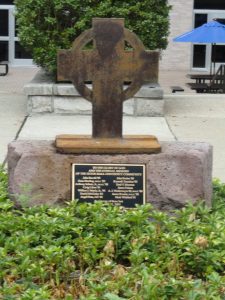
Memorial Cross and Register of Deceased from 9-11 located in front of Boland Hall, Seton Hall University

The Seton Hall University Homepage also includes a number of different resources that commemorate the aftermath of 9-11 over the past decades along with other significant pages that touch upon this anniversary. A corresponding list of individual site links can be found here – https://www.shu.edu/search.cfm?q=9%2F11#gsc.tab=0&gsc.q=9%2F11&gsc.page=1

For more information related to any aspect related to 9-11 please feel free contact us via e-mail at: archives@shu.edu or by phone at: (973) 275-2378.
St. John’s Eve and Midsummer in Celtic Lore

In Ireland, the holiday of Midsummer marks the middle of summer and comes just a few days after the Summer Solstice. Much of the celebration takes place the evening before on Midsummer’s Eve, also known as St. John’s Eve. As with many Celtic celebrations, great bonfires are lit, and fairs and festivals are held to celebrate. Just like May Day, St. John’s Eve has its own stories, customs, and superstitions.

“In ancient times the sacred fire was lighted with great ceremony on Midsummer Eve; and on that night all the people of the adjacent country kept fixed watch on the western promontory of Howth, and the moment the first flash was seen from that spot the fact of ignition was announced with wild cries and cheers repeated from village to village, when all the local fires began to blaze, and Ireland was circled by a cordon of flame rising up from every hill” (Wilde, 113).

It was also a time to worship the Goddess Áine.

“…Áine, who gave her name to Knockainy hill and village in the county Limerick. She ruled, and still rules, that district as fairy queen and banshee. In the second century of our era, she cut off the ear of Ailill Oluim, King of Munster. It was on this account he was called Oluim, from “o”, and ear, and “lom”, bare; bare of one ear” (Mahon, 137).

“Aynia, deemed the most powerful fairy in Ulster, and Áine, queen of South Munster, are perhaps the same person, the mysterious and awful goddess once adored as Anu, or Danu. Of the two, it is Áine who especially seems to carry on the traditions of the older Anu, worshipped, according to the “Choice of Names”, in Munster as a goddess of prosperity and abundance. Within living memory, she was propitiated by a magical ritual upon every Saint John’s Eve, to ensure fertility during the coming year. The villagers round her sidh of Cnoc Aine (Knockainy) carried burning bunches of hay or straw upon poles to the top of the hill, and thence dispersed among the fields, waving these torches over the crops and cattle. The fairy, or goddess was held to be friendly, and, indeed, more than friendly, to men” (Squire, 245).

Another tale tells the story of a St. John’s Night were a number of girls stayed late on the Hill to watch the clairs (torches) and join in the games when suddenly “Áine appeared among them, thanked them for the honour they had done her, but said she now wished them to go home, as they wanted the hill to themselves” (Rolleston, 128).

Since “fire is the holiest of all things” many customs and superstitions surround the bonfire and included carrying off a coal, jumping and leaping through the flames forward and backwards a certain number of times, and walking “three times round a fire on St. John’s Eve, and you will be safe from disease for all that year” (Wilde, 211). These customs and superstitions were not just limited to people but could include animals. Cattle were “driven through the half-extinguished bonfire, as a preventive against witchcraft” (W. R. Wilde, 40).

As Christianity spread and Midsummer became “christianized”, dedicated by the Church to honor St. John the Baptist, certain customs and superstitions survived (O’Súilleabháin, 322). “…Baal fires were kindled as part of the ritual of sun-worship, though now they are lit in honour of St. John. The great bonfire of the year is still made on St. John’s Eve, when all the people dance round it, and every young man takes a lighted brand from the pile to bring home with him for good luck to the house” (Wilde, 113). Whether Celtic or Christian, fire was still seen as a central part of the celebration, bringing good luck just like the fires of May Day did.


Reference

O’Súilleabháin Seán. (1942). A handbook of irish folklore.

No online version available.

Wilde, & Wilde, W. R. (1919). Ancient legends, mystic charms & superstitions of ireland : with sketches of the irish past. Chatto & Windus.

For the online version, click here. Please note they may not be exactly the same.

Putzi, S. (Ed.). (2008). To z world superstitions & folklore : 175 countries – spirit worship, curses, mystical characters, folk tales, burial and the dead, animals, food, marriage, good luck, and more. ProQuest Ebook Central https://ebookcentral.proquest.com

Wilde, W. R. (1852). Irish popular superstitions. J. McGlashan.

No online version available.

Mahon, M. P. (1919). Ireland’s fairy lore. T.J. Flynn.

For an online version, click here. Please note they may not be exactly the same.

Squire, C. (191AD). Celtic myth & legend, poetry & romance. Gresham Pub.

For the online version, click here. Please note they may not be exactly the same.

Rolleston, T. W. (1911). Myths & legends of the celtic race. G.G. Harrap.

For an online version, click here. Please note they may not be exactly the same.

Object of the Week: Benin Courtier

CELEBRATING JUNETEENTH

Juneteenth commemorates June 19, 1865, the day federal troops led by General Gordon Granger arrived in Galveston, Texas to inform Texans that all enslaved people were now free. Their arrival came two and a half years after the Emancipation Proclamation was issued by President Abraham Lincoln on January 1, 1863, which freed all enslaved people in Confederate states. Slavery continued in Texas during the Civil War since there was not any large-scale fighting as well as a lack of Union troops. Many slave owners even moved to Texas during that time.[1] Upon General Granger’s arrival in Galveston, there were 250,000 enslaved people in Texas.[2] Slavery was formally abolished in the United States with the ratification of the 13th Amendment in December 1865. Juneteenth, a combination of “June” and “19th,” is the oldest known celebration commemorating the end of slavery in the United States.[3] While Juneteenth celebrations originated in Texas, which was also the first state to make it an official holiday, 47 states and Washington D.C. recognize it as a state holiday today and there is a push to make it a federal holiday as well.

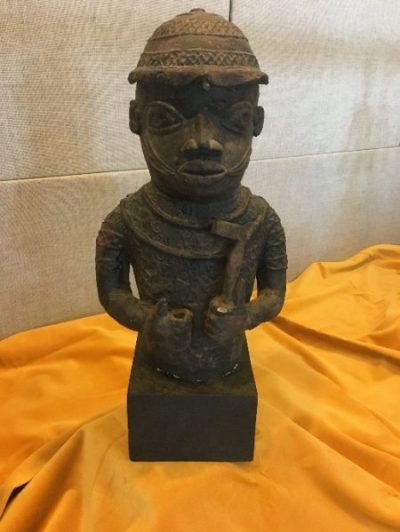
Small reproduction statue of a Benin Courtier from the waist up
Benin Courtier (reproduction), Seton Hall University Teaching Collection, T2017.01.0016

In recognition of Juneteenth, the Walsh Gallery has created a teaching collection from a subset of the Seton Hall Museum of Anthropology and Archaeology Collection (SHUMAA). It is a vast collection of art and artifacts compiled by former Seton Hall Professor Herbert Kraft from a variety of world cultures. This collection in particular consists of sculptures and masks from places such as Mali, Guinea, Burkina Faso, Senegal, Nigeria, and Ghana in addition to many other countries and cultures. The statue featured above is a Benin courtier serving as an emissary to the Oba, or king, of Benin from the Ooni of Ife, the monarch of the Yoruba people. The original sculpture was cast in bronze. The Kingdom of Benin (which is different from the present-day nation state of the same name), also known as the Edo Kingdom or the Benin Empire, existed from around the 11th century CE until 1897. The kingdom was located in West Africa in what is now Nigeria. This statue, along with two other pieces from the collection, are currently on view in the window display in the Walsh Library Rotunda on the second floor. Make sure to take a look! Materials in the Teaching Collection can be utilized by students and faculty for research projects and classroom learning for object-based projects. To check out these objects, contact the Walsh Gallery at walshgallery@shu.edu or by phone at 973-275-2033.


[1] https://www.history.com/news/what-is-juneteenth, accessed 6/11/21.

[2] https://nmaahc.si.edu/blog-post/historical-legacy-juneteenth, accessed 6/11/21.

[3] https://www.archives.gov/news/articles/juneteenth-original-document, accessed 6/11/21.

Object of the Week: “Immaculate Conception Seminary in Winter” by Edwin Havas

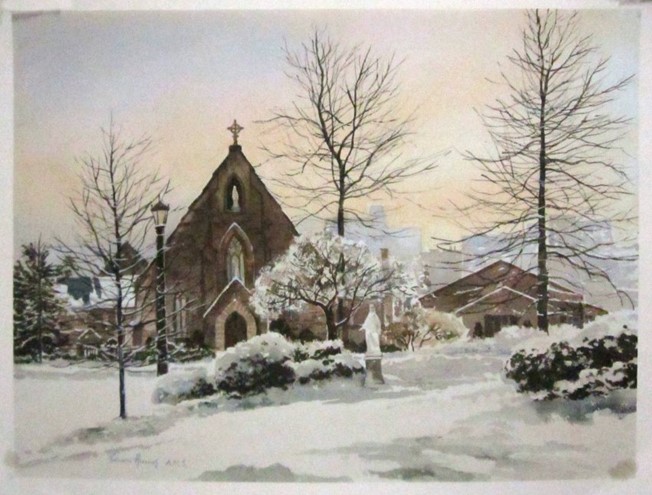
Edwin Havas
Immaculate Conception Seminary in Winter
watercolor on paper
1992
2016.11.0001
Courtesy of the Walsh Gallery


IMMACULATE CONCEPTION CHAPEL

On May 21,1863, the cornerstone of the Immaculate Conception Chapel was laid by Bishop James Roosevelt Bayley – the first Bishop of the Archdiocese of Newark – and nephew to Seton Hall University’s namesake, Saint Elizabeth Ann Seton.[1]  The chapel, designed by architect Jeremiah O’Rourke of O’Rourke & Moran, was dedicated seven years later in 1870.  O’Rourke, who immigrated from Ireland, was known in America for his design of Roman Catholic churches and institutions such as hospitals and post offices.  He designed the Cathedral Basilica of Newark, the fifth largest cathedral in North America and seat of the Archdiocese of Newark, as well as President’s Hall on the Seton Hall campus.[2]  Both the Immaculate Conception Chapel and President’s Hall are examples of Gothic Revival architecture, the preeminent style for Roman Catholic churches of the period which features pointed arches, narrow windows and elaborately carved details.[3]

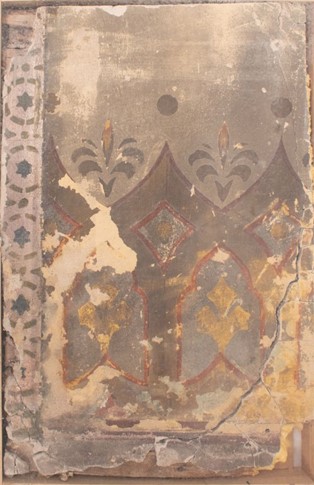
Design with red, blue, green, and white
plaster wall fragment attributed to E. Erbe
c. 1870
2016.08.0001
Courtesy of the Walsh Gallery

The Immaculate Conception Chapel’s interior design was completed by J.R. Lamb.  Founded in 1857, J.R. Lamb Studios is the oldest continuously operating stained glass studio in the United States.  Originally located in Greenwich Village, New York, the studio now operates from Midland Park, New Jersey.  They continue to take new commissions as well as restoration work for historic stained glass panels.[4]  This section of plaster was preserved by the facilities staff during one of the many chapel restorations completed over the past 158 years.  The section of decorated plaster is believed to have been painted by E. Erbe, an ‘artist in oil and fresco.’[5] The fragment depicts a red, blue and gold palette with organic motifs and geometric designs typical of the period. It may reveal some of Lamb’s original design for the interior, though we cannot be sure due to lack of documentation at the time and there have been numerous interior renovations since the chapel’s 1870 dedication.[6]

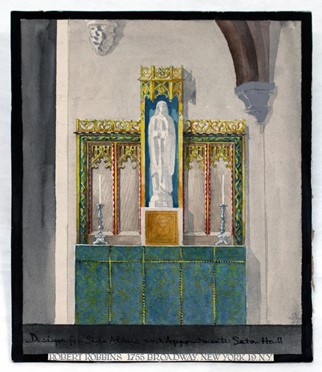
This sketch by Robert Robbins for the proposed design of the side altar

Image with blue and green and a white statue
Robert Robbins
Design for Side Altar and Appointments
Painted sketch on board
1963
2016.03.0002
Courtesy of the Walsh Gallery

dates to the 1963 chapel renovation.  The color scheme from the section of fresco above was repeated in Robbins’ new design, with a blue and gold palette and red accents.  This side altar retains J.R. Lamb’s distinguishing Gothic Revival style with the pointed arches, ornate tracery and trefoil (tri-lobed) details at the top of each arch.  The trefoil is an architectural detail that is also symbolic of the Holy Trinity, fitting for a church design.

Today, the Immaculate Conception Chapel is still considered the heart of Seton Hall University.  Masses are held daily and the chapel is a popular space for weddings.  Since the chapel was built, it has been lovingly restored numerous times, the latest round of updates occurring in 2008.  The chapel contains a shrine to the university’s namesake, Saint Elizabeth Ann Seton, who remains a tangible presence throughout campus, particularly in this sacred space.


The Walsh Gallery has a considerable collection of fine art, artifacts and archeological specimens for use by faculty, students and researchers. For access to this or other objects in our collections, contact us at 973-275-2033 or walshgallery@shu.edu to make a research appointment. 


[1] https://academic.shu.edu/chapel/1863.html, accessed 5/13/2021.

[2] https://en.wikipedia.org/wiki/Jeremiah_O%27Rourke, accessed 5/14/2021.

[3] https://academic.shu.edu/chapel/overview.html, accessed 5/17/2021.

[4] https://lambstudios.com/stained-glass-studios/, accessed 5/17/2021.

[5] https://academic.shu.edu/chapel/1863.html, accessed 5/13/2021.

[6] https://academic.shu.edu/chapel/interior.html, accessed 5/17/2021.

Object of the Week: Portrait of Dr. Wang Fang-yu

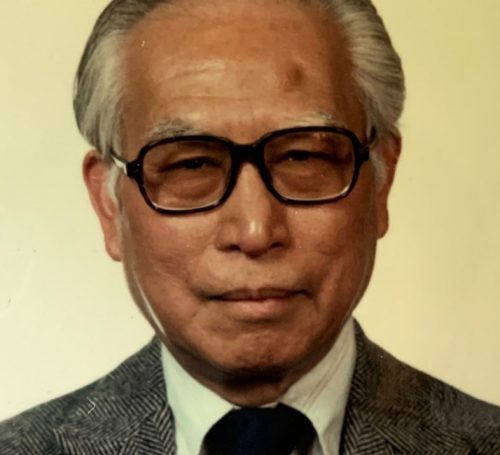
Portrait of Dr. Wang Fang-yu in his later years
c. 1990s

MAY IS AAPI HERITAGE MONTH

               AAPI Heritage Month recognizes the contributions of generations of people of Asian and Pacific Islander descent who have enriched America’s history and been instrumental to the country’s success.  Wang Fang-yu, Professor Emeritus and Chair of the Department of Asian Studies at Seton Hall University serves as an exemplar of this spirit.  Though he passed away almost 25 years ago, his efforts continue to support, promote and positively influence the study of Chinese language in the Asian Studies Program which, for over 50 years, has been recognized for its outstanding faculty and programs.[1]  A pioneer in the teaching of the Mandarin language, he was part of a team which developed the first Chinese language teaching computer system. He also wrote several books and dictionaries on the Chinese language which are available to researchers through the Seton Hall’s Department of Archives and Special Collections.[2]

In addition to establishing new methods for teaching Mandarin, Wang Fang-yu founded and curated a large and distinguished collection of Asian art and artifacts while at Seton Hall University.[3]  Along with Dr. Louis de Crenascol and Barbara (Kaufmann) Cate of the Art Department, Wang worked tirelessly to cultivate donations from some of the most distinguished private collections in the region.  He was often competing with large institutions such as the Freer Gallery in Washington D.C, but he was persuasive, ultimately establishing a collection of hundreds of objects.  The core of the collection consists of painted silk scrolls, ceramics and notable calligraphy pieces and it was the foundation of many exhibitions in the Art Center and other locations on campus prior to the building of the Walsh Gallery in 1994.  The collection includes pieces from Korea, China, Japan, The Philippines and India, as well as other Asian and Pacific Island cultures.

Image of scroll on table with woman inspecting it
“Landscape” Attributed to Chu Ta, aka Bada Shanren, 1699, 77.10.37, Wang Fang-yu Collection of Asian Art, Courtesy of the Walsh Gallery

An accomplished calligrapher in his own right, Wang’s art became the subject of exhibitions at the Walsh Gallery and numerous other venues including the Asian Society, The Newark Museum of Art, The Duke University Art Museum and E & J Frankel Gallery in New York, one of the oldest galleries in the country to specialize in Asian art.[4]   Wang was also an avid collector of artist Bada Shanren, a 17th century Chinese calligrapher and poet.   In the image above you can see Meghan Brady, Collections Assistant at the Walsh Gallery, inspecting and documenting “Landscape”, attributed to Chu Ta, a pseudonym used by the artist.  A recent exhibition at Fu Quimeng Gallery in New York City featured the work of Bada Shanren in tandem with Wang Fang-yu’s art.[5]   The exhibition also included a special section dedicated to Wang Fang-yu’s ground-breaking art authentication system which used computers and comparative analysis techniques borrowed from linguists.  The show, “Authentic or Forgery: How does a Chinese Connoisseur Work?” described how Wang’s use of computers and algorithms was way ahead of the curve in establishing the authorship of artworks.  Wang’s scholarship was further revealed in the display of his manuscripts, photographs and writings.[6]

In a recent interview at Fu Quimeng Gallery, Shao Fang described how his father’s methods of art connoisseurship were not universally accepted when they were first developed in the 1960s.[7]  People were skeptical of computers and his use of lingual theories as applied to art.  Before this time, authentication was the domain of art historians, curators and scholars whose judgments were contingent on visual observations and instincts based on extensive knowledge of a subject.  Wang Fang-yu was deeply appreciative of Seton Hall University’s embrace of his (then) unorthodox methods, which are no longer far outside of mainstream scholarship.

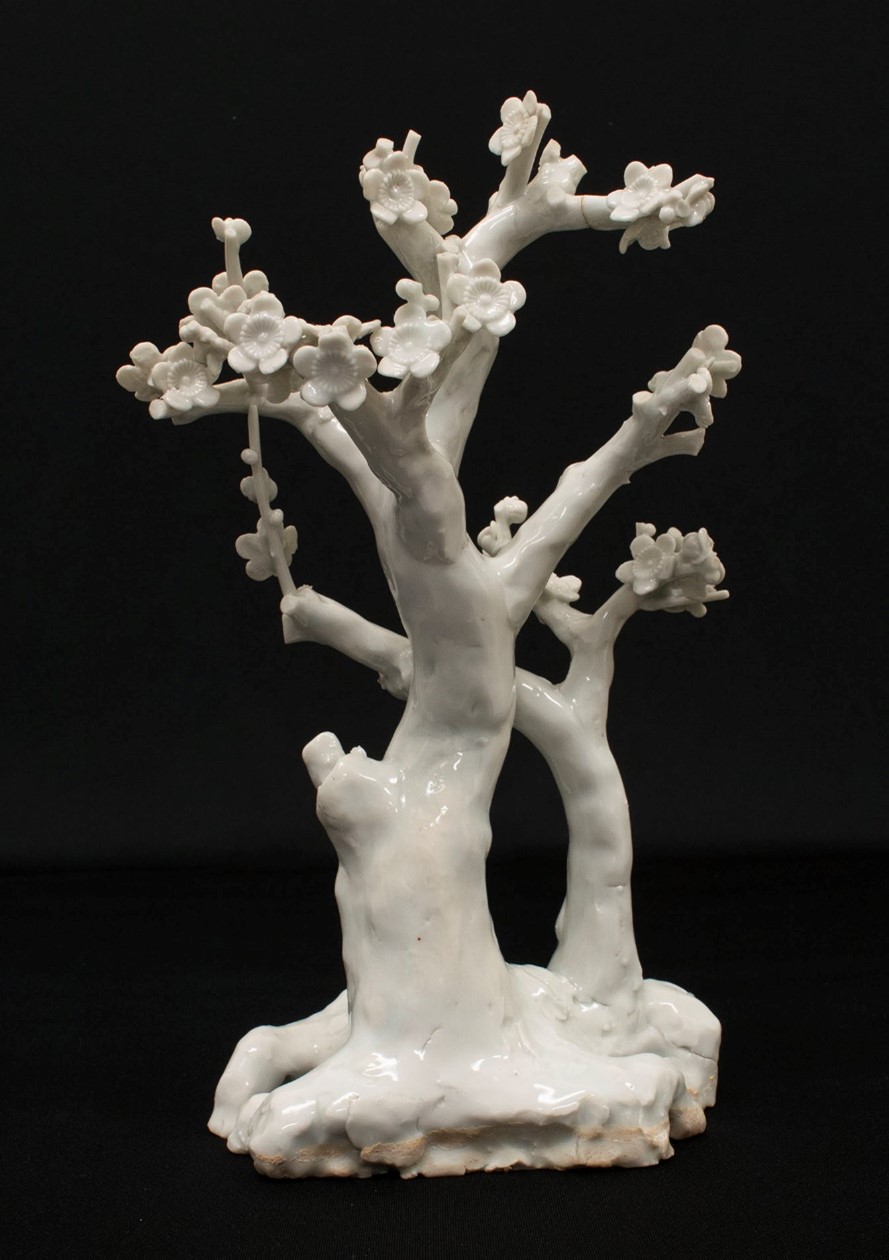
White porcelain prunus tree on black background
Porcelain prunus tree sculpture
Ch’ing Dynasty
Mid to late 18th century China
79.40.10
Wang Fang-yu Collection of Asian Art
Courtesy of the Walsh Gallery

Seton Hall University is celebrating AAPI Heritage Month with a series of events.  Students can vote for their favorite Asian American and Pacific Islander owned business and be entered to win a prize.   The University Libraries has created a virtual display of books to highlight the breadth, culture and creativity of AAPI books, both fiction and non-fiction.  To find other ways to participate, view the May calendar of events at Seton Hall University.


The Walsh Gallery has a considerable collection of fine art, artifacts and archeological specimens for use by faculty, students and researchers. For access to this or other objects in our collections, contact us at 973-275-2033 or walshgallery@shu.edu to make a research appointment. 


[1] https://www.shu.edu/languages-literatures-cultures/asian-studies-languages-literatures-cultures.cfm, accessed 5/10/2021.

[2] https://en.wikipedia.org/wiki/Fred_Fangyu_Wang, accessed 5/10/2021.

[3] Typescript of the “Inventory – Wang Fang-yu Collection of Asian Art” by Dr. Lee de Crenascol, 1976, Walsh Gallery, Seton Hall University, South Orange, NJ, USA.

[4] http://www.allthegalleries.com/dealers/e-j-frankel-2492.html, accessed 5/10/2021.

[5] https://fuqiumeng.com/en/category/artists/fangyu-wang/, accessed 5/10/2021.

[6] https://fuqiumeng.com/en/wangfangyuexhibition/, accessed 5/10/2021.

[7] Shao Fang, gallery talk and interview with Dr. Sarah Ponichtera, Jeanne Brasile and Meghan Brady at Fu Quimeng Gallery, New York, NY, 1/31/2021.

Pomp and Circumstance Zet Forward – Commencement Exercises at Setonia

Graduation Day is a rite of passage for any senior who has fulfilled all coursework requirements necessary to earn a diploma, but this milestone is further seen as both recognition and reward for their dedication to educational achievement.  Traditionally, the annual commencement ceremony is one that is seen as a high point and celebratory event as a capstone for any academic year at Seton Hall.

There is a primary graduation exercise that typically takes place during the month of May, but the experience for each graduate is typically enhanced through related ceremonies sponsored by each individual School and College on campus.  The name of each graduate, their major and degree along with information about the rituals that are observed at each event.  These details are memorialized through the pages of commemorative program booklets are often complimented with invitation cards, event tickets, and other documentation that have made for valuable archival resources that outline these multiple observances for future generations to reference.

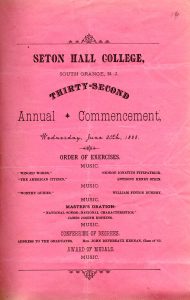
Seton Hall College Commencement Program, 1888

Between the founding date of Setonia in 1856 to the present day, the planning and pageantry of all commencement exercises has a noteworthy history.  Official ceremonies were held during the first few years that the campus was located in Madison through its move to South Orange.  However, it was not until 1862 when the first graduate Mr. Louis Firth started a trend for thousands of other future alumni who would ultimately earn a diploma from Seton Hall.  Printed programs of that era outlined the ceremonial aspects of each annual observance and these records show that musical and dramatic programming was a traditional feature along with the parade of those donning the gown, hood, and mortar boards which further enhanced the occasion for attendees through most of the nineteenth and early twentieth centuries.

When it came to the choice of commencement venues over the years, the first ceremonies often took place off-campus at local Music Halls in and around nearby Newark.  With the construction of Walsh Gymnasium (re-christened the Regan Recreation Center) by 1939 this central campus locale became the new home to ceremonies over the next several years for the few hundred students (on average) who earned their Latin-inscribed diplomas each year.  Degree parchments would change over time, but most contain variations on the following wording . . .

(Latin Text): REGENTES UNIVERSITATIS SETONIANAE – Omnibus Has Litteras Lecturis – SALUTEM IN DOMINO – Testamur nos, pro factultate nobis summa Republicae Neo-Caesarienis protestate facta, unaniemi consensus provechisse – Ad gradum – Cum omnibus honoribus iuribus ac privilegis huic gradus adnexis.  Quo malor sit fedis ac testimonium plerius, has litteras communi nostro Sigillo et manu nostra muniendas curavimus.

(English Translation): THE REGENTS OF SETON HALL UNIVERSITY – TO ALL WHO READ THIS DOCUMENT – GREETINGS IN THE LORD – We testify that, with the power given to us by the supreme authority of the State of New Jersey, we have promoted to the degree of <insert> with all the honors, rights and privileges appertaining to this degree.  Wherefore, so that its authenticity may be greater and the attestation the fuller, we have undertaken to reinforce this document with our common seal and our hand.”

Notes on the 1931 Seton Hall College Commencement (75th Anniversary)

The number of degrees minted for each class would change with the large influx of students that enrolled at Seton Hall who took advantage of the GI Bill of Rights and tuition support after World War II. This resulted in a several-fold increase in the number of graduates that would increase in number from the late 1940s to the present day.

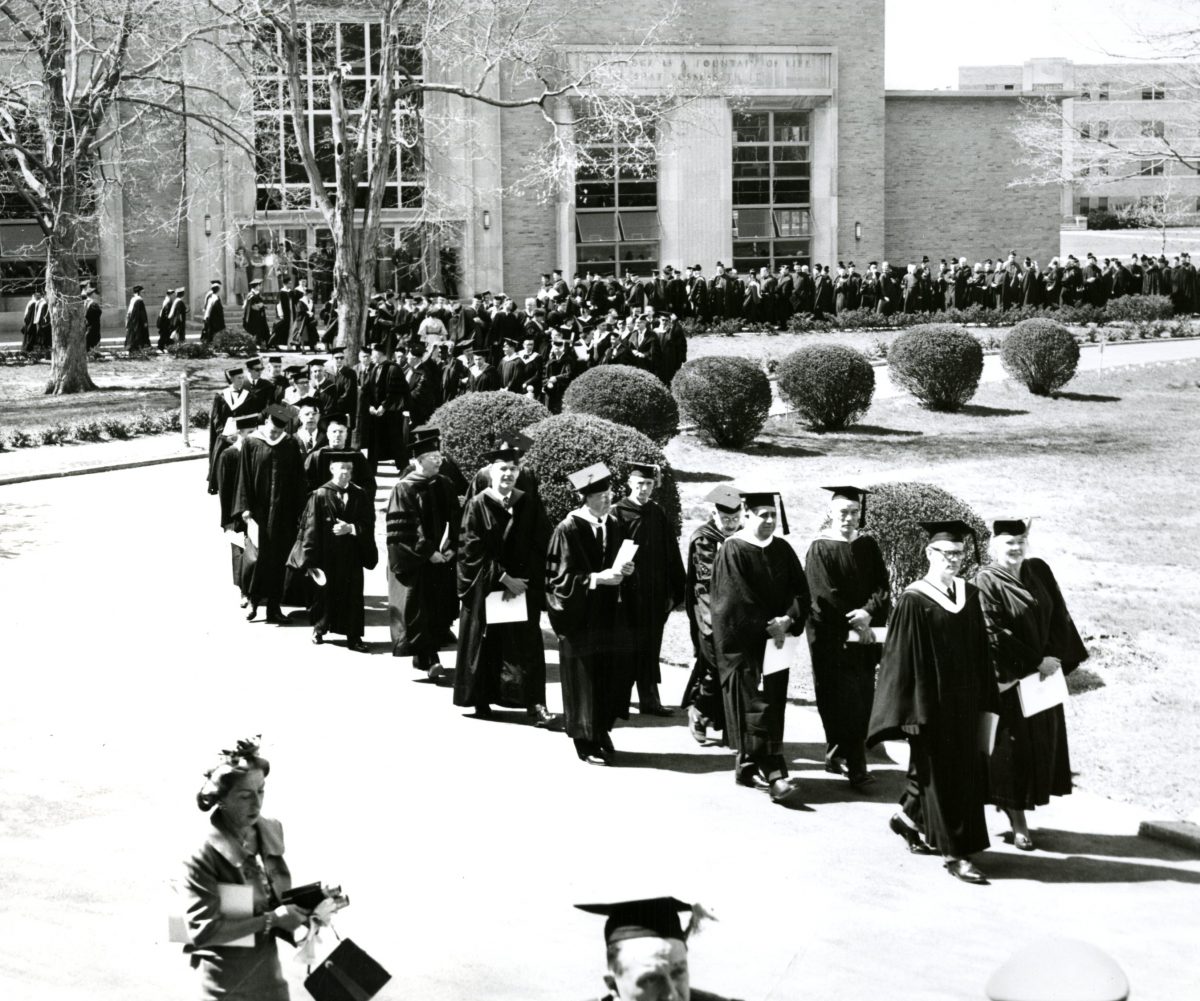
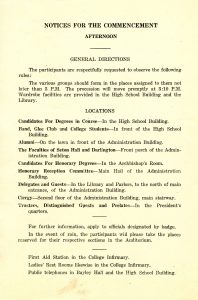
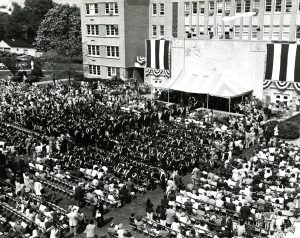
From the 1940s-50s and the succeeding decades, commencement-centered events were held on campus.  The ceremonies were usually held in the shadow of the “Atom Wall” (or other historical campus building depending upon the year and number of guests) which hosted the graduates, families, administrators, clergy, faculty, special guests, and friends who set upon the University Green.  During the mid-twentieth century with an increased number of graduates to account for and honor, multiple ceremonies were often scheduled usually a morning and afternoon session on the same day for example.  This helped with logistics such as parking and making sure that ample space on campus was available for all in attendance on particular graduation day.

1975 Commencement Exercises on the University Green at Seton Hall

Counted among the most memorable and highly publicized of individual commencement exercises came in 1983 when U.S. President Ronald Regan received an honorary degree along with artist Ms. Pearl Bailey and television executive Mr. Gary Nardino which resulted in a memorable event in Seton Hall History.

President Ronald Regan Speech at Seton Hall University – https://www.youtube.com/watch?v=6l1IUqtJiuI

The popularity of Seton Hall commencements throughout the early-mid 1980s led to the search for a larger venue by the end of this decade.  This led the administration to book an off-campus venue which resulted in a long-term relationship with the Brendan Byrne-Meadowlands Arena (now known as the IZOD Center) in East Rutherford.  This lasted until the 2010s when the Prudential Center in Newark became the primary choice and central place for graduation exercises to this day.  Due to restrictions brought on by the Global Pandemic, the 2020 ceremony was cancelled, but has returned this year as a hybrid and multi-session event with both live and video elements alike.

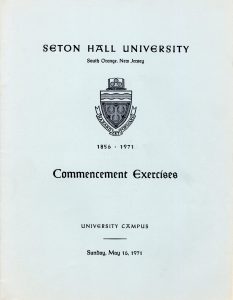
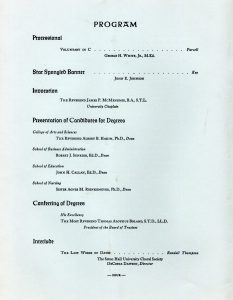
Regardless of the year, the commemorative program booklets produced for each graduation ceremony show their own distinctive artwork, content, and uniqueness for those representing Seton Hall by a particular academic year.  Within the Monsignor William Noe’ Field Archives & Special Collections Center, the University Archives proper contain copies of many annual Commencement Programs dating back to the nineteenth century.  Within the pages of these guides, the names of each graduate and degree they received along with the commencement committee, marshals, order of events and individuals involved with the event including professors.  In addition, honorary degree recipients have been recorded over the years and usually give the keynote speech along with the valedictorian(s) who represent the student body.  Overall this is a day for the graduate and their families and the printed materials generated in their honor is an important part of our collection.


1971 Seton Hall University Commencement Program

In addition to programs, various literature including invitation cards, press clippings, photographs, diplomas, and other materials of note that have memorialized one of the most special days within any academic year.  From the earliest graduation paraphernalia to the inclusion of present-day resources (including multiple ceremonies due to COVID-19 precautions) through the most recent editions during May of 2021 have been documented in various ways.  For example, the following links below provide additional specific information and context in regard to various graduation events in different forms and formats including catalog links and video presentations alike . . .

Commencement – Seton Hall University (ArchiveSpace)

https://archivesspace-library.shu.edu/search?utf8=%E2%9C%93&op%5B%5D=&q%5B%5D=commencement&commit=&field%5B%5D=&from_year%5B%5D=&to_year%5B%5D=

Commencement Sites (Seton Hall University Home Page) – https://www.shu.edu/search.cfm?q=commencement#gsc.tab=0&gsc.q=commencement&gsc.page=1

Commencement – Seton Hall University Graduation Exercises (YouTube) – https://www.youtube.com/results?search_query=seton+hall+commenccement

University History LibGuide = Honorary Degree Recipients, Yearbooks, Seton Hall Magazine, and other resources featuring Commencement-related information) –https://library.shu.edu/ld.php?content_id=13780930

1910 Seton Hall College Commencement Program

For more information on Graduation Ceremonies, Seton Hall History, and related subjects please feel free to reach out to us.  We can be contacted via e-mail at: Archives@shu.edu or by phone at: (973) 275-2378.  Thank you in advance and congratulations to all members of the Class of 2021!