This hammered silver coin was made during the reign of Caesar Augustus (27 B.C.E. – 14 C.E.), the first Roman emperor. He spearheaded the transformation of Rome from a republic to an empire through military strength and governing. The chariot and laurel wreath symbolize this military success, while the robes represent those worn by highly ranked government officials called consuls. This coin is from a distinguished collection of Etruscan and Greco-Roman antiquities, including over 400 coins, donated by alumnus Ronald D’Argenio (MS ‘76/JD ’79).
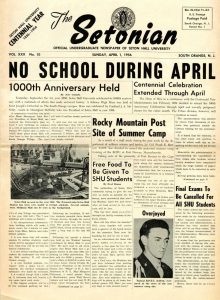
Our school newspaper known as The Setonian has been a staple on campus since 1924 and since that time has featured numerous stories that focus on factual reporting. Accuracy in journalism is the goal for anyone involved with the press from the writer to the editor before any article reaches the public. Even before the upsurge in “fake news” that has become more commonplace in contemporary society there are times when content is purposely meant as satire in order to provide comedic relief. This was clearly stated in the annals of Setonia lore as the paper regularly featured a special “April Fools’ Edition” dated April 1st from its inaugural appearance in 1956 through the remainder of the decade through the 1960s in particular.
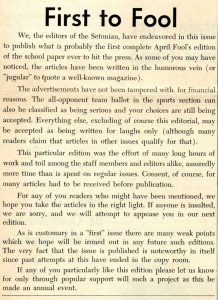
These special editions were clearly meant to lampoon college life and often featured clever headlines and text to bring momentary shock, but with it harmless humor and often an inkling that something is amiss. In many cases, the more outrageous the headline, columns, and photograph(s) shows the creativity of those involved with the prank. In all cases though a disclaimer is issued that warns the reader of what they are to expect. For the latter day audience these special issues have historical value on what constituted comedic values in a particular era.
For more information about college humor, satire in print, and other historical notes about Seton Hall please feel free to contact Alan Delozier, University Archivist at: Alan.Delozier@shu.edu or phone at (973) 275-2378.
We are pleased to announce a new exhibit in honor of the late Governor Brendan T. Byrne which is being hosted by the Archives & Special Collections Center through the Spring 2018 semester.
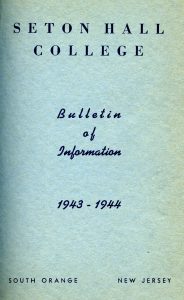
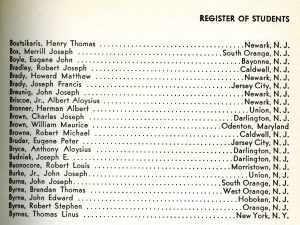
Brendan Thomas Byrne was born April 1, 1924 in West Orange, New Jersey, the fourth of five children born to Francis A. Byrne and Genevieve (Brennan) Byrne. He attended Seton Hall College in 1943 before leaving to enroll in the United States Army Air Corps as a navigator during World War II. Byrne earned a Distinguished Flying Cross, three Air Medals, and a Presidential Unit Citation before his honorable discharge from the service in 1945. Upon returning from overseas, Byrne graduated from Princeton University in 1949 and received his LL.B. from Harvard Law School two years later. The future governor first worked as a clerk for future Chief Justice of the New Jersey Supreme Court, Joseph Weintraub and assisted attorney John W. McGeehan of Newark during the early 1950s.
The public career of Byrne began in the early 1950s as a member of the West Orange Planning Board. He then earned appointed as Assistant Council within the administration to Governor Robert B. Meyner in 1955. Byrne was later promoted to the position of Executive Secretary the following year, and held this post until 1959. Later that year, Byrne was named Deputy Attorney General in charge of the Office of the Prosecutor for Essex County and within months he was made the Essex County Prosecutor. Over the next decade, Byrne argued over 60 different cases before the New Jersey Supreme Court and achieved recognition for prosecuting dishonest contractors and powerful underworld figures. Starting in 1968, Byrne served as President of the State Board of Public Utility Commissioners. He left this position when he was appointed to the New Jersey State Supreme Court in 1970. In 1971, he handed down a decision that declared the state law on capital punishment unconstitutional. He resigned from the Supreme Court in 1973 to run for Governor.
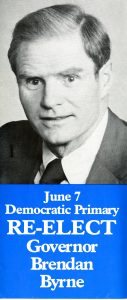
The platform chosen by Byrne in the gubernatorial election of 1973 was based on the slogan “one honest man can make a difference.” Between the years of 1970 and 1973, several New Jersey public officials were indicted by federal grand juries, and with Watergate still in the news, Byrne ran on a platform of restoring public confidence in the government. His opponent was Republican candidate Charles Sandman, who criticized Byrne throughout the campaign for his reluctance to publicly state his position on controversial issues, but instead preferred to issue position papers. On November 6, 1973, Byrne won by over 721,000 votes.
Nicknamed “One Term Byrne” by critics, he surprised political experts in 1977 when he won re-election against Republican candidate Raymond H. Bateman. Despite being considered the underdog in the race, Byrne won by a large majority. During his two terms time as governor, he created a legacy that includes the Meadowlands Sports Complex, development of Casinos in Atlantic City, dedication to the environment exemplified in the Pinelands Preservation Act, and a commitment to improving public education.
After stepping down as governor in 1982, Byrne returned to the private sector as an attorney, co-wrote a column in the Newark Star-Ledger with his gubernatorial successor Thomas Kean, and taught classes at various colleges prior to his death on January 5, 2018.
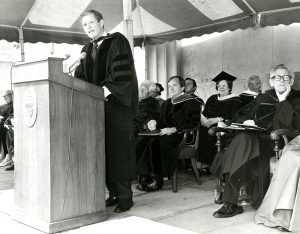
Governor Byrne receives an Honorary Degree from Seton Hall University on May 18, 1974.
This exhibit (which will run throughout the Spring of 2018 and viewable at the Archives & Special Collections Center, located on the First Floor of Walsh Library) shows the ties Byrne had to Seton Hall as a student prior to the call to service in World War II. In addition, included are his debate stop during his first gubernatorial campaign, honorary degree ceremony (1974), and aid with the Meadowlands Development project which bore his name during the 1970s-80s where Seton Hall sponsored a number of events from Men’s Basketball games (held regularly between 1982 until 2007) to Commencement and other activities of note. Additionally, select materials that provide an overview of his campaigns, work among the citizenry of New Jersey, summary of initiatives, and related items that provide a look at the man and his work on behalf of the Garden State and its citizens encompass this display.
More information on the Brendan T. Byrne Collection at Seton Hall University can be accessed via the following site link – http://academic.shu.edu/findingaids/mss0007.html or you can contact Alan Delozier, University Archivist/Education Coordinator by e-mail at: <Alan.Delozier@shu.edu> or phone: (973) 275-2378.
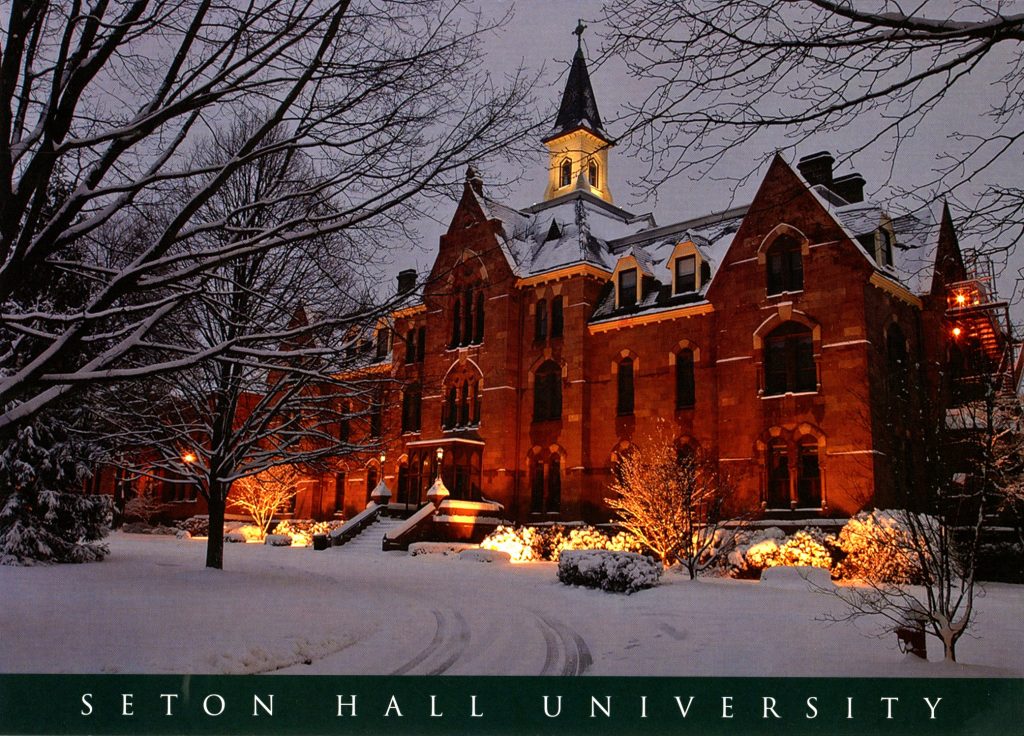
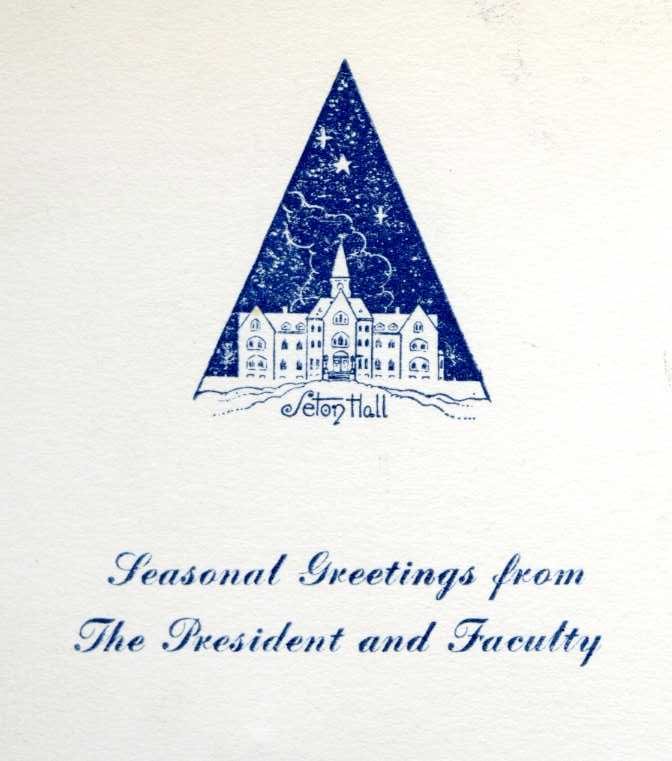
Christmas has been an event traditionally embraced by generations of Setonians as a special time in their lives both in experiencing campus traditions leading up to the celebration and looking back at memorable days of yore. This prelude and embrace of the holiday is not only clearly expressed in such Seton Hall traditions as the Nativity Scene constructed outside of the Immaculate Conception Chapel, the presence of Holly Wreaths on entrance ways on many iconic buildings from South Orange Avenue to Ward Place, Musically-Themed Concerts, Pageants, Plays, and other artistic endeavors that highlight Holiday Music, and other signs of the season are evident across campus throughout December. In recent times, the lighting of the Christmas Tree found outside of President’s Hall has grown into a major event each year and officially signals the beginning of celebrations campus-wide. The popularity of these and other rituals are not only anticipated, but are typically announced or memorialized in that most customary of seasonal gifts – the Christmas Card.
The University has issued a number of different seasonal greetings over the years and these posts have offered not only joyful wishes and expressions of peace, but also featured illustrations or photographs that capture the feeling of the school community in collective celebration. These cards often link to the spirit of Christmas Past or Christmas Present in their look along with expressing the positive wish for New Year and Christmas Future in word and sentiment. A few historical examples are provided here to show some of the shared experience.
For more information about Christmas and other aspects of University History please feel free to contact us at: Archives@shu.edu or by phone at: (973) 275-2378
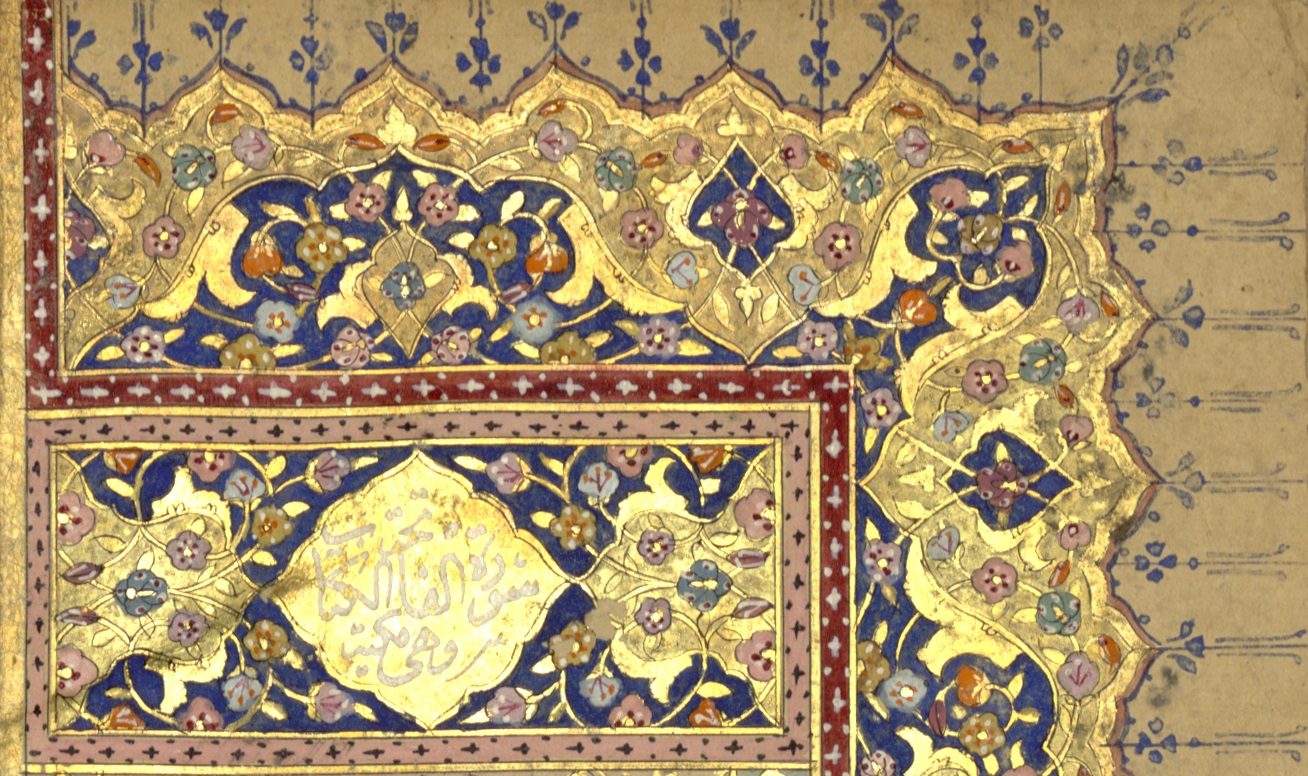
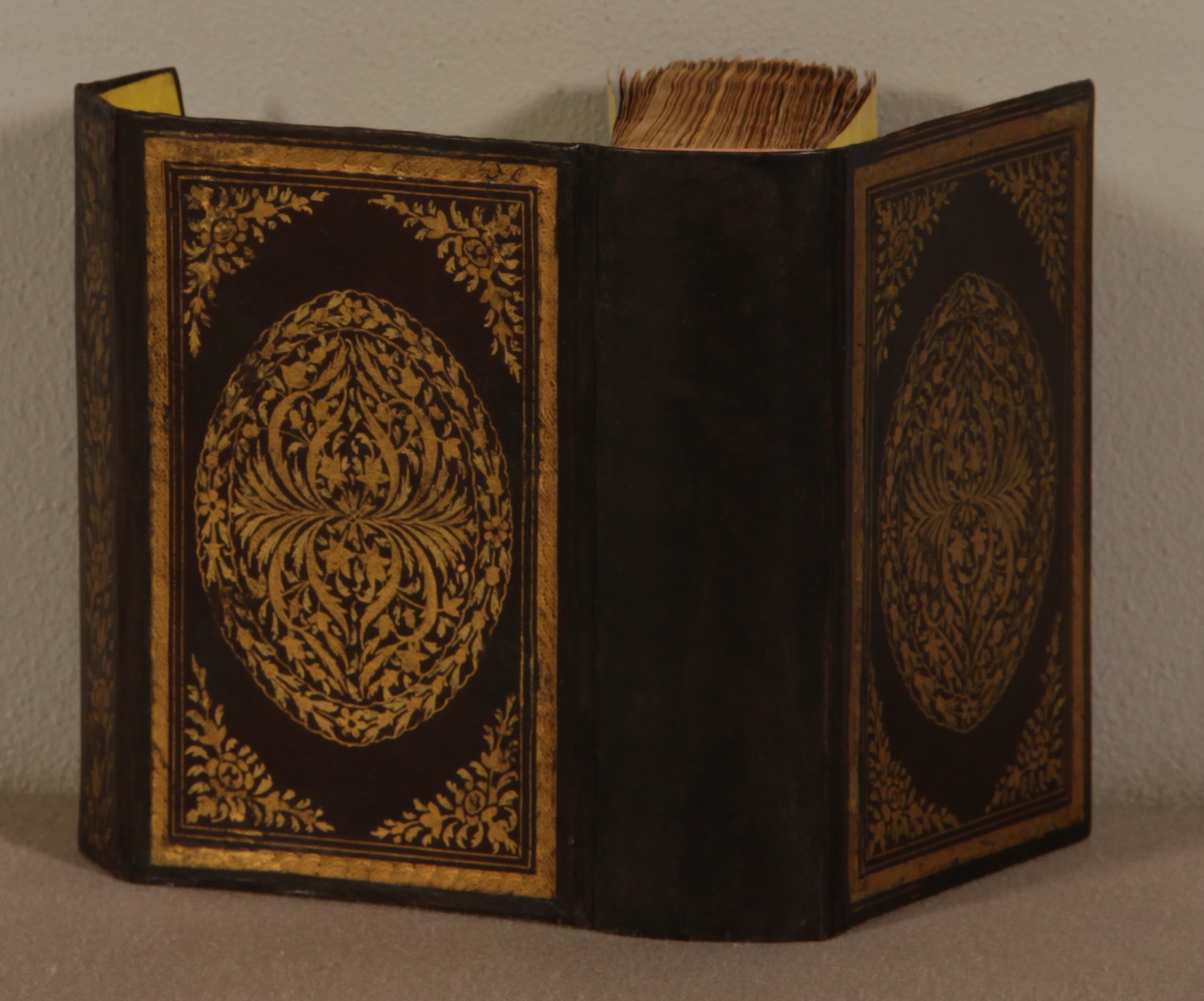
The Archives & Special Collections Center in collaboration with the Digital Humanities Committee recently had conservation work and digitization performed on a 17th century illuminated manuscript Qur’an from the rare book collection. The Qur’an was originally brought from Lebanon by Edwin D. Hardin, who was a missionary stationed at the American University of Beirut from approximately 1900 to 1915. It first came to Seton Hall in 2003 when it was featured in a Walsh Gallery exhibition entitled The Beauty of Sacred Texts: Celebrating the 50th Anniversary of the Institute of Judeo-Christian Studies. The lender, Mr. Peter Kennedy, had intended to gift the volume to the University and in 2016 donated the Qur’an to the Archives & Special Collections Center.
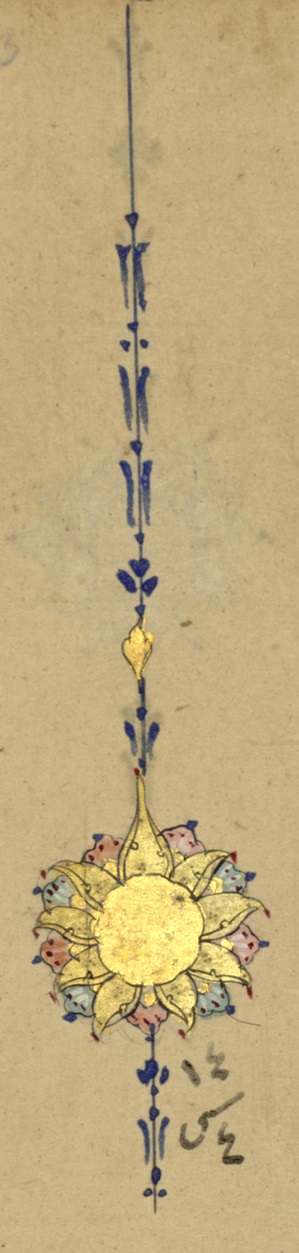
Before conservationAfter conservationMarginal decoration with handwritten annotation
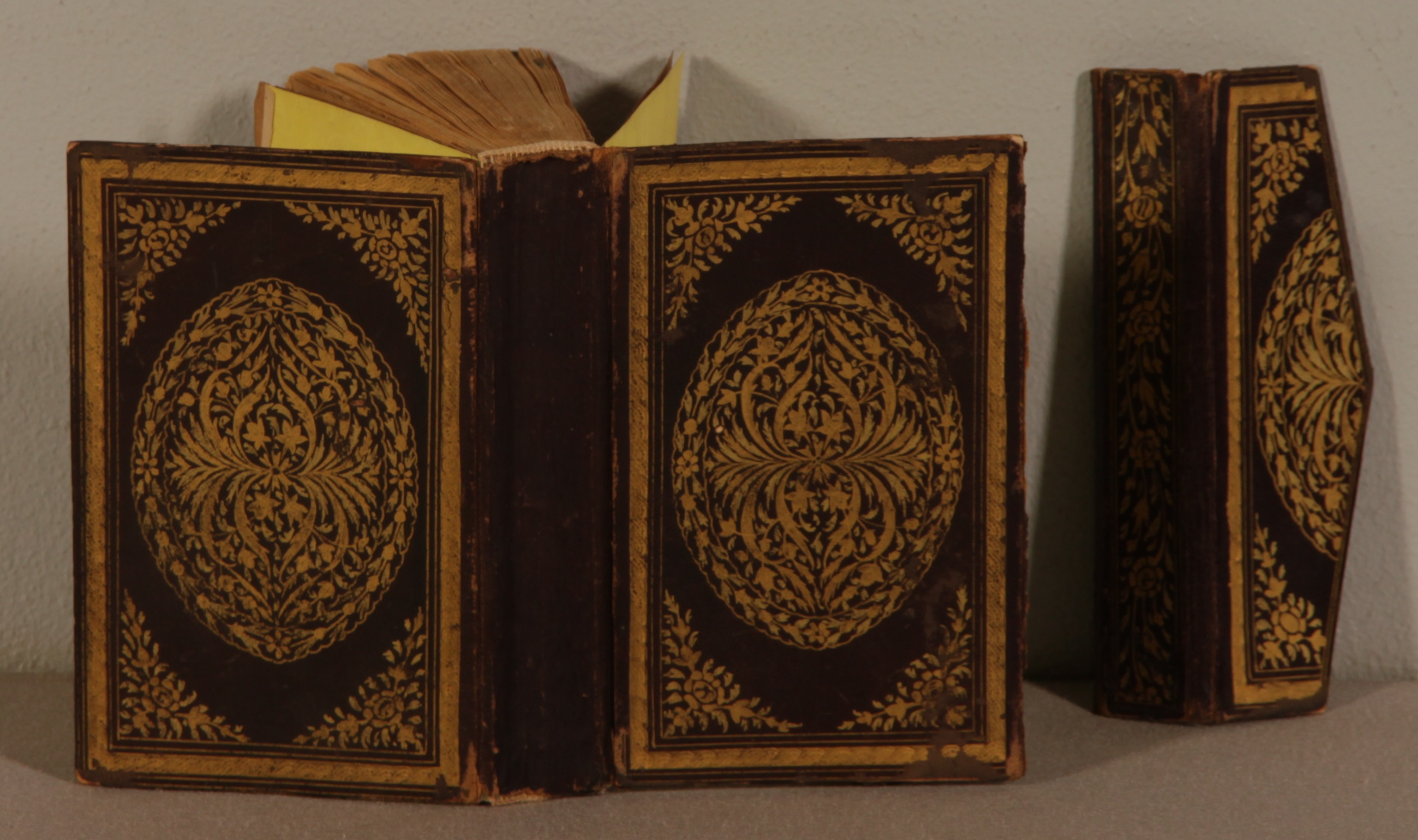
The Qur’an was sent out for conservation in order to stabilize it for digitization and handling. The volume had undergone some previous repairs and was re-bound sometime during the 18th or 19th century. The envelope flap, which extends from the back cover of the volume and folds up to cover its fore edge, was very weak at the hinges and became detached during the conservator’s examination. The binding was also failing, causing some leaves to loosen and begin to detach. We sent the volume to Etherington Conservation Services in North Carolina, where conservators reattached and reinforced the envelope flap, repaired minor damage to the covers, re-sewed the binding, and re-covered the spine. While the binding was removed, they scanned the pages to create a digital copy of the book.
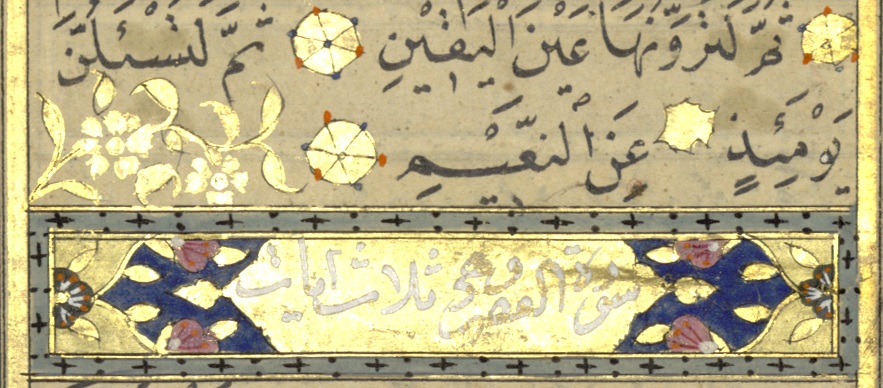
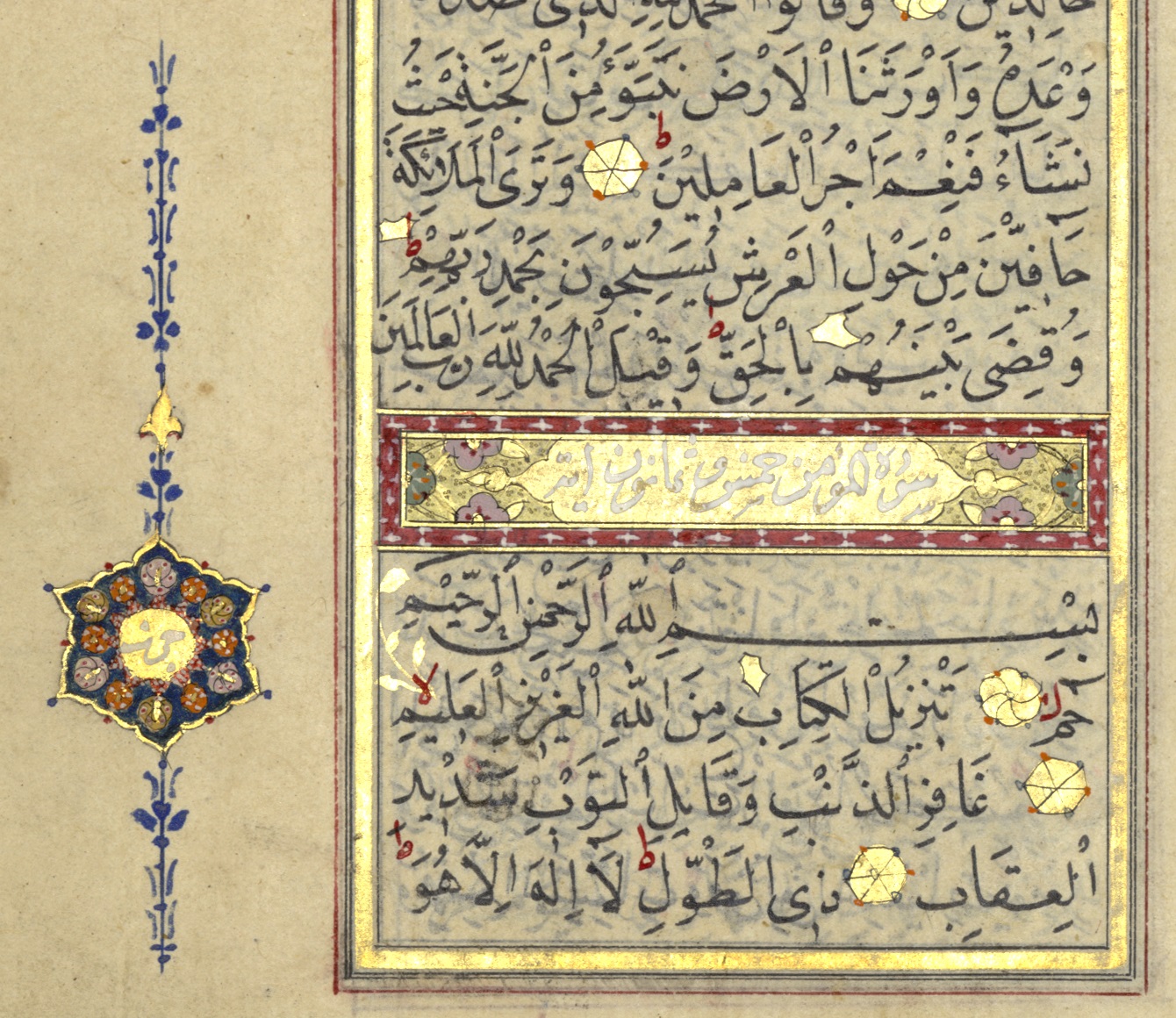
Decoration within the text
As a result of this work, this historic Qur’an is stable enough for handling and display, and the digital images can be made available online. This will allow researchers to view the Qur’an’s beautifully illuminated pages and intricate marginal decorations without putting stress on the volume. It will also open up many possibilities for research projects, such as a potential project to decipher and translate the annotations that appear throughout the volume. The digital collection is coming soon!
The Archives and Special Collections Center recently had conservation work performed on an early 17th century Papal Bull issued by Pope Paul V, who was Pope from 1605 until his death in 1621. The Papal Bull is a large vellum document with a lead seal attached by a cord. It was donated to the Archives by Dr. Herbert Kraft, a Professor Emeritus of anthropology at Seton Hall and director of the Seton Hall University Museum of Archaeology and Anthropology.
Pope Paul V was born Camilo Borghese in Rome in 1550. He studied jurisprudence at Perugia and Padua and became a renowned canon lawyer. He was made a cardinal in 1596 by Pope Clement VIII and was elected as Pope Leo XI’s successor in May 1605. Pope Paul V was most famous for persecuting Galileo for his defense of the heliocentric theory of Copernicus. He also canonized St. Charles Boromeo, Frances of Rome and Albert de Louvain and beatified Ignatius Loyola, Philip Neri, Teresa of Avila and Francis Xavier.
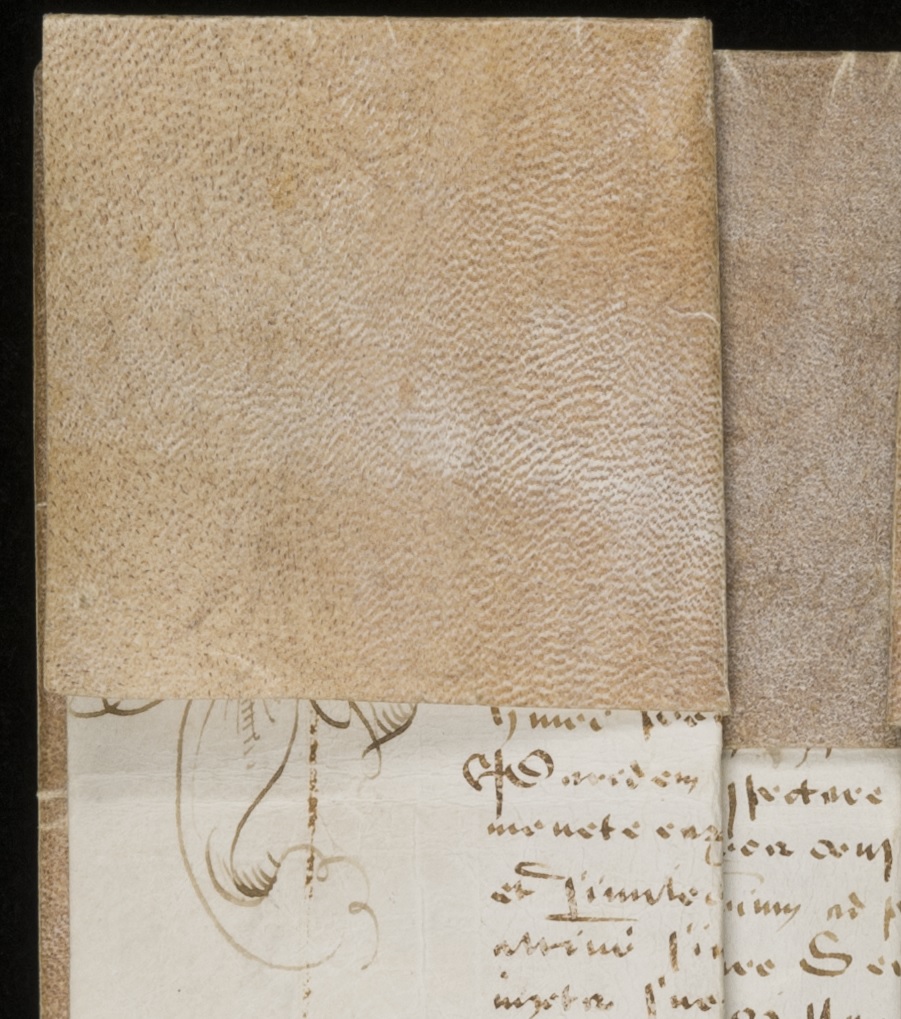
Before treatment – folded vellum obscuring text and decoration
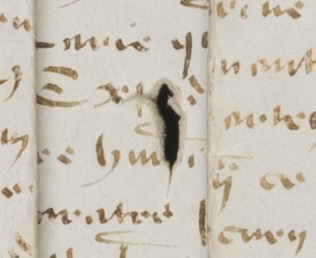
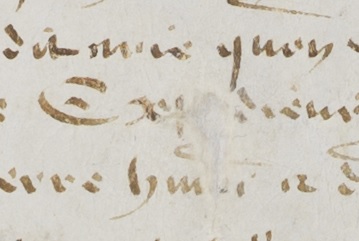
Prior to its conservation, the Papal Bull was folded several times and remained in a folded condition for so long that it was impossible to unfold without risking damage to the document. Conservators at the Conservation Center for Art and Historic Artifacts in Philadelphia were able to use a process of humidification, which is the controlled introduction of moisture, to increase the suppleness of the vellum and to allow the document to be unfolded and safely flattened. Once the document was flattened, they cleaned its surface with soft polyurethane sponges and mended a small hole in the vellum. Finally, the document and seal were housed in a custom-made mat designed to support the heavy lead seal and framed for easy displaying.
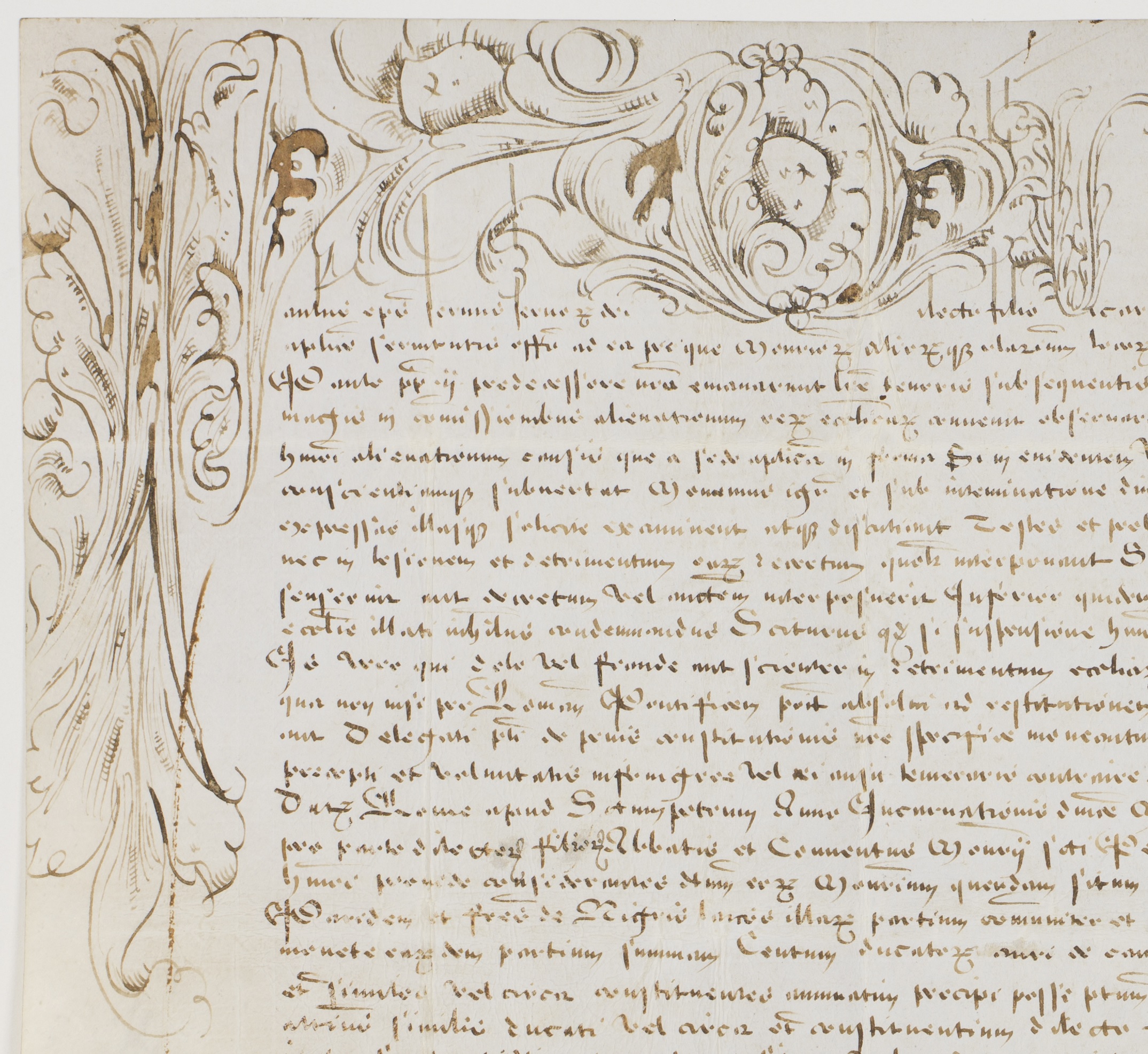
‘After treatment – flattening the document revealed intricate text and decoration
Before treatment – hole in velllumAfter treatment – hole repaired with mulberry paper and dilute gelatin
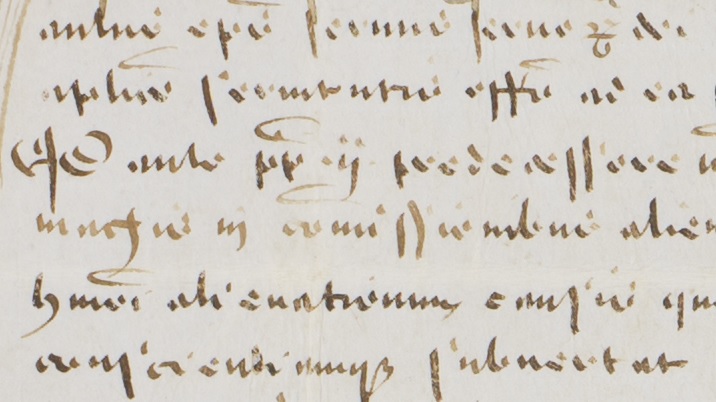
Conserving the Papal Bull revealed its text and intricate design. However, the beautiful, ornate script presented a challenge for translators. We consulted Dr. Michael Mascio in Seton Hall’s Classics Department for assistance with translating the document. He was unable to decipher the script, and conferred with a few colleagues around the country who also were unable to decipher it. On his recommendation we contacted a specialist in this area of script analysis, the Reverend Doctor Federico Gallo of the Biblioteca Ambrosiana in Italy. Rev. Dr. Gallo was able to work on the text during the summer months to provide us with a translation from the archaic Latin script to modern Latin. Dr. Michael Mascio is now working with Dr. Frederick Booth, also in Classics, to translate the modern Latin to English.
This archaic Latin script proved difficult even for experts to decipher and translate.
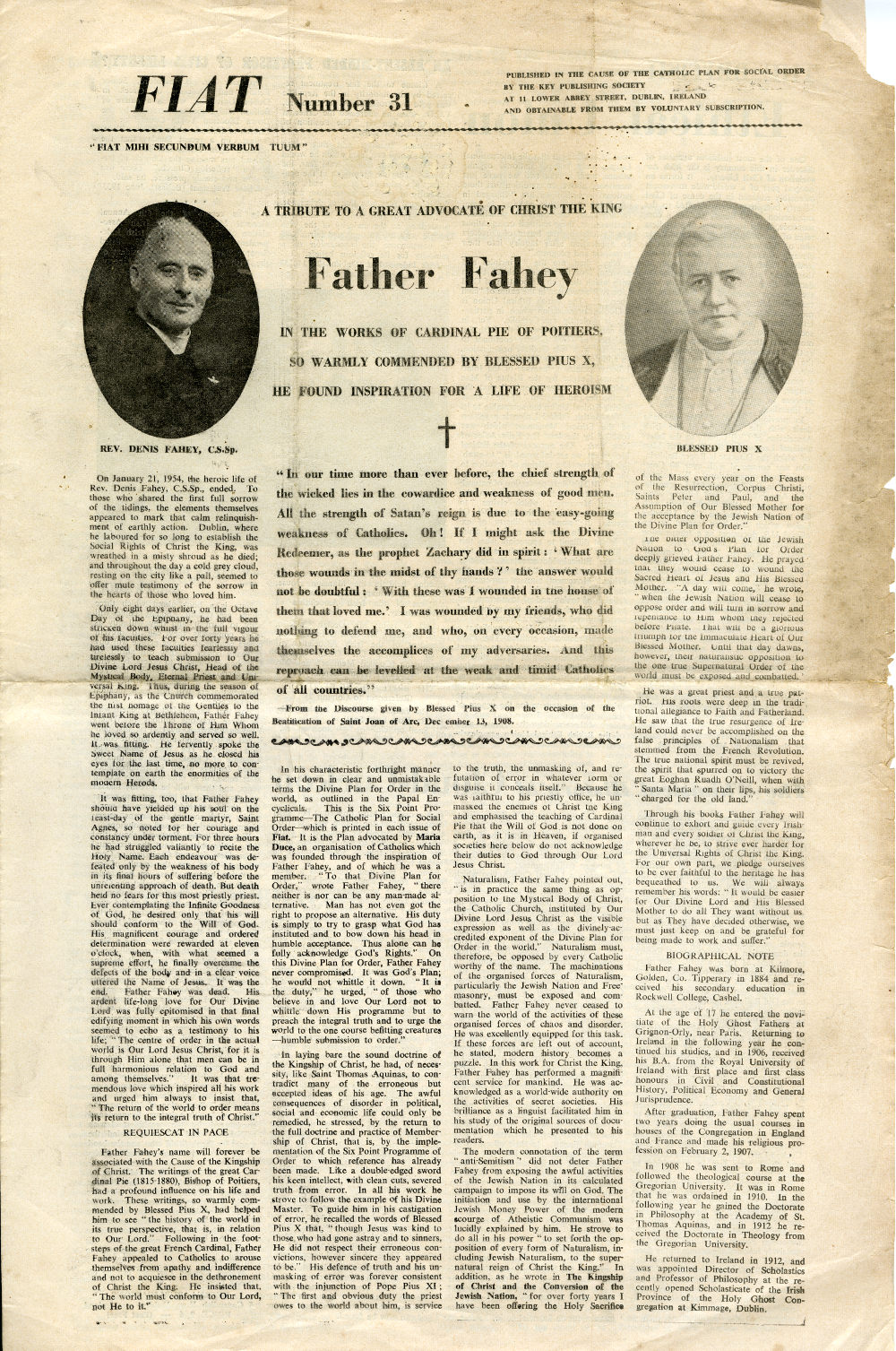
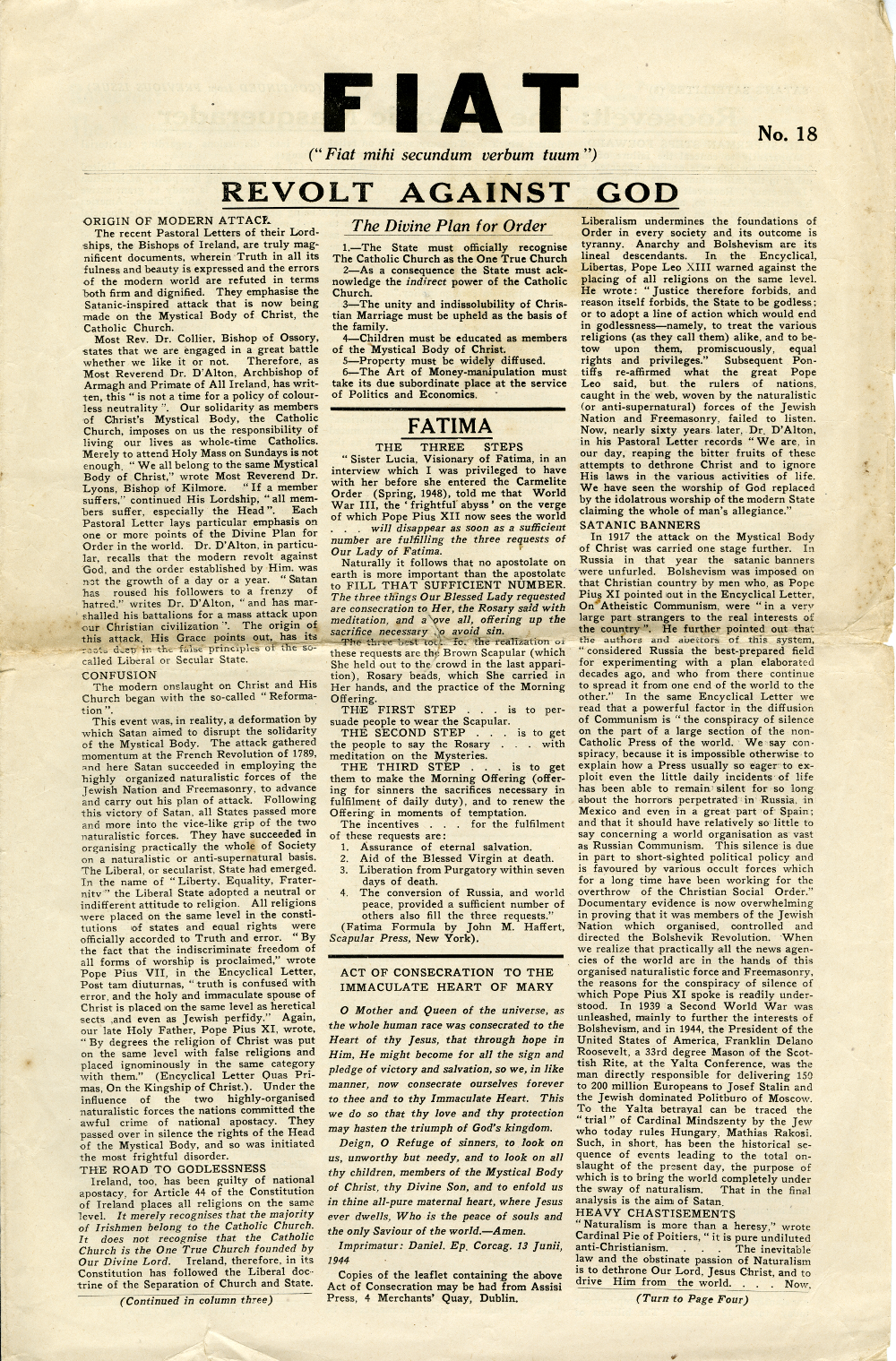
The Archives and Special Collections Center recently acquired a small collection of Catholic Right Ephemera. Among these materials is an incomplete run of the rare Irish newspaper Fiat. Fiat was the monthly newspaper of the Maria Duce movement, which was a small ultraconservative Catholic group founded in Ireland in 1945. The group’s founder Fr. Denis Fahey was an Irish Catholic priest who was born in the village of Golden, County Tipperary, Ireland in 1883. He entered the novitiate of the Holy Ghost Fathers at the age of 17 and studied in France and Rome before returning to Ireland in 1912, where he was appointed professor of philosophy at the Senior Scholasticate of the Irish Province of the Holy Ghost Fathers at Kimmage, Dublin. Fahey is best known for his writings, which were widely distributed and controversial. He was forcefully opposed to anything he perceived as an attempt to go against God’s divine plan. Fahey was especially critical of naturalism, a philosophical viewpoint that proposes that only natural forces are at work in the world, discounting the spiritual or divine. This put him in conflict with systems that he felt promoted naturalism, including communism, Freemasonry, and Rabbinic Judaism.
The Maria Duce movement grew out of a study circle held by Fr. Fahey. There was some secrecy surrounding the group so exact membership numbers are not known, but it is estimated that at its peak it probably did not exceed one hundred members. One of the most notable activities of the Maria Duce organization was its campaign to amend Article 44 of the Irish Constitution of 1937, which recognized the “special position” of the Catholic Church in Ireland, but also recognized Jewish congregations and several Protestant groups. In his writings Fahey called for stronger recognition of the Catholic Church by the Irish Constitution, and objected to the fact that Article 44 placed it on the same level as other religions. From 1949 to 1951 Maria Duce members circulated petitions calling for the article to be amended to reflect the Catholic Church as the “one true church” of Ireland. However, the campaign was largely unsuccessful because it was not able to secure the backing of Archbishop John Charles McQuaid of Dublin. The movement lost momentum after the failed campaign and Fahey’s death in 1954. In 1955 Archbishop McQuaid ordered the group to change its name as an indication that it did not have official church support. The group continued publishing Fiat into the 1970s under the name Fírinne, and eventually dissolved.
For more information about the Fiat newspapers or the Catholic Right Ephemera collection, visit the Archives or contact us at archives@shu.edu or (973)-761-9476.
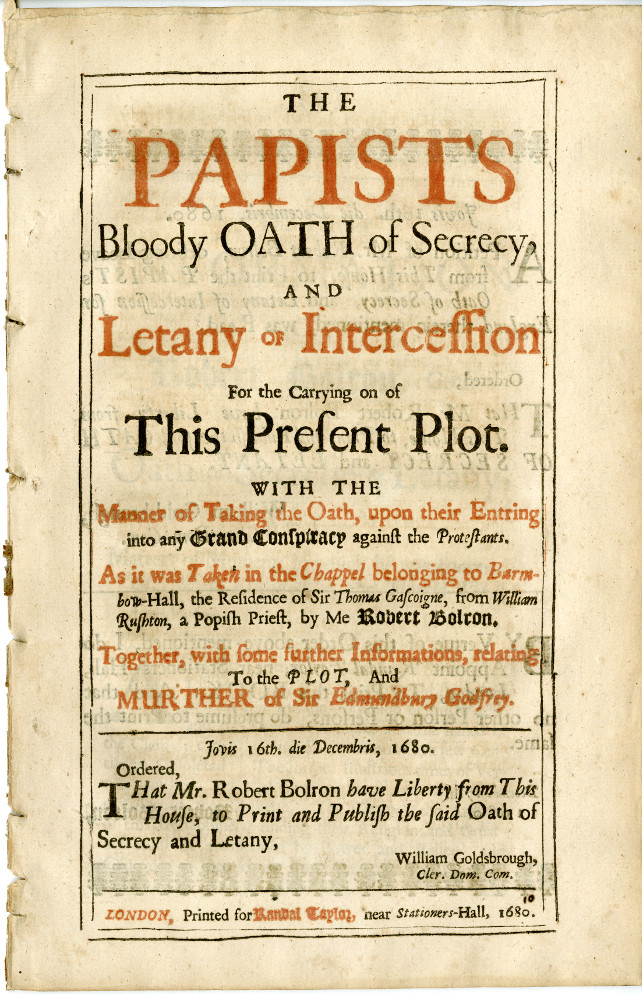
The papists bloody oath of secrecy, and letany of intercession for the carrying on of this present plot. Robert Bolron, London: Printed for R. Taylor, 1680.
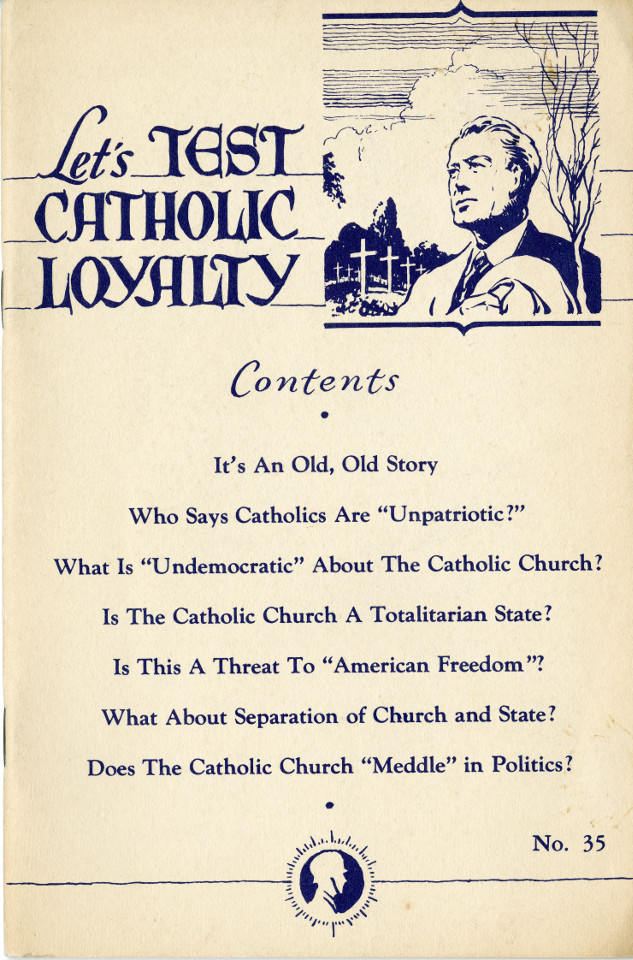
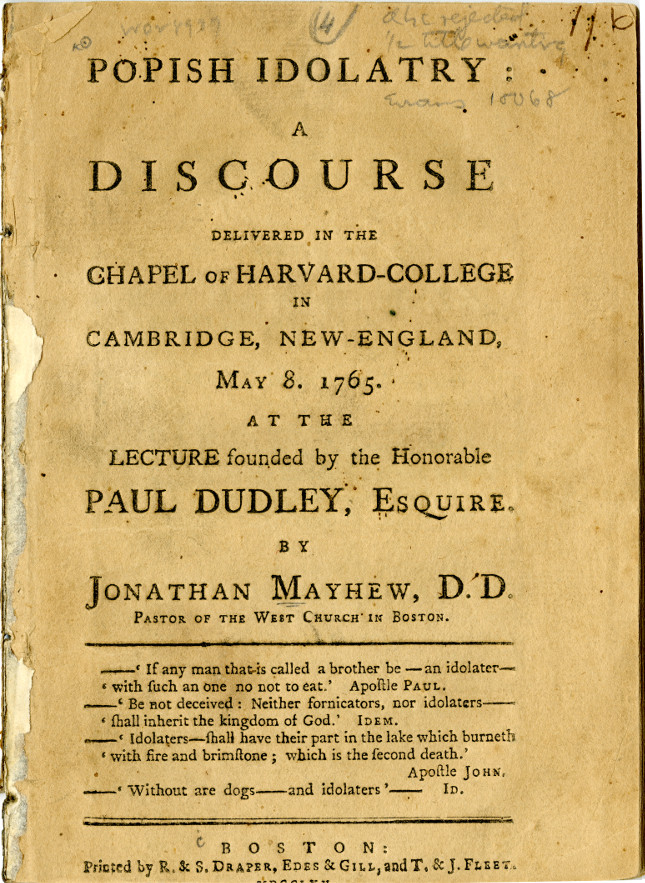
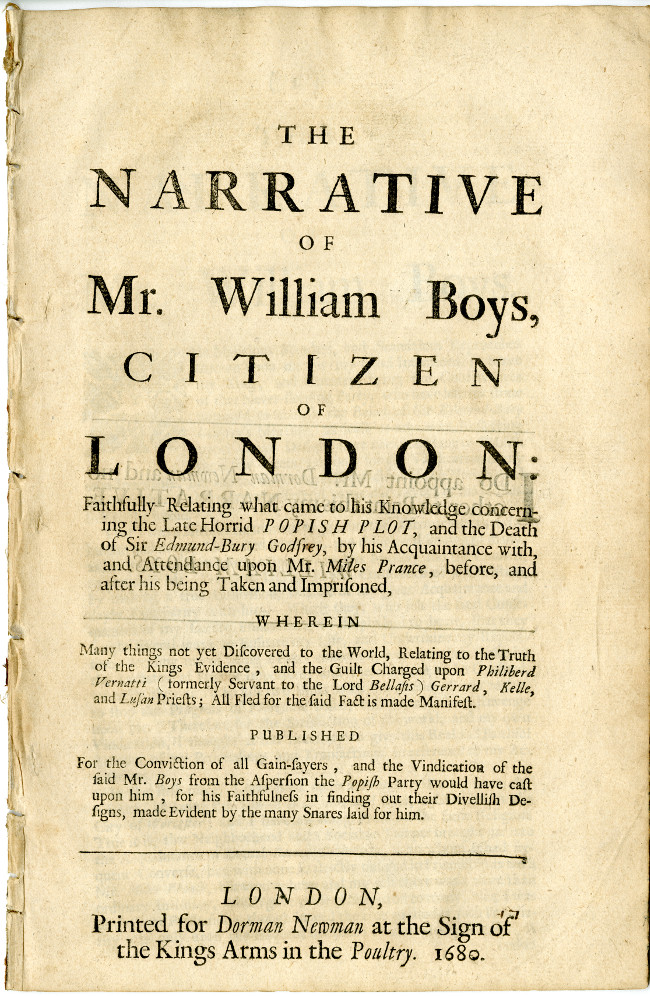
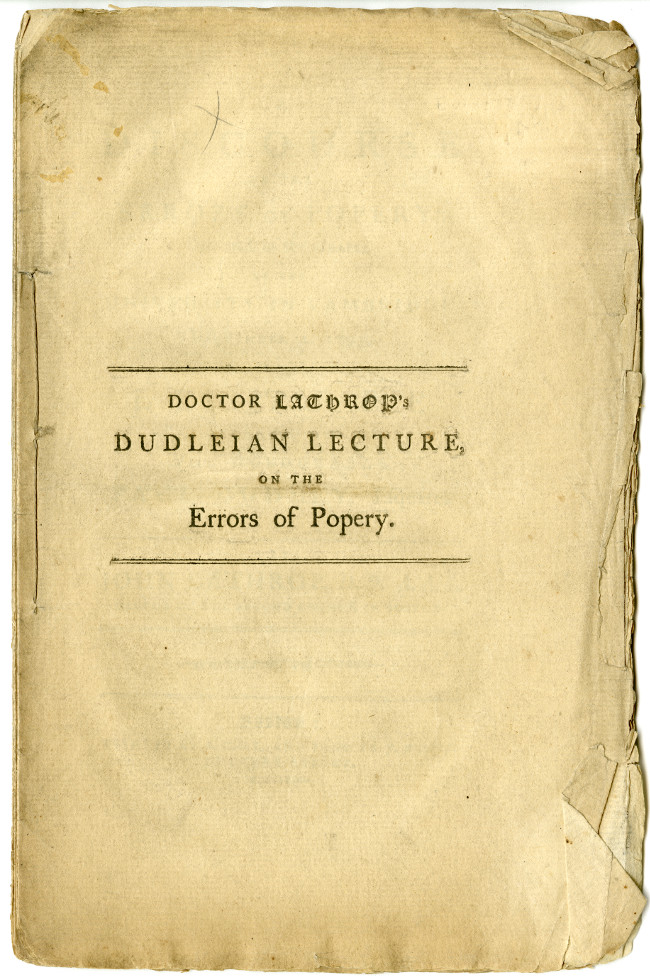
A new exhibit in the Msgr. William Noé Field Archives & Special Collections Center Reading Room highlights materials from our Anti-Catholic Ephemera collection. This small collection dates from 1765-1952. It contains several pamphlets expressing anti-Catholic sentiment and denouncing Catholicism. Although they are not displayed in this exhibit, the collection also includes some materials relating to the Philadelphia Nativist Riots, in which Protestant nativist groups lashed out against Irish Catholic immigrants and burned several Catholic churches. In addition to materials from the Anti-Catholic Ephemera collection, several of the items in the exhibit are from our Rare Books collection.
“Let’s Test Catholic Loyalty” – a pamphlet by the Knights of Columbus in response to Anti-Catholicism, 1952.
Anti-Catholicism grew out of the Protestant Reformation in the 16th century, and continues in some forms today. It was most common in countries that were majority-Protestant, such as Great Britain and the United States, and sometimes led to discrimination and violence. Catholics were often derogatorily referred to as “papists” or “Romanists,” and were suspected of remaining loyal to the Vatican rather than their countries. Anti-Catholic sentiment overlapped with movements such as nativism when majority-Protestant countries experienced an influx of Catholic immigrants.
Some of the items featured in this exhibit include “Let’s Test Catholic Loyalty,” a 1952 pamphlet produced by the Knights of Columbus as a response to Anti-Catholicism; Popish idolatry; a discourse delivered in the Chapel of Harvard-College in Cambridge, New-England by Jonathan Mayhew, 1765; and The papists bloody oath of secrecy, and letany of intercession for the carrying on of this present plot by Robert Bolron, printed in London in 1680. This document relates to the “Popish plot” and murder of Sir Edmund Berry Godfrey, an English magistrate whose mysterious death stirred up Anti-Catholic turmoil in England.
For more information about the exhibit or the Anti-Catholic Ephemera collection, stop by the Archives or contact us at archives@shu.edu or (973)761-9476.
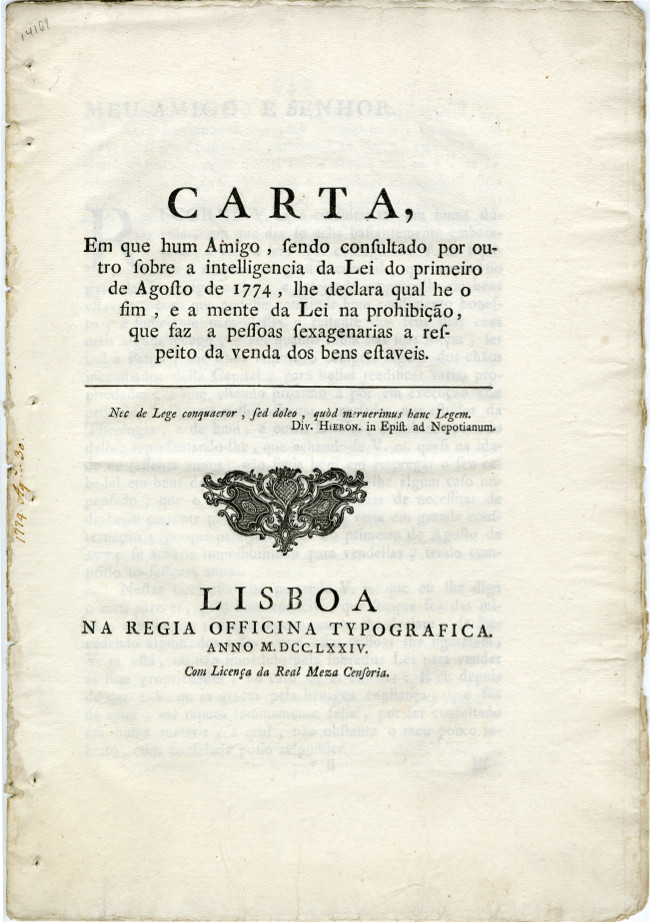
Popish idolatry; a discourse delivered in the Chapel of Harvard-College in Cambridge, New-England. Jonathan Mayhew, 1765The narrative of Mr. William Boys, citizen of London. William Boys, London: Printed for Dorman Newman …, 1680.A discourse on the errors of popery : delivered in the chapel of the University in Cambridge, September 4, 1793, at the lecture founded by the Honourable Paul Dudley, Esquire. John Lathrop, D.D.A.A.S. Pastor of the Second Church in Boston, 1793“Carta em que um amigo sendo consultado por outro sobre a inteligencia da lei do primeiro de Agosto de 1774”, Anti-Church Law Explained. Lisboa: Na Regia Officina Typografica, 1774.
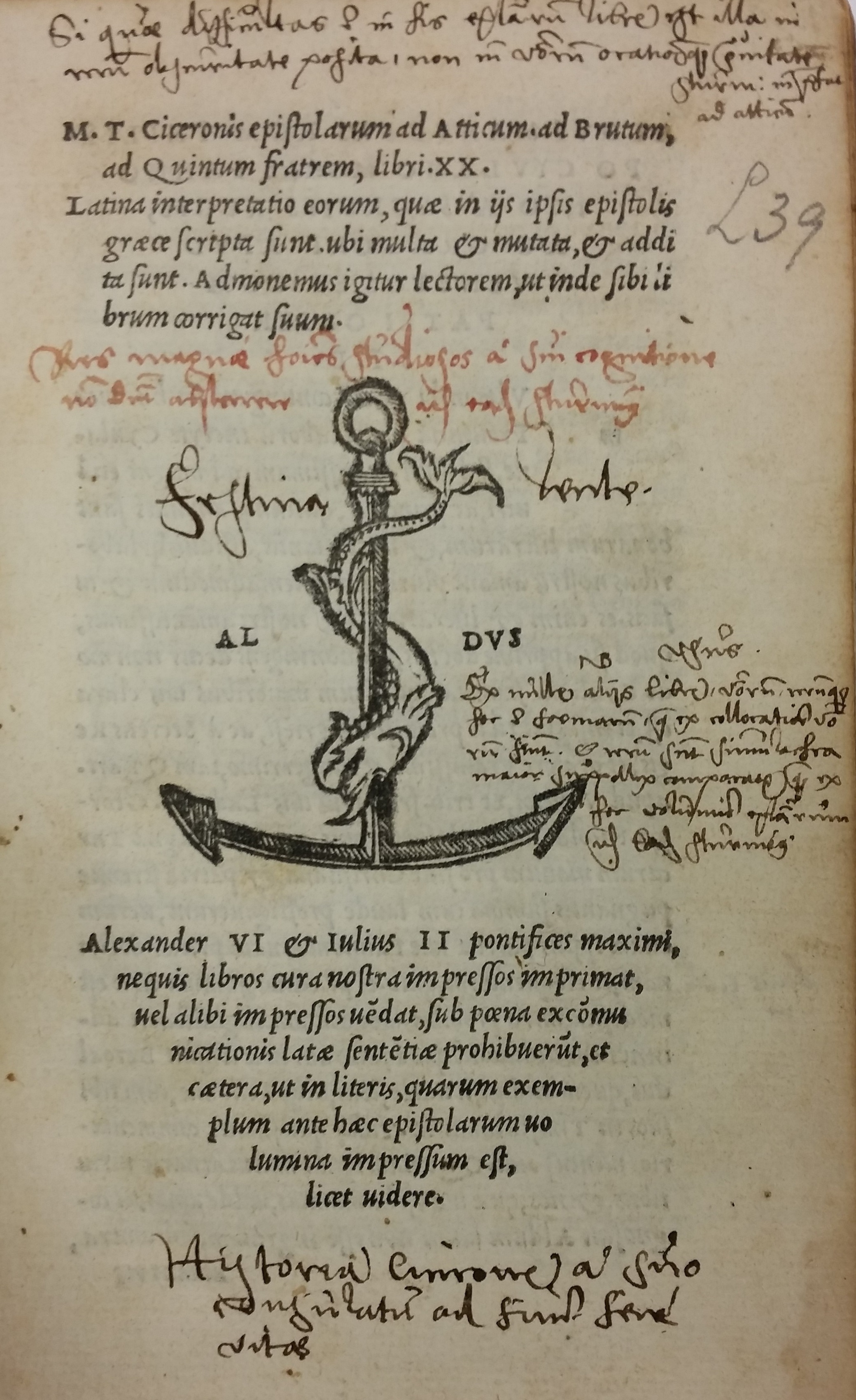
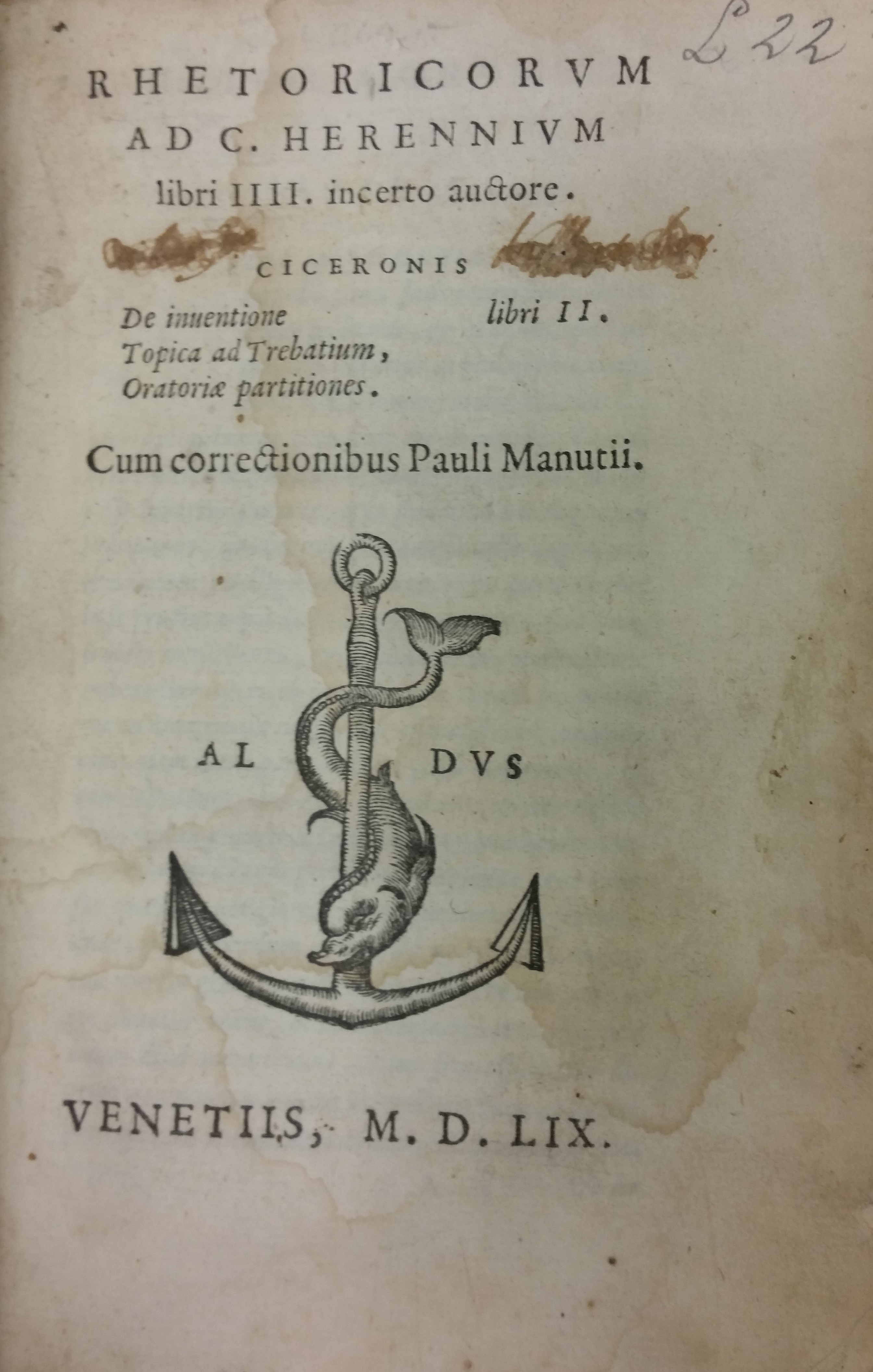
These two volumes of the works of Cicero, which are part of the Tullio Ascarelli collection, are examples of books from the Aldine press. The Aldine press was founded in Venice by Aldus Manutius (Aldo Manuzio, c. 1449-1515). Manutius was educated as a humanist and sought to preserve classical Greek literature by printing many significant Greek works. He also printed notable Latin and Italian authors. Manutius is also known for his contributions to typography. His firm was the first to use italic type, and introduced books in the octavo format, which can be considered as the equivalent of the modern paperback. His goal was to print small, inexpensive books for scholars. Books published by the Aldine press can be identified by the unique printer’s device, which depicts a dolphin and an anchor. After his death, Manutius’ firm was carried on by his son Paulus, followed by his grandson, Aldus.
M.T. Ciceronis epistolarum ad Atticum, ad Brutum was printed in 1513, presumably under the direction of Aldus Manutius. Rhetoricorumad C. Herennium was printed under the direction of Manutius’ son Paulus (Paolo) in 1559.
M.T. Ciceronis epistolarum ad Atticum, ad Brutum // ad Quintum fratrem, libri XX.Rhetoricorum ad C. Herennium libri IIII. incerto auctore.
The Archives and Special Collections Center is launching a new Adopt a Book program! This program gives donors the opportunity to contribute to the conservation of specific items from our collection that interest them. Each month, we will feature a different adoptable book here on our blog. To learn more about the program, or to make a donation, please visit our Adopt a Book page.
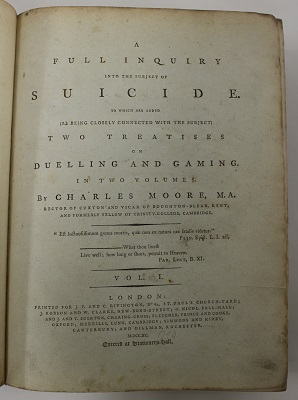
A full inquiry into the subject of suicide. To which are added (as being closely connected with the subject) two treatises on duelling and gaming … by Charles Moore
Charles Moore (1743-1811) was a rector and vicar of the Church of England. He was born in London in 1743, and during his career he worked in churches throughout England. In 1792 he was appointed to the College of Six Preachers of Canterbury Cathedral, a distinguished group of priests who were called upon to preach both at the Cathedral and in their own parishes.
A full inquiry into the subject of suicide is Moore’s most significant scholarly work. It was written as a response to Hume’s 1783 Essay on Suicide. While Hume argues that suicide can be justified and even preferable in some cases, Moore contends that any form of suicide is morally wrong and an affront to God. He includes an extensive literature review that is a great resource on attitudes towards suicide in the 18th century. He also wrote two treatises on dueling and gaming and their relation to suicide, which are included at the end of the volume.
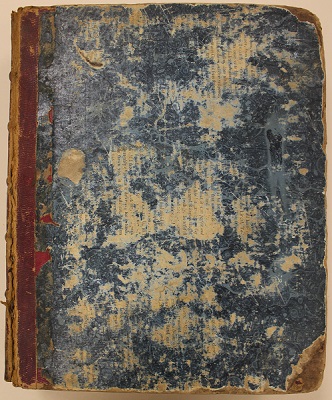
Front cover of A full inquiry into the subject of suicide
The Archives and Special Collections Center holds a rare copy of A full inquiry into the subject of suicide. While the work was originally published as a two volume set, the Archives’ copy contains both volumes and the two treatises on dueling and gaming bound together as one. This copy is in need of conservation treatment to clean and repair its leather spine, reattach its back cover and some of its leaves, and mend damaged areas on its covers. You can help support the conservation of this important work! Any donation toward preservation of this rare volume would be gratefully accepted. To donate, please visit our Adopt a Book page.

 For more information about college humor, satire in print, and other historical notes about Seton Hall please feel free to contact Alan Delozier, University Archivist at: Alan.Delozier@shu.edu or phone at (973) 275-2378.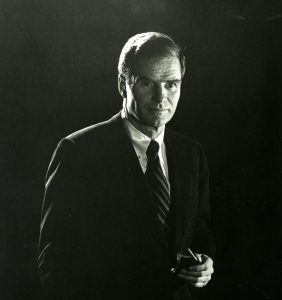
 and within months he was made the Essex County Prosecutor. Over the next decade, Byrne argued over 60 different cases before the New Jersey Supreme Court and achieved recognition for prosecuting dishonest contractors and powerful underworld figures. Starting in 1968, Byrne served as President of the State Board of Public Utility Commissioners. He left this position when he was appointed to the New Jersey State Supreme Court in 1970. In 1971, he handed down a decision that declared the state law on capital punishment unconstitutional. He resigned from the Supreme Court in 1973 to run for Governor.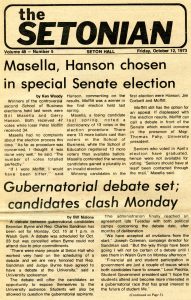
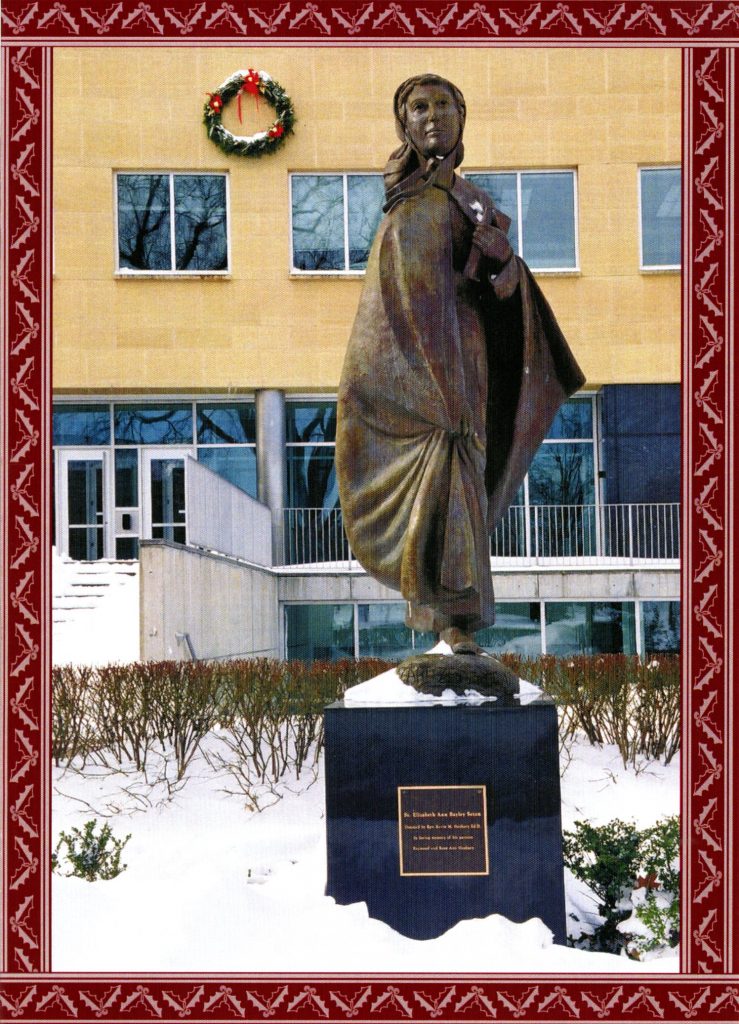 Christmas has been an event traditionally embraced by generations of Setonians as a special time in their lives both in experiencing campus traditions leading up to the celebration and looking back at memorable days of yore. This prelude and embrace of the holiday is not only clearly expressed in such Seton Hall traditions as the Nativity Scene constructed outside of the Immaculate Conception Chapel, the presence of Holly Wreaths on entrance ways on many iconic buildings from South Orange Avenue to Ward Place, Musically-Themed Concerts, Pageants, Plays, and other artistic endeavors that highlight Holiday Music, and other signs of the season are evident across campus throughout December. In recent times, the lighting of the Christmas Tree found outside of President’s Hall has grown into a major event each year and officially signals the beginning of celebrations campus-wide. The popularity of these and other rituals are not only anticipated, but are typically announced or memorialized in that most customary of seasonal gifts – the Christmas Card.