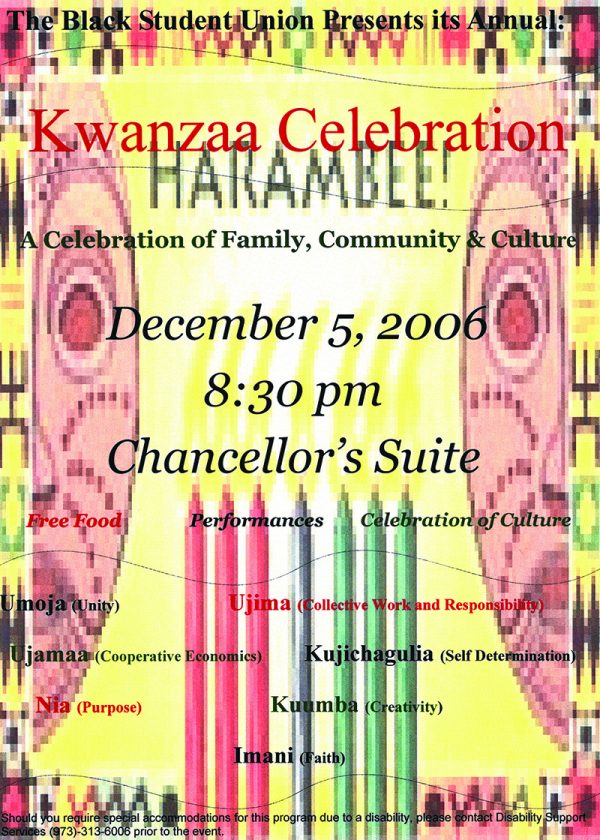
“Kwanzaa Celebration Invitation”
2006
Black Student Union vertical file
Seton Hall University Archives and Special Collections
HABARI GANI
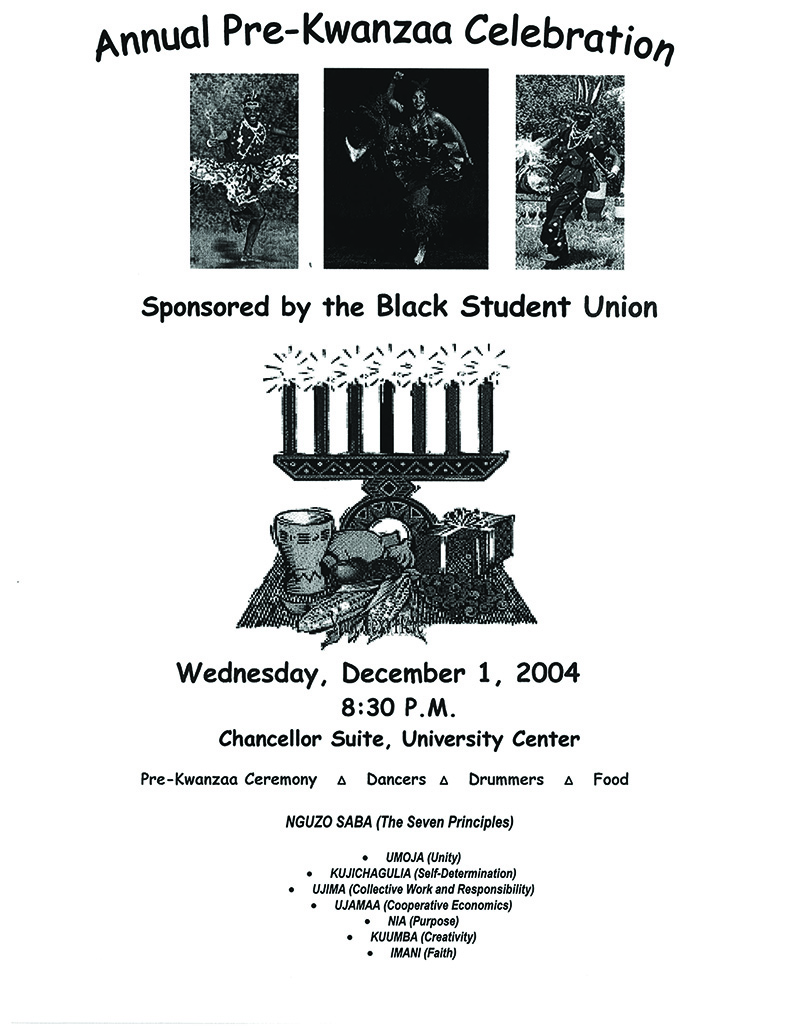
Kwanzaa is a seven-day celebration of African American culture observed annually from December 26 through January 1. During Kwanzaa, it is customary to greet friends and family with the phrase, “Habari gani,” meaning, “What is the news?”[1] In response, one can reply with one of the seven different principles assigned to each day. Every evening during Kwanzaa, a candle is lit on the kinara, or traditional candleholder, to honor the seven principles:
Umoja (Unity)
Kujichagulia (Self-determination)
Ujima (Collective Work and Responsibility)
Ujamaa (Cooperative economics)
Nia (Purpose)
Kuumba (Creativity)
Imani (Faith)
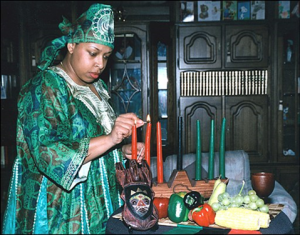
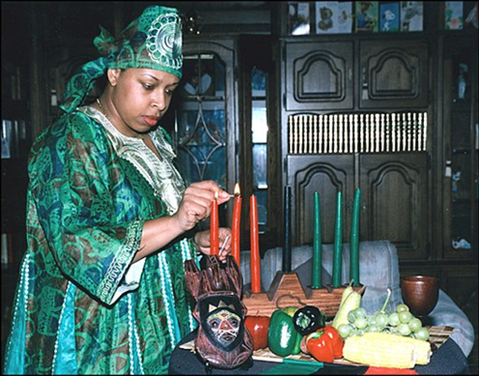
Tech. Sgt. Jennifer Myers (above), 66th Air Base Wing noncommissioned officer in charge of the Military Equal Opportunity office, lights a candle in the Kinara. photo by Christopher Myers, Public domain, via Wikimedia Commons
These seven tenets of Kwanzaa, or Nguzo Saba, are collectively referred to as Kawaida, a Swahili word meaning “common.”[2] The candles used in the kinara are red, green and black – each color having a different attribute. The three red candles on the left of the kinara signify the blood shed in the fight for liberation, three green candles on the right stand for the future of Black liberation and the single black candle in the center symbolizes the people this celebration honors.[3]
“Annual Pre-Kwanzaa Celebration Invitation” Black Students Union vertical file, 2004, Archives and Special Collections, Seton Hall University, South Orange, NJ
Kwanzaa was first celebrated in 1966 when Maulana Karenga, a college professor of Africana studies at California State University in Long Beach, created the holiday to honor and celebrate pan-African culture. Karenga said his goal was to “give Blacks an opportunity to celebrate themselves and their history, rather than simply imitate the practice of the dominant society.”[4] At the time Karenga conceived of Kwanzaa, Los Angeles was reeling in the aftermath of the Watts Rebellion which devasted the south Los Angeles neighborhood in August 1965 after a traffic stop resulted in the arrest of a 21-year-old African American man, Marquette Frye. For the next six days, violence and civil unrest rocked 46 square miles of Los Angeles.[5] It was against this political backdrop that Karenga sought to create a positive force for African Americans and African American culture.[6] According to Karenga, Kwanzaa was partly inspired by the Zulu harvest festival, Umkhosi Wokweshwama, a five-day lunar ritual that takes place during the last full moon of the year.[7]
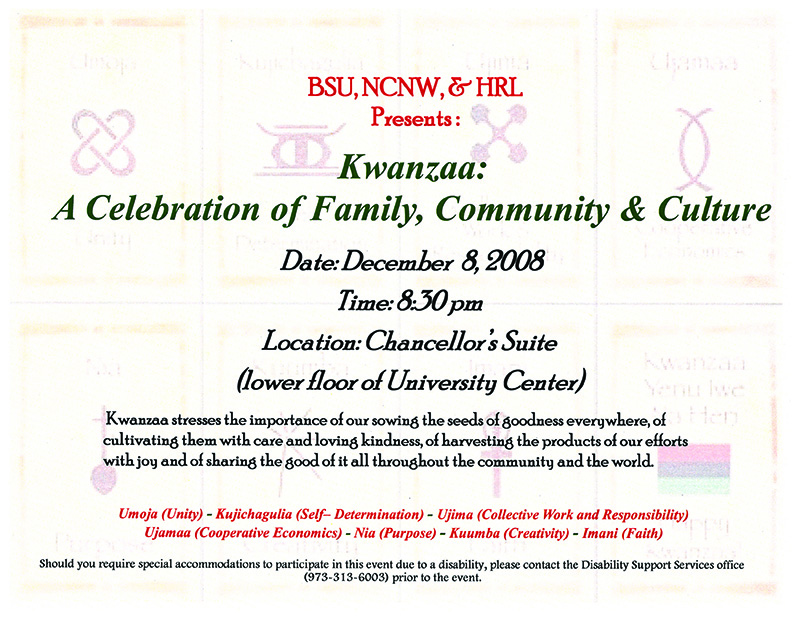
“Kwanzaa Celebration Invitation” Black Students Union vertical file, 2008, Archives and Special Collections, Seton Hall University, South Orange, NJ
The name Kwanzaa is taken from the Swahili phrase “matunda ya kwanza,” meaning first fruits. The extra “a” was added, said Karenga, to make the word Kwanzaa seven letters to enhance its symbolic power.[8] Kwanzaa is a cultural event imbued with spiritual values, but it is not a religious observance. People of all faiths may celebrate Kwanzaa and non-blacks can also observe the holiday.[9] On his official Kwanzaa website, Dr. Karenga notes, “The holiday, then will of necessity, be engaged as an ancient and living cultural tradition which reflects the best of African thought and practice in its reaffirmation of the dignity of the human person in community and culture, the well-being of family and community, the integrity of the environment and our kinship with it, and the rich resource and meaning of a people’s culture.”[10]
The Department of Archives and Special Collections maintains vertical files of documents and materials related to African American Studies, Black Studies, African American Alumni Association/Council, African American Heritage Month, African American Students Association, Africana Studies, African Student Association, Black History Month, Women of Hope, Black Studies Center, Institute in Afro-American History and Culture, Rallies, and University of Sierra Leone Summer School. The images accompanying this blog post show Annual Kwanzaa celebrations organized by the Black Student Union at Seton Hall University, part of this large collection of materials preserved by the university’s archives. These materials are available to students, faculty and researchers. For access, complete a research request form to set up an appointment or contact us at 973-761-9476.
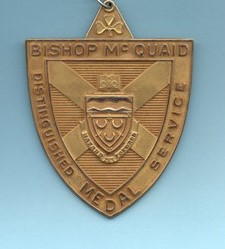
Not only is December the month when the world celebrates the dawn of the Lord Jesus Christ, but within the annals of Seton Hall history, the last part of the year is also known for the birth of our first (and third) College President (from 1856-57 and 1859-66), Bishop Bernard J. McQuaid. Born on December 15, 1823, McQuaid was an important figure in the christening of the Catholic College of New Jersey during its early years and the impact of his vision and belief in the worth of higher education lives on through his early and enduring initiatives and memorials in the latter day including McQuaid Hall (Home to the School of Diplomacy) and the McQuaid Medal (the highest honor bestowed on those affiliated with the University) among other landmarks outside South Orange.
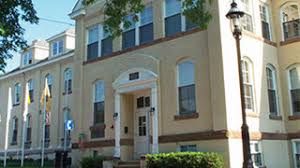
McQuaid Hall (Home to the School of Diplomacy and International Relations), c. 2015McQuaid Medal – Front Side of the Award, c. 2000
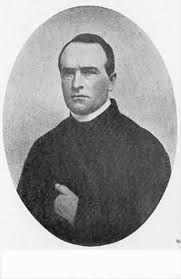
According to The Catholic Encyclopedia (1911) and the seminal work The Catholic Church in New Jersey of 1904 (found online within the Library Guide – https://library.shu.edu/nj-catholic-history and in hard copy form within our Rare Book Collection, Call Numbers – BXZ841.C25 and BXZ1415.N5 F6 1904 respectively), the following highlights have been recorded in relation to the life and legacy of Bishop McQuaid. The trailblazing president of Seton Hall, McQuaid (1823-1909) was born in New York City and his parents were of Irish Catholic origin and the family made history as they played host to the first Mass said in Powel’s Hook (presently known as Jersey City) in 1829. Inspired by his practice in the Catholic faith, McQuaid was educated in Quebec and later at St. John’s Seminary at Fordham prior to his ordination in 1848. He was assigned as a priest to the Diocese of New York and preceding the creation of the See of Newark (five years later) and was made a curate at St. Vincent Martyr in Madison, New Jersey.
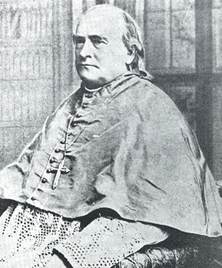
Bernard J. McQuaid, c. 1855
When Bishop James Roosevelt Bayley became the first Bishop of Newark he assigned McQuaid to cover multiple missions including the rectorship of St. Patrick’s Pro-Cathedral in Newark, and co-founding of Seton Hall College along with aid in establishing the Seton Sisters of Charity in Madison during the 1850s prior to becoming Vicar-General of the See in 1866.
During the mid-nineteenth century, the accomplishments made by McQuaid at Setonia were often tied into school firsts. Seton Hall College was initially located in Madison, New Jersey, and commenced operations on September 1, 1856 with an initial enrollment of five students. Those who were included on the registration rolls under the leadership of McQuaid could expect to endure a structured seven-year Classical, Liberal Arts program (three year prep and four year college study) with heavy emphasis on Theology, Philosophy, Latin, Greek and Foreign Language offerings. during his second term as chief executive, McQuaid helped with the move of the Seton Hall College campus from Madison to South Orange in 1860. The College was Incorporated by Act of the New Jersey State Legislature on March 8, 1861. McQuaid also belonged to the first Board of Trustees and co-authorized approval of the first Bachelor of Arts degree (A.B.) that was awarded to Louis Edward Firth in 1862. The earliest corporate seal included the Seton Family coat of arms and image of the Blessed Mary along with the enduring motto — Hazard Zit Forward — “No Matter What The Hazard, Yet Forward” was subsequently designed and adopted by the institution during May 1864 with sanction offered by McQuaid.
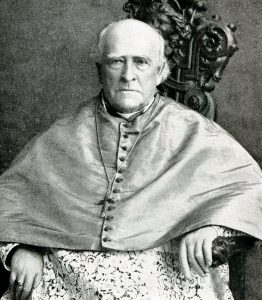
Bernard J. McQuaid, c. 1900
McQuiad was later appointed the first Bishop of Rochester (New York) in 1868 and continued forward with his primary cause of Catholic education in creating a strong parochial school systems, seminary, and was instrumental in working with the State university in the city on collaborative educational initiatives, all of which was generated in earnest during his time at Setonia and served the See of Rochester until his death in 1909.
More details on Bishop Bernard J. McQuaid can be found via our varied collections within the Monsignor William Noé Field Archives & Special Collections Center and the Seton Hall University Libraries. Finding aids and lists can be found via the following links below . . .
For more information and to inquire about obtaining information off-site or looking into a future research appointment please feel free to contact us by phone at: (973) 275-2378, or via e-mail at: Archives@shu.edu
In religious terms, December 26th is the second day of Christmastide is part of the “Twelve Days of Christmas” observance between the Nativity and Epiphany. In secular contemporary circles, the day itself is often seen as a time to rest, shop, or return gifts for exchange, but is also notable for the observance of what has come to be known as “Boxing Day” and has endured over the centuries. Various theories regarding the naming of this holiday have endured including among others servants receiving boxed gifts from their respective managers that emanated from Great Britain and is celebrated throughout the commonwealth wherein along with gifts in past days “lords of manor” and servants would trade places for that 24-hour period and in modern times the switch is based more on creative role playing in the present day. In Éire proper, December 26th among the Christian population in particular, a different style commemoration that honors the Feast of St. Stephen has its own customs and traditions which has lived on through the ages.
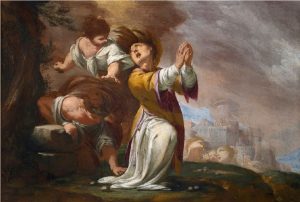
“The Stoning of Saint Stephen” by Giovanni Battista Lucini (1508) [Public Domain Image]St. Stephen (5-34 AD) was a church deacon who is often recognized (and memorialized in the Acts of the Apostles found throughout texts within the New Testament) as the first martyr of Christendom who lost his life in defense of his faith. The specific reason for his death came through reprisal for negative remarks about Jewish authorities that spread to the ears of various Synagogue overseers throughout the City of Jerusalem during the fourth century. According to existent accounts, Stephen was stoned to death for this sacrilege which led to his martyrdom and subsequent place of adoration over time. His deed is recognized throughout various Christian denominations on a worldwide scale. When it comes to the place of this martyr in Irish life, the famed Georgian square in Dublin, christened “St. Stephen’s Green” has immortalized him along with a Catholic parish that bears his name situated in Tyrrellspass, County Westmeath as well.
In broad terms, the traditional celebration of St. Stephen’s Day is actually a National Public Holiday (following in the wake of the Irish Banks Holiday Act of 1871) throughout the Republic of Ireland. This observance is also celebrated in other locales (especially prevalent across Europe), but within the townlands and villages of Ireland, pubs and stores are often open to accommodate the crowds and visiting family members, attending musical-comedy performances that rely mainly on pantomime as a means of expression, and/or attending special Masses honoring Stephen for the more devout are popular traditions and more modern in approach than in past years when a Wren was the true centerpiece.
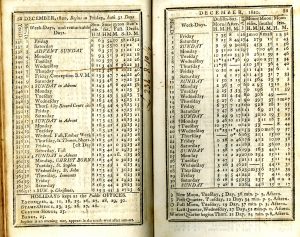
Atmospheric and Astrological details on St. Stephen’s Day, December 26, 1820 from the Irish Almanack of that year
This celebration is known in the Irish language as: Lá an Dreoilín or Lá Fhéile Stiofáin which in translation is known variously as “Wren Day,” “Wren’s Day,” or “Day of the Wren,” or the “Hunt of the Wren” (pronounced “wran” in Ireland) in which this bird is short in physical stature with a small wingspan is conversely loud and bold in its actions. Known in some circles as “The King of Birds,” the wren according to historical accounts was the betrayer of Stephen who was found after hiding from those who sought to kill him making this fowl who squealed an integral part of the story in this martyrdom. In the present day, it is considered good fortune for the individual to capture a live wren or a least secure a feather to find abundant good fortune while this bird of death is also associated with the old year.
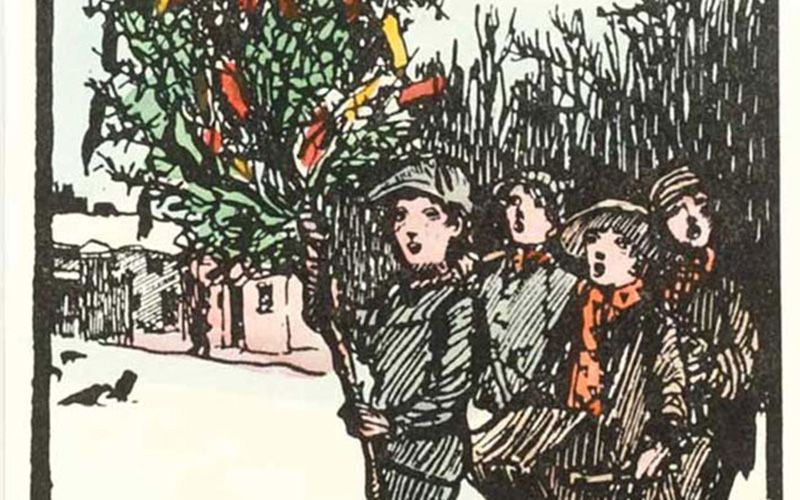
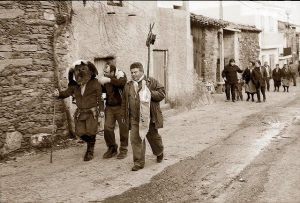
Tradition has it that on every December 26th, a procession of individuals (known variously as “mummers” or “strawboys” or “wrenboys”) don suits and hats of dried hay, colorfully mixed and matched old clothing with some festooned in tinsel or colored paper and wearing masks to hide their faces while playing musical instruments in Céilí style, or process and dance on their own downtown streets. During days of yore, in-between the march, the revelers stopped at homes along the way to ask for money, food, and drink as ingredients for the parties that were celebrated on that day.
Image of child-led procession in celebration of St. Stephen’s Day – “The Day of the Wren” c. early 20th century. Image from the site – https://www.doolin2aranferries.com/blog/the-day-of-the-wren-la-an-dreoilin/
For those who did not contribute according to legend would risk having a wren buried outside of their door which would constitute twelve years of back luck for the non-donor. In present times, those who collect money often donates these alms to charity or local schools instead of using it on themselves. Leading the way for the band of revelers within the parade itself is a pole bearer (or a few) who has a faux wren (in past ages it was a real bird, but this practice was phased out around the turn of the twentieth century) mounted atop this staff and in some cases also adorned with a holly bush to further denote the hiding place of Stephen upon his discovery. Thu tradition is more common and celebrated fervently in different parts of Ireland including Dingle and Westmeath among others and has since fallen out of vogue in other regions of Ireland, but has undergone a more modern revival while keeping core traditions alive especially the honoring of the wren, song, dance, and expression which is now co-educational while in past days was a male only revelry.
Many who have no recognition of St. Stephen, may have heard his name within the refrain of the song “Good King Wenceslas” by John Mason Neale in 1853 actually in honor of his feast day. This ballad begins in the following manner: “Good King Wenceslas look’d out, On the Feast of Stephen; When the snow lay round about, Deep, and crisp, and even . . . Brightly shone the moon that night . . .”
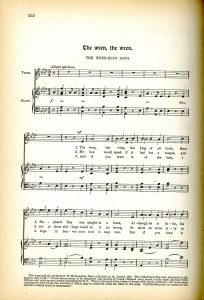
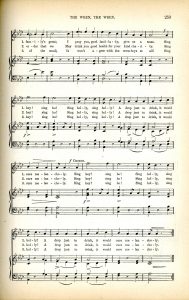
This mention is also a compliment to a number of poems and songs that honor St. Stephen and the Day of the Wren including: “The Wren, The Wren” (The Wrenboys Song) published in popular music anthologies during the nineteenth centur
.
Sheet Music to the Tune – “The Wren, The Wren” c. 1870s
However, he most prevalent and standard of rhymes that is repeated over and over on December 26th is the following verse . . .
The Wren, the Wren the king of all birds, St. Stephens’s day, he was caught in the furze. Although he is little, his honour is great, Rise up, kind sir, and give us a trate.
We followed this Wren ten miles or more Through hedges and ditches and heaps of snow, We up with our wattles and gave him a fall And brought him here to show you all.
For we are the boys that came your way To bury the Wren on Saint Stephens’s Day, So up with the kettle and down with the pan! Give us some help for to bury the Wren!
For more information about the story of St. Stephen can be found within New Testament text found in our Rare Book Collection including one of the oldest of our Irish-language volumes entitled: Tiomna Nuadh ar dTighearna agus ar Slanuigheora Iósa Criosd : ar na ťarrv, ng go firněać as Greigis go Gioďeilg (1681) along with other versions in later editions in multiple languages.
For more information on St. Stephen, Wren Day, and other aspects of Irish and Religious History please feel free to contact us by phone at: (973) 275-2378, or via e-mail: Archives@shu.edu
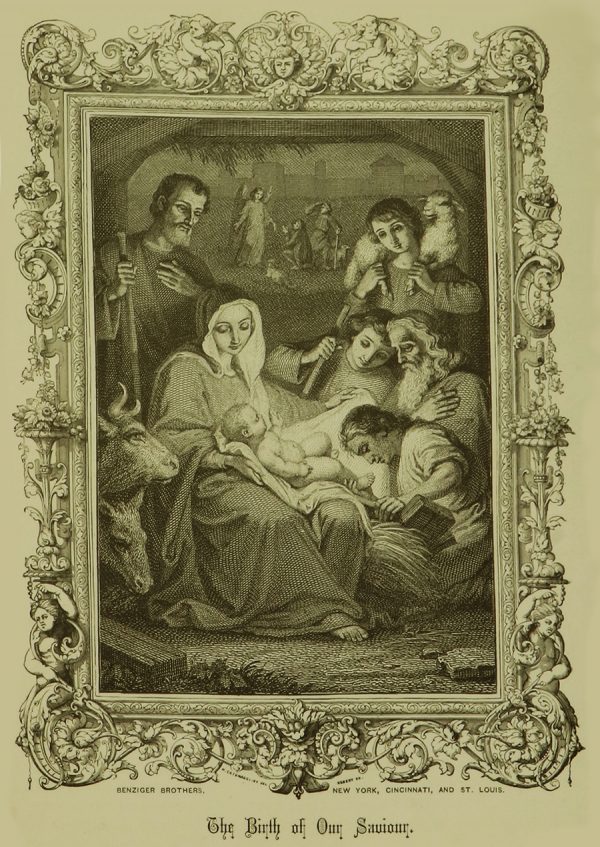
Hercule Louis Catenacci The Birth of Our Saviour In The Life of Our Lord and Savior Jesus Christ and of the Blessed Virgin Mary engraving
1879, published by the Benzinger Brothers
Courtesy of Archives and Special Collections
MERRY CHRISTMAS
“We desire to be able to welcome Jesus at Christmas-time, not in a cold manger of our heart, but in a heart full of love and humility, in a heart so pure, so immaculate, so warm with love for one another.” – St. Teresa of Calcutta
This engraved image depicting the birth of Jesus is from one of many bibles in the university’s Rare Book Library, which is cared for by the Department of Archives and Special Collections. This volume, entitled The Life of Our Lord and Saviour Jesus Christ and of his Virgin Mother Mary, was published in 1879 by Benzinger Brothers Publishing.[1] The illustration shown here was engraved by Hercule Louis Catenacci, a French painter and illustrator.
Catenacci was born in Ferrara, a province in present-day Italy, in 1816. He later moved to France, illustrating numerous books and journals on a variety of subjects. Cantenacci’s versatility was demonstrated thematically as well in his ability to adopt numerous illustrative styles depending upon the commission. His illustrations included Moorish architecture in Spain, sarcophagus designs from a French exposition, the art and architecture of India, liturgical objects, garden landscapes, Italian piazzas, Cambodian ruins and images of protestors.[2]
Benzinger Brothers Publishing was founded in Switzerland in 1792 with the express purpose of functioning as a Catholic publishing house. In the late 19th century, the publisher expanded its operations to the United States, opening offices in Chicago and Cincinnati.[3] It has been through many iterations since then, being bought, sold and consolidated several times. Still in existence today, Benzinger Brothers has been operating under the name RCL Benzinger since 2016, when it became a subsidiary of Kendall Hunt Publishing of Dubuque, Iowa.[4] RCL Benzinger still has offices in Cincinnati and primarily serves religious education programs for Catholic dioceses, parishes, schools, families, and individuals, including bilingual students and students with disabilities.[5]
The images and materials shown here are but a small part of the vast patrimony available to students, faculty and researchers. For access to this or other objects in our collections, complete a research request form to set up an appointment or contact us at 973-761-9476.
[1]The Life Of Our Lord And Saviour Jesus Christ And Of His Virgin 1 Mother Mary. New York: Benzinger Brothers, 1879. p.298.
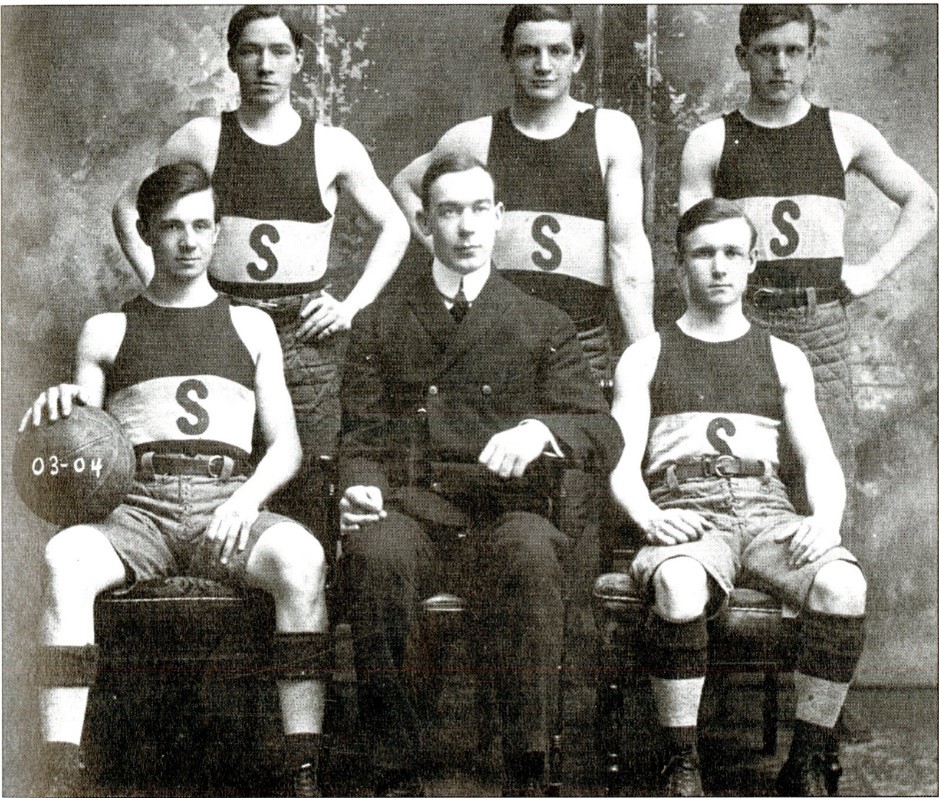
Members of the 1903 – 1904 Inaugural Seton Hall Men’s Basketball Team Courtesy of Archives and Special Collections, SHU 0031
Seton Hall University Athletics & Recreation Collection
Top, left to right: William Baird, Henry McDonough (team captain), Robert Barrett Bottom, left to right: Martin Reynolds, John Holton (manager), Bernard Barrett Not pictured: Charles O’Neill, Francis Reilly, John Stafford, Charles Tichler.
SETON HALL MEN’S BASKETBALL TEAM WINS FIRST GAME EVER –DECEMBER 19, 1903
Basketball has a long and storied history at Seton Hall University. The 1903 – 1904 season was the first time a men’s team was organized at the university to play the sport which had been developed in the late 19th century by Dr. James Naismith at Springfield College in Massachusetts.[1] Naismith sought a way to keep student athletes physically active during the winter months when sports could not be played out-of-doors.[2] The inaugural men’s basketball team at Seton Hall consisted of 9 players and their manager. Their first game was against the Mohawk Club of Newark which ended in a draw (15 – 15) on December 9, 1903. Just ten days later, on December 19, the team would win their first game ever against Brooklyn High School (28 – 12). At the time, it was not uncommon for college teams to compete against local YMCA’s, club teams and high schools as well as other colleges. The first basketball season was a short one, ending after six games on January 16, 1904 with a record of two wins, three losses and one tie.[3]
Matchbook cover from WNJR Radio advertising Seton Hall basketball 1949 2020.07.0001 Courtesy of Archives and Special Collections
From the 1890s through the 1900s, Seton Hall’s sports teams were known as the Villagers. Shortly after the turn of the 20th century, the teams were known as The White and Blue, a reference to the school colors. In was not until 1931 that the University’s sports teams took the familiar name Pirates.[4] The men’s basketball team has come a long way from their humble beginnings playing in attics and assembly halls on campus. The award-winning series The Voyage chronicles their 2019-2020 season that ended in winning the Big East regular season championship. You can find all 22 episodes on Youtube. Today, both the men’s[5] and women’s[6] basketball programs represent Seton Hall University in the Big East Conference. Dozens of former Pirates have played or currently play basketball professionally in the NBA, WNBA and on overseas teams.[7]
The Walsh Gallery has a considerable collection of fine art, artifacts and archeological specimens for use by faculty, students and researchers. For access to this or other objects in our collections, contact us at 973-275-2033 or walshgallery@shu.edu to make a research appointment.
[1] Delozier, Alan Bernard. “1 – Foundation 1903 – 1940” Seton Hall Pirates – A Basketball History, 9 – 11. Charleston, SC: Arcadia Publishing, 2002
Portrait of Monsignor Fahy, from the Seton Hall Vertical File
I learned about Monsignor Fahy in the spring semester of 2018. It was at an intergenerational panel discussion at the Walsh Library of former Seton Hall student-activist leaders. The event was organized by the Concerned 44, an activated student group. The panel discussion was a teach-in about the history of protest on Seton Hall’s campus and discussion about the progress of the then student movement. You can follow the Concerned 44 on Instagram. If it weren’t for this panel discussion I would not have learned about President Fahy and I’d still be pronouncing Fahy Hall wrong. As an alumna, I can’t help but be angry that it took this long. I became more interested and invited colleagues into the journey of getting to know Fahy.
Alan Delozier, University Archivist, did the work to uncover the Fahy Inaugural address which is as relevant today as it was 50 years ago. The CORE has integrated the speech as a required reading for the Journey of Transformations course. And this article intends to showcase a digital
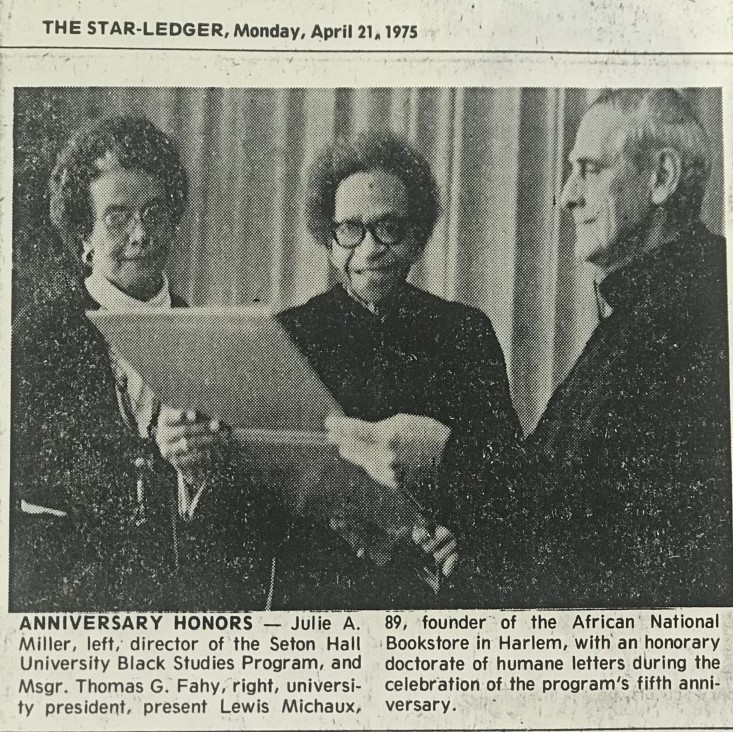
Monsignor Fahy with the leadership of the Black Studies Program, Newark Star Ledger, April 21, 1975
communal reading of the text as an activist performance practice. The point of the project is to position the text and its ethos as a cultural imprint on our collective memory. To me, Fahy is a white anti-racist abolitionist ancestor who risked and used his power to benefit others. Social justice is a term we’re hearing a lot. What is it? How do you define it? What does it look like? Everyone will have a different answer. I define it as: righting a wrong. If it doesn’t right a wrong, it is not justice. Not only did Fahy leverage his power to right a wrong with some of the most impactful undertakings of Seton Hall’s history but he acknowledged the problem. Often, we rush to solutions without first doing the self interrogation to name the problem. He used this moment, his inaugural address, when everyone was listening and we’re still listening 50 years later.
The video, this collective recitation, brings many voices together for one message. Faculty and students, separate, but together. It carves a lineage. There are protests now as there were 50 years ago. In the streets and on our campus.
Greg Iannarella offers insight into what moved him to gravitate toward one of the most unwavering parts of Fahy’s speech, “This section always felt really powerful to me. The description, the intentional language, invoking real scenes and real communities, conjuring the people! It’s a moment where he turns the gaze outward and challenges the audience to see what is relevant.”
Participants were encouraged to think about their location as a backdrop. These choices offer additional meaning and subtext. Virtual performance lets us become our own set designers. Brooke Duffy presented her portion outside of a new school. “It is a public elementary school in Teaneck that was recently renamed for Theodora Smiley Lacey, a civil rights activist, ‘living legend.’ The NorthJersey.com website describes, ‘it was because of her efforts that Teaneck became the first city in the United States to voluntarily integrate its public schools.’”
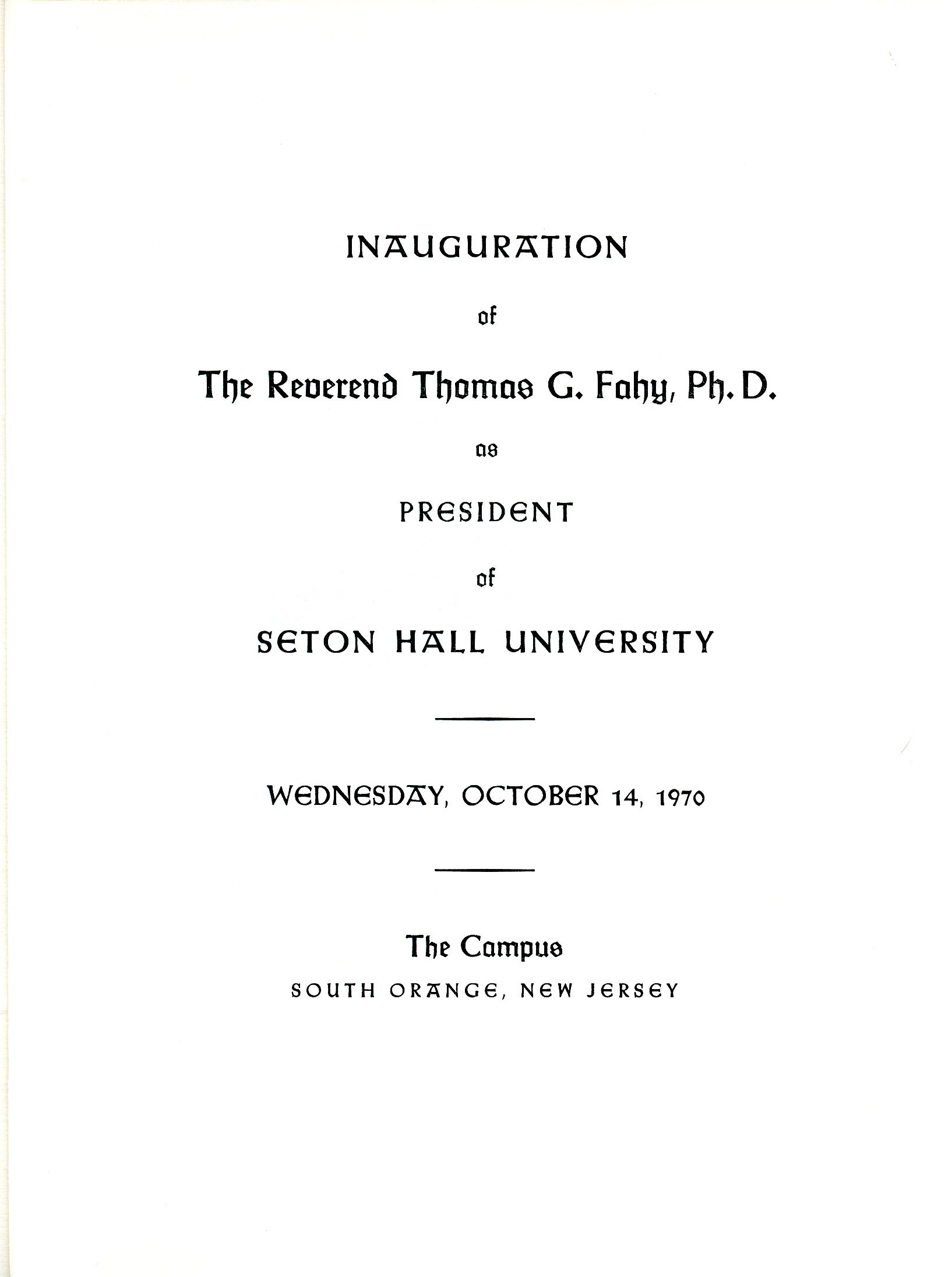
Program of Monsignor Fahy’s Inaugural Address, October 14, 1970, from Seton Hall’s Vertical Files
This isn’t the last we’ll hear of Fahy’s address. Jon Radwan describes a new participatory oral history project designed to ensure access, inclusion, and equity in its research process to document and preserve the entirety of this part of the University’s history. “We are confident that the Inaugural Address is only the beginning of learning about Msgr. Fahy’s social justice leadership. Our recent proposal to the New Jersey Council for the Humanities seeks funding for a large scale oral history project. We plan to contact alumni, faculty, and administrators who worked closely with Fahy to record their stories about SHU’s collaboration with Newark activists to launch the Black Studies Center.” To support this project please contact Angela Kariotis and Jon Radwan.
Centering historical figures creates their own mythology. Retrospectives are not without their limitations. But there are so few white allies to look up to for this work. Allies must dig deep, activating themselves, stepping into their consciousness. We can extend the Fahy legacy and course correct. Like 50 years ago, it is a transformative yet fragile time. We must have the will to meet it.
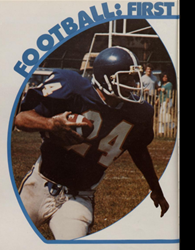
“Touchdown for Old Setonia!” was an exclamation that was cheered on by players, cheerleaders, supporters in the grandstands, and all who followed the fortunes of Seton Hall College football throughout its earliest days in action. Joining both Baseball and Basketball as a signature sport during the earliest years of intercollegiate competition at Seton Hall, Football was also included as one of the most prolific and successful athletic teams on campus.
American Football celebrated its Sesquicentennial last year with the game being created in New Jersey in 1869, and as colleges and universities discovered the sport they introduced it to their respective student bodies in turn. This ultimately led to wide-spread popularity of this game which quickly became synonymous with Fall Saturdays and captured the imagination of the overall sporting public. This is especially true during the nineteenth century when Football was developing itself as a unique and unifying force around the country. The attractiveness of this sport especially among the immigrant sons and first generation of college students at Setonia at first and as it became the “American Game” (as a parallel to Baseball as the “American Past-Time) built in popularity over the century plus.
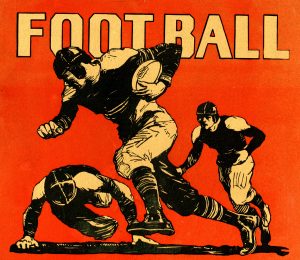
Football Poster Illustration, c. 1923
Seton Hall can share in a chapter of College Football history through the posting of several memorable seasons, players, coaches, and milestones that make this story a memorable on in various ways beyond the “gridiron” alone. In retrospect, the days of Seton Hall Football is a case of fond memories, regular inquires about the research aspects of the sport, and many wistful questions about if it will return as a sport on campus at some point in the future? Time and circumstances will tell if we can kick-off once again, but for now let us reflect on a sport that at one time gripped the imagination of the campus and its fandom.
Seton Hall campus back in the day when the school fielded a competitive football eleven at various junctures from the late nineteenth century through the early 1980s. An auspicious moment came when looking at the “kickoff” of the sport at the college, it is recognized by various scholars that Seton Hall played in the very first football contest between two Catholic institutions of higher education when they matched up against St. John’s (later known as Fordham and not to be confused with St. John’s of Queens) during the Autumn of 1882. Although this seminal moment resulted in a loss, the following December when the Setonia Eleven posted their first victory as a program over St. John’s by a score of 2-0 (This was measured in “goals” as different scoring rules were in vogue during the nineteenth century and would later change as the game expanded and modernized over time) which helped to solidify the sport and show it had the potential to succeed.
Illustration of Football Player, 1931 White & Blue Yearbook
Between 1885 and 1886, Seton Hall posted undefeated campaigns, had a five game winning streak, and were unscored upon and handily defeated St. John’s in particular by scores of 14-0, 36-0, 12-0, 32-0, and 63-0 before dropping the sport in 1887. The squad resumed play the following season with a new nickname – “The Alerts” (with a Junior Varsity or Freshman team nicknamed – “The Senators” or “Crescents” at various times over the next few years) and boasted a 2-1 record after playing St. John’s three more times before diversifying their scheduling by the end of the 1880s.
By 1889, The Alerts played a more diverse set of opponents when they matched up against a number of independent Northern New Jersey-New York City metropolitan based club teams in particular including the Oritani Field Club and Bedford FC, defeating them both 28-0 and 18-4 respectively that year. Additional athletic organizations and high school contingents were played during the 1890s including such entities as the Newark AC, Palma Club of Jersey City, Varuna Boat Club, Brooklyn Poly, Hoboken HS, Iron Cross of Jersey City, Willet’s Point Engineers Corp , Motor Team of Brooklyn, Crescents of Harlem, and the Morristown Field Club, etc. Conversely, Seton Hall also started to play other collegiate squads aside from St. John’s alone including Hackettstown Institute (later known as Centenary College), St. Francis Xavier, Trenton State Normal School, St. John’s (Queens), College of New Jersey (later known as Princeton) Frosh, City College of New York (CCNY) Juniors, St. Peter’s College (Jersey City), and Manhattan College among others who had campuses around the region.
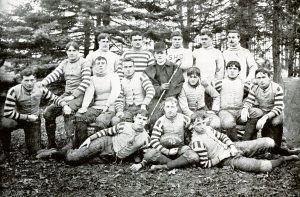
Undefeated Seton Hall College Eleven, 1893
In terms of coach guidance, Seton Hall relied on James P. Lee (Harvard, ’90) who was an All-American selection for the Crimson in 1889 and enrolled at the Columbia Law school earning his LL.B. degree while simultaneously employed by Seton Hall during the 1890s. Counted among the standout players during this era included such “gridders” as Gene Kinkead, John Phelan, Jim Smith, Tom Reilly, Tom Walsh, Richard Kane, Gene McDonald and the first of many members of the McDonough family who donned the White and Blue sweaters of Setonia. Under the guidance of Coach Lee and company, winning seasons were attained in 1892, 1893 (undefeated), 1894, 1895, 1896, 1897, 1898, 1899 were earned and Setonia amassed a combined record between 1883 and 1899 of 63-13- 5 (with various cancelations and forfeits) to end the century on a high note.
Moving into the early twentieth century, more action was in play at different levels for the Setonia Football teams and fans as an Alumni squad was formed to compliment the Varsity and “Frosh” contingents and a more structured scheduling trend emerged as more collegiate elevens and fewer club or prep school teams were played, but not entirely eliminated from the opponent list altogether. Counted among those squads Seton Hall played included such squads as the Seton Hall Alumni, Nassau Club of Princeton, Knickerbocker AC, 5th U.S. Artillery, Dreadnaught AC, Willet’s Point Engineers Corp, Robert Davis Association at St. George Cricket Ground, Hoboken. Fort Hancock (Sandy Hook), Eaton Business College, New Jersey State School, Columbia College of Physicians and Surgeons, New York , University & Bellevue Medical College, and others.
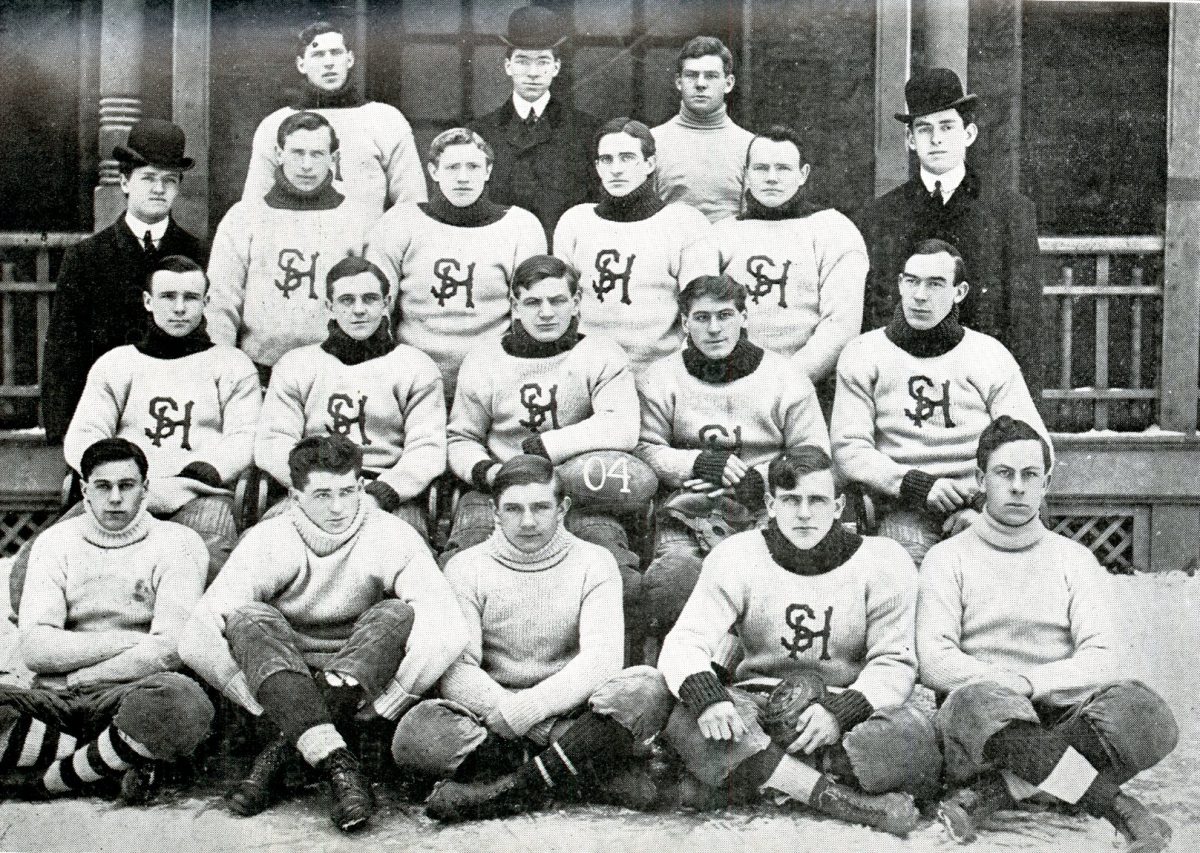
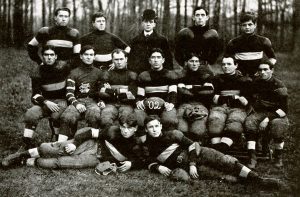
Seton Hall College Football Team, 1902
In 1900, Seton Hall posted a 7-3 record and improved to 9-2 a year later. Perfection came in 1903 when The Alerts went 8-0 and the point total for the year was an amazing 174-2. A majority of home games were scheduled for the first time and through this memorable season Seton Hall defeated such opponents as Philadelphia Dental College, Manhattan College, Villanova, Columbia Law, and Pratt Institute. By 1904, Seton Hall had another winning campaign at 7-2 when they defeated a number of higher profile institutions including the University of Maryland (17-0), Fordham (6-0), and Delaware (26-0). In 1905, The Alerts defeated St. Francis-Brooklyn (71-0) and Rutgers (22-10) which served as a high water mark to cap the first decade of the twentieth century.
Beyond the “Golden Age” of Seton Hall Football, the presence of records become somewhat sketchy as there is no existing log of results from 1906-1912. The last pre-Great War documentation shows that Setonia went 5-1 in 1913 and defeated among others the Fordham “B” team, St. Francis-Brooklyn, and St. Peter’s College by a differential of 212 points for Setonia to 27 for their opponents. By this time, Jack Fish (who later coached Baseball and at Seton Hall Prep) scored 48 points and James “Honey” Dugan 47 of his own which contributed to this successful season and marked the last major success during the “Golden Age” as the college dropped football for the duration of World War I and the administration would not sponsor the sport again until the Fall of 1922 when they registered a 3-2 record.
During the 1920s, football at Setonia was short-lived, but highlights included the renewed emergence of Junior Varsity Football with more prominence among the star players during this period included John J. Dougherty (later an Auxiliary Bishop and President of Seton Hall from 1959-69) who was a guard on the 1926 team which went 5-2-1 and Bud Conlan a starting center and team captain for three years. This era included a mix of highs and lows as they played such schools as Trenton Normal (later Trenton State and presently the College of New Jersey), Upsala, Pennington School, University of Pennsylvania Frosh, Cooper Union, Temple, Albright, CCNY JV and Villanova Frosh among others as Football at Seton Hall was doomed to pause again after 1928.
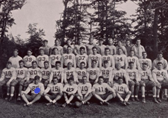
Seton Hall Football Squad, 1931
A serious move was made to create a successful tradition with the hire of Richard Paul “Red” Smith (1904-1978) an alumnus of the University of Notre Dame and protégé of legendary coach Knute Rockne. After playing for the Irish, Smith also played professional football with the Green Bay Packers, New York Giants, and New York Yankees in the National Football League (NFL) and baseball with the New York Giants of the National League (NL) prior to serving as Head Coach of the Seton Hall eleven during the early 1930s before going back to the professional leagues as an assistant coach for the Packers and Giants in the NFL and also the Chicago Cubs of the NL.
The last appearance of the team during the Great Depression era came from 1930-33 with little success although they did not have any winning records, they did post singular wins over Moravian, Brooklyn College, East Stroudsburg State, Canisius, and others. Nearby Upsala of East Orange was a natural rival and in 1931 they played a benefit game to help aid the destitute during this time in what was billed as the “Championship of the Oranges” in a memorable community encounter. Setonia also played its first documented night game (a rare occurrence during the 1930s) against Davis & Elkins of West Virginia held in Municipal Auditorium, Atlantic City before a crowd of 5,000. Otherwise, Seton Hall played a spotty schedule during the 1940-47 seasons including a gap during World War II, but an undefeated 2-0 campaign where they defeated the 1941 – 2-0 Scranton Frosh and the Marianopolis Club.
Many Catholic colleges disbanded their long standing football teams including St. Bonaventure, Manhattan, University of San Francisco and others during the late 1940s and early 1950s as a cost saving measure and to invest in their basketball teams for success and Seton Hall was no exception to this trend. However, in moving forward to the mid-1960s and the desire to have Football back on campus once again a vision shared not only in South Orange proper, but also by various Eastern schools in the Newark-metropolitan area in particular who wanted to feature the sport once again. As a result of this promise of fielding Football and linking into the wishes of student and alumni fan based in particular, a new Club league that was structured among higher educational entities that were similar sized, many being peer institutions, and geographically balanced formed in 1965. Seton Hall would eventually play the following schools through the remainder of the decade into the early 1970s including Fordham Iona, St. peter’s, Jersey City Sate, King’s College (PA), Georgetown, Providence, Adelphi, Scranton, Manhattan College, Rutgers-Newark, Fairleigh Dickinson, American University, William Paterson State, St. John’s, Concordia, Pace, Upsala, Army “B” squad, etc.
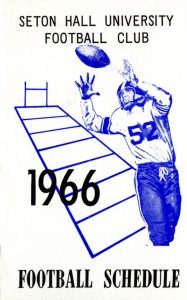
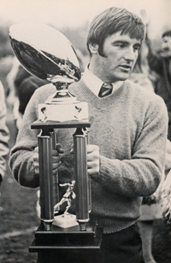
The first Club-based season of 1965 included the inaugural game, a night contest that led to a victory v. Marist at Newark Stadium by a tally of 28-6 and contributed to a season record of 3-1 wins that included a second win over Marist and St. Peter’s College at Roosevelt Stadium in Jersey City. Subsequent memorable moments followed in 1966 (4-2-1), 1967 (5-2), 1968 (5-3), and 1971 (6-2). The highpoint of the Club-era came in 1972 (9-1) Eastern Club Bowl/Empire Bowl Championship. The Schaeffer Bowl at Jack Coffey Field (Fordham), the Pirates (new nickname adopted by the school in 1931) defeated Marist by a count of 20-18 with 3,000 in attendance. This also aided the selection of Ed Madigan as Coach of the Year honors for head man and success for the team as a whole.
The success of the 1972 squad and the consistency of the program during the 1960s led them to advance a notch upward in the College Football hierarchy when they became a non-scholarship, program within the ranks of NCAA Division III (Division I being the highest) and they would encounter some victories in their first year (3-5) of 1973 including shutout wins over Rutgers-Newark (42-0) and Rochester Tech of New York (24-0). In 1974 7-2. Overall winning records would come in 1978 (5-4) and 1979 (4-4-1 with a forfeit in favor of Seton Hall). However, the rest of their time playing within the NCAA ranks led to consecutive losing seasons.
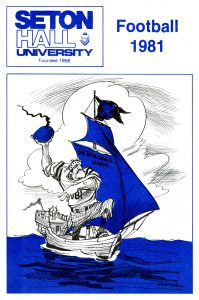
Football Image, 1981
Although a high point in terms of venue came via playing select Saturday home and away games at Giants Stadium in the New Jersey Meadowlands from 1977 through 1981. In addition, Seton Hall played in the annual “Pride Bowl” of 1980 against Cheyney State although in a losing effort (0-26) a benefit contest of note for that time period. The final years included contests played against Catholic University of America, Hofstra, Pace, Montclair State, Coast Guard Academy, Rochester, Wagner, C.W. Post, Kings Point MMA, Kean, and others.
Despite being competitive and hopes of improved records, 1981 marked the last season of Seton Hall Football to date as the school discontinued the sport in 1982. Despite its absence, the legacy of the sport lives on in the heart and memories of Seton Hall alumni and local football fans in particular.
More information on College Football in general and particular can be found within the following Internet links along with many other sources that can be referenced upon request . . .
For more information regarding the History of Football and other Seton Hall Athletics History topics please feel free to contact Alan Delozier, University Archivist via e-mail at: Alan.Delozier@shu.edu or by phone at: (973) 275-2378.
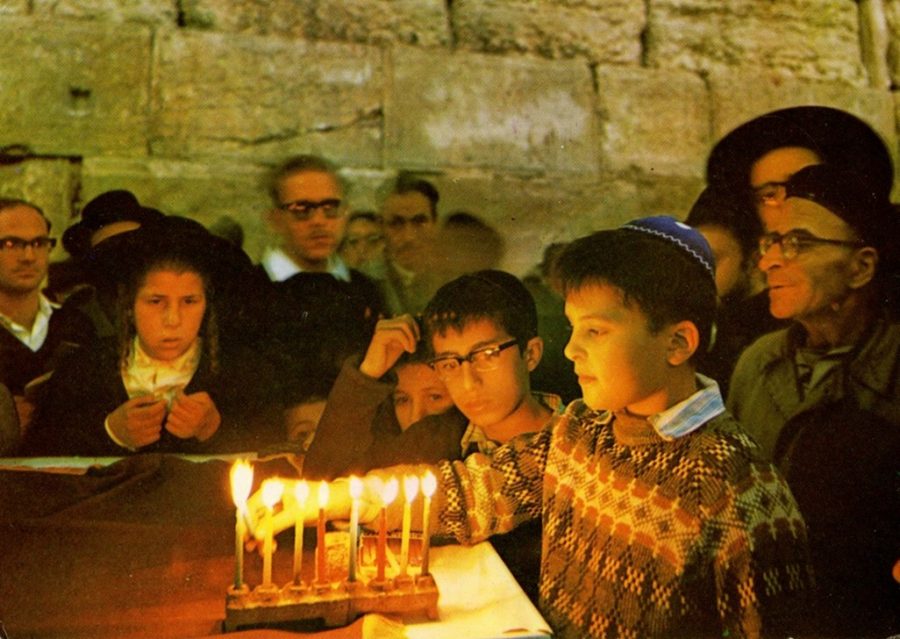
Postcard: Hanukkah observances at Jerusalem’s Western Wall
MSS 0016 – Sister Rose Thering Papers
Courtesy of The Department of Archives and Special Collections
“Hanukkah Sameach!” (Happy Hanukkah)
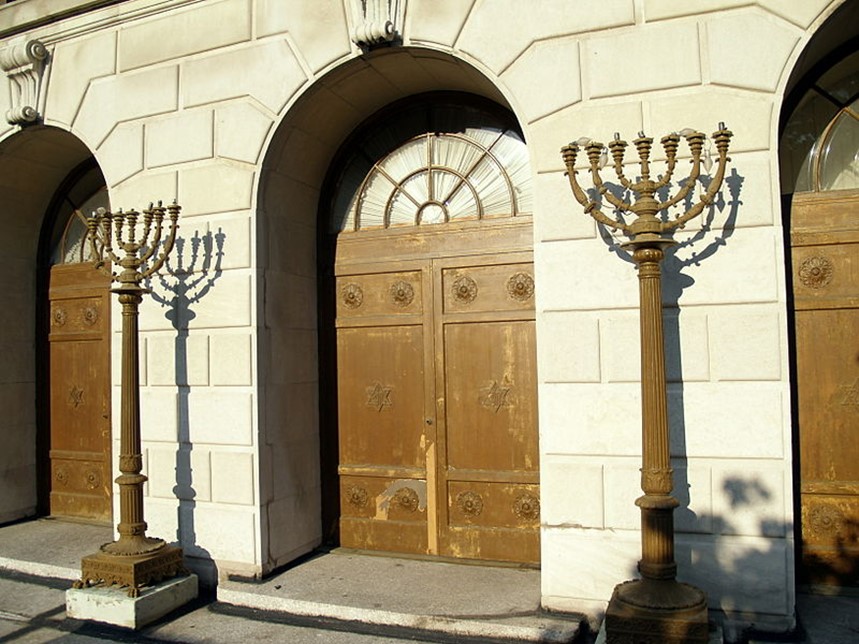
Menorahs flanking entrance to East Midwood Jewish Center in Brooklyn, New York Image: David Shankbone https://commons.wikimedia.org/wiki/File:East_Midwood_Jewish_Center_menorah.JPG
Hanukkah is the Festival of Lights, the holiday that commemorates the rededication of the Jewish temple in Jerusalem in the 2nd century BCE.[1] This historical event memorializes when a small army of Jews, known as the Maccabees, rebelled against the Seleucid Greek King Antiochus IV Epiphanes who had outlawed the Jewish religion and defiled the holy temple by installing an altar to Zeus Olympios and sacrificing pigs within the sacred space, an affront to Jewish law.[2] The king’s soldiers massacred thousands during the uprising.[3] When the Maccabees regained control of the temple, they built a new altar to again offer sacrifices in accordance with, halakha,[4] the collective body of Jewish laws that addresses civil, criminal and religious codes.[5]
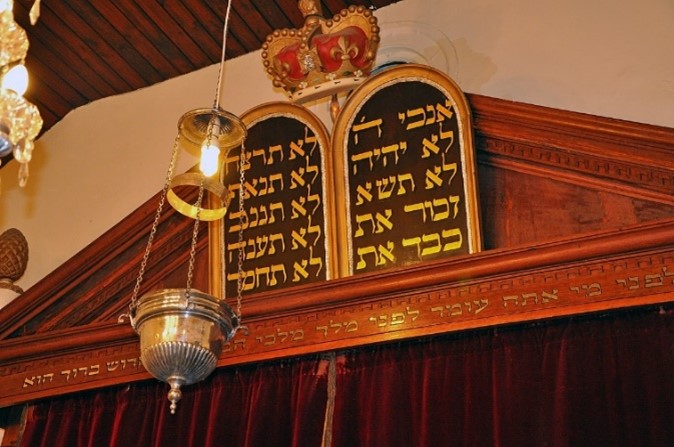
An Eternal Light (ner tamid) hangs above or near the ark in every synagogue Image: Moshi Anahory, https://www.flickr.com/photos/mosh70/9447892262/
The postcard image accompanying this post is from the University’s Archives and Special Collections’ Sister Rose Thering Papers, an archive of correspondence, speeches and travel information dating mostly to her time in New Jersey working for the Institute of Judaeo-Christian studies, as well as documents relating to her teaching and scholarly activities.[8] Sister Rose Thering belonged to the Dominican Order which was founded in 1206 in France. She advocated tirelessly in favor of legislation for the teaching of the Holocaust and was an international activist against anti-Semitism.[9] The Sister Rose Thering Fund at Seton Hall University continues her work by fostering understanding and cooperation among Jews, Christians and people of other religious traditions through advocacy and education. Sister Rose Thering founded the fund in 1993 and worked there until her retirement in 2005.[10] Sister Rose said, “To be a better Christian you need to find out where you are rooted. Take a good look at Judaism. Our roots are in Judaism. Jewish people have much to teach us. We must learn from our elder brothers and sisters.”[11]
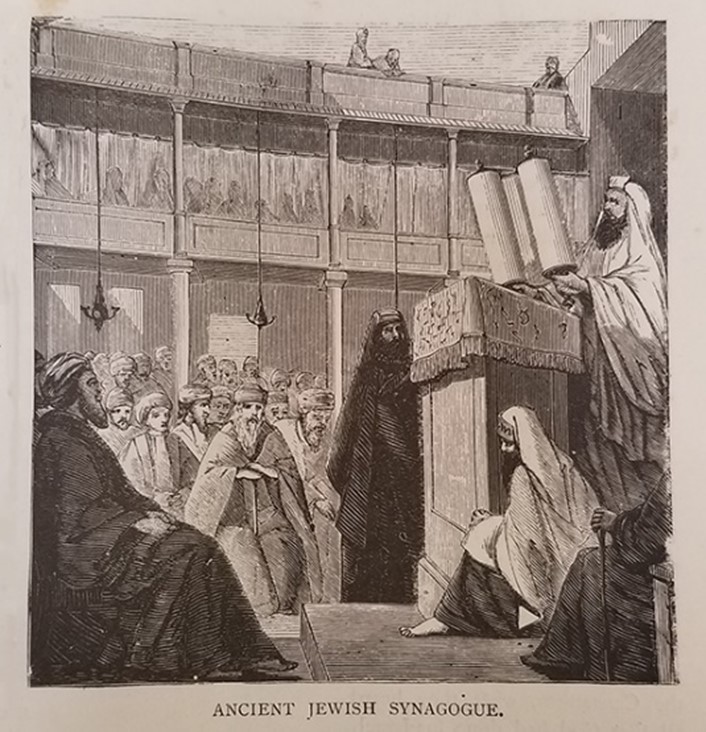
Engraving: “Ancient Jewish Synagogue.” New Devotional and Practical Pictorial Family Bible. Philadelphia, PA: The National Publishing Co. and Jones Brothers & Co., 1879, pg. 17. Courtesy of The Department of Archives and Special Collections
The images and materials shown here are but a small part of the vast patrimony available to students, faculty and researchers. For access to this or other objects in our collections, complete a research request form to set up an appointment or contact us at 973-761-9476.
Donald M. Payne served as a U.S. Representative for New Jersey’s 10th Congressional District from 1989 through 2012 and was the state’s first African American congressional representative. Born and raised in Newark, he is an alumnus of Seton Hall University where he earned his bachelor’s degree in 1957 before continuing his studies at the graduate level at Springfield College in Massachusetts.[1] Before his life in politics, Donald M. Payne was an executive at Prudential Financial, served as vice president at Urban Data Systems and taught in Newark’s Public Schools. In 1970, he became the first black president of the National Council of Y.M.C.A.s before becoming Chairman of the World Y.M.C.A. Refugee and Rehabilitation Committee. In 1972, Payne ran for a seat on the Essex County Board of Chosen Freeholders and was elected – serving three terms in total. He also served three terms on the Newark Municipal council from 1982 to 1988.[2]
During his time in the U.S. House of Representatives, Congressman Payne served on many important committees and was a leading advocate for education, democracy, and human rights. In his first term as congressional representative, Donald Payne was appointed to the House Committee on Education and Labor and the House Committee on Foreign Affairs. During his subsequent eleven terms in Congress, he also served on the following; Subcommittee on Workforce Protections; the Subcommittee on Early Childhood, Elementary, and Secondary Education; the Subcommittee on Africa and Global Health, of which he was also the chairman; the Subcommittee on the Western Hemisphere; and the Subcommittee on Organizations, Human Rights, and Oversight. He was also a member of the Congressional Black Caucus, serving as chair from 1995-1997. He belonged to several other congressional caucuses, including the Progressive Caucus and the Congressional Human Rights Caucus, and co-founded the Sudan Caucus in 2005. [3]
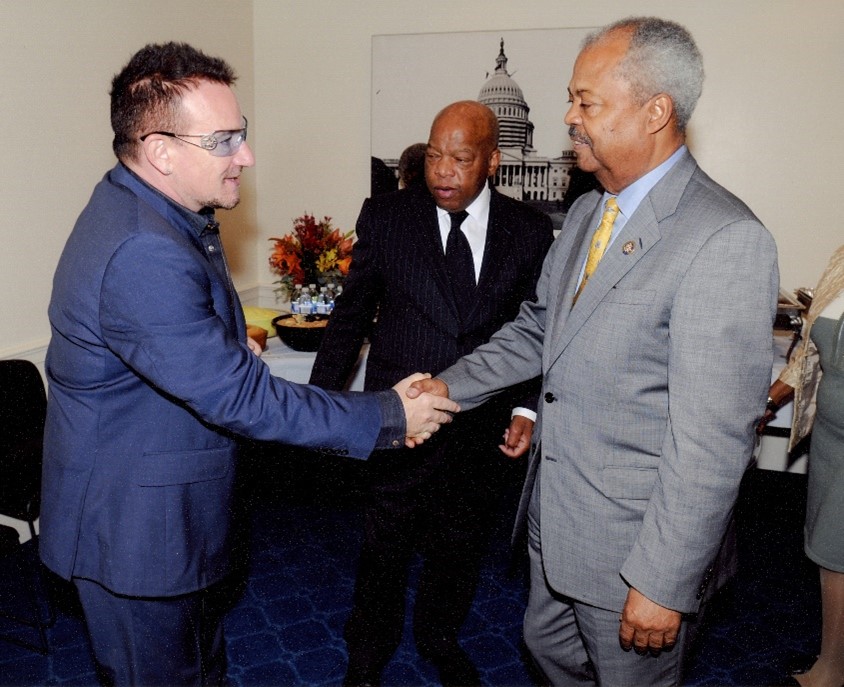
from the left: U.S. Representative Gregory Meeks – NY (L) with Nobel Peace Prize Laureate Wangarĩ Muta Maathai, Representative Donald Payne and Ambassador Leonard Ngaithe – Courtesy of Archives and Special Collections, MSS 0078
In 1994, Representative Payne led an official delegation to Rwanda, seeking to end the ethnic violence that claimed hundreds of thousands of lives. He was also among the first to publicly denounce the Sudanese genocide in the country’s Darfur region in 2003. Later, Payne called for an international tribunal which brought Sudanese militia members responsible for the massacres to justice.[4] Representative Payne championed the Africa Growth and Opportunities Act (2000) to promote African economic development and trade with the US. He sponsored or co-sponsored dozens of bills to help African countries economically, support peace, expand agricultural programs, provide safe drinking water and promote educational opportunities for millions of children. In 2008 he had a key role in the authorization of up to $48 billion over 5 years to fight HIV/AIDS, a substantial portion of it going to Africa.[5]
Upon his death in 2012, Professor Alemayehu G. Mariam, professor of political science at California State University, San Bernardino and expert in human rights law, eulogized Representative Payne in EthiopianNews and Views: “His passing marks a major setback to the cause of freedom, democracy and human rights in Ethiopia and Africa. But Don Payne has left us a rich legacy of human rights advocacy and legislative action spanning over two decades. It is now our burden — indeed our moral duty — to build, to expand and to deliver on that legacy.”[6] The son of a chauffeur and lumber handler, Representative Payne worked his way through college while attending Seton Hall University. He said, “We have to understand there are no more impossible dreams for black youngsters. They can do basically anything they want to do, and if I’m a prime example of that, all the better.”[7] Whether serving on a global scale as a human rights activist, or motivating black youth locally, both messages are inspiring and demonstrate Payne’s unwavering commitment to service. The Donald M. Payne Sr. Global Foundation continues Representative Payne’s work as a global human rights advocate and community activist. You can watch this documentary video, The Life of Congressman Donald M. Payne, Sr. to learn more about his life’s work.
Seton Hall University’s Department of Archives and Special Collections holds the professional papers of Donald M. Payne from his time as U.S. Representative for New Jersey’s 10th congressional district. The materials are related to Congressman Payne’s legislative work, particularly for the
Letter from Representative Gregory Meeks to Donald Payne, 2005 – Courtesy of Archives and Special Collections MSS0078
House Committee on Education and Labor and the House Committee on Foreign Affairs, as well as his work on behalf of his district and state. There are also background materials on a wide variety of issues, projects, events, and pieces of legislation relevant to Congressman Payne’s career, and materials related to his involvement in congressional organizations and activities, including a large number of press clippings, recorded appearances and speeches, and photographs depicting Congressman Payne with notable public figures and celebrities including Presidents of the United States and several other countries.[8]
The images and materials shown here are but a small part of the vast patrimony available to students, faculty and researchers. For access to this or other objects in our collections, complete a research request form to set up an appointment or contact us at 973-761-9476.
November is National Black Catholic History Month and the Monsignor William Noé Field Archives & Special Collections Center honors this legacy by preserving long-term holdings and continually acquiring relevant resources in order to provide our research community with valuable primary source materials for consultation purposes year round. With this in mind, our Research Center celebrates the contributions of the three million plus African American Catholics on a national and local level alike in providing depth to this ongoing story that directly reflects upon our main collecting areas and research constituencies especially in this time of celebrating the importance of diversity.
The historical legacy of African Americans who adhere to the teachings of Catholicism within the United States has a proud history despite having to overcome obstacles to establish a respected presence within the Church. With this in mind, our Research Center celebrates the contributions of the three million plus African American Catholics on a national and local level alike in providing depth to this ongoing story that directly reflects upon our main collecting areas and research constituencies especially in this time illustrates the importance of diversity in all its forms.
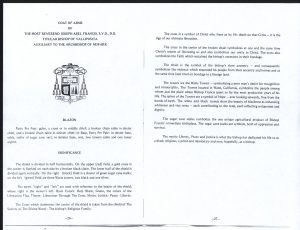
Coat of Arms Significance – First African American Bishop, Joseph Francis, SVD (1923-1997)
In specifically theological terms, African American faithful typically adhere to conventional Catholic doctrine. However, this often connects with ties to traditional and honored practices dating back to the days of Pre-Emancipation and beyond through the development of various African-based Protestant traditions that celebrated close community ties and sought to worship God while also promoting the need for combating prejudice and establishing wide-spread social justice among their congregants.
Black Catholics went on to attain a higher status with the USCCB pastoral letter of “Brothers and Sisters to Us” in 1978 along with the publication of various historical tracts including the trailblazing: The History of Black Catholics in the United States, by Rev. Cyprian Davis (New York: Crossroad, 1990) [BXZ1407.N4 D38 1990] along with others connected to this subject that can be found within our University Libraries Catalog from the Main Collection and/or Turro Seminary Library in particular. These two milestones combined with academic life and coursework linked to the Black Catholic Movement from the Late 1960s to the present has been beneficial to establishing understanding of the many spiritual and symbolic contributions made by African Americans within the Church as a whole.
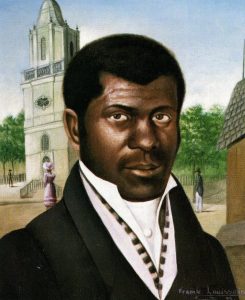
The Venerable Pierre Toussaint (1766-1853)
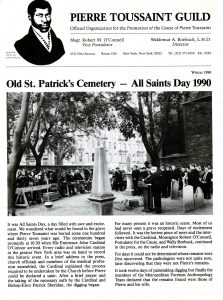
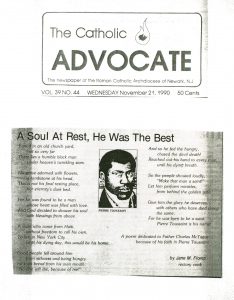
Counted among our most relevant collections include the “Cause for Pierre Toussaint Collection” [MSS 0036] which reflects on one of the earliest and most notable Black Catholics who lived during the Early American Republic and lived by all accounts a holy and selfless life of service. As the abstract to this collection highlights: “Pierre Toussaint was born into slavery in 1766 in what is now Haiti. He moved with his family and master to New York where he lived until his death. He spent his life helping the sick, homeless, and orphaned. He died in 1853 (The year the Diocese of Newark was founded). The Pierre Toussaint Guild was created to advocate his induction into sainthood. His body was exhumed in November of 1990 as part of the investigation into the cause for his sainthood.”
The Collection proper is broken down in the following manner within the Scope and Content Notes section: “This collection primarily consists of newspaper clippings describing the life and cause for sainthood of Pierre Toussaint, as well as photographs, correspondence, and mass cards related to Pierre Toussaint. Many of the news clipping focus on the exhumation of the Pierre Toussaint’s body in 1990. Photographs are generally reproductions of illustrations of Pierre Toussaint or of Jane Flores at places and events related to Pierre Toussaint.” More information on these Papers can be found via the following link: https://archivesspace-library.shu.edu/repositories/2/resources/203
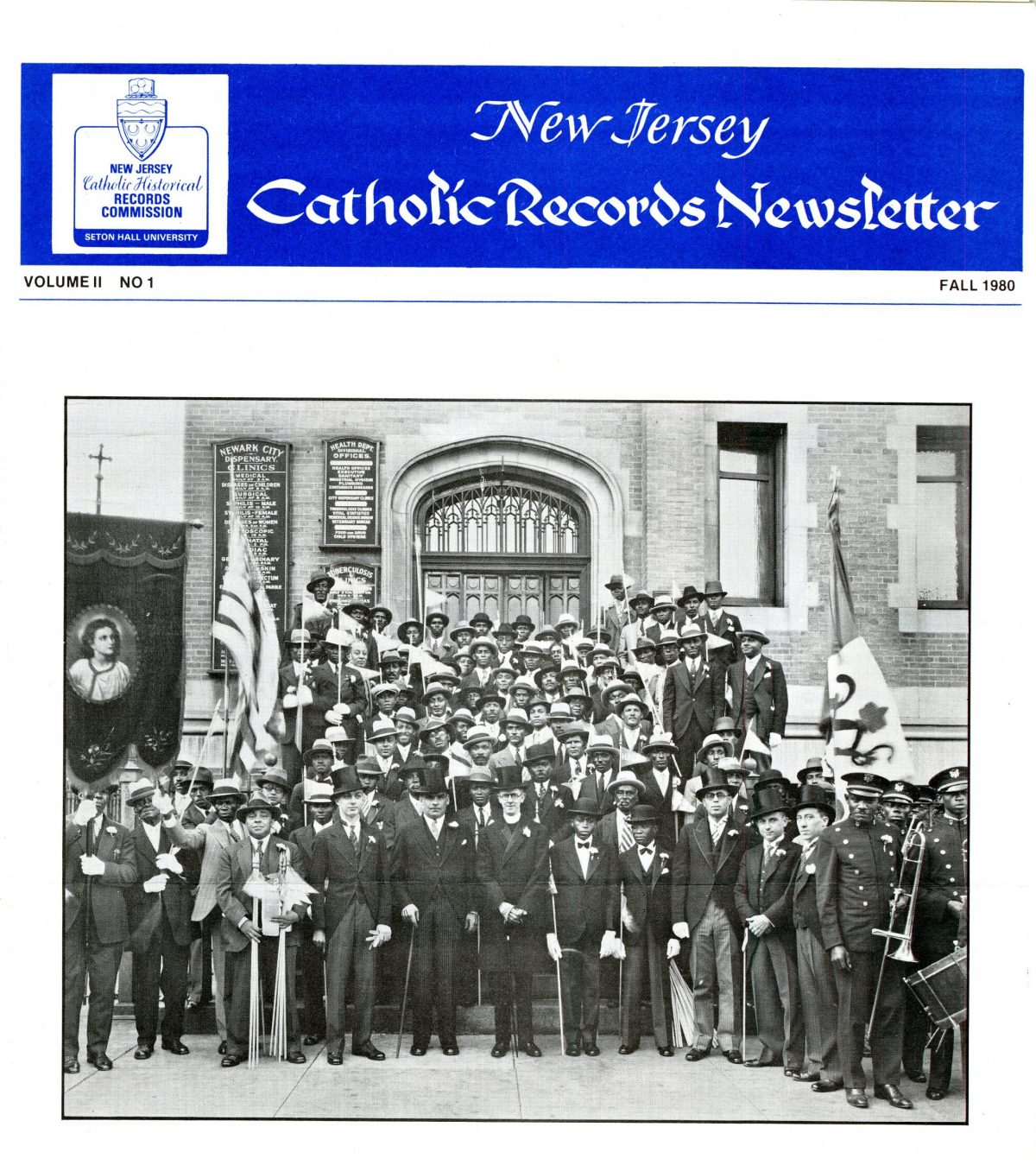
Document Type – Newsletter, Publication Date – Summer 1990
Abstract – The “Birth of Christ The King Parish, Jersey City” looks at some of the first establishments of African-American Catholic parishes in the Diocese of Newark. https://scholarship.shu.edu/njchc/22/
Document Type – Newsletter, Publication Date – Spring 1994
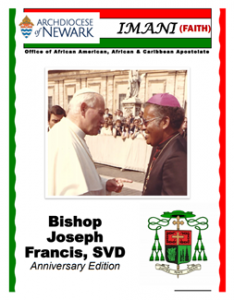
Imani Newsletter of the Office of the African American Apostolate of the Archdiocese of Newark, c. 1996
Another figure connected to the NJCHC, but to the Archdiocese of Newark in particular is the first African American prelate for the See, Most Rev. Joseph Francis, SVD (1923-1997) who was made an Auxiliary for the Archdiocese of Newark in 1976 and retired in 1995 had a lasting impact on the spiritual impact on the Northern New Jersey community and beyond. More information on his life and activities can be found within the following published compilation published by the Archdiocese of Newark . . . https://www.rcan.org/sites/default/files/files/Newsletter%2C%20Bishop%20Francis%20Edition(1).pdf
Other important sources of note include, but are not limited to various Seton Hall-related resources (going back to c. 1912), but other Special Collections (including ones that require permission to review) can be found via the link to our ArchivesSpace site catalog can be found here . . . https://archivesspace-library.shu.edu/
Within the University Libraries Homepage is a Research Guide Section that also ties into key documents that highlight and explain African American Catholic highlights from the Vatican and other important resources in general and particular . . .
For more information related to African American/Black Catholics found within our repository and research resources in general can be requested and research appointments scheduled by reaching out to us via e-mail: Archives@shu.edu or by phone at: (973) 275-2378.



 The success of the 1972 squad and the consistency of the program during the 1960s led them to advance a notch upward in the College Football hierarchy when they became a non-scholarship, program within the ranks of NCAA Division III (Division I being the highest) and they would encounter some victories in their first year (3-5) of 1973 including shutout wins over Rutgers-Newark (42-0) and Rochester Tech of New York (24-0). In 1974 7-2. Overall winning records would come in 1978 (5-4) and 1979 (4-4-1 with a forfeit in favor of Seton Hall). However, the rest of their time playing within the NCAA ranks led to consecutive losing seasons.