Blog

Object of the Week: “Far Away and Long Ago” by William Henry Hudson

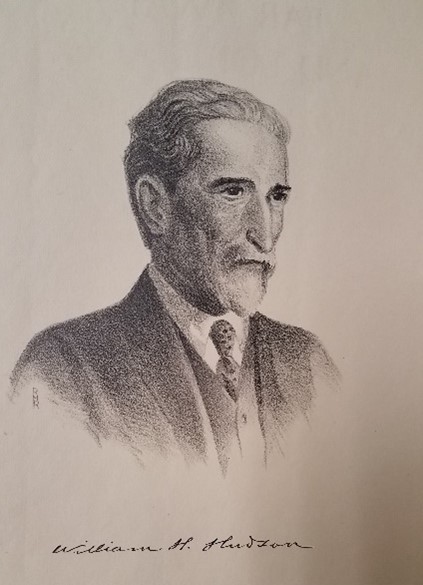
William Henry Hudson
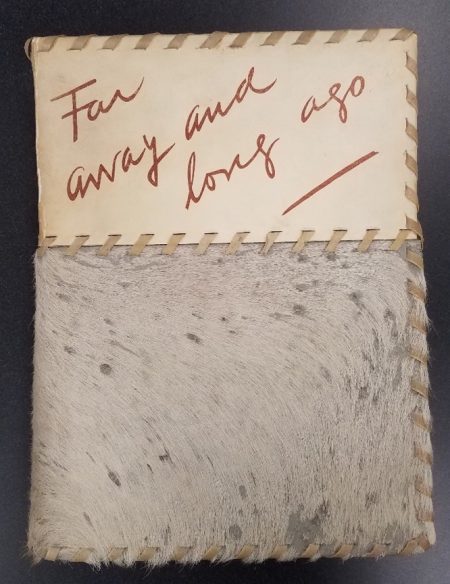
“Far Away and Long Ago”
Printed for members of the Limited Editions Club by Guillermo Kraft ltda., Buenos Aires:  1943.


FEBRUARY IS LIBRARY LOVER’S MONTH!

Library Lover’s Month is dedicated to the people who love whole buildings devoted to the reading, housing, organizing, categorizing, finding, studying, preserving and otherwise loving books.[1]  Libraries are sanctuaries, offering safe spaces for study, reflection and enjoyment.  Libraries indulge our desire to acquire knowledge – they are essentially ‘places of information.’[2]  When we think about libraries, we often think about a building brimming with shelves of books on all topics.   However, there is more to libraries than just books.  They are community hubs supported by librarians who fulfill multiple roles as information experts, subject matter specialists, program organizers, educators, community builders and partners in research. Seton Hall University contains a number of libraries across its three campuses including the Walsh Library, Interprofessional Health Sciences Library, Valente Italian Library, Turro Seminary Library and Law Library.  The Walsh Library also houses the Department of Archives and Special Collections and the Walsh Gallery which care for rare books, manuscripts, art and artifacts and hosts spaces for exhibitions, programs and displays.[3]

The book featured in this post, “Far Away and Long Ago” by William Henry Hudson, recollects the author’s early life, between the ages of four and twelve, which were spent in Argentina.  It is part of the Rare Book

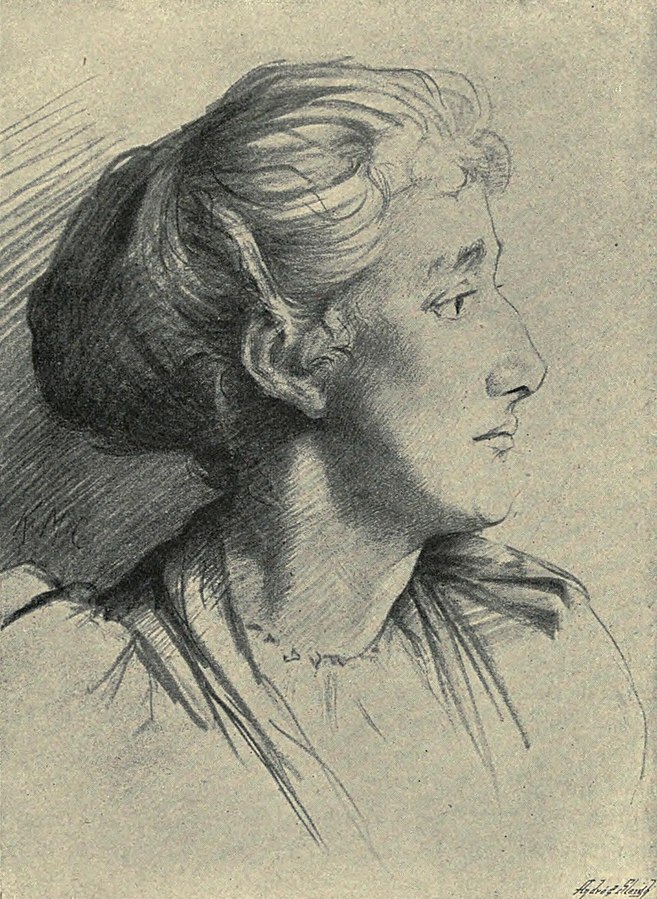
Image of William Henry Hudson
Portrait of William Henry Hudson by Raúl Rosarivo from “Far Away and Long Ago”

Collection, housed in the Department of Archives and Special Collections. This limited-edition book had a run of just fifteen hundred copies and was designed by Alberto Kraft.  The volume in the Seton Hall Archives is signed by Kraft and illustrator Raúl Rosarivo.  This edition is bound in cowhide with undressed leather on the lower portion and features laced edges. [4]  The materials used in the binding reflect William Henry Hudson’s childhood, much of which was spent in the rugged pampas of Argentina, where his parents raised sheep, though the region is known for its free-ranging cattle.  These formative experiences in nature would profoundly impact his future.  As an adult, Hudson would achieve recognition as an author, naturalist, and ornithologist.  He was lauded for his exotic romances, especially “Green Mansions” which was published in 1904.  “Far Away and Long Ago” lovingly recounts his childhood — roaming the pampas at liberty, studying the plant and animal life, and observing both natural and human phenomena on the harsh frontier.  At age 15, he suffered an illness which would impact his health adversely for the remainder of his life.  Around this period of infirmity, he read Charles Darwin’s “Origin of Species” which reaffirmed his interest in the natural world.[5]

Illustration of a man by Raúl Rosarivo from “Far Away and Long Ago”
Illustration by Raúl Rosarivo from “Far Away and Long Ago”

Though William Henry Hudson may not be a household name today, he had many admirers in his time.  In 1934, renowned author Ernest Hemingway wrote a list of book recommendations to a young, aspiring writer. It included William Henry Hudson’s “Far Away and Long Ago” in addition to books by celebrated authors such as Stephen Crane, e.e. cummings, Leo Tolstoy, Emily Bronte, Fyodor Dostoyevsky and James Joyce.[6]  Hudson’s book was also among the objects auctioned from The Private Collection of President and Mrs. Ronald Reagan at Christie’s auction house in 2016.[7]  Praise for Hudson’s writing consistently mentions his palpable imagery, as was noted in this thoughtful review on amazon.com:

“This book was like knocking on an old friend’s door, being welcomed in and settling in front of a fire with a glass of something in one’s hand. The author then talks, gently and beautifully, weaving this picture of his early life. He brings his characters to life and describes the birds and other creatures so well, I felt as if I was there with him, every time I picked up the book to read. A gentle lovely story of a young boy’s steps from childhood.” – L.M. Gainsford[8]


The images and materials shown here are but a small part of the vast patrimony available to students, faculty and researchers.  For access to this or other objects in our collections, complete a research request form to set up an appointment or contact us at 973-761-9476. 


[1] http://www.librarysupport.net/librarylovers/, accessed 2/16/2021.

[2] http://www.ilovelibraries.org/what-libraries-do, accessed 2/16/2021.

[3] https://library.shu.edu/home accessed 2/16/2021, accessed 2/16/2021.

[4] http://eds.b.ebscohost.com/eds/detail/detail?vid=4&sid=b64ff686-5122-4343-b1c9-852f6588dd78%40sessionmgr103&bdata=JkF1dGhUeXBlPXNzbyZzaXRlPWVkcy1saXZl#AN=sth.ocn542094967&db=cat00991a, accessed 2/16/2021.

[5] https://www.britannica.com/biography/W-H-Hudson, accessed 2/16/2021.

[6] https://www.openculture.com/2013/05/ernest_hemingways_reading_list_for_a_young_writer_1934.html, accessed 2/16/2021.

[7] https://www.christies.com/lot/lot-limited-editions-club-hudson-wh-far-6018661/?lid=1&from=relatedlot&intobjectid=6018661, accessed 2/16/2021.

[8] https://www.amazon.com/Far-Away-Long-Ago-Childhood/dp/0907871747, accessed 2/16/2021.

Object of the Week: Mangbetu Effigy Jug

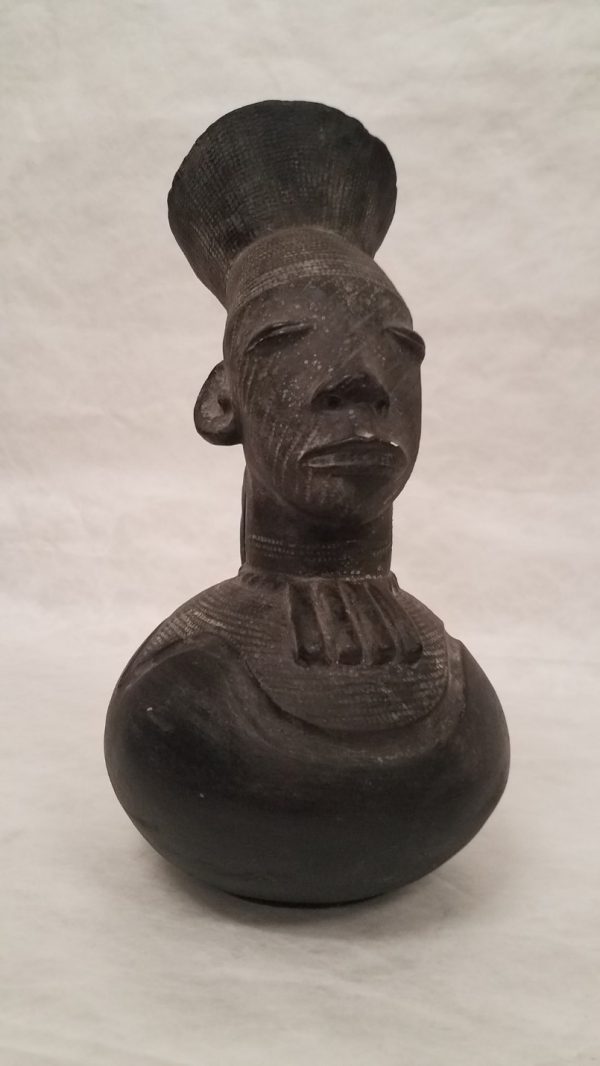
Mangbetu Effigy Jug (reproduction)
Teaching Collection – Seton Hall University Museum of Anthropology and Archaeology Collection
T2017.01.0009
Courtesy of the Walsh Gallery


CELEBRATING AFRICAN AMERICAN HISTORY MONTH 2021

This year’s annual celebration of African American History Month is anchored by the theme “Black Family: Representation, Identity and Diversity,” which focuses on the African diaspora and the spread of Black families across the United States.  This reproduction from Seton Hall University’s Museum of Anthropology and Archaeology is from the Mangbetu peoples of the Democratic Republic of the Congo in Central Africa.  Like other Central and West African groups in the United States, the first Congolese arrived in the Americas as enslaved people during the transatlantic slave trade which endured from the 16th to the 19th century.    Congolese people were often taken to locales in Louisiana and South Carolina.  People from West and Central African regions comprised almost 40% of enslaved peoples in the Americas.[1]

Mangbetu refers to an amalgam of linguistically and culturally related people in the northeastern Democratic Republic of Congo. The group includes the Mangbetu, Meegye, Makere, Malele, Popoi and Abelu. These groups share the common language known as Kingbetu.[2]  Beginning in the 1960s, a new influx of voluntary immigrants from the Democratic Republic of the Congo arrived in the United States, primarily to pursue an education.  Immigration from the country to the United States rose again in the 1990s.  However, this time, Congolese people arrived as refugees due to civil conflicts, violence and economic hardship.[3]  The United Nations High Commissioner of Refugees reports that between 2008 and 2013, approximately 11,000 Congolese refugees arrived in the United States, settling primarily in Texas, Arizona, Kentucky, and New York.[4]

Despite this fraught history, the Mangbetu have held fast to many of their rich cultural traditions.  They are especially known for their pottery, metal work and as makers of musical instruments.  Women potters would have been the primary makers of effigy jugs like this figurative vessel with its characteristic dark, burnished surface.  Though the Mangbetu still make jugs like these, they are now sold to tourists and art collectors rather than used in daily life. [5]  The elaborate coiffure depicted on this jug is characteristic of a traditional Mangbetu woman and is not idealized.

Contemporary Ivory Coast artist Laetitia Ky is inspired by traditional hair styles from African peoples such as the Mangbetu.  Her art is a fusion of hair, design and sculpture.  Ky ‘sculpts’ her hair into the traditional forms she finds in archival images of African women.  Ky then photographs her style and juxtaposes her image next to the historic photograph that inspired her.  She also teaches “Ky-braid” workshops to teach others how to style their hair in traditional African ways.  Ky uses hair as a form of social justice – merging cultural and feminine pride while bringing awareness to issues such as violence against women, gender parity, colonialism and bullying.  Ky uses her TikTok and Twitter accounts to reach the public.[6]

https://twitter.com/laetiky/status/1229867159335112708?s=20

Laetitia Ky (left) with archival image of an unknown Mangbetu woman that inspired her.

This video shows an array of hairstyles from Africa such as the types that Ky is inspired by.  You can see the Mangbetu hairstyle similar to the effigy jug around the 3:30 timestamp in this celebration of hair.


The Walsh Gallery has a considerable collection of fine art, artifacts and archeological specimens for use by faculty, students and researchers. For access to this or other objects in our collections, contact us at 973-275-2033 or walshgallery@shu.edu to make a research appointment. 


[1] https://en.wikipedia.org/wiki/Atlantic_slave_trade, accessed 1/26/2021.

[2] https://thisisafrica.me/african-identities/mangbetu-people-drc/, accessed 1/26/2021.

[3] https://en.wikipedia.org/wiki/Congolese_Americans#cite_note-Africansdescend-11, accessed 1/25/2021.

[4] https://www.cdc.gov/immigrantrefugeehealth/profiles/congolese/population-movements/index.html, accessed 1/25/2021.

[5] https://spectrumartsincblog.com/2015/07/25/the-mangbetu-people-and-their-pottery/, accessed 1/25/2021.

[6] https://en.wikipedia.org/wiki/Laetitia_Ky, accessed 2/8/2021.

Ike and the Seton Hall University Centennial

During the Centennial Year of Seton Hall University in 1956, this milestone date in school history led to the planning of a number of public programs that commemorated not only the evolution of the academic-based legacy of Setonia found in the classroom, but also the contributions of her students, faculty, and alumni to American society at large.  The presentations and specially-themed events scheduled throughout the 1956 Academic Year not only touched upon the ties Seton Hall nurtured in relation to religious life and educational enlightenment, but also linked to industry, commerce, medical support, science, publishing, and a number of other disciplines that touched upon community support.  Additionally, the most visible area of community public service in which Setonia had a long history of connections was that of political science and governmental affairs.

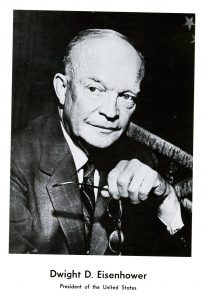
Event program cover from the Centennial of Seton Hall University (1956)Beyond having a long and productive relationship with a number of local and national politicians alike, the school and its cognizance of the United States Presidency is one that has been one that has been studied via courses campus-wide over the last several semesters and the campus has hosted various candidates for the highest office in the land over the last several decades.  When it comes to sitting Chief Executives and their appearances within the Seton Hall story, the most famous example was the visit of President Ronald Reagan at the Commencement Exercises held on the University Green in 1983.  However, another chapter that is notable was the invitation extended to President Dwight David Eisenhower by University President Monsignor John McNulty to be a part of the Centennial Convocation in 1956.

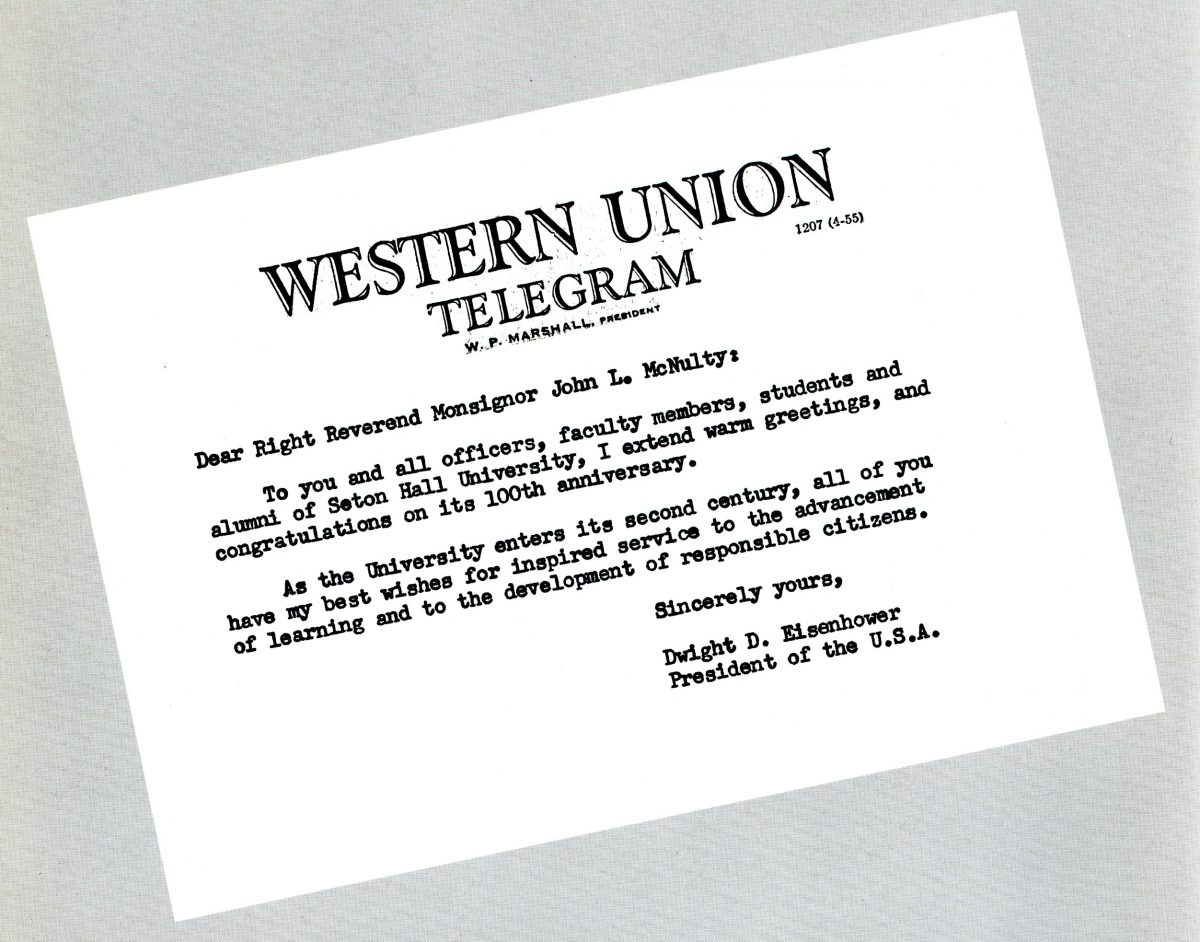
The invitation to “Ike” was a logical idea since it was a major anniversary celebration for the institution, but the Deputy White House Chief of Staff and Appointments Secretary to President Eisenhower was noted lawyer, Mr. Bernard Shanley, a native of Newark who served in this capacity from 1955-57 and had established ties to Seton Hall and the Archdiocese.  Ike was also connected to the values of higher education as the former President of Columbia University (1948-53) along with his prestige as a war hero and leader of the country  all made for the hope that he would be a part of this anniversary pageant.  However, President Eisenhower would ultimately send his regrets via telegram that he could not attend ceremonies in South Orange that year.
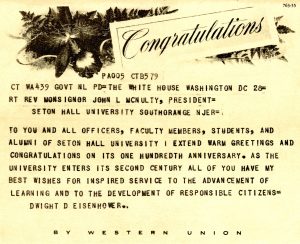

When retrospectively looking behind the reasons why Ike would not grace center stage at the podium, or the strains of “Hail to the Chief” were not heard, were various and understandable.  In conducting research through the diaries of Bernard Shanley held within the Monsignor William Noé Field Archives & Special Collections Center and various Seton Hall-centered resources a picture of the inner-workings of scheduling during late-February through early March emerges.  Ike was a popular president, but he was facing the unknown when it came to re-election and the Democratic primaries going on at that time which included candidates Estes Kefauver (TN), W. Averell Harriman (NY) and eventual nominee Adlai Stevenson (IL).  This took on greater significance as rumors as to the ill health of President Eisenhower were reported nationwide through the early months of 1956.  On February 29th, Ike made a public pronouncement that he would seek re-election that November.  Otherwise, during that first week of March, Ike was in conference regarding a letter written by FBI Chief J. Edgar Hoover on the topic of Civil Rights (3/1), preparation for a Summit Meeting with leaders from Canada and Mexico later that month with input from former President Herbert Hoover (3/3), a speech to the Fourth Annual Republican Women’s National Conference (3/6), taking time to send a birthday greeting to Pope Pius XII, and other duties along with sending the telegram of regrets to Monsignor McNulty and the Seton Hall community.

Banner and Headline of The Setonian from March 15, 1956

Although he did not physically visit our campus, this gesture of recognition by President Eisenhower was well-received by the Seton Hall community at the time and his place although directly fleeting in terms of personal contact with the school would be helpful through various initiatives such as the first White House Commission on Education (1955), various Higher Education initiatives (1950s-1960), and the Federal Aid Highway Act (1956) for commuters, among other imprints made by Ike and other Chief Executives over the years as we remember them on as part of this President’s Day observance.

For more information on Dwight David Eisenhower, please consult his President Library Website via the following URL – https://www.eisenhowerlibrary.gov/

For more information about our Manuscript Collections including the Bernard Shanley Papers, and other aspects of U.S. Political and Seton Hall University history we can be reached via e-mail at: Archives@shu.edu or by phone at: (973) 275-2378.

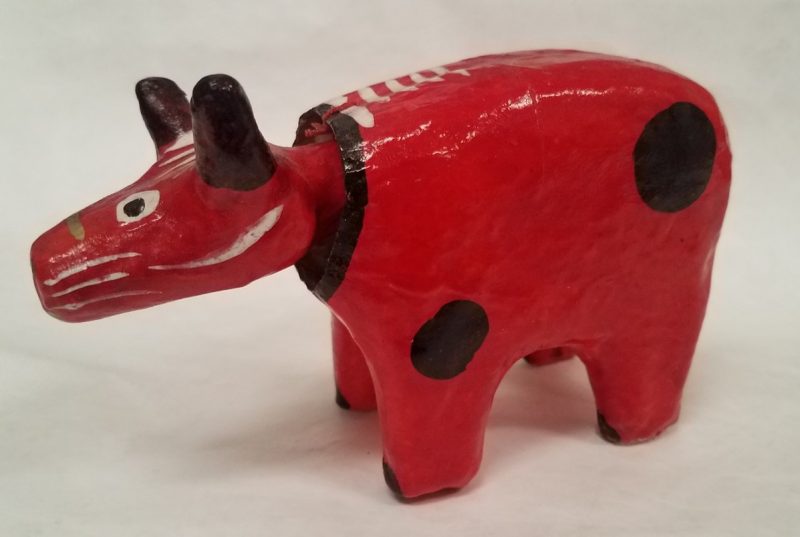
Object of the Week: Akabeko (Ox or Cow Toy)

Akabeko (Ox or Cow toy)
Painted and lacquered papier-mâché
3 ¾” H x 5 ְ⅝” W x 1 ⅞” D
Fukushima, Japan
2828
Seton Hall University Museum of Anthropology and Archaeology Collection


HAPPY NEW YEAR

2021 – YEAR OF THE OX

The Lunar New Year is primarily celebrated in Asian countries such as China, Vietnam, South Korea, Singapore, Tibet and Mongolia.  The festival has different names depending upon the country.  It is called Tết in Vietnam and Losar in Tibet.  The Lunar New Year represents new beginnings regardless of the region or country, though each region’s traditions vary.  The holiday occurs on the first new moon of the lunisolar calendar, which lasts roughly 354 days and is traditional to many east Asian countries, in contrast to the 365 day Gregorian calendar used in the United States. Traditionally, the festival was a ceremonial day to pray to gods and ancestors for a good planting and harvest season. The three main themes of the holiday are fortune, happiness, and health.

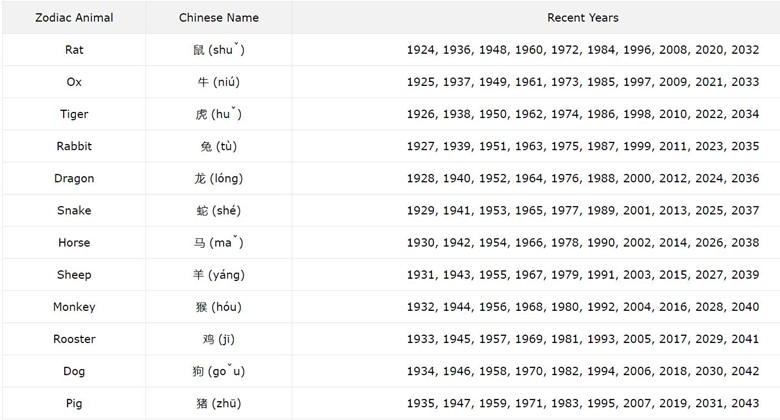
Each new year is associated with an animal sign from the zodiac.  The Lunar New Year marks the transition from one animal to the next and each has its own attributes. In order, the zodiac animals are: Rat, Ox, Tiger, Rabbit, Dragon, Snake, Horse, Goat, Monkey, Rooster, Dog and Pig.[1]  This year, 2021, is the Year of the Ox.  If you were born in an Ox year, you are diligent, dependable, strong and determined.  Oxen have traditional, conservative characteristics.[2]  If you would like to know what your zodiac animal is, you can look it up on this chart[3]:

Chart with the zodiac animals and which years in the past and future coincide with each animal

Unlike other Asian countries, Japan no longer celebrates Lunar New Year. In 1873, during the Meiji Restoration – the political revolution – Japan adopted the Gregorian calendar to put the country in step with the West.  Initially, this break with the traditional lunisolar calendar was strongly opposed.  Many Japanese continued to celebrate the Lunar New Year well into the 20th century, especially in rural areas. Eventually, the lunisolar calendar faded completely from daily life in Japan.[4] Today, the New Year in Japan is celebrated on December 31 and is known as Ōmisoka.[5]

Image of the Enzoji Temple, Japan
Enzoji Temple, Japan

Though Japan no longer celebrates the Lunar New Year as a whole, there are vestiges of the traditional celebration that hold fast.  “Little New Year,” or Koshōgatsu, is celebrated on January 15. For the New Year’s breakfast, it is still customary to eat azukigayu (rice porridge) with sweet, red azuki beans. In the past, after eating this meal, a divination ritual would then be performed by placing bamboo cylinders in the remaining porridge and leaving them overnight. The more rice that was stuck inside the cylinders the following morning, the better the harvest would be that year.  Today, some temples and shrines still perform the traditional divination rituals.[6]  Another custom that is held over from traditional Lunar New Year celebrations is to make and eat rice cakes (mochi).[7]

The object of the week is an ox is from the Seton Hall Museum of Anthropology and Archaeology. This toy is known as Akabeko (赤べこ), a legendary cow[8] from Japan, said to have helped build the famous Enzoji Buddhist Temple. It is one of the three main temples dedicated to Kokuzo Bosatsu, a bodhisattva whose wisdom was said to be as expansive as the universe.  The toy is made out of two pieces of wood covered with

Life-size akabeko outside the Enzoji Temple in Fukushima Prefecture

papier-mâché, shaped and painted to look like a red cow or ox. One piece comprises the cow’s head and neck and the other, its body. The head and neck hang from a string which runs through the hollow body so that when the toy is moved, the head bobs up and down and side to side. The earliest akabeko toys were created in the late 16th or early 17th century.[9]    Today, the toy has become a symbol of the Fukushima Prefecture where the Enzoji Temple is located[10].


The Walsh Gallery has a considerable collection of fine art, artifacts and archeological specimens for use by faculty, students and researchers. For access to this or other objects in our collections, contact us at 973-275-2033 or walshgallery@shu.edu to make a research appointment. 


[1] https://chinesenewyear.net/zodiac/, accessed 1/28/2021.

[2] https://www.chinahighlights.com/travelguide/chinese-zodiac/ox.htm, accessed 1/28/2021.

[3] https://www.travelchinaguide.com/intro/social_customs/zodiac/, accessed 1/28/2021.

[4] https://www.cheng-tsui.com/blog/why-doesn%E2%80%99t-japan-celebrate-the-lunar-new-year, accessed 2/3/2021.

[5] https://www.cheng-tsui.com/blog/why-doesn%E2%80%99t-japan-celebrate-the-lunar-new-year, accessed 2/3/2021.

[6] https://www.cheng-tsui.com/blog/why-doesn%E2%80%99t-japan-celebrate-the-lunar-new-year, accessed 2/3/2021.

[7] https://en.wikipedia.org/wiki/Japanese_New_Year, accessed 2/3/2021.

[8] https://en.wikipedia.org/wiki/Akabeko, accessed 2/1/2021.

[9] https://www.japan-guide.com/e/e7712.html, accessed 2/1/2021.

[10] https://en.wikipedia.org/wiki/Akabeko, accessed 2/1/2021.

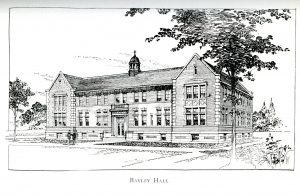
Bayley Hall – The Grammar School of Setonia

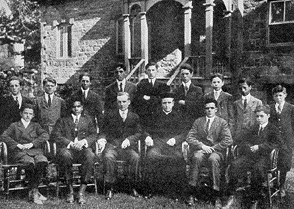
In respect of the recent commemoration of National Catholic Schools Week, Seton Hall has a long and honored tradition of hosting countless students who have their academic roots in parochial-sponsored classrooms across New Jersey and around the world.  Our institution is no exception to showing its support of pre-secondary level education.  Between 1901 and the late 1920s, Seton Hall established the Bayley Hall Grammar School initiative to help students prepare for more advanced study with anticipation that pupils would better continue their educational journey at the Preparatory Academy and College in subsequent semesters.

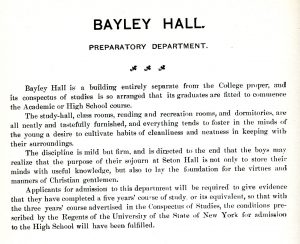
Founded by Msgr. John A. Stafford, President, the following overview is the first notice of the school with the details extracted from the 1901 Seton Hall College Catalogue and signaled a renewed look at youth-centered instruction after the school attained its first accreditation status four years previous . . .

Over time, the Bayley Hall Grammar School received consistent support and regularly hosted an average of 40-50 students per academic year.  Over its approximately three decades in operation, the school prospered and by the mid-1920s, the description of the school touted its accomplishments, but also provided full disclosure in their approach in print as the following notice from the 1924 Seton Hall College Catalogue was heralded within its pages at a time when the institution was male-only and highly structured in almost every manner . . .

“BAYLEY HALL GRAMMAR SCHOOL – CHARACTER AND PURPOSE . . . in the few years of its existence has won for itself a position second to none among the preparatory institutions of the country.  It has its origin in the realization, forced on the President year after year, that many of the students who sought admission to the High School were, in some one or other of the required studies, inadequately prepared.  It was evident that a department which should take students at an earlier age and give them a thorough grammar school course would not only serve a useful purpose in itself, but would in addition facilitate the more difficult work of the High School.  This ideal has been fully realized.  The graduates of Bayley Hall have, almost without exception, demonstrated by their work in the High School the need and the value of the training given them in the preparatory department.

Such an institution has, of course, to struggle against the difficulties which inevitably arise when boys are for the first time taken from parents and home.  And it is in this particular that Bayley Hall has achieved its greatest success. The occupations of every hour have been so apportioned that mind and body are given useful work and healthy play from the morning bell at half-past is to the last bell at half-past eight.  Periods of recreation alternate with periods of study; every species of athletics is encourages, and every means is employed to develop a sound mind in a sound body.  One of the Reverend Fathers, resident in Bayley Hall, immediately supervises the work in this section.  The discipline is firm, as discipline must always be; but harshness is never permitted to mar the relations of teacher and pupil.  As in the other departments of the institution, the development of the moral character is looked upon as equally important with the acquisition of knowledge; and no pains are spared to lay the foundations of that combination of culture and religious virtue which constitutes the Christian gentlemen.”

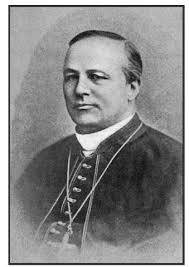
James Roosevelt Bayley (1814-1877)

The school building was named in honor of James Roosevelt Bayley (1814-1872), the first Bishop of Newark and hosted the Grammar School, hence the name of the institute and separate from the College proper.  As further described in the catalogues of the era: “The study-hall, class rooms, reading and recreation rooms, and dormitories are all neatly and tastefully furnished, and everything tends to foster in the minds of the young a desire to cultivate habits of cleanliness and neatness in keeping with their surroundings.”  Aside from the well-appointed surroundings, the model of having classes in one space led to consistency and a logical pattern of instruction.  The following synopses provide the typical path of pedagogy found among the first three years encountered by the Bayley Hall student of yore . . .

  • FIRST GRADE

ENGLISH.  Grammar Reviewed; Punctuation; Elementary Precepts of Composition; Forms of Style.

LITERATURE.  Reading of Masterpieces in Prose and Verse; Spelling; Studies in Critical Analysis; Memory Work.

ELOCUTION.  Special Exercises.

SCIENCE.  Physiology and Hygiene.

ARITHMETIC.  Advanced Arithmetic Completed and Reviewed; Business Forms.

GEOGRAPHY.  The United States and Territories.

HISTORY.  Elementary General History.

CHRISTIAN DOCTRINE.

OPTIONAL SUBJECTS.  Music, Drawing, German, French, Stenography, Type-writing.

  • SECOND GRADE

ENGLISH.  Grammar Completed; Prosody; Description and Narration.

LITERATURE.  Selections in Poetry; Spelling and Analysis; Studies in Figures: Memory Work.

READING AND WRITING.  Bi-Weekly Exercises.

ARITHMETIC .  Continued; Mental Work.

GEOGRAPHY.  Asia, Africa, South America.

HISTORY.  United States History Completed.

CHRISTIAN DOCTRINE.

OPTIONAL SUBJECTS.  Music, Drawing, German, French, Stenography, Type-Writing.

  • THIRD GRADE

ENGLISH.  Grammar, Etymology Reviewed; Sentences; Essentials of Syntax: Letter Writing; Elementary Composition.

LITERATURE.  Selections in Prose; Spelling and Analysis; Studies in Etymology and Use of Words; Word Formation.

READING AND WRITING.  Special Exercises.

ARITHMETIC. Written and Mental Exercises.

GEOGRAPHY.  Europe.

HISTORY.  Elementary United States History.

CHRISTIAN DOCTRINE.

OPTIONAL SUBJECTS.  Music, Drawing, Type-writing

As the individual progressed through the system, they reached the end of their time at Bayley Hall during the Eighth Grade.  It was at this point, that pupils had the option belong to a host of clubs and societies including the Athletic Association which promoted competition in billiards, handball, and competition between neighboring schools.  The Library Association was active in collecting and establishing a top flight reference center for the student body.  In addition, the Saint Aloysius Society hosted weekly meetings in order to: “. . . instill into their minds an appreciation and tender regard for this illustrious patron of the young.” Which offered many students a preview, and a wider selection of extra-curricular activities when the reached the high school level.  This was designed to educate the “whole person” as consistent with the goals of the instructors and administration from the start of the program.

The parting wish for graduates from Bayley Hall when they entered the Eighth Grade led to the following prescription:  “The object of this organization is to transact the business of the class, to foster in the pupil the idea of self-reliance in the management of his affairs, and to prepare him for the more formal organization of the High School and College classes.”  Although long defunct, the legacy of the Bayley Hall School lasts and remains a part of the history of Catholic parochial education annals and within the story of specialized schools hosted by Seton Hall over the last century and a half.

For more information on Bayley Hall and other aspects of Seton Hall history please feel free to contact us via e-mail at: archives@shu.edu or by phone at: (973)275-2378.

Object of the Week: Guro Mask

Guro Mask (reproduction)
Teaching Collection – Seton Hall University Museum of Anthropology and Archaeology Collection
T2017.01.0001
Courtesy of the Walsh Gallery


SETON HALL UNIVERSITY CELEBRATES AFRICAN AMERICAN HISTORY MONTH

This year’s theme for African American History Month is “Black Family: Representation, Identity and Diversity.”  This theme illuminates the African diaspora and the spread of Black families across the United States.  This mask, from Seton Hall University’s Museum of Anthropology and Archaeology, is from the Guro (also Gouro) People of the Ivory Coast in West Africa.   This region of the continent was profoundly affected by the Transatlantic Slave Trade.  An estimated 12 to 12.8 million forced migrations of African people took place over the course of more than 400 years.  Those who survived the passage were enslaved in Europe and the Americas.[1]

Despite this trauma, West Africans and African Americans have retained many customs from their respective cultures.  Music and dance are two of the most prevalent ways humanity connects with the past, and masks are a powerful and important part of these traditions in West Africa.  In many African cultures, including the Guro, masks are potent instruments of unity, family and community.[2]  Used in traditional ceremonies and rites such as funerals, weddings and festivals, the masks are activated through music and dance, playing an important role in honoring ancestors and providing community members with palpable links to the past.[3]

Guro dancer performing
Guro Dancer performing
Courtesy of Danse traditionnelle du du centre-ouest de la Côte d’Ivoire (Zaouli) à la cérémonie de la flamme de la paix à Bouaké.
Feb 25, 2008
Courtesy of Zenman

In West Africa, secret societies are an important part of community life.   The Guro societies are called Je for females and Kne for males.  Only members of these secret societies may wear masks and perform in rituals honoring ancestors.[4]  Chika Okeke-Agula, a West African performer/curator/artist and art historian explained, “When fully activated, masks become ‘spirits made tangible’.”[5]  The mask provides an entry into the spirit world to channel the divine, summon ancestral wisdom, escort the departed, accompany initiates, reaffirm societal values, venerate the living, and to mark the natural cycles of existence, from birth to death, season to season.​[6]  The ceremonies in which masks are used are called ‘masquerades’ – interventions between the world of the living and the world of the ancestors. During masquerades, the full powers of the masks are released.[7]

The video below from UNESCO shows a masked Guro dancer wearing traditional clothing.  Dances are energetic and marked by quick footwork, accompanied by drumming and elaborate costumes.  This traditional music and dance known as Zaouli[8] plays an educational, playful and aesthetic role, contributes to environmental preservation, conveys the cultural identity of its bearers and promotes integration and social cohesion among community members.[9]


The Walsh Gallery has a considerable collection of fine art, artifacts and archeological specimens for use by faculty, students and researchers. For access to this or other objects in our collections, contact us at 973-275-2033 or walshgallery@shu.edu to make a research appointment. 


[1] https://en.wikipedia.org/wiki/Atlantic_slave_trade#:~:text=Slaves%20were%20imprisoned%20in%20a,a%20span%20of%20400%20years, accessed 1/21/2021.

[2] https://en.wikipedia.org/wiki/Zaouli, accessed 1/21/2021.

[3] https://www.africancraftsmarket.com/products/african-masks/African-Guro-mask.html, accessed 1/21/2021.

[4] https://kwekudee-tripdownmemorylane.blogspot.com/2014/06/guro-gouro-people-artistic-mande-mask.html, accessed 1/25/2021.

[5] https://www.culturesofwestafrica.com/west-african-mask/, accessed 1/26/2021.

[6] Binkley DA. Masks and Masquerades. In: Peek PM, Yankah K, eds. African Folklore: An Encyclopedia. New York, NY, USA: Routledge; 2004:479-485.

[7] Akubor EO. Africans’ concept of masquerades and their role in societal control and stability: Some notes on the Esan people of southern Nigeria. Asian and African Studies. 2016;25(1):32-50.

[8] https://en.wikipedia.org/wiki/Zaouli, accessed 1/26/2021.

[9] https://ich.unesco.org/en/RL/zaouli-popular-music-and-dance-of-the-guro-communities-in-cote-divoire-01255, accessed 1/26/2021.

Object of the Week: Seton Hall College School Bell

Seton Hall College School Bell
1856
Meneely Bell Foundry
bronze
Gift of the Seton Hall University Alumni Association
2019.14.0001
Walsh Gallery at Seton Hall University


WELCOME BACK FOR THE SPRING SEMESTER!

This mid-19th century bronze bell was originally located at the Seton Hall College campus in Madison, New Jersey. In the late 1960s, Dr. Louis de Crenascol, Chair of the Department of Art and Music, saw it for sale in an antique shop in nearby Summit.  The bell was purchased through an arrangement between Dr. de Crenascol, Norbert Kubilus – President of the Society for the Preservation of Setonia—and John L. Botti – Executive Secretary of the Alumni Association—and brought to Seton Hall University where it hung in the McLaughlin Library until the building was razed in the 1990s to make way for Jubilee Hall.  The bell then moved to the current Walsh Library and is presently on view in the Reading Room of the Department of Archives and Special Collections.[1]  The bell was manufactured by Meneely’s of Troy, New York, a foundry which was known for making school bells of 100 pounds or more.[2]

Bronze bells such as this one were commonly used in America from the 19th century until the mid-20th century and were rung to mark important times for students and teachers, such as to signal the beginning or end of the school day, classes or lunch breaks. They were intended to carry sound over a wide area in a world largely without clocks, wrist watches or cell phones to keep track of time.  For this reason, bronze, with its resonant qualities, was the metal of choice.[3]  Today, the old bronze school bell has largely been displaced by electric buzzers, public address (P.A.) systems or music.[4]   You can hear what the Seton Hall College bell might sound like by listening to this sound sample of a similar Meneely Bell of the period below.[5]

School house bells were often sold ready for installation, bundled with a frame, wheel and wood sills.  If you look closely at the image of Seton Hall

Diagram of the parts of a bell
Figure 1. https://www.pinterest.com/cpbellfoundry/_created/

College’s bell above, you will see horizontal arms that would have been attached to the frame to support the bell.  Bells would be placed in the upper part of a belfry, or belltower, with a rope hung from the wheel. School bells were typically between 20 and 28 inches across to produce a slightly higher pitch than church bells which, would have been larger to peal with a deeper sound. This detail regarding size and tone was important.  The public had to be able to distinguish between school, civic and church bells to avoid confusion.[6]

Church, clock and tower bells are also used to communicate with the public to commemorate important events such as the swearing in of an official or state leader, or religious rites including marriage and death.  Bells are frequently associated with the concepts of peace and freedom, but they can also mark specific times on a clock or serve as a percussive musical

Image of red and white mid-19th century schoolhouse with belfry
Image of mid-19th century schoolhouse with belfry in Maysville, Colorado. Courtesy of Jeffrey Beal, Colorado, USA. https://commons.wikimedia.org/wiki/File:Maysville_School_(6287064191).jpg

instrument.  The earliest archaeological evidence of bells dates from the 3rd millennium B.C.E. in the Yang Shao culture of Neolithic China.[7]  Bells figure prominently in the public imagination, especially literary works.  The Guardian has compiled a list of the 10 Best Bells in Literature. The list includes stories such as Macbeth by William Shakespeare, The Magician’s Nephew by C.S. Lewis, The Bells by Edgar Allan Poe and Notre Dame de Paris by Victor Hugo.  Check out the full list to see how many you have read.


The Walsh Gallery has a considerable collection of fine art, artifacts and archeological specimens for use by faculty, students and researchers. For access to this or other objects in our collections, contact us at 973-275-2033 or walshgallery@shu.edu to make a research appointment. 


[1] Interview with Alan Delozier by Meghan Brady, 10/08/2020.

[2] https://antiques.lovetoknow.com/collectibles/antique-school-house-bells accessed 1/19/2021

[3] https://en.wikipedia.org/wiki/Bell#:~:text=The%20earliest%20archaeological%20evidence%20of,bells%20appear%20in%201000%20BC. Accessed 1/19/2021

[4] https://en.wikipedia.org/wiki/School_bell, accessed 1/19/2021.

[5] http://www.brosamersbells.com/hear.html, accessed 1/19/2021.

[6] https://antiques.lovetoknow.com/collectibles/antique-school-house-bells, accessed 1/19/2021.

[7] https://en.wikipedia.org/wiki/Bell#:~:text=The%20earliest%20archaeological%20evidence%20of,bells%20appear%20in%201000%20BC, accessed 1/19/2021.

Documenting Setonia – Written by Hand and Handled With Care

January 23rd marks National Handwriting Day which was established in 1977 to promote and celebrate the usage of writing instruments from the quill to ballpoint pens along with the paper upon which such methods as cursive, script, and other self-expression is put into print for posterity.  This particular date was also chosen to commemorate the birthday of John Hancock, first Autographer of the Declaration of Independence who arguably has the most famous signature in American History.  However, the story of handwriting can be traced further back in time.

Iconic Illustration from the 1926 White & Blue, Seton Hall College Yearbook

Written communication can be traced back to Ancient Rome (c. fifth century AD) that was built on contributions from other founding civilizations and in the process became an important means of non-verbal communication and by extension preserving the word of the author for future reference.  As this practice caught hold and moving forward to other eras, the Medieval period has been noted for manuscripts reproduced by cloistered monks who patiently and expertly provided copies of texts (mainly Christian and classical-based) as an important service to humanity as a means of promoting literacy and inspire deeper learning opportunities than ever before.  With the advent of the Printing Press during the sixteenth century this lessened the need for handwritten, mass produced works and ushered in a new era of mass-produced writings.  Despite this invention the trade art of “penmanship” still became a sought after skill set especially in the documentary establishment of the American Republic and as the nation grew in size and population where school systems, mail service, and other forums for handwritten communication were created.

With the establishment of the United States and moving into the nineteenth century, a bookkeeper named Platt Rogers Spencer who adopted a method to teach cursive writing that was captured in various textbooks and made its way to various schools and colleges to help students improve their respective writing styles.  Eventually print and cursive developed into various methods side-by-side in the dawn before typewriters and later computers would help with journaling and interpersonal communication.  Overall, expanded technology has superseded the need or want to write as a matter of preferred course.  More information on the historical evolution of handwriting can be referenced via the V-Letter and History Channel sites found via the links located below . . .

https://www.vletter.com/help/font-faq/history-of-handwriting.html

https://www.history.com/news/a-brief-history-of-penmanship-on-national-handwriting-day#:~:text=Borrowing%20aspects%20of%20the%20Etruscan,script%20for%20transactions%20and%20correspondence.&text=Elegant%20handwriting%20emerged%20as%20a,educating%20generations%20of%20master%20scribes

Page featuring student autographs – 1926 White & Blue Seton Hall College Yearbook

Although handwriting is not in vogue in the present day except for the most part among those who prefer traditional forms of communication and to “jot down” information, but if nothing else a personal signature and/or requested autograph are at the very least a form of handwriting that has held on as a mark of personal identification and shows that the practice has not departed altogether.  These examples are true to life within the world of Seton Hall academic life where note-taking is now mainly done via a computer laptop, etc.  But there is always a place for handwriting to remain even though it is rarer to find schools that teach this craft in full, or even the elementary level basics nowadays.

When looking at historical textbooks and examples within our Rare Book Collection there are a pair of texts found that show how the student of the nineteenth century learned the finer art of taking their writing skills into advanced applications.  The following works include the following texts . . .

A volume entitled: Five Hundred Mistakes of Daily Occurrence in Speaking, Pronouncing, and Writing the English Language, Corrected. (New York: D. Burgess & Co., 1856) [Call Number: PE1460 .B8 1856] is one that saw print in the same year that Seton Hall College was founded.  Within this book, the modern reader can see what some of the most common errors and correct approaches were made among the student body of yore.

Within this volume you can see five hundred individual examples from the first . . .

“THE business would suit any one who enjoys bad health.”  [From an advertisement in a daily newspaper of New-York.]  Few persons who have bad health can be said to enjoy it.  Use some other form of expression: as, one in delicate health, or, one whose health is bad.”

Through to the five-hundredth on their list . . .

The last direction which this little book will give on the subject with which it has been occupied, is one that long ago was given in the greatest of books – “Let your conversation be as it becometh the Gospel of Christ.”  If obedience to this injunction may not guard him who heeds it against the commission of such mistakes as are numbered in this catalogue, it will not fail to lead him out of the way of errors more grievous and solemn.”

More specific to Setonia, is the book entitled – How to Write Letters: A Manual of Correspondence Showing the Correct Structure, Composition, Punctuation, Formalities, and Uses of the Various Kinds of Letters, Notes, and Cards by J. Willis Westlake (Philadelphia: Christopher Sower Co., 1876) [Call Number: PE 1485 .W4 1876]  Our version was once owned by a former student – Thomas Raftery, ’93 who not only possessed this copy, but along with the book, but also found within the text block was a letter from his mother that shows a perfect example of cursive writing from that period.

Letter written Mrs. Raftery found in the book of her son (c. 1880s-early 1890s)

Along with their primer in tow, Mr. Raftery would have encountered a core curriculum that was totally structured and included detailed classes in English Composition along with optional instruction in stenography and/or drawing (for $50.00 per annum apiece) to help with his writing practice and perfecting his form.  Even though Mr. Raftery attended the school for a brief time without graduating he did have the basic tools to aid with his writing efforts.  This is one of many examples that features unique handwritten registers, letters, and other documents based content that have been transcribed and preserved in our repository.  These materials are available to researchers for exploration and perspective on handwriting styles and content that have been created through sight and hand alike.

For more information on the other 498 Mistakes, see other examples of handwriting in the name of academic life and administrative business, and other aspects of handwriting along with the Rare Books and Seton Hall History feel free to reach out to us via e-mail at: Archives@shu.edu or by phone at: (973) 275-2378.

Ceramics Exhibit Launched on Google Arts & Culture

Dragon Ewer (15th-16th century)
China
Walsh Gallery at Seton Hall University.

The Walsh Gallery has launched a new exhibit in Google Arts and Culture featuring some of the highlights of Seton Hall’s collection of ceramics.  The exhibit draws from Wang Fang-yu’s Asian Art collection, Ron D’Argenio’s collection of Coins and Antiquities, and Herbert Kraft’s Archeology and Anthropology collection to show connections between material cultures widely disparate in both time and place.  According to Gallery Director Jeanne Brasile, this exhibit is not only about the formal qualities of the pieces but most importantly how they reveal the technological development of cultures from the Neolithic era to the twentieth century.  The wealth of world cultures featured in this exhibit demonstrates the breadth and scope of Seton Hall’s museum collections.

Object of the Week: Civil Defense Medical Corp Armband

Civil Defense Medical Corp Armband
embroidered textile
mid-20th century
Leonard Dreyfuss papers
MSS 0001
Courtesy of Archives and Special Collections


JANUARY IS NATIONAL BLOOD DONOR MONTH

            First observed in January 1970, National Blood Donor Month brings attention to the heightened need for blood and platelet donations in the winter months, typically the most difficult time of the year to meet

Notice of Re-Appointment to Board of Directors, The American Red Cross – Newark Chapter, January 26, 1943, Leonard Dreyfuss papers, MSS 0001, Courtesy of Archives and Special Collections.
Notice of Re-Appointment to Board of Directors
The American Red Cross – Newark Chapter
January 26, 1943
Leonard Dreyfuss papers (MSS 0001)
Courtesy of Archives and Special Collections

patients’ needs for these products.  Inclement weather and the onset of flu season shrinks the donor pool while demand increases.[1]  Though COVID-19 has altered our daily lives, hospitals and clinics still serve patients in need of blood transfusions. COVID-19 has forced many health care facilities to serve patients at a different capacity by temporarily closing clinics and suspending elective services and procedures or shifting to virtual care in many cases. Yet the need for blood still exists to perform transfusions in most emergent cases, such as traumas, cancer patients, orthopedic surgeries, and many others.  Unfortunately, while the need for blood is growing, fewer people are donating presently.[2]

Did you know that one in seven hospital patients will use blood?  Or that one in 83 births will require a blood transfusion?  If you know someone who has cancer, is pregnant, or has sickle-cell disease, then you might know someone who may need blood.  On December 31, 1969 President Richard Nixon proclaimed January 1970 as the first official observance of National Blood Donor Month as requested by Senate Joint Resolution 154, to

Certificate of Merit from American Red Cross – Newark Chapter 1943 Leonard Dreyfuss papers MSS 0001 Courtesy of Archives and Special Collections
Certificate of Merit from American Red Cross – Newark Chapter
1943
Leonard Dreyfuss Papers (MSS 0001)
Courtesy of Archives and Special Collections

pay tribute to voluntary blood donors and encourage new donors.[3]  The American Red Cross provides roughly 35% of donated blood in the United States, while community-based organizations provide 60% and the remaining 5% of the blood supply is collected directly by hospitals.[4]  The American Red Cross was founded in Dansville, New York in 1881 by Clara Barton, who served as a nurse during the American Civil War.[5]

These objects are from the Leonard Dreyfuss Collection on deposit at the university’s Archives and Special Collections.  Leonard Dreyfuss served as Chair of the Newark Chapter of the American Red Cross from 1956 to 1960, and was distinguished as an honorary director of the of the chapter for life.[6]  He also volunteered for the New Jersey Civil Defense which was formed by legislation in 1942 “to provide for the health, safety and welfare of the people of the State of New Jersey and to aid in the prevention of damage to and the destruction of property during any emergency.”[7] Dreyfuss also served as a trustee of the Newark Museum and the advisory board at Seton Hall University, which awarded him an honorary degree in 1950. Leonard Dreyfuss was born in Brooklyn, New York, on November 6, 1886.  In 1914, he joined the Newark Sign Company – an outdoor sign

Christmas Roll Call Acknowledgement Letter American Red Cross – Newark Chapter January 12, 1919 Leonard Dreyfuss papers MSS 0001 Courtesy of Archives and Special Collections
Christmas Roll Call Acknowledgement Letter
American Red Cross – Newark Chapter
January 12, 1919
Leonard Dreyfuss papers (MSS 0001)
Courtesy of Archives and Special Collections

advertising firm.  After 1923, he led a highly successful merger with several advertising companies which became known as U.A.C.  Dreyfuss rapidly moved up the executive ladder, becoming Vice President, President and finally, Chairman of the Board before retiring in 1965.  Leonard Dreyfuss died on December 29, 1969 in Essex Fells, New Jersey. [8]

The Leonard Dreyfus Papers show the namesake’s commitment to service, particularly his efforts with the Civil Defense and Newark Chapter of the American Red Cross. These materials are available to students, faculty and researchers.  For access, set up a research appointment online or contact us at 973-761-9476.


[1] https://www.few.org/national-blood-donor-month/ accessed 1/12/2021

[2] https://news.llu.edu/patient-care/why-giving-blood-necessary-during-pandemic accessed 1/12/2021

[3] https://www.adrp.org/NBDM accessed 1/12/2021 accessed 1/12/2021

[4] https://en.wikipedia.org/wiki/American_Red_Cross#Blood_donation, accessed 1/12/2021.

[5] https://en.wikipedia.org/wiki/Clara_Barton, accessed 01/12/2021.

[6] https://archivesspace-library.shu.edu/repositories/2/resources/168, accessed 01/12/2021.

[7] http://ready.nj.gov/laws-directives/appendix-a.shtml, accessed 01/12/2021.

[8] https://archivesspace-library.shu.edu/repositories/2/resources/168, accessed 01/12/2021.