State of U.S. Troop Presence in Eastern Europe
Aidan Ishann Raman Bogan
Staff Writer
NATO allies are reassessing their defensive strategy in Eastern Europe as shifting U.S. priorities raise concerns about long-term deterrence. Deterrence has remained a key priority in United States foreign policy for the past century, with the prevention of escalation into war characterizing much of the defensive strategy at play in Europe in particular. With the threat of mutually assured destruction—through the use of nuclear weapons—the U.S. has sought to use its large military and soft power to deter conflict and protect its North Atlantic Treaty Organization (NATO) allies. This strategy has led to the establishment of many U.S. military bases in Europe from the times of the Cold War to dissuade any military operations from the Soviet Union; many of which survive into the present. With the dissolution of the Soviet Union in 1991 and the effective conclusion of the Cold War, the question of the U.S. maintaining a large military presence in Europe has been contested. As NATO incorporated new members from the former Soviet bloc, such as Poland, Estonia, Latvia and Lithuania, the defensive makeup of the alliance shifted to Eastern Europe. In light of the 2014 Russian annexation of Crimea, and the latest phase of the Russo-Ukrainian War—which began with an invasion in February 2022—NATO allies are reassessing their security in the event of Russian aggression. AP reports that incursions like the threat of Russian drones flying over Polish airspace have already encouraged NATO leadership to reconsider the effectiveness of their current defensive strategy.
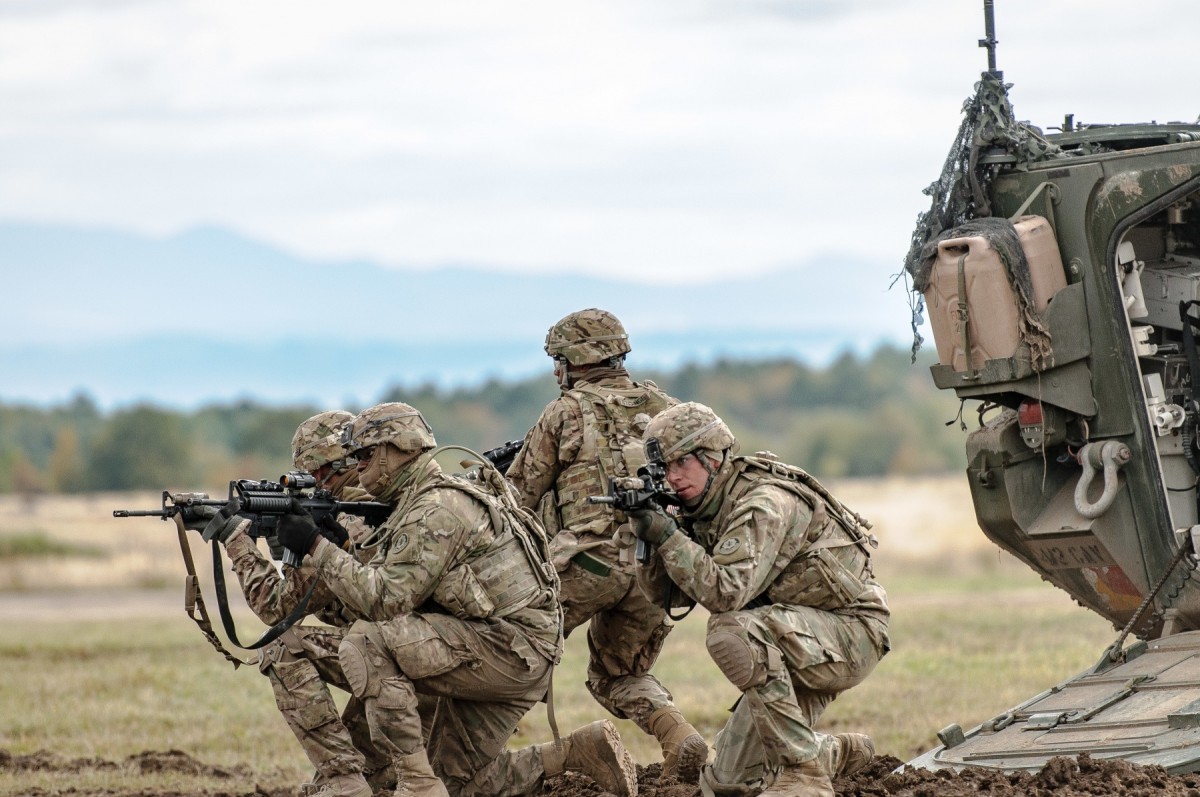
Specialist Hector Blanco, writing for the U.S. Army, explains that the Eastern Flank Deterrence Line (EFDL) is being developed alongside European allies to strengthen the readiness of the Eastern Flank of NATO. He discusses how this most recent iteration of the deterrence strategy will incorporate more emerging technologies such as artificial intelligence to observe how they can help personnel during combat, “V Corps continues to prioritize interoperability with NATO partners through shared technology, datalink experimentation, and joint training. Major exercises, including Combined Resolve, Avenger Triad, and upcoming Warfighter exercises, serve as testing grounds for integrated systems and operational concepts. These events move emerging technologies from experimentation into operational use while building the shared procedures and trust required for coalition operations.” In this, the U.S. is able to prove its use of the most advanced technologies during wartime while also assisting in training the militaries of European states to make the most out of emergent technologies.
Despite the promises of the EFDL, the Trump administration has threatened to pull U.S. troops out of Europe. According to Independent, this follows President Trump’s comments regarding a perceived lack of action by NATO allies with regard to the ongoing U.S. war against the Islamic Republic of Iran. As NATO is primarily an alliance of collective defensive, offensive wars such as the campaign against Iran do not apply to Article 5 of the North Atlantic Treaty. While Germany retains the largest number of U.S. military personnel as a holdover from the division of East and West Germany in the Cold War, Poland holds among the most geopolitically advantageous positions in the alliance. If U.S. troops withdraw from Eastern Europe, officials warn that Russia would no longer be deterred from military intervention. In this context, several NATO members in Europe have relented to U.S. demands and now assist in basing and logistics for the war against Iran. While this new commitment has been adopted by many NATO allies, according to Le Monde there are ongoing talks between France and Poland to strengthen military ties in the face of a diminishing U.S. troop presence. While this may be beneficial toward the fostering of greater cooperation on the continent, analysts say this could signal a shift in how European allies view U.S. leadership; how the conduct of the U.S. toward its European allies is potentially leading them to rely more upon one another, rather than the U.S, placing the true cohesion of NATO into question.
A key concern among analysts is that the demands of the U.S. for NATO member states to support the offensive war against Iran is that they undermine the purpose of the organization and cause disunity among its members as each state takes a different policy. According to Al Jazeera the war against Iran has forced the U.S. to redirect many of its military resources toward the Middle East and away from other contentious theatres such as the Korean Peninsula and Eastern Europe. These discussions with regard to the safety of Eastern Europe, CSIS reported that the eastern flank of NATO still is in need of reinforcement after what has been observed in the Russo-Ukrainian War. The necessity of a sizable troop presence is made clear in its ability to signal to the international stage in general and Russia in particular that there will be no room for more invasions in the region as was seen in Ukraine, “In the future, NATO will continue to undertake preparations for collective defense against Russian aggression from the east. The deterrent force will be constituted of forward-deployed troops acting as a tripwire.” If the U.S. continues to redirect its military resources away from Eastern Europe, the strength of NATO deterrence in the region will begin to weaken.
Image courtesy U.S. Army Europe