Hungary’s Parliamentary Elections and the Country’s Possible Future
Avery Kachmarsky
Staff Writer
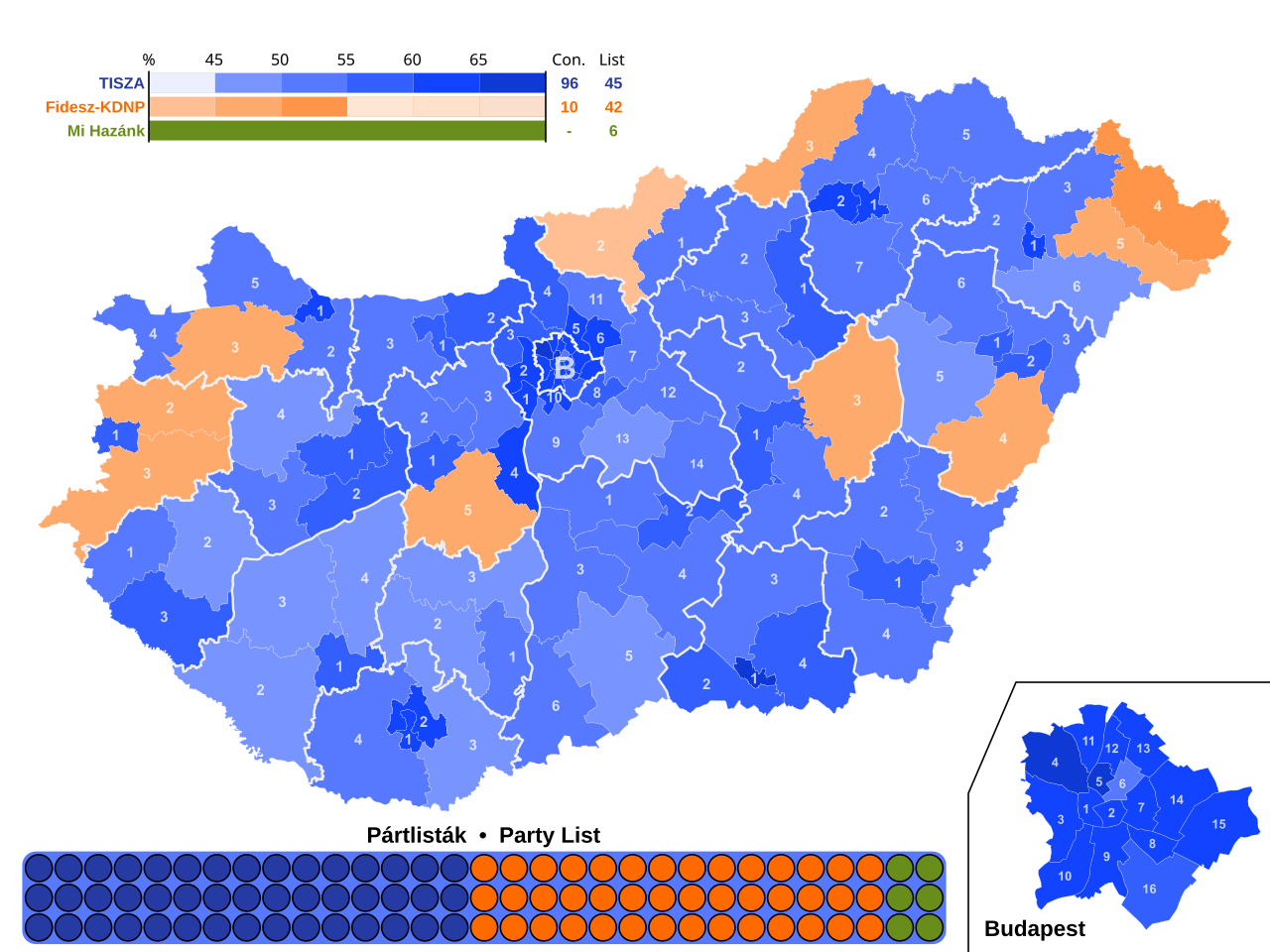
Hungary’s electoral system combines single-member districts with proportional representation, which tends to give an advantage to the dominant party. Over the past 16 years, this system has helped Viktor Orbán and his Fidesz party maintain consistent control of parliament. Changes to the system over time have also made it harder for opposition parties to win outright, since opposition parties must outperform the ruling party by several percentage points nationally in order to secure a parliamentary majority, according to NYU’s Jordan Center. As a result, even when public dissatisfaction increases, the existing system continues to favor continuity in leadership.
In recent months, political developments have been influenced by the emergence of Peter Magyar as a serious opposition figure. His background within Hungary’s political establishment, especially as a previous member of Fidesz, has allowed him to present himself as both experienced and reform oriented. His platform emphasizes anti-corruption measures, institutional accountability, and closer alignment with European Union standards. His rise reflects a shift in political sentiment, as dissatisfaction with governance, scandals, and economic conditions led voters to support the Tisza party and embrace a sense of hope, per Al Jazeera.
Public opinion leading up to the election has been shaped largely by economic concerns and Hungary’s relationship with the European Union. Inflation and limited access to EU funding have contributed to growing frustration, particularly among urban populations. However, support for Fidesz has remained relatively strong in rural areas, where political alignment, localized messaging, and longstanding social values continue to reinforce the government’s position. This urban-rural divide has become increasingly central to understanding voter behavior and electoral tendencies within Hungary, according to the Center for European Policy Analysis.
During the election period, voter turnout served as a key indicator of political engagement and potential change. Higher participation rates were expected to benefit opposition candidates, particularly in regions where dissatisfaction has been more prevalent. Initial outcomes suggested that while Fidesz retained a strong base of support, opposition candidates achieved improved performance in several districts compared to previous elections, as 74 percent of registered Hungarian voters voted by the end of the afternoon, as stated by Politico. These results indicate a more competitive political environment, though not necessarily an immediate shift in overall power.
The potential implications of a post-Orbán landscape in Hungary are especially significant in relation to Hungary’s position within the European Union. One of the most important issues is the status of frozen EU funds, which have been withheld due to concerns over judicial independence, corruption, and anti-democratic laws being passed in Hungary, per the International Bar Association. A new government aiming for reform could take steps to address these concerns, potentially restoring access to substantial financial resources and improving economic conditions.
Hungary’s role in EU decision-making may also be affected by changes in leadership. Under Orbán, the country has frequently delayed or complicated consensus on issues, including sanctions on Russia and financial aid packages to Ukraine. A shift in political reform could lead to a more cooperative approach, allowing Hungary to align more closely with broader EU policies and reducing tensions within the bloc, while still preserving Hungarian interests, as reported by the Centre for European Reform.
Despite these developments, structural factors within Hungary’s political system continue to favor established power. Institutional influence, electoral design, and existing political networks may limit the extent of immediate change, even in the presence of growing opposition support. As a result, any transition away from current leadership would likely occur gradually rather than through a single electoral outcome.
Image courtesy of Wikimedia Commons, licensed under the Creative Commons Attribution 4.0 International license.