
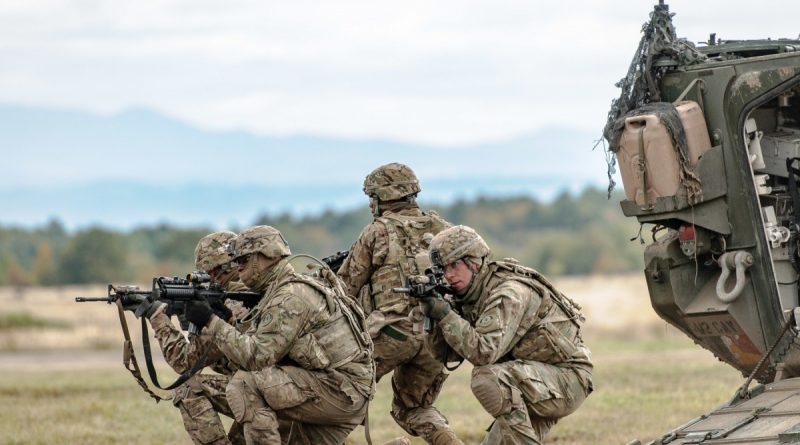
State of U.S. Troop Presence in Eastern Europe
Aidan Ishann Raman Bogan Staff Writer NATO allies are reassessing their defensive strategy in Eastern Europe as shifting U.S.
Read More
Aidan Ishann Raman Bogan Staff Writer NATO allies are reassessing their defensive strategy in Eastern Europe as shifting U.S.
Read MoreThere is a new kind of boom sweeping Washington, D.C. — not in real estate or politics, but in defense technology. From the Pentagon’s, to Arlington, to venture-capital-funded corridors, investors, engineers, and policymakers are pouring billions into what they see as the next huge national-security frontier: artificial intelligence, autonomous systems, quantum computing, and 5G-enabled battle networks.
Read MoreOn Africa’s evolving battlefields, the skies are a new front in the fight against terror. Over the past two years, both Islamist militants and state-actor rivals have increasingly relied on drones, not only for reconnaissance, but for lethal strike missions. The result is a fundamental transformation in the projection of violence across the continent, especially in Sudan and the Sahel, where comparatively low-cost unmanned aerial vehicles (UAVs) are rebalancing the dynamics of asymmetric conflict.
Read MoreAs President Donald Trump begins his second term in office, significant cuts in foreign assistance aid had been announced earlier this year, affecting the 177 eligible countries in 2023 that received United States aid. Ukraine faces the highest reduction at the country level among these nations. Ukrainians are already beginning to feel the impact of these aid cuts, and many are growing more concerned over the uncertainty of the future.
Read MoreCatholic Relief Services (CRS), a non-profit organization that was founded over 80 years ago in the aftermath of World War II to help starving and suffering survivors, is among the many organizations to take a major hit from USAID cuts. CRS is USAID’s largest faith-based international partner and their top NGO recipient, receiving $4.6 billion dollars in funding between 2012 and 2022, reports Forbes.
Read MoreUnited Kingdom Prime Minister Keir Starmer announced in February that the country will cut its aid budget to 0.3 percent of gross national income by 2027, Devex reports. International development minister Anneliese Dodds resigned following the decision. The Labour Government had planned to return to spending 0.7 percent of Gross National Income (GNI) on foreign aid, and even during the announcement, Starmer said he remained committed to reaching that goal, the Commons Library says.
Read MoreThe lights have dimmed in USAID offices around the world. Thousands have lost their jobs, and with only 294 set to remain, according to The New York Times, a stain is forever left on the United States’ history of humanitarian aid.
Read MoreOn March 22, Japan, China, and South Korea met in Tokyo for what Japanese Foreign Minister Takeshi Iwaya is calling a “turning point in history.” According to Reuters, top diplomats from all three countries met to find common ground on security and East Asia and on economic issues. At this meeting, the foreign ministers of each country discussed trilateral cooperation on disasters, aging, the green economy, and declining birth rates writes The Associated Press.
Read MoreGermany’s elections on February 23 brought a new chancellor for the country and the largest voter turnout the country has recently seen. While Freidrich Merz and the Christian Democrats won the chancellery, they will still have to work to form a coalition with at least one other party.
Read MoreFar-Right protestors have lined the streets in Romania’s capital Bucharest as hundreds call out what they see as a failing of democracy. Călin Georgescu, the 62-year-old leader of the Romanian Far-Right populist movement, was notified by the Central Election Bureau (BEC) that his presidential bid was denied.
Read More