- March Madness popularity rises among men’s and women’s basketball fans
- March Madness brackets and betting bring us together
- Americans overwhelmingly support college athletes’ rights to determine value
- Americans favor college athletes’ rights to collective bargaining and Title IX protection
America is eager for the upcoming NCAA (National Collegiate Athletic Association) Men’s and Women’s Basketball Championships. The Seton Hall Sports Poll finds that among self-described NCAA men’s basketball and self-described NCAA women’s basketball fans, March Madness anticipated viewership is as high as 93 and 91 percent for their respective tournaments. These percentages are even higher than the 69 percent of Major League Baseball fans who reported that they plan to watch the popular World Baseball Classic. Nationally, more than a third (39%) of Americans plan to watch the men’s tournament while just under a third (31%) of Americans plan to watch its counterpart, the women’s.
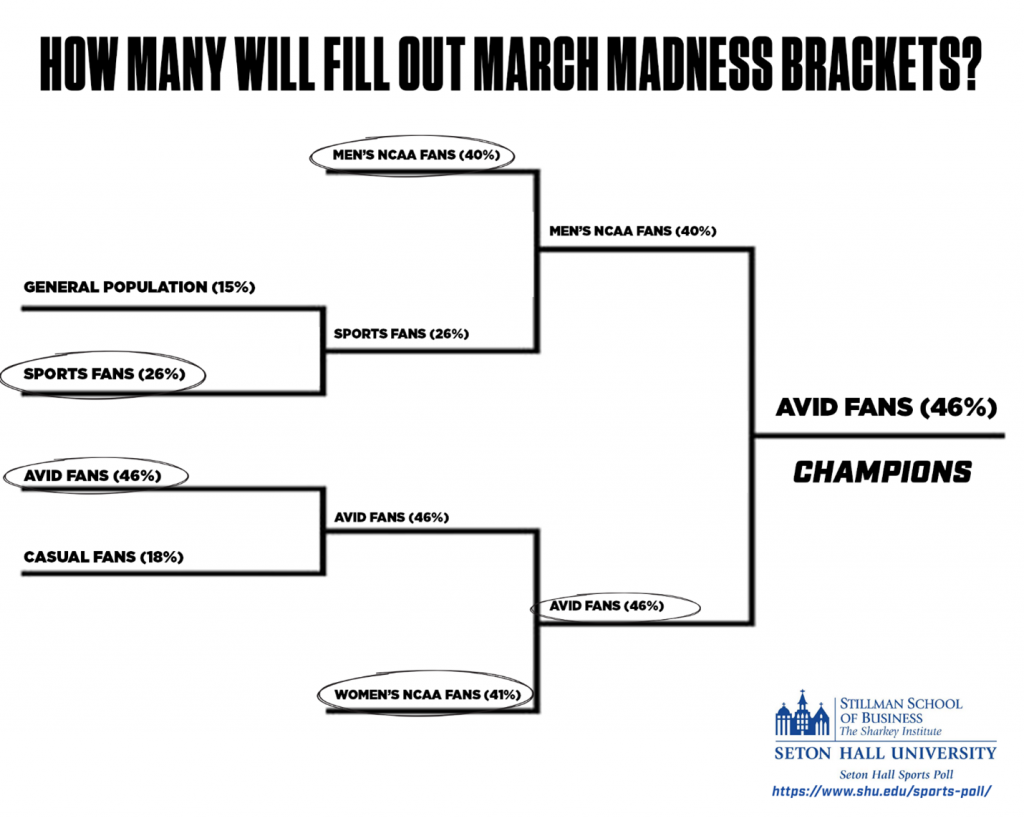
Beyond watching, one of the best parts of March Madness is competing against friends and family in a bracket contest. The Poll finds that 15 percent of Americans, 40 percent of NCAA men’s, and 41 percent of NCAA women’s fans will fill out a bracket for the upcoming tournaments.
In terms of formal betting, ten percent of Americans plan to place a bet or wager on either tournament. In contrast, 26 percent of NCAA men’s and 29 percent of NCAA women’s fans plan to place a bet or wager, indicating how betting platforms have infiltrated sports culture.
These results are derived from a Seton Hall Sports Poll conducted March 5th-9th among 1,536 adults. The Poll, which is sponsored by The Sharkey Institute within Seton Hall University’s Stillman School of Business, features a national representative sample from YouGov Plc., weighted on U.S. Census Bureau figures for age, gender, ethnicity, education, income and geography with a margin of error of +/- 3.0 percent.
The Changing Landscape of College Sports
There is no question that college sports is changing drastically. Athletes are challenging the status quo through the courts. The Poll reveals strong support for college athletes, the one group that conspicuously was not invited to the March 6th special meeting on college sports at the White House.
Americans overwhelmingly agree on allowing athletes their right to publicity via the use of their name, image and likeness (NIL) with 54 percent supporting its fairness. Agreement reaches as high as 70 percent of NCAA men’s and 72 percent of NCAA women’s fans. There is less intense, but still strong support for the fairness of businesses, alumni, and donors pooling their money to offer NIL endorsements to student athletes to attract players. Thirty-two percent (32%) of Americans believe this is fair while 20 percent think it is unfair. The support ratio rises 48 percent fair versus 19 percent among NCAA men’s fans, and 51 percent fair versus 17 percent among NCAA women’s fans.
The Poll also asked whether it is fair to consider college athletes as student employees as claimed in the ongoing Johnson v. NCAA litigation. Forty percent (40%) of Americans, 50 percent of NCAA men’s fans, and 56 percent of NCAA women’s fans agree that student athletes are entitled to minimum wage and overtime.
The major professional sports leagues in the U.S. have all negotiated a collective bargaining agreement. When asked if college athletes should be allowed to do the same, 43 percent of Americans, 58 percent of NCAA men’s fans, and 64 percent of NCAA women’s fans agree that it would be fair. Americans believe by a margin of five to one (51%-9%) that Title IX protections which prohibit discrimination based on sex should apply to the current revenue distribution model.
While there exists overwhelming support for the college athletes in their right to NIL and collective bargaining agreements, that support wanes when presented with the revenue distribution model of the recent House v. NCAA settlement. There is rising opposition to the settlement rule to distribute 95 percent of the required $22 million annually among only the sports of football, men’s basketball, and women’s basketball. While NCAA women’s fans think this is fair by a small margin (39%-34%), overall Americans think this unfair by 11 points (35%-24%).
“Those who feel that athletes should be content with their scholarship and cost of admission is a shrinking class who yearn for the NCAA of a half century ago,” says Charles Grantham, Director of the Center for Sport Management and the Seton Hall Sports Poll at the Seton Hall Stillman School of Business. “Much like the end of the reserve clause in baseball and free agency in all sports, college athletes are finally being recognized for the assets they’ve become. Whether or not schools are comfortable with the new landscape is not as relevant as the determination of the athlete’s value in the market. It is as American as March Madness and apple pie.”
March 2026 Seton Hall Sports Poll Results
Daniel Ladik, Ph.D., Methodologist – daniel.ladik@shu.edu
This Poll was conducted March 5th through March 9th and includes responses from 1,536 U.S. adults with a margin of error of +/- 3%. The sample mirrors the U.S. Census percentages on age, gender, income, education, ethnicity, and region.
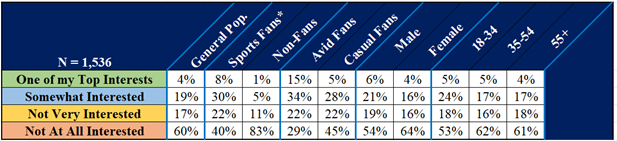
Q1. Which of the following statements best describes you?
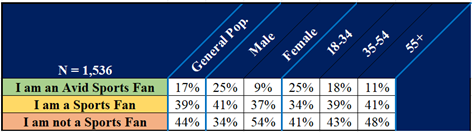
*Note: Presented in each table, Avid + Casual = total sports fandom in the data. Some tables break out the Avid and Casual segments.
Q2a. Major League Baseball (MLB)
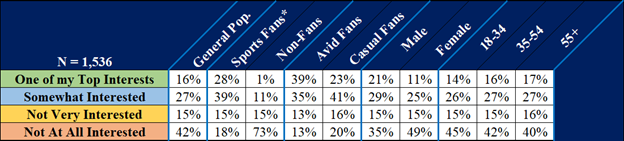
Q2b. NCAA Men’s College Basketball
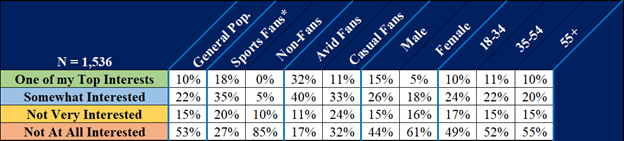
Q2c. NCAA Women’s College Basketball
We’d now like to ask you some questions about your plan to watch each of the following tournaments: The World Baseball Classic (WBC), the Men’s and Women’s NCAA Basketball Tournament.
On which device, if at all, will you be watching each of the following? For each row please select the option that best applies.
Q3a. World Baseball Classic

Q3b. NCAA Men’s Basketball March Madness Tournament

Q3c. NCAA Women’s Basketball March Madness Tournament

To what extent do you agree or disagree with each of the following statements?
Q6a. Athletes receiving compensation for their right to publicity via their own name, image, and likeness (NIL) third party endorsements is fair.

Q6b. Requiring schools to distribute over $22 million annually to their athletes from broadcasting and other sources in the following manner: 75% for football, 15% for men’s basketball, 5% for women’s basketball and 5% to all other sports is fair.

Q6c. College athletes are “student employees” entitled to minimum wage and overtime, like work-study students is fair.

Q6d. The major professional sports leagues in the U.S. all negotiated a collective bargaining agreement between their league and the players. College athletes should be able to seek a similar agreement with their colleges.

Q6e. Title IX protections prohibit discrimination based on sex in athletic programs that receive Federal assistance. The provisions of Title IX should also apply to the distribution of revenue coming from these cases to female college athletes.

Q6f. At many colleges, it is fair for alumni to pool their money in collectives to offer lucrative name, image, and likeness (NIL) endorsements to student athletes attracting them to play for their university.

And now a few questions about the Men’s and Women’s NCAA Basketball Tournaments…
Q7a. Will you be filling out a bracket for either the Men’s or Women’s NCAA March Madness Tournaments?

Q7b. Will you be placing any bet or wager on any of the games for either the Men’s or Women’s NCAA March Madness Tournaments?
