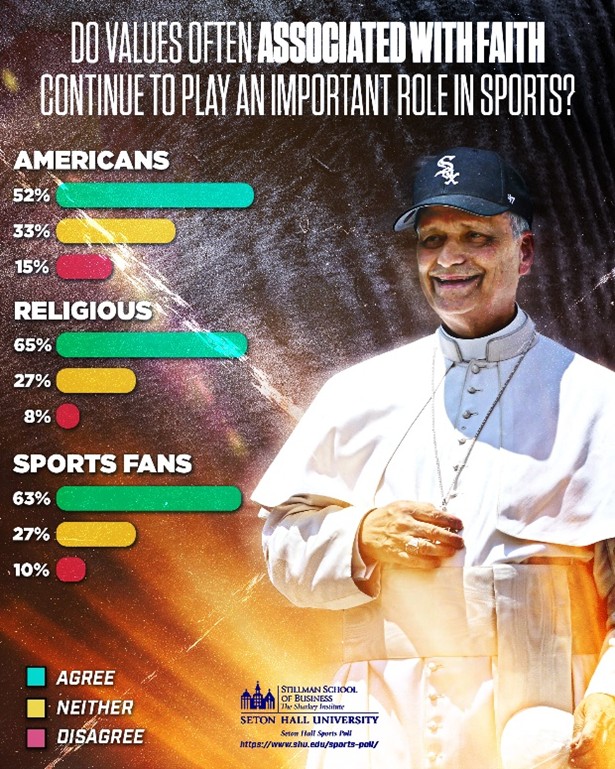
- Americans (52%) and sports fans (63%) believe faith-values align with sports-values
- Americans support an athlete’s freedom to express their faith during competition (53% of Americans, 60% of sports fans)
In his Papal letter entitled “Life in Abundance1,” Pope Leo XIV emphasizes the value of sport in anticipation of the Olympic Winter Games Milano Cortina 2026. Sport is more than just competition. Pope Leo frames it as a rejection to social division. “It offers a privileged space for relationship and dialogue with our brothers and sisters belonging to other religious traditions, as well as with those who do not identify with any religious tradition.” A recent Seton Hall Sports Poll explored these very thoughts presented by Pope Leo.
Continuing in his letter, Pope Leo highlights how sport builds crucial character traits like honesty, humility, and teamwork, which are also heavily encouraged by faith. He sees sport as a transformative experience where personal goals are subordinated to team objectives. He believes that when athletes embrace true sportsmanship, they shift their focus from themselves to the group, striving together to achieve a common goal. In doing so, sport teaches important values such as unity, sacrifice, and mutual responsibility.
When polled whether values often associated with faith (e.g., honesty, humility and teamwork) continue to play an important role in modern sport culture, more than half agreed. Fifty-two percent of the general population believe that these values are still important in sports. Those who describe themselves as religious agreed by a 2 to 1 margin over those who describe themselves as not religious (65% to 31%). Avid sports fans (69%) agree the most. This compares to 60 percent of casual fans and 36 percent of non-fans who similarly agree.
Values often associated with faith (e.g., honesty, humility and teamwork) continue to play an important role in modern sport culture.

“Overall, Pope Leo offers a lofty evaluation of sport—regarding it as a continuing and living witness to ‘the goodness of the world created by God,’” said Reverend Monsignor Thomas G. Guarino, S.T.D., Professor Emeritus of Systematic Theology at Seton Hall. “Indeed, for the Pope, sport provides a dynamic testimony to the extraordinary uniqueness of the human person as ‘a unity of spirit, soul and body.’”
This Poll was conducted November 9th through November 10th and includes responses from 1,564 U.S. adults with a margin of error of +/- 3%. The sample mirrors the U.S. Census percentages on age, gender, income, education, ethnicity, and region. The Poll is sponsored by the Sharkey Institute within the Center for Sport Management in the Stillman School of Business at Seton Hall University.
Americans Support Religious Expression from Athletes
Pope Leo reaffirms the Church’s support of the Olympic Truce, recently endorsed by the International Olympic Committee and the United Nations General Assembly. Highlighting a world “thirsting for peace,” he advocates for mechanisms that can stop “the abuse of power, displays of force and indifference to the rule of law.” He strongly encourages nations to embrace the Olympic Truce during the Olympic Winter Games Milano Cortina 2026 as a symbol of hope — a promise of global reconciliation. Through this message, the Pope views sport as more than leisure, seeing it as a moral and diplomatic tool capable of uniting divided societies.
Pope Leo emphasizes sport’s cultural, educational, and symbolic worth as a common language of encounter and hope. The Seton Hall Sports Poll surveyed Americans about whether they support an athlete’s freedom to express their faith and to display religious gestures during games.
Support for an athlete’s religious gesture is strong across all segments surveyed. The results show that 53 percent of the general population, 67 percent of those who describe themselves as religious, 60 percent of sports fans, and 64 percent of avid fans support an athlete’s freedom to express one’s faith during competition.
Professional and collegiate sports should actively support athletes’ freedom to express their faith during competition.

Moreover, the results show that 47 percent of the general population, 60 percent of those who describe themselves as religious, 54 percent of sports fans, and 59 percent of avid fans feel that it is appropriate for an athlete to display religious gestures during games.
It is appropriate for athletes to display religious gestures during games (e.g., prayer, kneeling, prostrating, pointing upward).

Religion and Sport Work Together
Combined, the Pope’s thoughts and the Seton Hall Sports Poll results show that sports are still a place where morals matter in today’s world. As we enjoy the Olympic Winter Games Milano Cortina 2026, Pope Leo XIV’s words are both inspiring and a call to action: when sports are based on honesty, humility, and working together, they become more than just games. They become a way to bring people together, talk to each other, and find hope.
[1] “Life in Abundance” On the Value of Sport. https://press.vatican.va/content/salastampa/en/bollettino/pubblico/2026/02/06/260206d.html
Questions and charted breakdowns are below; an online version of this release may be found at https://blogs.shu.edu/sportspoll/
November 2025 Seton Hall Sports Poll
Daniel Ladik, Ph.D., Methodologist – daniel.ladik@shu.edu
This Poll was conducted November 9th through November 10th and includes responses from 1,564 U.S. adults with a margin of error of +/- 3.0%. The sample mirrors the U.S. Census percentages on age, gender, income, education, ethnicity, and region. The Poll is sponsored by the Sharkey Institute within the Center for Sport Management in the Stillman School of Business at Seton Hall University.
Q1. Which of the following statements best describes you?
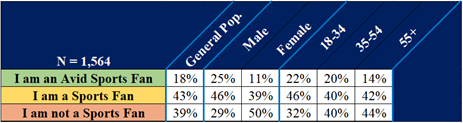
*Note: Presented in each table, Avid + Casual = total sports fandom in the data. Some tables break out the Avid and Casual segments.
Many professional and collegiate athletes express their faith in some way within a sporting context. How much do you agree or disagree with each of the following statements.
Q6. How important is religion in your life?
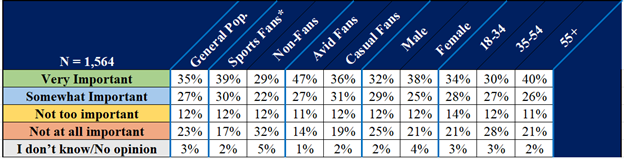
Q7a. It is appropriate for athletes to display religious gestures during games (e.g., prayer, kneeling, prostrating, pointing upward).

Q7c. Professional and collegiate sports should actively support athletes’ freedom to express their faith during competition.

Q9b. Values often associated with faith (e.g., honesty, humility and teamwork) continue to play an important role in modern sport culture.
