Diplomacy Foreign Policy Workshop
Julia Brown
Staff Writer
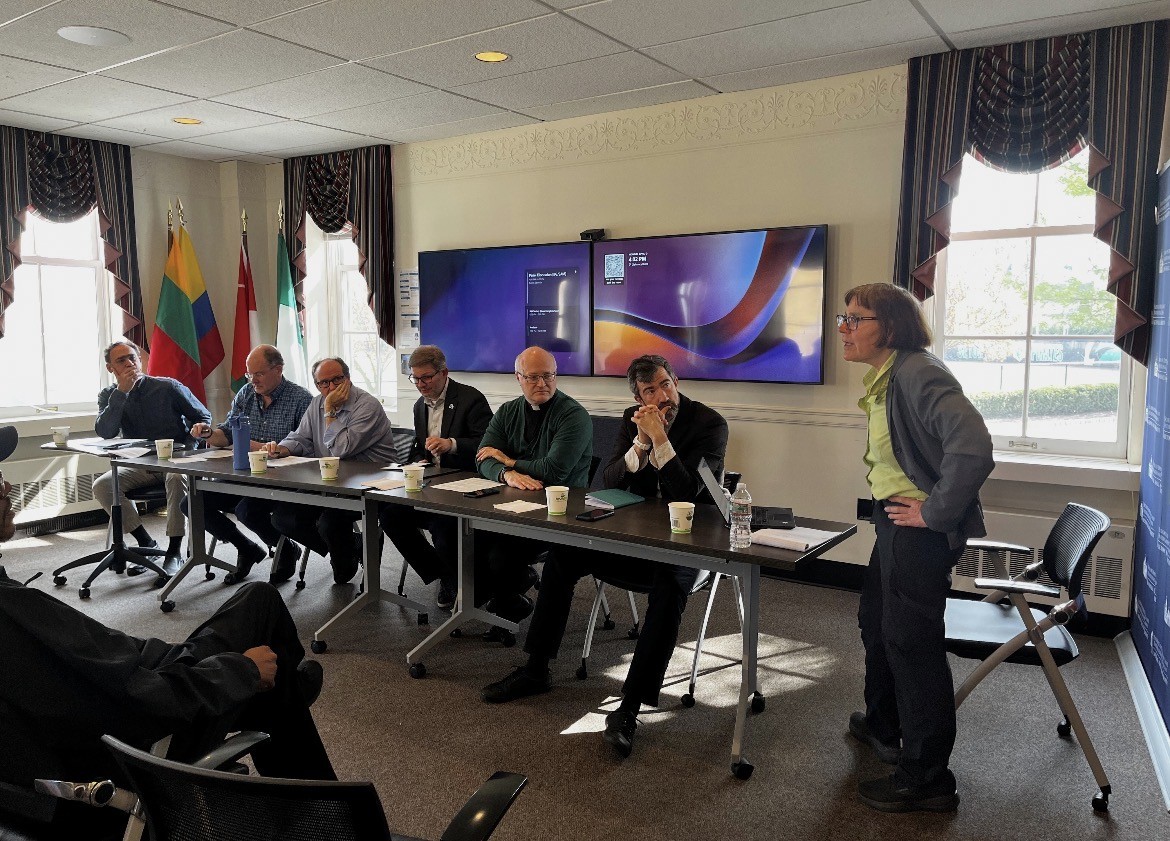
On April 13, Seton Hall University’s School of Diplomacy and International Relations organized a workshop entitled “US Foreign Policy in the Trump 2.0 Administration”, where professors shared their insights on critical areas of recent international action relevant to their professional backgrounds.
Students who attended heard from School of Diplomacy faculty Margarita Balmaceda, Ph.D., Dean Courtney Smith, Ph.D., Brian Muzas, Ph.D., Joseph Huddleston, Ph.D., Associate Dean Martin Edwards, Ph.D., Phil Moremen, Ph.D., and Benjamin Goldfrank, Ph.D., on topics related to President Trump’s grand strategy, international law, tariffs, war, and humanitarianism.
Panels reviewing American foreign policy are not new to the School of Diplomacy, as they were previously held for President Trump’s first term in 2017 and President Biden’s in 2021. This year’s panel was organized by Dr. Goldfrank after a student asked him if World War III was about to start following the U.S. attack on Iran. Throughout the panel, Dr. Goldfrank expressed that he does not think this is likely.
Each speaker was allotted eight minutes to discuss their chosen topic.
Dr. Balmaceda spoke first, describing how the Trump administration’s economic and political policies benefit Russia. Many of Trump’s recent decisions involving Russia, such as his attempts at brokering a ceasefire deal between Russia and Ukraine, seem to place blame on President Zelenskyy while exonerating and even supporting President Putin. In March 2026, Trump reaffirmed his sentiments from the February 2025 Oval Office meeting to Politico, saying, “Zelenksyy, he has to get on the ball, and he has to get a deal done.”
Dean Smith discussed global governance and the impact of the United States. In general, global governance, the United Nations in particular, is experiencing a significant financial crisis. In January 2026, Secretary-General António Guterres warned all 193 member states of an approaching and “imminent financial collapse.” In February, the United States paid $160 million toward its $4 billion debt. In terms of setting a global agenda, neither the United Kingdom nor France has cast a veto at the UN since 1989, but the U.S. does so frequently, regardless of the party in power. In March 2026 at the annual United Nations Commission on the Status of Women held in the New York City headquarters, the U.S. alone vetoed the Agreed Conclusions because of “ambiguous language promoting gender ideology.”
Dr. Huddleston spoke about the decline of soft power and how Trump’s actions counteract the idea that America is good and that other countries should emulate us. During an interview with Fox in 2017, Trump defended President Putin, saying, “You think our country’s so innocent?” After cutting millions of dollars for Christian aid groups, Dr. Huddleston argues our role is no longer to help people but to prioritize the economy and leverage hard power.
In terms of international law, Dr. Moremen argues it does not carry much weight in an America First era. In January 2026, President Trump made his stance clear in an interview for The New York Times in which he said, “I don’t need international law.” His position is supported by his intervention in Venezuela and attack on Iran without seeking Security Council approval. President Moremen says our military action against Iran was largely preemptive, anticipating a future attack against Israel, and is comparable to the justification Russia used when launching an invasion of Ukraine. The United States may be using an especially elastic interpretation of “imminence” to justify the use of force, or our rules-based international order may simply be a “dead letter,” sacrificed in favor of raw power. Dr. Moremen reassures us that violations of rules do not mean the law goes away: political regimes do not last forever, areas of international law will survive, and states will continue to demand stability.
Approximately thirty students attended the event, and many had positive feedback to share. Gabriella Cardoso, a second-year undergraduate student in the 3+3 Diplomacy and J.D. program, said, “It was incredible to listen to Dean Smith and Dr. Muzas discuss our current administration and their actions. Hearing how the U.S. has targeted international organizations that do not uphold policy interests and how Trump’s transactional approaches have made everything more complicated is not surprising but very worrisome. This panel was a great opportunity to get a more in-depth look at the Trump administration.”
James Murray, a fourth-year International Economics and International Relations student, said, “The foreign policy panel event was a refreshing experience because we got to see two of the School of Diplomacy’s most esteemed faculty debate the Trump administration’s foreign policy choices in a casual but direct way, reminding students that even our school’s leadership have specific disagreements about the decisions made by US leaders and institutions.”
Dr. Goldfrank argued we must reject old concepts like the idea of a grand strategy when analyzing Trump’s policies, as impulsivity has become our state policy. He referenced President Trump’s seemingly erratic posting on TruthSocial from 9 PM on April 12, 2026, to 4 AM on April 13, 2026. While other professors disagreed, Dr. Goldfrank declared that our checks and balances are failing, but in reference to Péter Magyar’s recent victory, if the Hungarians can do it, so can we.
Dr. Goldfrank praised the quality of the questions asked as well as the turnout. We can expect to see more events like this “more often than every 4 years.”
“If there’s student interest,” Goldfrank says, “anything can happen.”