Wordless Novels

A wordless novel, also known as woodcut novels, is a graphic narrative genre of literature that uses sequences of textless images to tell a story often using woodcuts or other relief printing techniques. With roots in the German Expressionist movement that emphasized emotion and responses, the aggressive black and white images produced by woodcuts enjoyed a revival during the early 20th century.1 The content typically contains socialist themes, expressing struggles against capitalism, or stories with strong social messages such as frustration at social injustice.2

These novels developed alongside the silent cinema that displayed thematic elements from fantastic and realistic worlds capturing the already familiar with black and white visuals that told a story.1 Essentially, wordless novels became a personal and portable silent film.1 But much like silent films fell out of favor and were superseded by the “talkies”, wordless novels had also reached their peak around 1929-1931. They further fell out of favor during World War II in both Germany, where it was viewed as degenerative art, and in the United States because of the socialist views they contained.

The first book of this type was created by Frans Manereel (30 July 1889-3 January 1972) a Belgian painter and graphic artist who worked mainly in France and favored woodcuts as his primary mode of expression to his death in 1972.1 Over the course of his life, Manereel produced numerous illustrations and over fifty wordless novels.

Soon enough other artists followed such as Otto Nückel (6 September 1888-12 November 1955) a German painter, graphic designer, illustrator, and cartoonist. Unlike others, Nückel used lead instead of wood to create his woodless novels because of a lack of wood during World War I. Due to his use of lead, Nückel was able to create finer lines in addition to creating depth and focus on his illustrations.1

Lynd Ward (26 June 1905-28 June 1985), an American artist and novelist created a wordless book called Gods’ Man, which established his reputation as an illustrator. It was a sought-after book during the Great Depression, and is considered a precursor to the graphic novel.3 Where the graphic novel combines text and imagery much like comic strips. Ward’s artistic vision was inspired by illustrations such as those found in Gustave Doré’s Bible.3 Much like Nückel deviated from traditional woodcut so did Ward by using wood engraving which allowed him to create finer lines and more details.2 While there are other artists that followed, these three names are the most well-known when wordless novels are discussed.

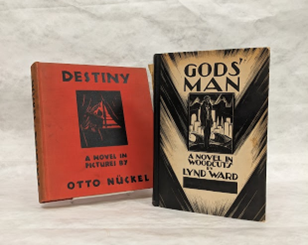
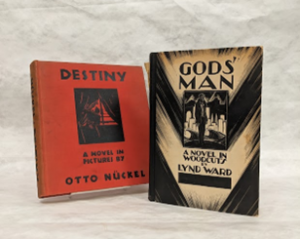
Image showing the red cover ot Destiny by Otto Nuckel and the black and white cover of God's Man by Lynd Ward

Within the Archives and Special Collections Center, there are two wordless novels. They are dark stories that trace the tragic lives of their protagonist. The second is by Lynd Ward and is a 1930 fifth printing of God’s Man. This wordless novel tells the story of a man who sells his soul for a magic paintbrush which resembles the decorative clock hand. There are 139 wood engravings to tell this Faustian story about an artist “who signs a contract with a masked figure in exchange for fame and fortune. He gains success but soon becomes disillusioned when he discovers the extent to which money, in the guise of his mistress, has corrupted every facet of society. When he assaults her, he is thrown into jail. He eventually escapes, is chased from the city by an angry mob, and jumps into an abyss to avoid his captors. A woman, living alone in the woods, discovers his body and nurses him back to health. The artist discovers happiness in her simple country life. The woman gives birth to their child, and they seem totally content until a masked figure appears and commands the artist to follow him to the summit of a cliff. When the figure removes his mask, revealing himself as the embodiment of Death, the artist recoils and falls off the edge of the cliff to his death”.1

The second is by Otto Nückel and is a 1930 printing of Destiny. There are over 200 lead-cut prints that tells the story of a woman in Western civilization during the 19th century. This story

“traces the tragic life of an impoverished woman who is constantly victimized not only by men but by a culture that offers little opportunity for women to survive. The heroine’s drunken father and overworked mother die early in her life, leaving her alone to survive. She works for a farmer in a village where she is seduced by a traveling salesman, resulting in an unwanted pregnancy. After imprisonment for the murder of her unwanted child, she works as a prostitute, forsakes a chance for a traditional relationship, murders a man with an ax during a drunken revelry, and is shot by the police as she jumps to her death from a window of an upper story room”.1

Both books were a ‘Gift of Otto Baum’ to the University. If you would like to view these books, please submit a Research Appointment Request and reference their catalog records which can be found here for God’s Man and here for Destiny.


References

  1. Beronä, D. A. (2008). Wordless Books : The Original Graphic Novels. Abrams.
  2. Postema, B. Chapter 4: Long-Length Wodless Books: Frans Masereel, Milt Gross, Lynd Ward, and Beyond. In The Cambridge history of the graphic novel(First paperback edition) 2018. Cambridge University Press.
  3. Lynd Ward as illustrator. Lynd Ward As Illustrator | Georgetown University Library. (2001, June 4). https://library.georgetown.edu/exhibition/lynd-ward-illustrator

Fascinating Facsimiles

Facsimiles have been around for centuries. They tend to be an exact copy of a book, manuscript, or other item of historical interest, appearing as close to the original as possible in terms of size, color, and condition. For works on paper, early facsimiles were produced by hand through drawings, rubbings, engravings, and lithographs. By the nineteenth and twentieth centuries, facsimiles were produced using far more complex techniques and equipment as photographic processes developed. In the case of a book or manuscript, facsimiles appear as numbered limited-edition reproductions that can range from a partial to full reproduction right down to the very holes in the pages. Facsimiles are important research and teaching tools that allow researchers and students to closely examine items that would otherwise be difficult or impossible to consult in person due to location, condition, and access policies.

Within the Archives and Special Collections, there are a few facsimile editions of manuscripts, besides the well-known Book of Kells, that the Seton Hall community and researchers alike can view:

Bible Moralisée

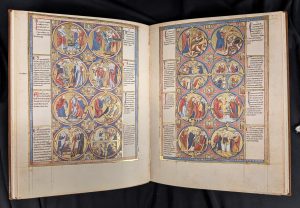
The original Bible Moralisée was likely made in 1220s and is held in the Österreichische Nationalbibliothek of Vienna under the shelfmark Codex Vindobonensis 2554, referred to as Vienna 2554. Bible Moralisée, while acknowledge as a title of this work, is French for moralized Bible which is a name given to a distinct genre of Bible that began to appear in the thirteenth century. These Bibles did not include the full text and instead contained illuminated, gothic styled images as a way to interpret and explain scripture, often focusing on teaching morality. Typically, they were for private educational use such as instruction for French kings. While the complete history of Vienna 2554 is unknown, it is said that it could have been commissioned by Blanche of Castille, wife of Louis VIII, mother of Louis IX, and regent of France (1226-1234).

The facsimile is a full-size color reproduction of the entire one hundred and thirty folio original manuscript with trimmed pages according to the original format. The leather binding, differs and is modelled on a contemporary binding found in the Austrian National Library.

Illuminated illustrations of the Bible Moralisée


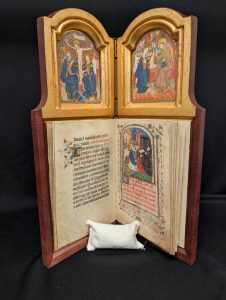
Buchaltärchen, Livre-autel (Book Altar of Philip the Good)Open Book Altar of Philip the Good showing illutstrations the diptych

The Book Altar of Philip the Good is a painted diptych on panel, depicting the Trinty and the Coronation of the Virgin, and a Christian prayer book, that depicts portraits of Philip, Duke of Burgundy throughout the miniatures, that have been united to create a portable altar. The diptychs open the same as a book with edge decorated to resemble the pages of a book.

The original was created around 1430 and made exactly according to the personal wishes of the commissioner, Philip the Good. He used this daily for quiet devotion and mediation. This 76-page book contains five miniatures in addition to the diptych.

The facsimile is full-size color reproduction of the entire original document, attempting to replicate the look and feel of the original. Pages are trimmed according to the original format. It is bound in brown kidskin leather on wooden panels, decorated with blind tooling. The binding reproduces that of the original.


The Leningrad Codex

The Leningrad Codex is the oldest complete manuscript of the Hebrew Bibles in the Hebrew language using Masoretic text and Tiberian vocalization. It is housed in the Saltykov-Shchedrin State Public Library in St. Petersburg, Russia.

The facsimile edition was published in 1998 and is the first complete facsimile edition with 990 folio pages in black and white including 16 full-page color plates.


The Grandes Heures of Jean, Duke of Berry

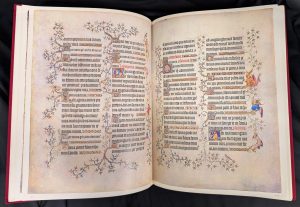
The original Les Grandes Heures de Jean de Berry is a Book of Hours commissioned by Jean, Duke of Berry and is held by the Bibliothèque Nationale de France with the shelfmark ms. Lat. 919. This commissioned manuscript was painted by famous artists of the time and lavishly bound before being rebound and losing one image in 1930.

The facsimile within the collections is a partial facsimile of the original manuscript that does not reflect the format or look and feel of the original. The pages are represented on a larger white background but still conveys the grandeur of the original commissioned manuscript.

Illuminated pages of The Grandes Heures of Jean, Duke of Berry


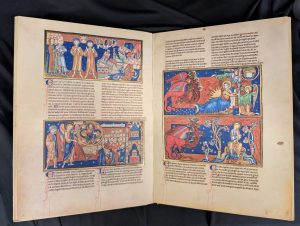
The Trinity College Apocalypse

The original manuscript, named for its repository, Trinity College, was believed to have been made around 1255-1260 in southern England, featuring the pictorial biography of Saint John the Evangelist with illuminated scenes of the Apocalypses.

The facsimile is a full-size color reproduction of the entire original manuscript and attempts to replicate the look-and-feel and physical features with trimmed pages.

Illuminated illustrions of the Trinity College Apocalypse


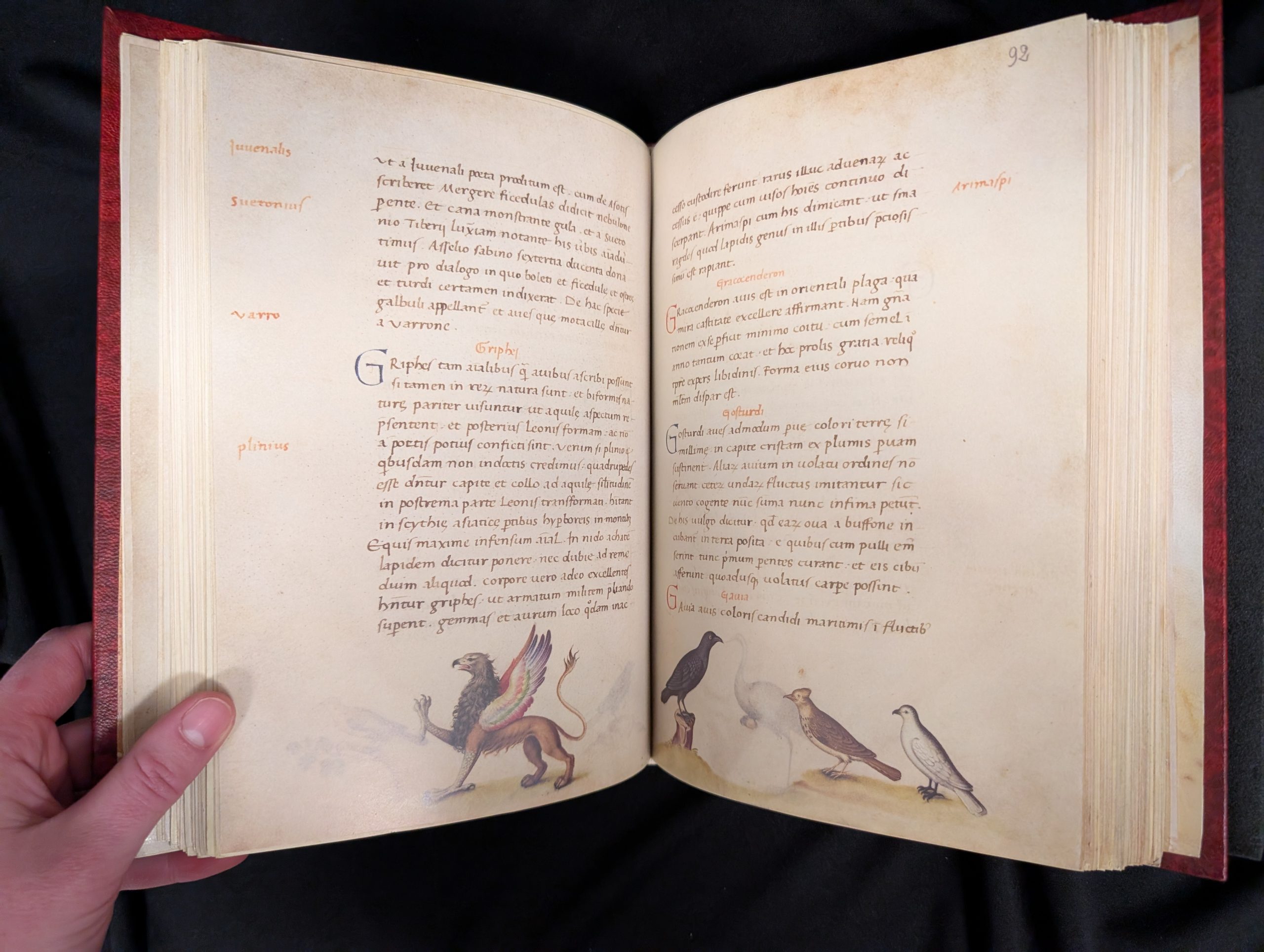
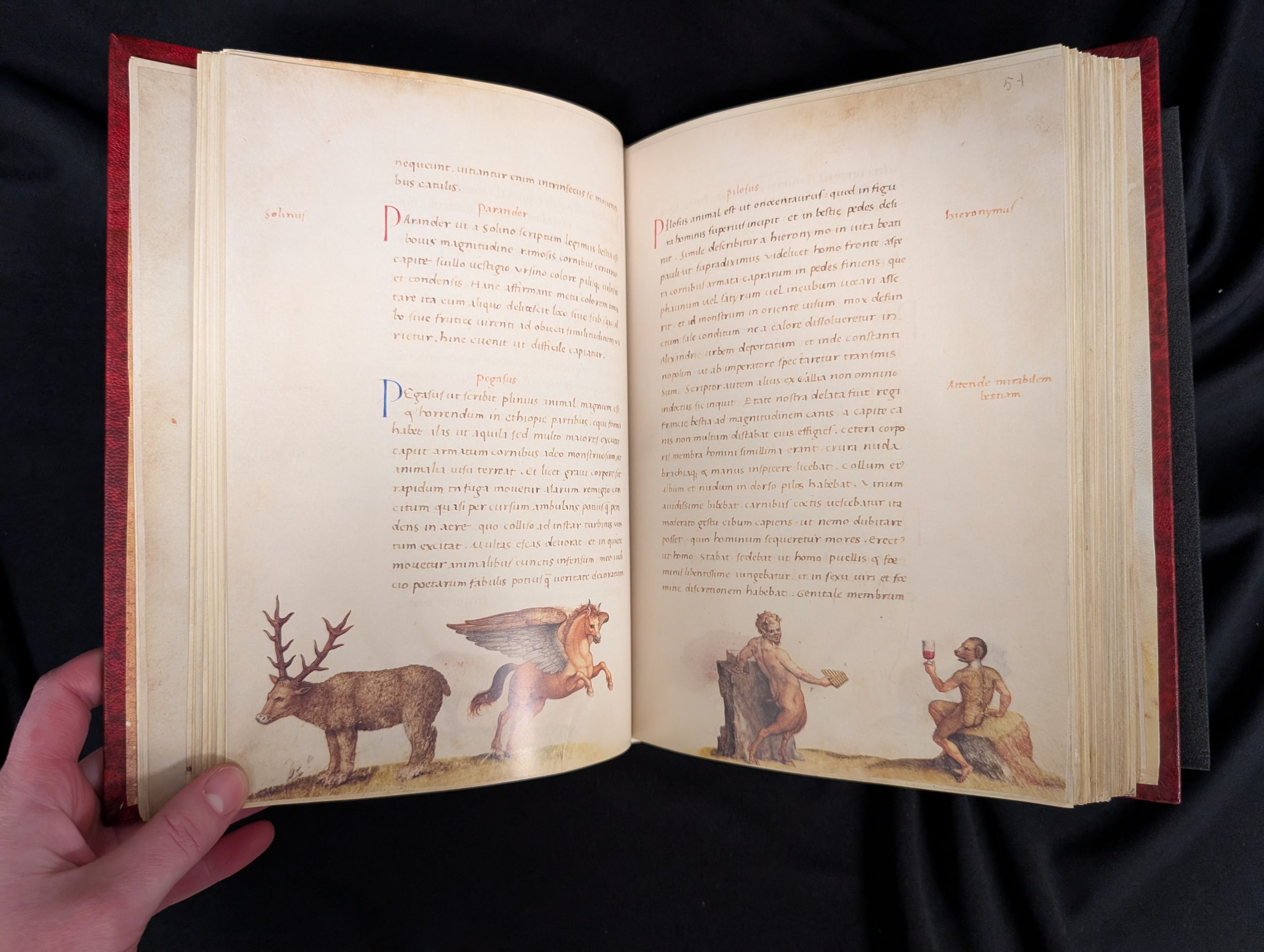
Das Tierbuch des Petrus Candidus : Urb. lat. 276 : Geschrieben 1460, illuminiert im 16. Jahrhundert (The Book of Animals by Petrus Candidus, Codex Urbinus Latinus 276.)

The original Animal Book of Pier Candido, or Pietro Candido Decembrio, was written in Italy around 1460 by Pietro Candido (around 1399-1477 in Milan), a humanist scholar, author, secretary to numerous Renaissance princes, even worked at the chancery of Pope Nicholas V.

His Latin text describes natural history and the life of animals which was appended by an anonymous master around 1550 with over 200 bas-de-page miniatures. In total the book contains depictions of 496 animals, birds, and insects, some of which have gold and silver highlights. But it was just the natural world, satyrs and hybrids as well as other mythological creatures like the Pegasus depicted!

The facsimile is an exact reproduction of the original document in terms of extent, color and size with as much detail as possible to match the original book in terms of scope, format, and colors.


Gradual of St. Katharinenthal

The Gradual of St. Katharinenthal is a liturgical book that contains chants and notations that were sung in Latin during High Mass. The original manuscript came from the St. Katharinenthal Abbey near Diessenhofen in Switzerland and was completed in about 1312.

The facsimile is a full-sized color reproduction of the entire original manuscript including details such as the size and trimmed pages. The facsimile is bound in nappa leather and decorated with corner fittings, a central rosette, and clasps.


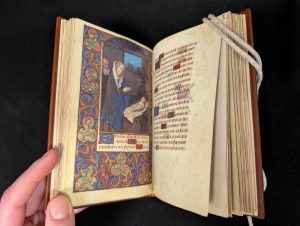
Bruges Hours Vat. Ross. 94Illuminated pages of the Bruges Hours

The Bruges Hours Vat. Ross. 94 is a Book of Hours that contains 39 full page illustrations, numerous golden miniatures, and realistic bordures that adorn the margins. The original located in the Vatican Library comes from Bruges near the end of the 15th century or beginning of the 16th century. It is believed there were three illuminators who worked on this text however, they remain unknown, adding an air of mystery to the creation to the Bruges Hours, as does the commissioner of this book.

The facsimile is an exact reproduction of the entire original document (extent, color and size) with as detailed as possible (scope, format, colors). The binding may not correspond to the original or current document binding.


A Vatican book of hours from the circle of Jean Bourdichon, Cod. Lat. Vat. 3781A full-page illuminated illustration from a Vatican book of hours from the circle of Jean Bourdichon

The original manuscript was created in France in the second half of the 15th century. It was crafted by master illuminator and court painter Jean Bourdichon with the assistance of his pupils for an unknown patron. The manuscript contains 17 full-page miniatures, borders, and over 1,200 ornate initials.

The facsimile is a full-size color reproduction of the entire original document, attempting to replicate the look-and-feel and physical features of the original document; pages are trimmed according to the original format. It is bound in red Morocco leather, decorated with gold tooling. The binding reproduces that of the original.


The red leather cover with gold inlay of the facsimile called Masses of Saint Francis of Assisi and Saint Anne

Masses of Saint Francis of Assisi and Saint Anne

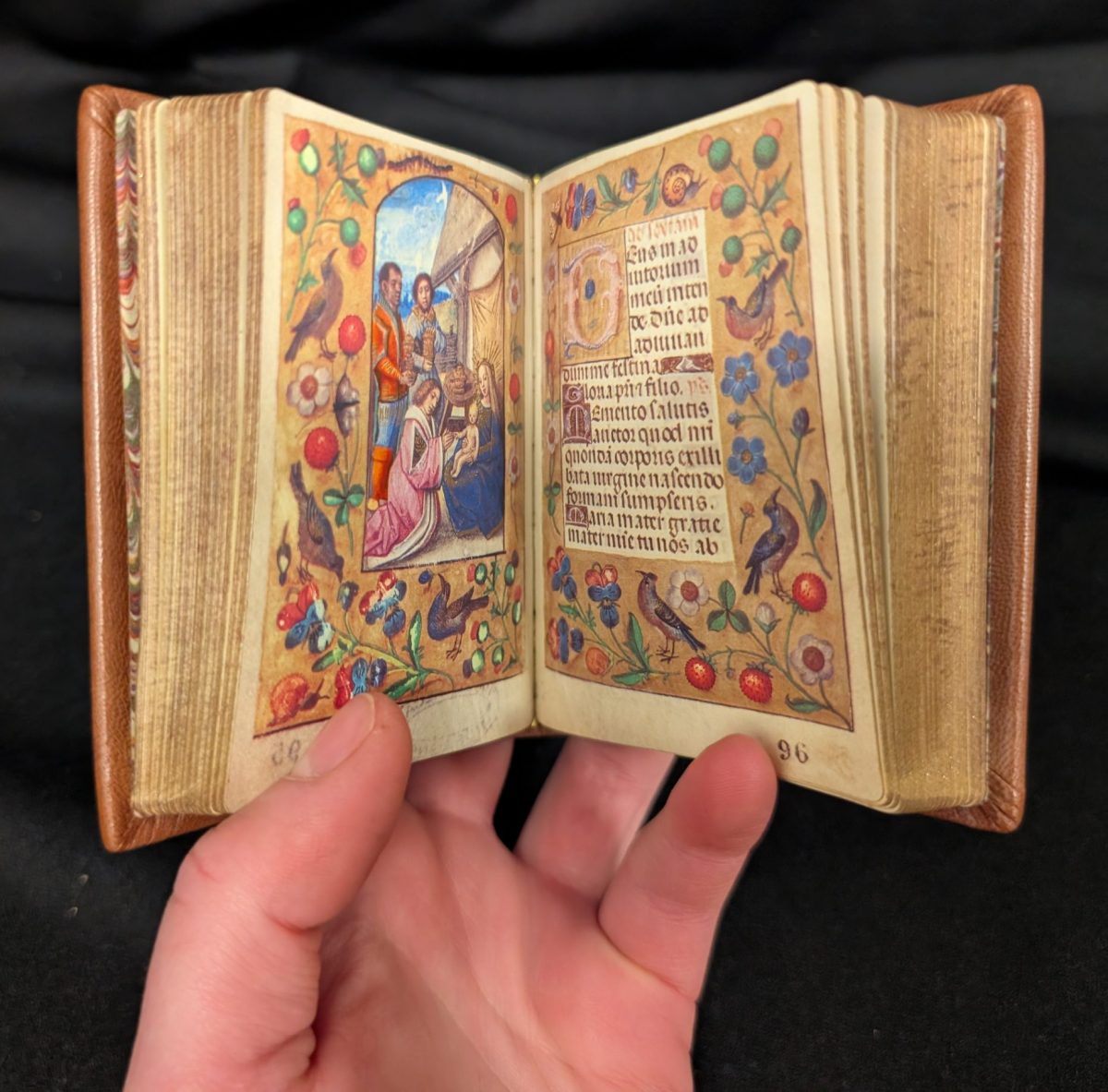
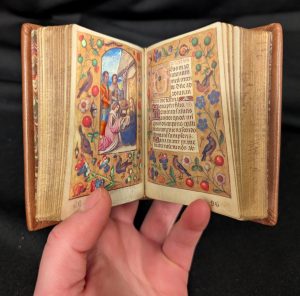
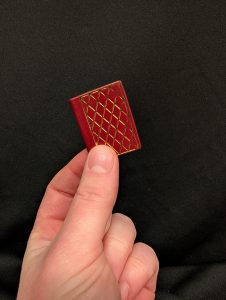
The Masses of Saint Francis of Assisi and Saint Anne is the smallest facsimile in the Archives and Special Collections! Measuring 4 cm x 3 cm, this facsimile contains two missals, St. Francis of Assisi and Saint Anne. The original located at the Vatican, Vat. lat. 11254, was created in the 16th century by an unknown creator. This book features detailed miniatures with decorative elements on every page, detailed and written in gold ink. These small codices were intended to be carried on the person. As was this one, which would have been placed inside a small silver case that was suspended from a chain and worn around the neck.

The facsimile is a detailed reproduction of the entire document (size, format, color). The binding which is red leather with gold trim inside a silver slipcase (engraved with “A” on the front, “F” on the back) on a chain may not correspond to the original or current document binding.


If you would like to view these items for research, have them included as part of a class visit, or have further questions, please email archives@shu.edu

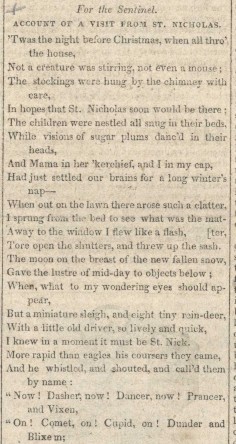
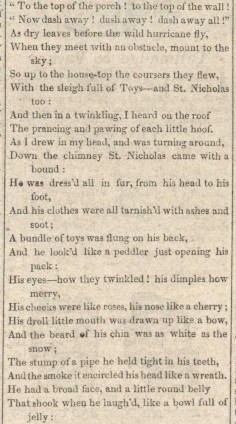
A Visit from St. Nicholas

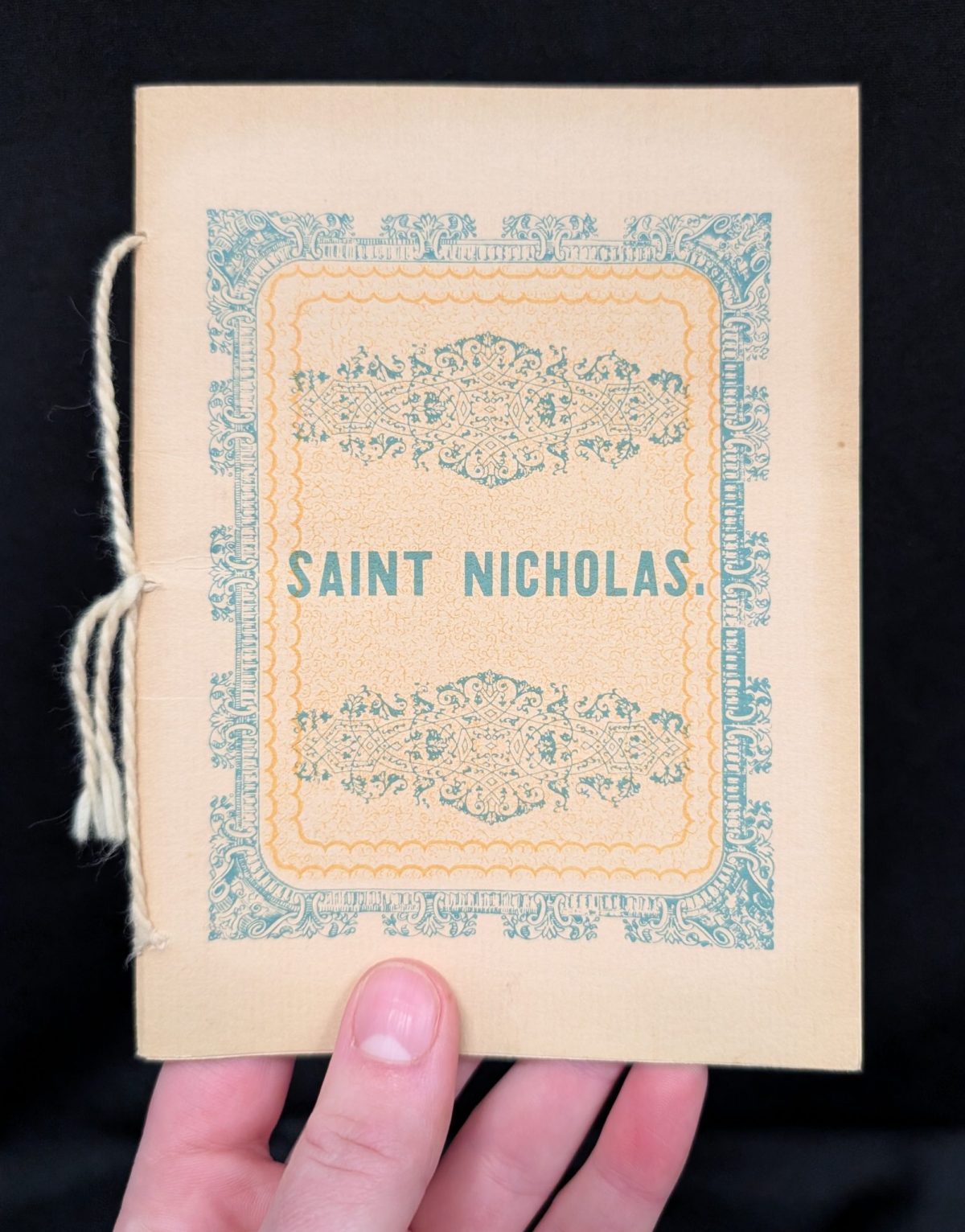
As Christmas approaches, old traditions are carried out while new ones are created. One tradition many know is the happy reciting of ‘Twas the Night Before Christmas’. But I bet you didn’t know it is actually called A Visit from St. Nicholas written by Clement C. Moore.  This little booklet contains original cuts, designed and engraved by Boyd and was published in New York by Spalding & Shepard possibly around the 1960s. The inside cover states:

This is a Happy re-creation of the 1849 illustrated edition of which only two copies are known to exist. That from which this facsimile was reproduced remains behind locked doors in New York’s Fifth Avenue Library.

Measuring 16 cm with a rope tie to keep the pages together, it was probably issued as a Christmas card. In fact, the copy within the collections contains a small inscription on the  last page, stating:

Love + Kisses,

Betty, Frank + Judie

Clemente Clarke Moore was a New York born American writer, scholar, even real estate developer who was a professor of Oriental and Greek Literature as well as Divinity and Biblical Learning at the General Theological Seminary of the Protestant Episcopal Church, in New York City. But Moore is best known for his poem A Visit from St. Nicholas.

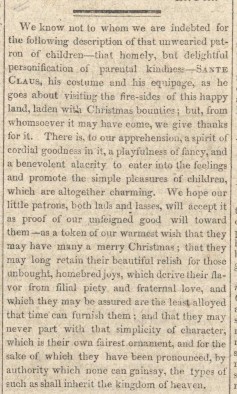
This poem first appeared on December 23, 1823, in the Sentinel, which was the local newspaper of Troy, New York where it was published anonymously.

Thirteen years after it was published, Moore took credit for its authorship, though his claim has been disputed. Many believe the poem was instead penned by New York writer Henry Livingston.

This piece was unique as it offered a different take on Santa Claus, a figure who was, until up until this point, traditionally depicted as a thinner, a less jolly, horse-riding disciplinarian. He was a combination of stories about the British Father Christmas, the Dutch Sinterklaas, and the fourth-century bishop Saint Nicholas of Myra.

Father Christmas emerged around the 15th century as a symbol of merrymaking and good cheer, dressed in green robes to symbolize the spirit of Yule. Yule, also called Yuletide or Yulefest, is a winter festival historically observed by Germanic peoples with connections to the rebirth of the sun, and was associated with gods like Odin, who was said to lead the Wild Hunt, a ghostly procession through the sky. There are even connections to the Oak King, known as the Green Man, and the Holly King, known as the Red Man. And if you have ever had a Yule log, the tradition comes from this festival. While the Yule log, nowadays is more of a candle holder, the tradition goes that a large log is burned in the hearth to bring warmth and light. And was often kept burning for twelve days, symbolizing protection and prosperity.

Sinterklaas was inspired by Saint Nicholas of Myra. He is depicted wearing bishop’s red robes and mitre, carries a crosier, and rides a white horse. Saint Nicholas of Myra was a Christian bishop born in the 3rd century in Patara which is in modern day Turkey. He is known for his generosity, especially towards children and the poor. His Feast Day is December 6th and this is when children will leave their shoes out, on the stairs or in the hallways, for gifts to appear in.

The poem ultimately paints a Santa Claus that is a combination of these figures but in a different tone: it gave Santa eight reindeer, even named them; it described a Santa who could magically sneak in and out of homes via chimneys; and it created a recognizable cheerful, chubby icon that we know as Santa Claus today, that would be further cemented by companies like Coca Cola and become ever present in holiday cards, movies, television shows, and even malls.

Please listen to the following audio clip for a reading of A Visit from St. Nicholas written by Clement C. Moore.

Spooky Stories, Returns!

Welcome to another season of Spooky Stories!

To get into the ~spooky season~ spirit, we wanted to share some stories and tales from the collections found within the The Monsignor Field Archives and Special Collections Center at Seton Hall University. Join Jacquelyn Deppe (Technical Services Archivist & Rare Books Specialist) over the next 10 days as she reads some selections and provides commentary on the works themselves and sometimes the history surrounding them!

To listen to other episodes please click the “Playlist” icon in the upper right hand corner of the video to see the full list of episodes or click here.

Spooky Stories — a mini series with Jackie and Martha

Happy Halloween! This year to get into the ~spooky season~ spirit, we wanted to share some various books, poems, periodicals found in Seton Hall’s Archives and Special Collections. Join Jackie Deppe (Technical Services Archivist & Rare Books Specialist) and Martha Slomczewski (Special Collections Assistant & Social Media Coordinator) over the next 11 days as they read these selections and provide colorful commentary on the works themselves and the history surrounding them. We will update this post each day with a new episode. Happy Halloween and happy listening!

To listen to other episodes please click the “Playlist” icon in the upper right hand corner of the video to see the full list of episodes or click here.

National Hispanic Heritage Month

National Hispanic Heritage Month is a celebration and a recognition of contributions to the United States from the Hispanic community. Originated in 1968 under President Lyndon Johnson as a weeklong event, it was expanded to a month in 1988 under President Ronald Reagan, starting September 15 and ending October 15 to coincide with national independence days in several Latin American countries. According to Pew Research, the United States Hispanic population reached 62.5 million in 2021 which would mean the Hispanic community accounts for about 19% of the United States population. Here at Seton Hall University, 21% of the student body is Hispanic along with numerous staff members, administrators, and faculty.

During this month, the Archives and Special Collections Center and the Walsh Gallery would like to showcase collections that highlight Hispanic heritage:

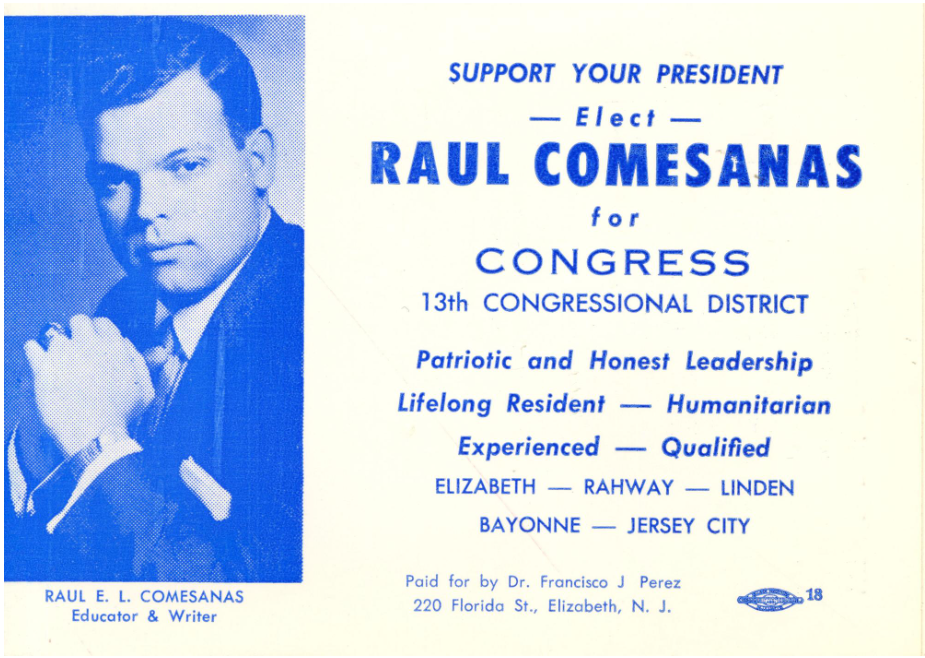
MSS 0130 – Father Raúl Comesañas Papers

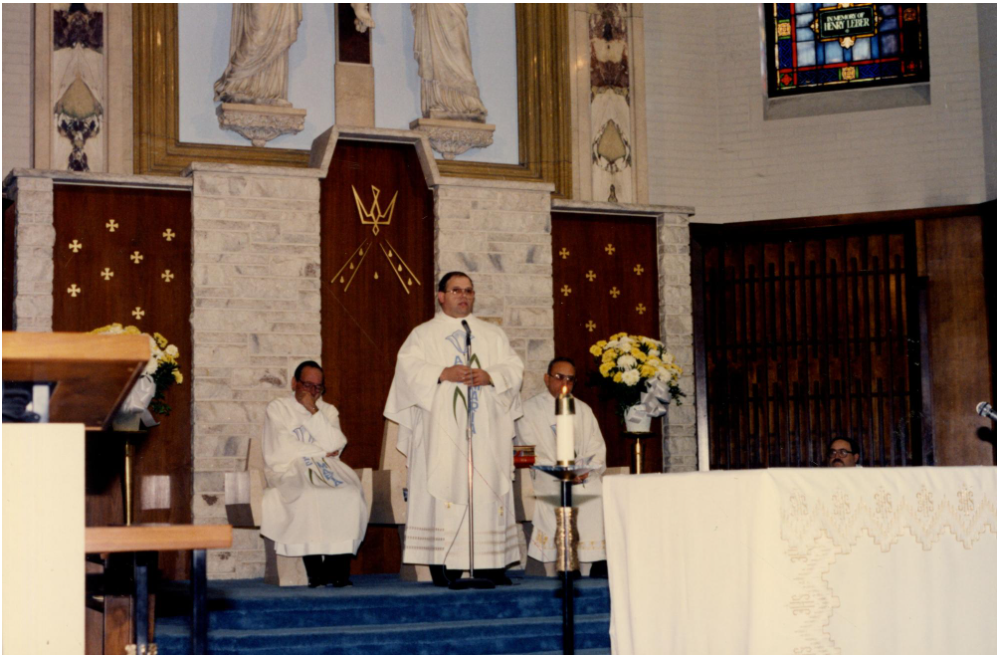
The Father Raúl Comesañas Papers is the first bilingual finding aid created by the Archives. These papers document the life, work, and activities of Father Raúl Comesañas, a Roman Catholic priest of the Archdiocese of Newark who was born in Cuba and became a civic advocate for Union City, New Jersey. Below is what the collection contains:

This collection covers materials related to Father Comesañas’s run for the 13th Congressional district of New Jersey, his work as a Catholic priest in New Jersey, and his work as president of the Union of Cuban Exiles (U.C.E.). There is also a variety of background information related to Fr. Comesañas’s political interests including his role on various boards, his post-secondary education and seminary work, and personal correspondence. There is a significant collection of newspapers, including La Nación Americana, El Clarín, La Tribuna, and Vanguardia Católica all of which Fr. Comesañas had a role in the publication or editing of. The remainder of the newspapers in the collection cover news in North New Jersey and is published in English and Spanish.

The collection covers the years 1943, from paperwork and correspondence of Fr. Comesañas’s family prior to arriving in the United States, to 2017, one year before his death.

——————————————————-

Esta colección cubre materiales relacionados a la carrera política para el trece distrito del Congreso de Nueva Jersey, el trabajo como un Padre de la iglesia católica, y el trabajo como presidente de la unión de exiles cubanos (U.C.E.) de Padre Comesañas. También, hay una variedad de información de fondo sobre sus intereses políticos incluyendo su papel en mesas directivas, su educación y trabajo en el seminario, y sus letras personales. Hay una colección significativa de periódicos, incluyendo La Nación Americana, El Clarín, La Tribuna, y Vanguardia Católica, todos en que Padre Comesañas tenía un papel en su publicación o revisión. El resto de los periódicos cubren noticias del norte de Nueva Jersey y se publican en ingles y español.

Los documentos cubren los años de 1943, con documentos de la familia de Padre Comesañas antes de mudarse al Estados Unidos, al 2017, un año antes de la muerte de Padre Comesañas.

Make sure to check out this digital exhibit!

MSS 0020 – Trina Padilla de Sanz papers

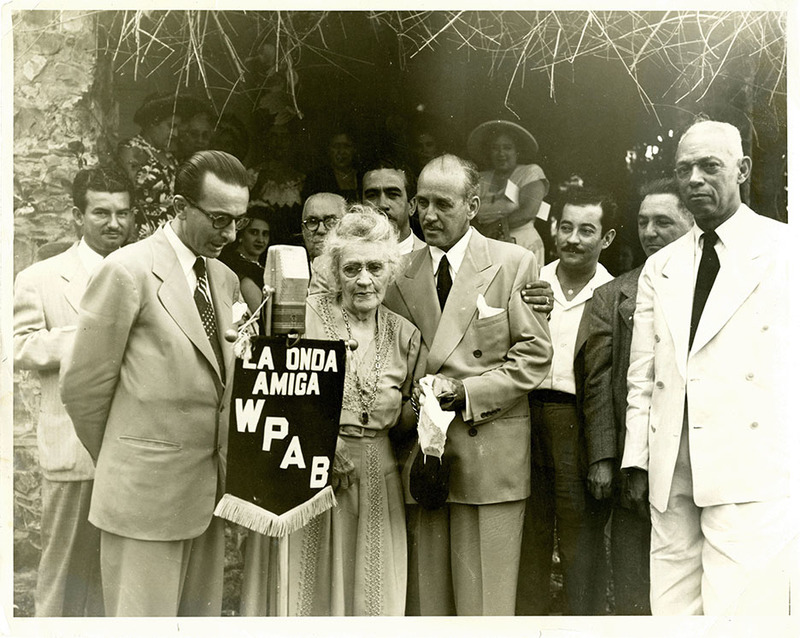
The Trina Padilla de Sanz papers covers the writings and correspondence of Trinidad (Trina) Padilla de Sanz, a Puerto Rican poet, suffragist, and composer, known as “La Hija del Caribe” in honor of her father José Gualberto Padilla, a prominent medic, poet, and political activist known as “El Caribe”. Below is what the collection contains:

The Trina Padilla de Sanz papers date from 1845 to 1968, with the majority of records dating from 1902 to 1957, and document the life and literary career of Puerto Rican poet, writer, suffragist, and composer Trina Padilla de Sanz. The collection consists mostly of correspondence, original manuscripts, and printed works and also contains a small number of photographs and family papers.

The collection is arranged into three series: “I. Correspondence, 1845-1957 (Bulk: 1902-1957)”, “II. Writings, 1910-1966 (Bulk: 1910-1956)”, and “III. Personal and family papers, 1905-1968”.

Series “I. Correspondence” dates from 1845 to 1957, with the majority of correspondence dating from 1902 to 1957, and consists of correspondence with friends, family, and notable musicians, poets, politicians, and writers of her day. Prominent correspondents include, but are not limited to: Luis Llorens Torres, a well-respected Puerto Rican poet, playwright, and politician; Luis Muñoz Marin, the first democratically elected governor of Puerto Rico; Cayetano Coll y Toste, an esteemed Puerto Rican historian and writer; José de Diego y Martinez, a statesman and journalist known as the “Father of the Puerto Rican Independence Movement”; Gabriela Mistral, the first Latin American to win the Nobel Prize in Literature; Manuel Fernandez Juncos, a Spanish journalist and poet who wrote the lyrics to Puerto Rico’s official anthem “La Borinqueña”; Braulio Dueño Colón, co-writer of the song series “Canciones Escolares” and lauded as one of Puerto Rico’s greatest composers; and Lola Rodriguez de Tio, the first Puerto Rican-born poetess to achieve widespread acclaim throughout Latin America. Other noteworthy correspondence includes a letter penned by José Gualberto Padilla, known as “El Caribe”, in 1845 and correspondence between La Hija and her son, Angel A. Sanz Padilla, and daughter, Amalia “Malín” Sanz Padilla. This series is arranged alphabetically by correspondent.

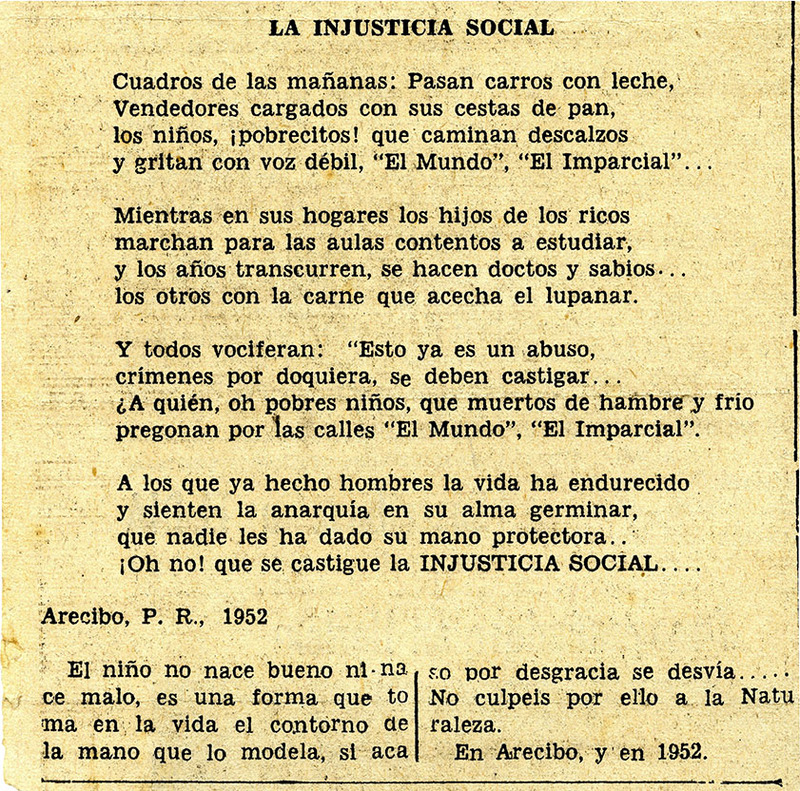
Series “II. Writings” dates from 1910 to 1966, with the majority of writings dating from 1910-1956, and consists of articles, essays, poems, short stories, and open letters in both manuscript and printed formats. The series also contains newspaper and magazine clippings of La Hija’s work, writing fragments, and a small number of articles published after her death. Featured in this series are La Hija’s published works in several prominent Puerto Rican magazines, includingAlma Latina,Condor Blanco,Heraldo de la Mujer, andPuerto Rico Ilustrado. This series is arranged alphabetically by title.

Series “III. Personal and family papers” dates from 1905 to 1968 and contains newspaper and magazine clippings related to La Hija and her family, writings about La Hija, photographs, keepsakes and ephemera, a scrapbook documenting La Hija’s musical career, and a small number of papers belonging to her son, Angel A. Sanz Padilla. This series is arranged alphabetically by record type and chronologically thereunder.

This collection will be useful for researchers interested in the social, cultural, political, and economic issues specific to Puerto Rico during the first half of the twentieth century. It provides in-depth insight into a variety of topics of the pressing current events of that era. For researchers focused on the feminist movement, this collection offers insight into the role of women in society, inequality between genders, and domestic affairs. For those interested in the political sphere, La Hija’s writings contain analyses of not only Puerto Rican liberation efforts, but also the dynamic between the country and more powerful foreign influences, specifically the United States. Researchers who wish to study social problems faced by Puerto Rico will find various articles penned by La Hija related to poverty, wealth disparity, divorce, the death penalty, and juvenile delinquency.

Along with the archival collection, there is a small selection of books that belonged to Trina Padilla de Sanz. Included in these books are works by Hispanic authors such as:

Selección de poesías : Alma América, Fiat lux, Oro de Indias y otras poesías by José Santos Chocano

… Essais by Eugenio María de Hostos, translated by Max Daireaux

Las fronteras de la pasión : novela by Alberto Insúa

Make sure to check out this digital exhibit! And some digitized papers from the collection.

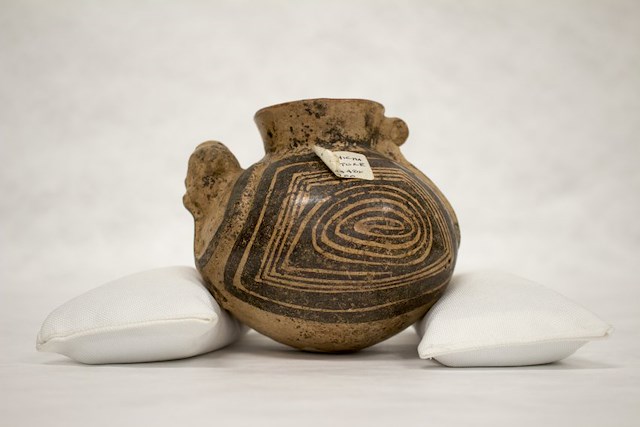
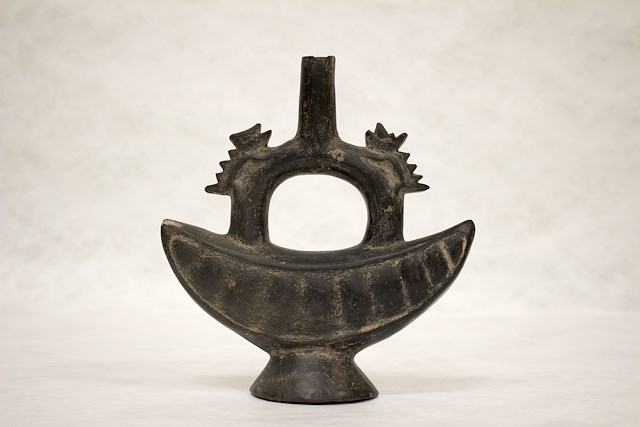
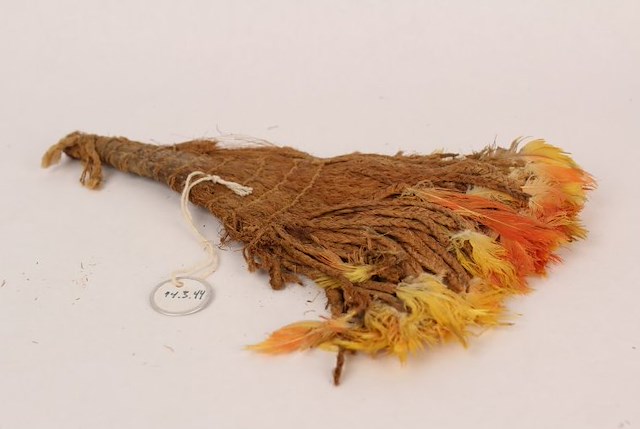
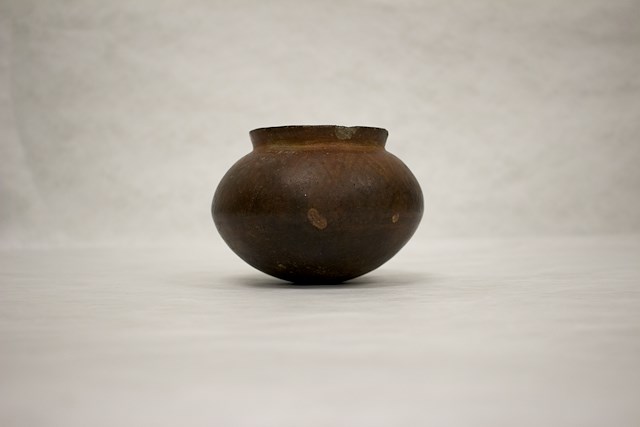
The Walsh Gallery holds many objects from all around the world, from places as close as parks within New Jersey to regions that have since been renamed. Here are a select few objects:

Make sure to check out this compiled map with more objects from around the world as well as Google Arts and Culture which has over 217 object photos. And stay tuned for the launch of PastPerfect!


If you are interested in using any of these materials as part of your research, please submit a Research Appointment Form.

If you are interested in using these materials as part of a class visit, please archives@shu.edu.

Learning Opportunities in Archives and Special Collections

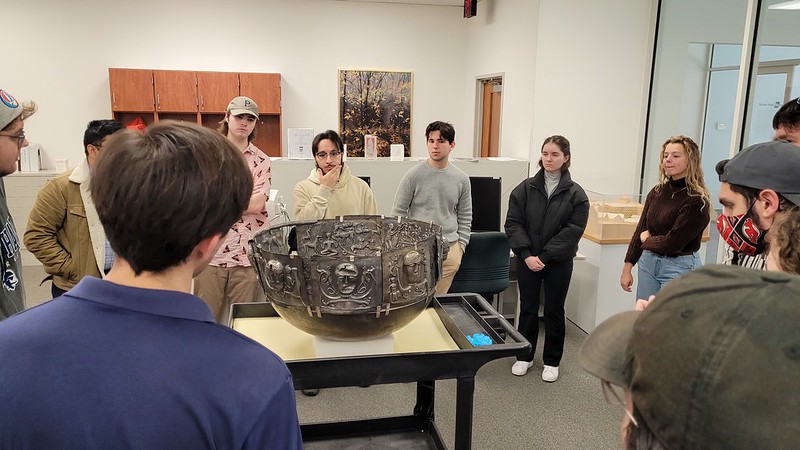
image of students viewing artifact
Students in Dr. Laura Wangerin’s “VIKINGS!” class discuss a replica of the Gundestrup Cauldron from the university’s collections

The Archives & Special Collections Center at Seton Hall University welcomes the opportunity to collaborate with faculty on crafting enriching educational experiences for their students. Class visits to the archives often spark a sense of awe and curiosity, which encourages students to participate in active learning activities, engage in inspired conversations, and connect the past to the present.

Primary sources, which comprise the bulk of our archives, rare books, and gallery collections, are powerful instruction tools. All students benefit from learning how to find, analyze, interrogate, and reference primary sources. Past class visits have included a range of disciplines, including Viking and Early Latin American history, typography, Catholic studies, and women’s studies. If you’re not sure our collections will have materials related to your subject area, try us! We love finding gems from the collections to support your research and instruction needs.

We welcome our faculty to contact our Public Services Archivist, Quinn Christie, to talk about how we can work together. Email quinn.christie@shu.edu, find her on Teams, or call (973)275-2033.

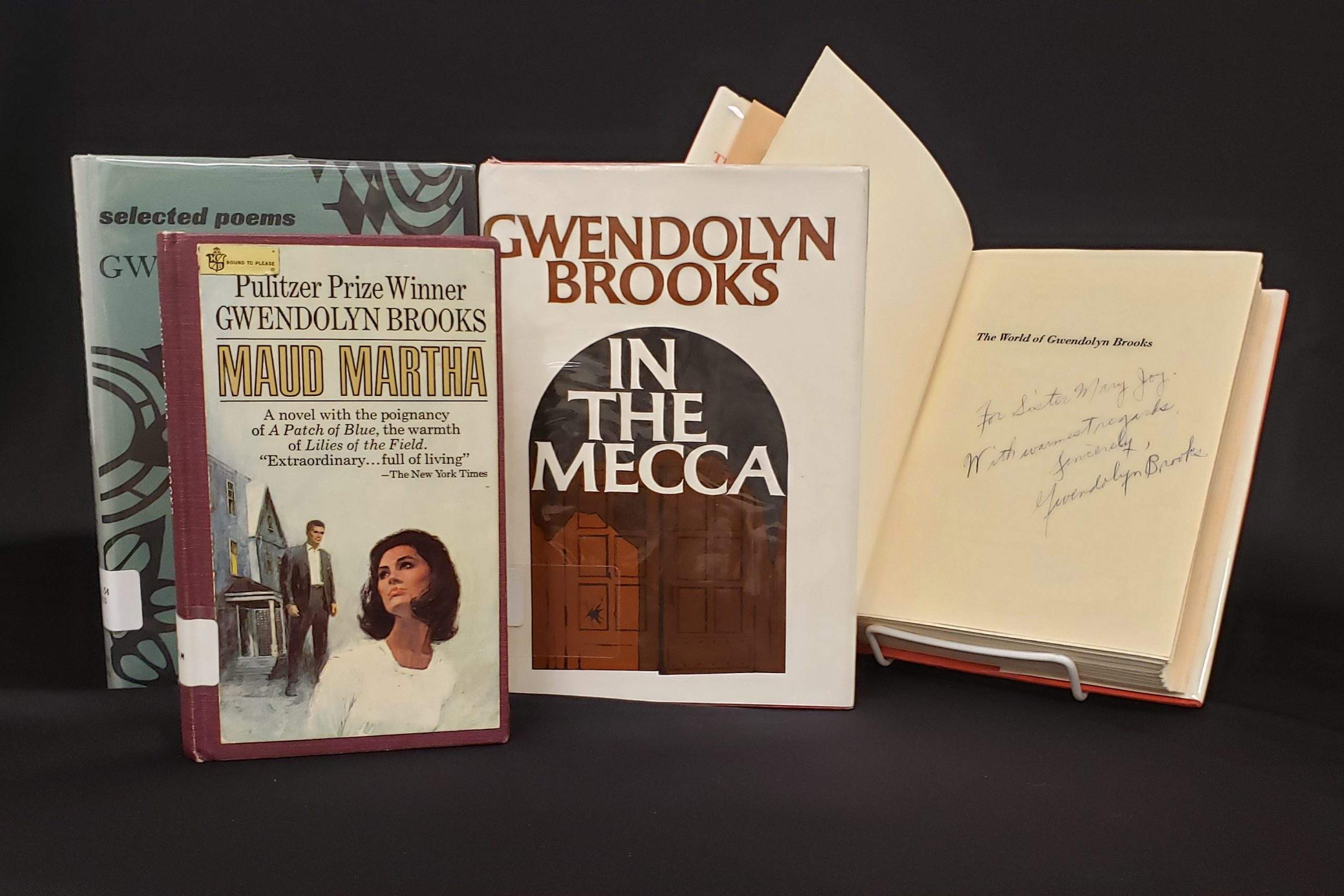
Walsh Library Acquires Signed First Editions of Gwendolyn Brooks and James Baldwin

Four books, one open, displaying Brooks' signatureWalsh Library has acquired signed first editions of books by some of the biggest names in African American literature: James Baldwin and Gwendolyn Brooks.

Gwendolyn Brooks (1917-2000) was one of the most influential poets of the twentieth century, the first Black author to win the Pulitzer Prize and the first Black woman to serve as poetry consultant to the Library of Congress.  She was also the Poet Laureate of the State of Illinois, where she lived for most of her life in Chicago.  Her poetry documents her experience and community even while being in conversation with the roots of the Western tradition, mobilizing forms such as the sonnet and reinterpreting classics such as the Aeneid to buttress her own powerful authorial voice.

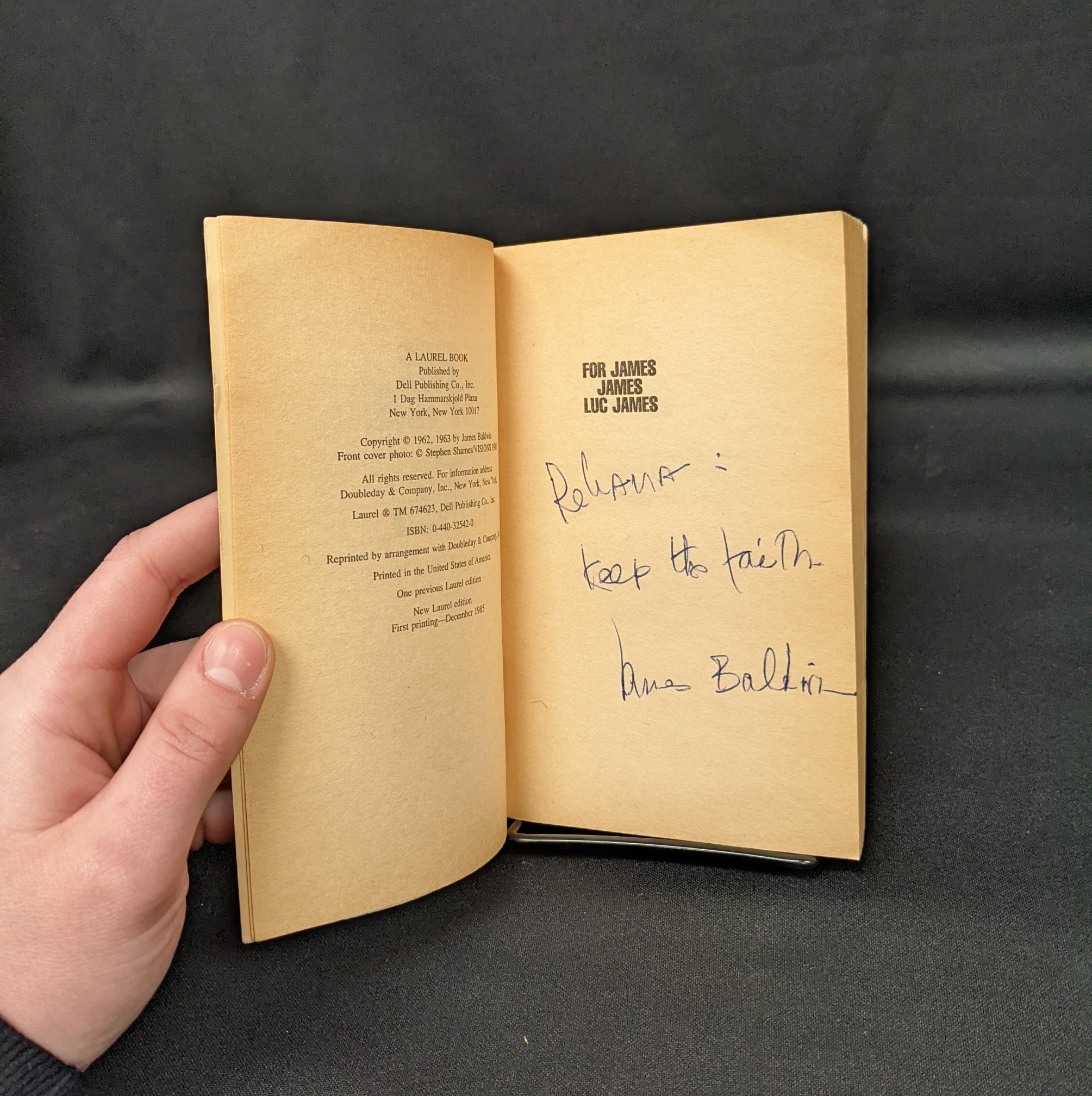
Image of the the book on a black background

The Library also acquired a signed first edition of James Baldwin’s The Fire Next Time.  This powerful work which recounts Baldwin’s personal experience of racism in America as well as his critique of Christianity, is part of the Core Curriculum at Seton Hall.  It is a key cultural touchstone.

Seton Hall’s edition is inscribed by Baldwin to a person named Reliana and says “Keep the faith.”  This inspiring message is an especially appropriate one for Seton Hall, given that this work plays a role in the conversations about life’s purpose and meaning that take place in the Core Curriculum’s classes.  An open book with Baldwin's inscription visible on a black background

BRINGING HISTORY TO LIFE!

image of students viewing artifact

Students in Dr. Laura Wangerin's "VIKINGS!" class discuss a replica of the Gundestrup Cauldron from the university's collections

This semester, students experienced history first-hand through object-based learning (OBL), an approach that adds value to classroom studies. In OBL, students learn via engaging in conversation and discourse using artworks, artifacts, archival materials, or digital representations of unique objects as catalysts to foster a sense of wonder, awe and curiosity. Object-based learning prioritizes critical thinking inspired by close observation to connect objects to concepts learned in the classroom.

Dr. Laura Wangerin’s “VIKINGS!” class visited the Archives and Special Collections recently to view the university’s replicas of the Gundestrup Cauldron and Book of Kells in a conversation guided by the student’s thoughts, questions and observations – relating the imagery back to what was learned through readings and coursework.  Students were taken by the scale of the work, the construction of the cauldron, and the high relief imagery which is visible 360 degrees around. Engaging objects via the senses connects students to the past while making connections to the present. Objects are powerful tools for learning, especially when students realize they are standing in the presence of an object made by people or cultures from long ago. In this sense, objects can become almost like time machines, bringing us back to pivotal moments in human or natural history.

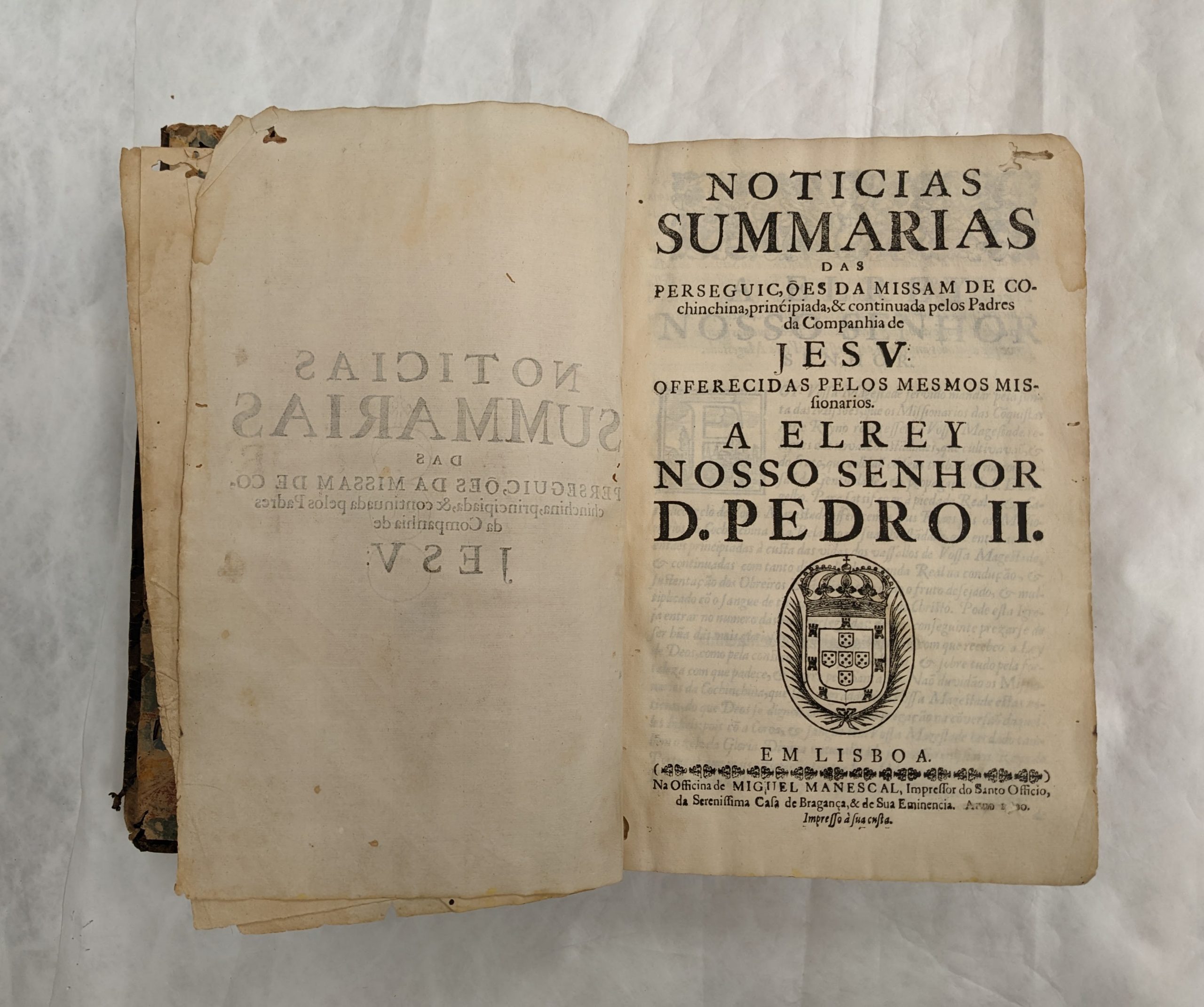
image of a rare book

Noticias Summarias das Perseguições da missam de Cochinchina, principiada, & continuada pelos Padres da Companhia de Jesu. (OCLC #: 16077971)

In Dr. Kirsten Schultz’s course “Religion and Society in Early Latin America” students visited to see rare books published around the time of the Counter-Reformation to enhance their understanding and appreciation of the issues at stake as they discussed the role of the Church in colonial society.   Conversation centered on the adventencia pages of the “Noticias Summarias,” which served as an agreement that the book could be published. The volume is an important account of the Portuguese mission in Cochinchina and Tonkin, today’s Vietnam.

The Walsh Gallery and Archives and Special Collections care for the university’s various collections and make them available for study, research, exhibitions and related programs. Objects include materials from world cultures and span from the neolithic era to the present. Highlights of the collection include Byzantine and Greco-Roman coins and artifacts; Native American basketry, ceramics and beaded crafts along with tools and leather goods; Japanese toys and 19th century woodblock prints; 3,000-year-old Chinese ceramics and metalwork; contemporary Chinese art; 17th and 18th century European engravings; and documents dating to the founding of the Newark Diocese and Seton Hall College. There are also significant collections from New Jersey politicians such as Brendan Byrne – the state’s 47th governor and Donald M. Payne, New Jersey’s U.S. representative who served the 10th congressional district from 1989 until his death in 2012.

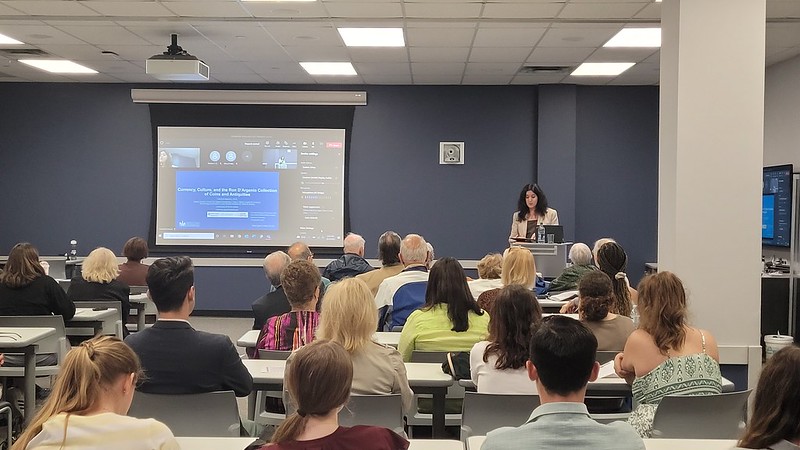
A portion of the university’s collections can be viewed on Google Arts and Culture and you can view scholar Dr. Caterina Agostini’s recent digital exhibition, “Currency Culture” which uses coins from the Ron D’Argenio Collection of Coins and Antiquities to discuss notions of power and politics as conveyed on minted coins from the Byzantine and Roman Empires.

Dr. Caterina Agostini presents her research on coinage
Dr. Caterina Agostini, D’Argenio Fellow at Seton Hall University presents her research on the university’s collection of coins to students in the Italian Studies Program.

Those interested in viewing the Gundestrup Cauldron can view it through the end of the semester on the first floor of the Walsh Library in the display windows outside the Archives and Special Collections. If you would like to make an appointment to use the collections for research, class visits or other scholarly pursuits, please contact us.  We would love to hear about your projects and how we can work together to illustrate your ideas!

______

The Walsh Gallery has a considerable collection of fine art, artifacts and archeological specimens for use by faculty, students and researchers. For access to this or other objects in our collections, contact us at 973-275-2033 or walshgallery@shu.edu to make a research appointment. Now on view in the Walsh Gallery:  Seton Hall Re/Collects through Friday, December 9th. The gallery is located on the 1st floor of the Walsh Library and is open Monday to Friday from 9am to 5pm. Groups of 8 or more must make an appointment prior to visiting. 


Scary Stories from the Rare Book Collections

Get into the Halloween spirit with these spooky tales from Seton Hall’s rare book collections!  They come from the book Ancient Legends of Ireland, written by Lady Wilde (mother of Oscar Wilde!), which we hold in our collections, and is currently on display in Walsh Gallery.  You can read the entire book online at the Internet Archive.

Happy Halloween!


With thanks to the Teaching, Learning, and Technology Center for filming and editing.