Blog

150th Anniversary of the Emancipation Proclamation: Civil War materials in the Archives and Special Collections Center

150 years ago, the country was deeply embroiled in war. The American Civil War began when seven Southern states (South Carolina, Mississippi, Florida, Alabama, Georgia, Louisiana, and Texas) seceded from the Union. After fighting began in April of 1861, four more Southern states (Virginia, Arkansas, Tennessee, and North Carolina) joined the Confederate States of America in fighting the United States of America, leading to the bloodiest conflict in American history. The issue of slavery was at the heart of Southern secession, driving questions of states’ rights verses federal rights and the vast economic differences between North and South. Ultimately, the 1860 election of Abraham Lincoln as President of the United States on a platform that emphasized abolitionist politics literally divided the nation.

On 22 September 1862, Abraham Lincoln signed the Emancipation Proclamation, freeing enslaved people in the Confederate States. This did not officially end slavery by law (the Thirteenth Amendment to the Constitution did that, in 1865), but it was an important first step that emphasized ending slavery as a goal of the war and freed enslaved people in the Confederacy as the Union Army advanced. After four horrific years of fighting, Confederate General Robert E. Lee surrendered to Union General Ulysses S. Grant on 9 April, 1865. The war ended and the Confederacy dissolved; slavery had ended. But there yet remained a long struggle for economic recovery in the South, and although slavery was now officially over, African Americans were denied equal rights and the protection of the law in most of the country. Issues of civil rights and race relations, as well as how this nation governs itself, continue to be debated, and the events and politics of the Civil War still shape our world today.

In the Monsignor William Noe Field Archives and Special Collections Center, we have several collections that deal directly or indirectly with the history of the Civil War. Highlighted below are Rare Book materials, the Seton Jevons family papers, the Salt family letters, and the Confederate States of America Treasury bond.

Four book collections, totaling almost 2,500 volumes, focus on secondary sources analyzing and interpreting the conflict, its causes, its characters, and its impact. The Reverent Pierce Byrne Civil War collection, the Gerald Murphy Civil War collection, and the Schoch Family Civil War collection include numerous books on a wide variety of Civil War topics, while the Julius C. Landeheim Lincoln collection includes books and print materials on the 16th President.

Several note-worthy books from the period immediately following the war are in these collections, including John Abbott’s The history of the Civil War in America and Joel Headley’s The great rebellion; a history of the civil war in the United States, both published in 1866. The Byrne collection includes multiple issues of Harper’s Weekly, which gave detailed accounts of the battles and events of the war, often accompanied by woodcut illustrations. The Gerald Murphy collection includes a medal bearing the likeness of Ulysses S. Grant and a facsimile of the original document commonly known as the Treaty of Appomattox, written by Ulysses S. Grant on 9 April 1865 and detailing the terms of the surrender of Robert E. Lee. The Landeheim collection includes early Lincoln biographies by Ward Lamon, Life of Abraham Lincoln from 1872, and William Henry Herndon and Jesse William Weik, Herndon’s Lincoln from 1889.

The Seton Jevons family papers is an extensive collection of archival material including family letters discussing the Civil War and its impact. Two Seton brothers, William Seton, Jr. and Henry Seton, both grand-children of St. Elizabeth Ann Seton, fought in the Civil War on the Union side. William Seton, Jr. was a captain in the 4th New York Volunteers and Henry was also a captain. The collection includes correspondence between William Seton, Jr. and his parents and sisters during the war, as well as letters between two members of the Jevons family, Thomas and William, who lived in England at the time. Thomas Jevons later married Isabel Seton, sister to William Jr. and Henry and another grandchild of St. Elizabeth Ann Seton. In the correspondence of the Seton brothers, William Jr. and Henry, there are notes and letters from enlisted men and fellow officers requesting leave or discussing business, as well as from each other and family members. William Jr. was injured in combat in 1862, and several letters refer to the effects of this injury. The Jevons brothers, William Stanley and Thomas, were living in England but wrote frequently to each other and discussed the events in America as news of the day. They had differing opinions on the possible outcome of the war, and neither seemed to think very highly of the United States government in general: William S. wrote in a letter dated 5 August 1861, possibly reacting to news of the Battle of Bull Run, “I had no doubt and do not now doubt that the North have the physical power sufficient to win ultimately, but it might take ten years or so, something in the style of English wars, and you may judge what chance there is of Yankees remaining of one mind for 10 years.” Six months later, on 12 February 1862, Henry wrote, “… though I think that we have hardly realized what a blow the rebellion is to the Northerners, yet I cannot but believe it is a lesson that will do them immense good, and that instead of one immoral badly governed country, we may within the next fifty years have two tolerably respectable communities.” While they both turned out to be incorrect in the details of their predictions, their opinions offer unique insight into foreign perspectives on the war. Several of these letters are in the process of being digitized, while some images from the collection are already online, including this photograph that includes Thomas E. Jevons and Isabel Seton Jevons.

A newly processed collection of family letters, the Salt family letters, gives a different first-hand look at life during the Civil War. William Salt, Jr. was teaching school in an Army fort in Arkansas at the outbreak of the conflict, and he wrote his sister to describe the events surrounding the transfer of the fort from Union to Confederate control. We know that Salt, a New York native who later became Father William Salt, a teacher and administrator at Seton Hall College, was conscripted into the Confederate Army and served for some time before making his way home to family in New York on foot; the collection of letters does not directly document this period of his life, but the letters describing Arkansas at the start of the war are detailed. Other members of the family, living primarily in New York at the time, discuss life continuing on despite the conflict, and mention in passing history-altering events. A cousin of the Salts, Elinor Gustin, comments at the end of one letter full of family updates, including where several male relatives are stationed: “These are awful times, who of us ever expected to see such a state of affairs in our once glorious country.” She then mentions the “great excitement” caused by the Emancipation Proclamation before calmly reminding her cousin to write back. Several of these letters (but by no means all) have been digitized, and while the majority of the collection dates from the post-war years, these first-hand accounts of life during the war paint sharply different pictures of North and South.

Another unique item dating from the Civil War is the Confederate Treasury bond, discovered at Seton Hall in 2003. The bond was issued by the Confederate Treasury in February 1864, one of the last group of bonds to be issued by the increasingly desperate Confederate government as it attempted everything possible to continue funding a war that was going very badly. Issued for $1,000, the bond was for a period of thirty years and would have allowed the collection of thirty dollars ($30) in interest every six months. Interestingly, the first two interest coupons are missing, suggesting that whoever purchased the bond was living in the South at the time. The exact provenance of the bond is unknown, but was discovered in a safe in the Office of the President; given that it seems extremely unlikely that the President of Seton Hall College (Reverend Bernard J. McQuaid was President from 1859-1868) would or could have purchased the bond, it was most likely stored there for safe-keeping years later, before the Archives were formed, and then forgotten. This item has not yet been digitized.

Of course, even the items listed here have more information to share, and there is plenty of additional material to explore in the Archives. After 150 years, there is still a great deal to learn about and from the Civil War and how it has shaped our nation. To start your exploration, email us, call us, or make an appointment to view materials in person. And don’t forget to check out the ever-growing Digital Archives and Special Collections Center!
Introducing the Digital Field Archives and Special Collections Center

The Monsignor William Noe Field Archives and Special Collections Center is pleased to announce a new digital collection: the Digital Field Archives and Special Collections Center. This broad new collection of digital objects will include representative images from a number of our Manuscript, Seton Hall University, and Archdiocese of Newark collections. As part of the A&SCC’s efforts to provide more digital images and items from a wider range of collections, this digital collection will be added to regularly with diverse items representing many individuals, families, communities, subjects, and historical periods that can be found in the materials here on the first floor of Walsh Library.

Currently included in the Digital Field A&SCC are items from the Seton Jevons family papers (Mss 0005 finding aid), the Salt family letters (Mss 0035 finding aid), and the W. Paul Stillman papers (Mss 0011 finding aid). These materials include family letters, photographs, a telegram, and an envelope advertising Merchant’s Gargling Oil Liniment, a topical treatment “for man or beast” in use during the 19th century. Soon to be added to the Digital Field A&SCC will be business correspondence and early 20th century records of men’s and women’s Catholic organizations, as well as additional materials to be selected as new collections are processed.

From the collection homepage, you can search for specific items or keywords in the search bar at the top of the page, or click Browse All to view all items currently available in the collection. Be sure to bookmark the Digital Field Archives and Special Collections site, or subscribe to the RSS for regular updates as new items are added!

Our Online Finding Aids Get a Face Lift

Here at the Monsignor William Noé Field Archives & Special Collections Center we have many wonderful archival collections containing a vast assemblage of historical artifacts, images, documents, and information. As part of our continuing efforts to make these resources more easily and readily available, we are working hard on making the descriptions of these materials easier to find and use. Finding aids for archival collections, the basic descriptions of and guides to the materials in collections, are now available as standalone web pages, available from our Online Finding Aids page.

The Online Finding Aids page will have a continually updated list of all the collection finding aids currently available as webpages, listed by the collection number and grouped by Manuscript Collections, Seton Hall University Collections, and Archdiocese of Newark Collections. To view the finding aid for a given collection, simply click on the link in the collection title. The finding aid for that collection will include information about the creator(s) of the collection, the types of materials the collection includes, and subjects covered by the collection. Use the navigation menu on the left side of the page for easier use of the finding aid, or use the command Control F to search for keywords.

Previously, our online finding aids were available through our Digital Collections site, via the Archives and Special Collections Finding Aids page. These finding aids will continue to be available, until they too can be updated.

Because finding aids are descriptions of the materials, they do not include digitized materials; to view the collections and materials described on this site, come visit the Archives and Special Collections Center in person (see our homepage for more information), or explore our Digital Collections. And keep an eye on this site for further developments!

Historic Archdiocesan Artifacts on Exhibit in Archives & Special Collections Center

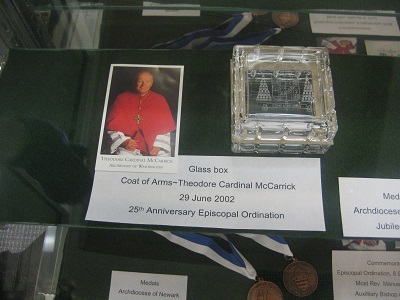
Two recent acquisitions have provided artifacts currently on public view in the Msgr. William Noé Field Archives & Special Collections Center, first floor, Walsh Library, Seton Hall University.  The old St. Peter’s German Church, Belmont Avenue, Newark, supplied many items that afford a view of pre-Vatican II worship.  There are two memorial patens, still used in the service of Holy Communion, along with two intinction cups.  Hosts would have been placed in the bowls, and wine in the cup within the bowl, so the priest could dip the host into the wine before placing it on the tongue of the communicant.  There is a stole, worn with priestly vestments during mass and a maniple which would have been worn over the priest’s left arm while serving mass.  Reflecting the placement of the altar at the back wall of the sanctuary before Vatican II moved the altar forward, so the priest would face the congregation during mass, there are two altar cards.  These were framed Latin script which would be hung on the wall beside the altar for the priest to read during the service.  The Sacerdos Infundit vinum would have been read as the wine was poured into the communion vessels.  At the end of mass, the “Last Gospel”, the Initium Sancti Evangelii Secundum Joannem, John I:1-14, would be read.  These two altar cards offer a glimpse of the fine German woodwork throughout St. Peter’s church in these intricately carved frames with running ivy leaf forms.  An example of an illuminated Communion certificate from 1895 complements the German woodwork of the frames.  Completing the items used in serving mass is a silver tray [damaged by water] and one of its two cruets.  The silver handle and top of the cut glass cruet with grape leaf motif show that this one was for wine, where the one for water is missing.  Accompanying these sacramental items are two fine examples of parish life.  The tabernacle crucifix was presented to Rev. A. Stecher on the occasion of the 25th Anniversary Jubilee of the church building in 1897.  The Altar Rosary Society Banner from 1922, handpainted and embroidered on silk, completes the collection.

Altar Rosary Society Banner

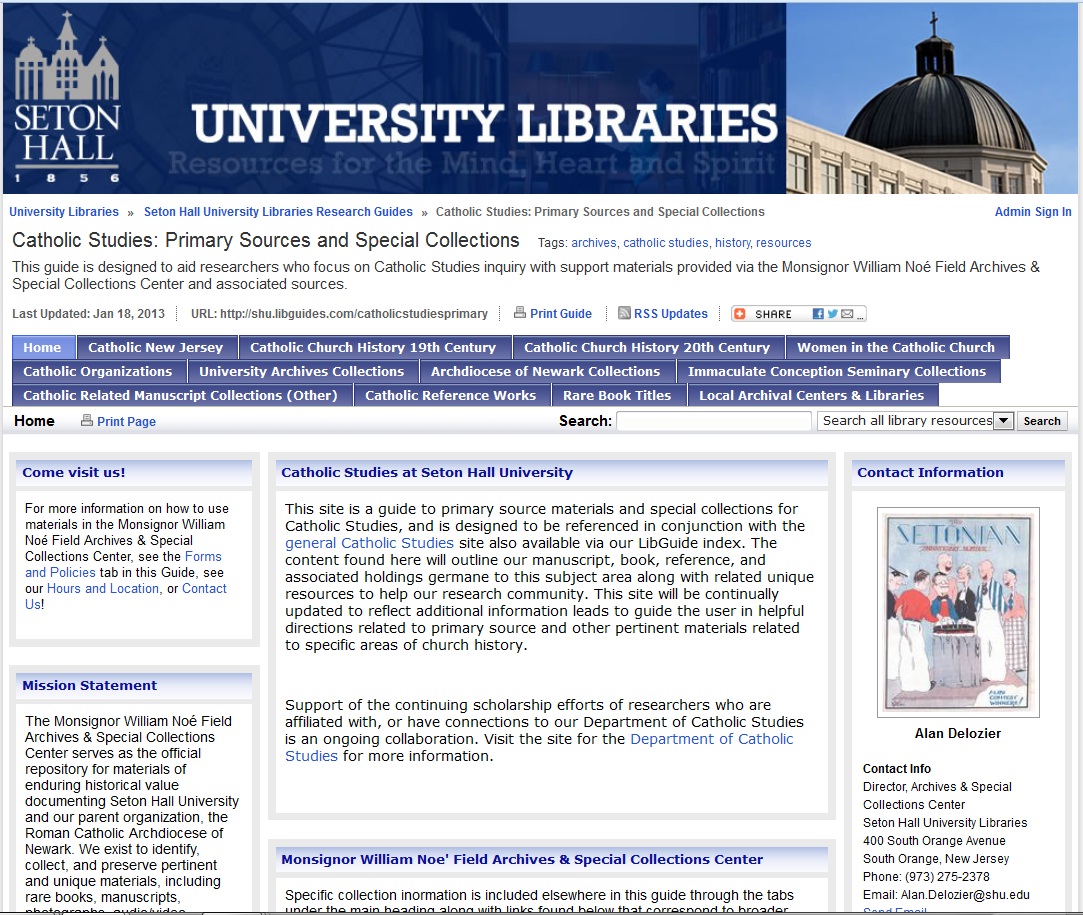
In the other case are the time capsule, a rectangular tin box from the cornerstone of the Chancery building on Mulberry Street, Newark.  Though the time capsule was sealed, moisture was still able to seep into the box as can be seen in the decay of the lining of the box which contained the bronze Immculate Conception Seminary medal fom 1927 with Bishop O’Connor on the reverse, and on the remains of his calling card which was with the medal in the box.  A protrait of Bishop Thomas J. Walsh who became Archbishop in 1937 when the Diocese of Newark was elevated to Archdiocese, also shows some decay.  Two newspapers, The Catholic News and The Paterson Evening News, were folded in an envelope, and weathered quite well to show an illustration and articles about the dedication of the building.  Along with a history of the church, several coins and stamps were placed in the capsule.  They include two Washington stamps, a one cent and a 3 cent, along with a two cent postage due stamp.  Accompanying a silver Pius X medal, are several coins including a1907 quarter, a 1923 Buffalo nickel, a 1925 Liberty dime and a 1901 Liberty nickel.

The Msgr. William Noé Field Archives and Special Collections Center is open Monday through Friday, 9:00 am to 5:00 pm.  Research appointments are available.  Please call 973-761-9476 or 973-275-2378.  The exhibit, curated by Leonard Iannaccone and Kate Dodds, can be viewed from the hallway between the Archives and Walsh Gallery when the Library is open and will be up through May 21, 2012.

Trina Padilla de Sanz Collection Exhibit

Trina Padilla de Sanz Invitation

In honor of Hispanic Heritage month and beyond, the Monsignor William Noe’ Field Archives & Special Collections Center in conjunction with the Joseph A. Unanue Latino Institute at Seton Hall University proudly present an introductory view of selections from the Trina Padilla de Sanz Papers,  one of the most prolific writers of the last century.

Trina Padilla de Sanz (1864-1957) was a noted poet, suffragist and composer in her native Puerto Rico, and her influence continues to be felt throughout most of Latin America and beyond.   She is recognized as one of the most important literary figures in Puerto Rican history often writing under the non de plume La Hija del Caribe in honor of her father Dr. Jose Gualberto Padilla (1829-1896).  Padilla was a physician, journalist and political figure within his own lifetime, and like his daughter a compelling figure in the evolution of Puerto Rican identity during the 19th century.

This exhibit will run from September through December of 2011.  These materials can be viewed from the facade of the Monsignor William Noe’ Field Archives & Special Collections Center (located on the first floor of Walsh Library) during regular library hours.

For more information please contact Alan Delozier, University Archivist at (973) 275-2378, or via e-mail at:  Alan.Delozier@shu.edu

Catholic New Jersey History Publication Award

Monsignor William Noe’ Field Award for Catholic New Jersey History. 

This award named in honor of the late Monsignor William Noe’ Field
(1915-2000), a noted rare book librarian and bibliophile is bestowed on
the best publication in the field of New Jersey Catholic history produced
over the past two year period.  This award is open to everyone who has
published anything related to the major theme including general works,
(auto)biographies, diocesan works, institutional, parish, or other topics
related to Catholicism and New Jersey
between January 1, 2009 and December
31, 2010 is acceptable for consideration.

Amount of Award
The best submission will receive an award of $500.00

Formats Accepted
Book (Academic, Popular, Specialty Presses and Self-Published), Journal
(Peer-Reviewed or Non Academic); Thesis, Dissertation, Monograph,
Conference Proceedings, etc.  Other types of media will be considered if
they meet the thematic qualifications outlined above.

Application Criteria
Applicants will be required to submit two copies of their work to the
review committee along with a cover letter outlining their submission in
brief.

Deadline
Materials need to be received by the review committee by July 1, 2011.

Announcement of Award
The awardee will be informed of the review committee decision by September
1, 2011.

Submission Information

Fernanda Perrone, Chair of Awards Committee
New Jersey Catholic Historical Commission
Msgr. William Noe’ Field Archives & Special Collections Center
Walsh Library – First Floor
Seton Hall University
400 South Orange Avenue
South Orange, NJ  07079

Questions
Alan De Lozier, Executive Director
Alan.Delozier@shu.edu
(973) 275-2378

Catholic New Jersey History Research Award

Joseph F. Mahoney Research Award in New Jersey Catholic History

This newly established award named in honor of the late Professor Joseph
F. Mahoney (1928-2006), a noted scholar in American Catholicism and
esteemed former Executive Director of the New Jersey Catholic Historical
Commission will be bestowed on an individual planning to conduct research
related to Catholicism in New Jersey over the next year.  This award is
open to everyone who has a project that fits this criteria.

Amount of Award
The top submission will receive an award of $1,000.00

Application Criteria
Applicants will be required to submit a cover letter, a letter describing
their project, a budget, a curriculum vitae and at least one letter of
reference.

Deadline
Materials need to be received by the review committee by July 1, 2011.

Announcement of Award
The recipient will be informed of the review committee decision by
September 1, 2011.

For More Information Please Contact

Submission Information

Fernanda Perrone, Chair of Awards Committee
New Jersey Catholic Historical Commission
Msgr. William Noe’ Field Archives & Special Collections Center
Walsh Library – First Floor
Seton Hall University
400 South Orange Avenue
South Orange, NJ  07079

Questions
Alan De Lozier, Executive Director
Alan.Delozier@shu.edu
(973) 275-2378

Nursing in the Archdiocese of Newark Exhibit

Display case with nursing uniform and historic photograph

The Msgr. William Noé Field Archives and Special Collections Center has a new exhibit related to nursing in the Archdiocese of Newark.  Uniforms for graduates of two training programs are on display in a case which can be viewed from the hallway between the Walsh Gallery and the Archives, ground floor, Walsh Library.  From 1927 we have a uniform and cape, along with a class picture, donated by graduate Marion Mook’s daughter, Barbara Lieberman.  Ms. Mook Goodwin passed away recently at the age of 105, perhaps the last of her class.  The uniform, blue and white striped cotton with white apron, pinafore and collar was highly starched and accompanied by a traditional red-lined navy woolen cape with gold insignia buttons and OMH embroidered on the collar.  We did not receive a cap, but the starched winged style with single black ribbon can be seen in the photograph.

In contrast, the Seton Hall Nurse’s uniform from the 1950’s is blue with white piping and Seton Hall College insignia on the pocket that matches the one on the cap.  A black woolen blazer with insignia on the pocket would complete the ensemble.  This cap comprises two pieces of buckram.  One about four inches wide, with the Seton Hall seal, arches up over the crown and meets a band which borders the bottom of the crown piece, and meets in the back.  This would be pinned to the hair atop the head like the one from St. Mary’s Hospital.  Every nurses’ training school had a different cap by which the graduates could be identified.  Completing the exhibit is a Miss Seton Hall doll in Seton Hall Nurse’s uniform from cap to blue uniform.

The exhibit will be available whenever Walsh Library is open, through 30 June 2011.

For more information please contact exhibit creator and coordinator Kate Dodds at:  973-761-9476, or by e-mail at: Kathleen.Dodds@shu.edu

Immaculate Conception Seminary History Presentation

wisterPlease join us on Wednesday, April 13th 2011 at 3:00 p.m. in the Dean’s Suite of Walsh Library to celebrate the  publication of the sesquicentennial history of the Immaculate Conception Seminary entitled:  Stewards of the Mysteries of God: Immaculate Conception Seminary, 1860 – 2010.  Author Monsignor Robert James Wister has provided a detailed and well-written historical treatment of the events, individuals and spirituality that has marked the growth and marvel that is the Immaculate Conception Seminary.

Monsignor Wister will deliver a slide presentation with images and excerpts from this volume and books will be available for purchase and to be signed personally by the author.

This event is Free of Charge and Open to the Public.  Light refreshments will be served.

For more information contact Alan Delozier, University Archivist at (973) 275-2378, or via e-mail at:  Alan.Delozier@shu.edu

BOOK DETAILS SESQUICENTENNIAL HISTORY OF UNIVERSITY’S IMMACUALTE CONCEPTION SEMINARY

Author captures events, individuals and spirituality that have marked the growth

(South Orange, NJ) – On Wednesday, April 13, 2011, Monsignor Robert James Wister will mark the publication of his new book, Stewards of the Mysteries of God: Immaculate Conception Seminary, 1860 – 2010, with a signing in the Dean’s Suite of Walsh Library at 3 p.m.

With this new narrative, Wister has provided a detailed, scrupulously researched and well-written historical treatment of the University’s Immaculate Conception Seminary.

“The story of the Seminary is a fascinating study of the religious, political, social, and ethnic history of New Jersey,” says Wister. “No aspect of regional or local history has failed to have an impact on the Seminary, and through its graduates, the Seminary has had a great and positive effect on society in general.”

The major seminary of the Archdiocese of Newark is currently in the midst of celebrating 150 years of forming priests for God’s people, with Sesquicentennial festivities continuing through December 2011. For a complete list of dates and events, visit theology.shu.edu.

“We are approaching a great time in the history of Immaculate Conception Seminary,” says Monsignor Robert Coleman, Rector and Dean. “As one of the very few seminaries founded before the Civil War which continues to serve the Church’s mission today, we rejoice in the great history of these 150 years and are filled with hope and confidence for a future of continued growth and service.”

Founded in 1860 by Bishop James Roosevelt Bayley, Immaculate Conception Seminary was first known by many as the “Diocesan Seminary” and the “Ecclesiastical Seminary.” A staple of Seton Hall College, its first class consisted of nine enrolled seminarians. Today, its rich and diverse student body represents such countries as Nigeria, Poland, Nicaragua and the United States. Its various academic offerings include a Master of Arts in Theology and a Master of Arts in Pastoral Ministry, in addition to its Master of Divinity. In 2007, the Seminary also added a Bachelor of Arts in Catholic Theology to its repertoire, which enrolled 95 students as of last fall.

Though Immaculate Conception Seminary continues to evolve over the passing years, its core focus remains unchanged: to provide the human, spiritual, intellectual and pastoral formation needed for priests to serve the Catholic Church.

“It is important to recognize that in the midst of so many challenges in the life of the Church, that the Seminary is a strong and healthy institution that will contribute to moving the Church forward, and bringing God’s Kingdom into the hearts of more people,” says Wister.

During the event, Wister will deliver a slide presentation with images and excerpts from this volume, and copies of the book will be available for purchase and autographs. Light refreshments will be served.

The event is free, and is open to the University community, as well as the general public. For more information, please contact

About Seton Hall University

For 154 years, Seton Hall University has been a catalyst for leadership, developing the whole student, mind, heart and spirit. Seton Hall combines the resources of a large university with the personal attention of a small liberal arts college. Its attractive suburban campus is only 14 miles by train, bus or car to New York City, with the wealth of employment, internship, cultural and entertainment opportunities the city offers. Seton Hall is a Catholic university that embraces students of all races and religions, challenging each other to better the world through integrity, compassion, and a commitment to serving others. For more information, visit the University’s website.