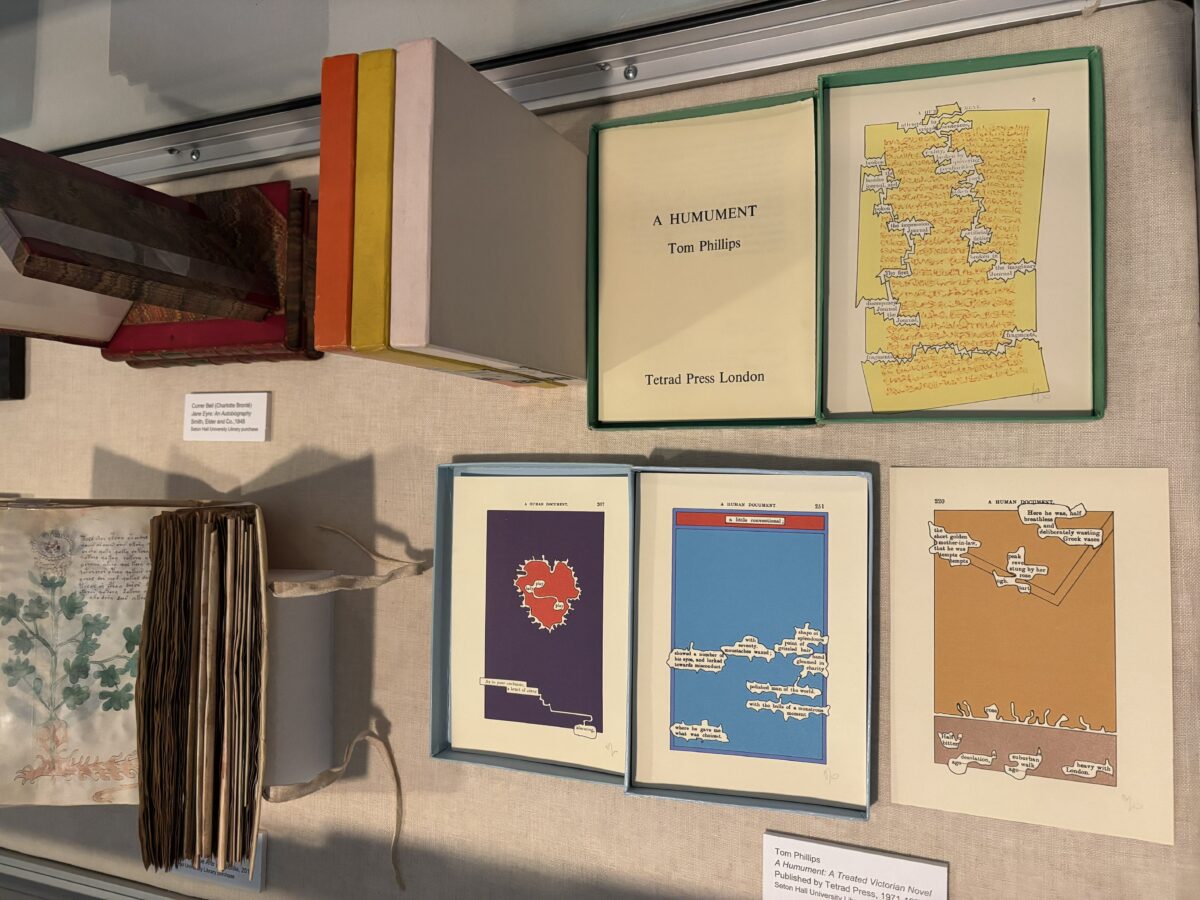
Welcome to #FacultyFaves, a recurring series where faculty from Seton Hall University select their favorite object from SHU’s Archives, Gallery collections, and/or Rare Books and share their knowledge with us. For the #FacultyFaves inaugural post, I sat down with Dr. Sarah Ponichtera, Assistant Dean of Special Collections & Walsh Gallery about one of our recent acquisitions– A Humument by Tom Phillips.
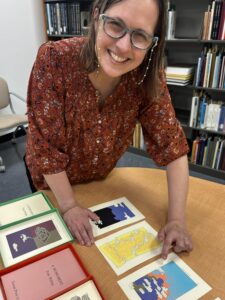
Martha: Can you tell us a little bit about your #fave?
Sarah: This is a work called A Humament, by Tom Phillips. It’s not exactly a book, nor a work of art – it’s an intersection between literature and art. In 1966 the author chose the original work, a book called The Human Document by W.H. Mallock. On the basis of this Victorian novel, Phillips created a new work entirely, by erasing most of the words and leaving only those that expressed the message Phillips wanted to convey. He creates new characters and a new story on the basis of what he finds in the text. This technique has links to Dada and William Burroughs, and is sometimes called the cut-up technique. It has deep roots in literature – T. S. Eliot’s Waste Land may be considered a precursor.
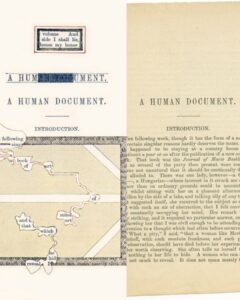
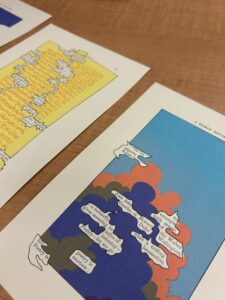
Martha: Looking at this work reminds me of doing “black out” poems in my creative writing class in undergrad, where we were instructed to circle certain words in newspapers and black bar the rest to create something new. Yet Phillips doesn’t just black out the text, he uses color, patterns, and various visual elements on each page. What other ways does he make this work his own?
Sarah: He plays with time, in one page finding the numbers nine and eleven in a page and reworking it as a tribute to New York – in this Victorian novel that could not have contemplated those events.
It also plays with chronology – the pages are not necessarily in the same order as the original, and the author has said that the work can also be read in any order, not necessarily only the order of the text as it was published. It cannot be boiled down to a single meaning, because Phillips kept reworking the pages. What we have here is the 1973 edition, but there are also many other editions: 1980, 1985, 1987, an app in 2011, the “final edition” in 2016 that still wasn’t final.
“I think we too can make infinite new things from what we find when we arrive in this world. This is basically the task of a human life.”
Martha: Why do you believe this was important to add to Seton Hall’s collections?
Sarah: I think this is a fascinating statement on creativity in the modern world. So much has already been said, yet we mark our own experiences by selecting the bits that speak to us from the wide array of cultural works that we encounter.
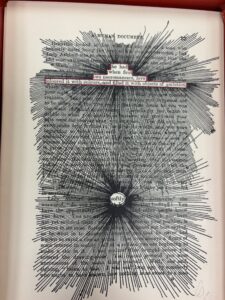
It speaks to our relationship with the past – what did we inherit from past generations, and what creative new use can we make from it? Phillips kept working on this piece until the day he died and I think we too can make infinite new things from what we find when we arrive in this world. This is basically the task of a human life.
Martha: What do you hope visitors of Archives, particularly our students, hope to take from this work?
Sarah: I hope students will feel inspired as they look into works like these to make their own mark on the culture. As they learn to appreciate the cultural heritage of the world at Seton Hall, that works like this inspire them to see it as a canvas to draw on rather than a list of instructions to follow.
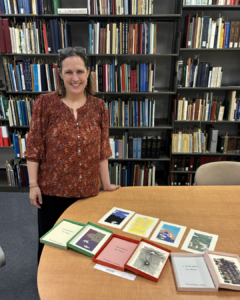
A Humument is currently on display in Walsh Gallery’s summer exhibition In a New Light: Recent Additions to the Collection, open Monday – Thursday 10am-4pm through July 30th. Call (973) 275-2033 or email walshgallery@shu.edu to make your appointment today.