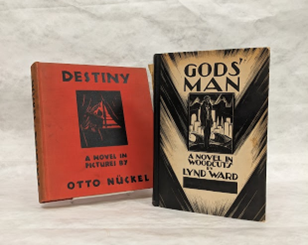
A wordless novel, also known as woodcut novels, is a graphic narrative genre of literature that uses sequences of textless images to tell a story often using woodcuts or other relief printing techniques. With roots in the German Expressionist movement that emphasized emotion and responses, the aggressive black and white images produced by woodcuts enjoyed a revival during the early 20th century.1 The content typically contains socialist themes, expressing struggles against capitalism, or stories with strong social messages such as frustration at social injustice.2
These novels developed alongside the silent cinema that displayed thematic elements from fantastic and realistic worlds capturing the already familiar with black and white visuals that told a story.1 Essentially, wordless novels became a personal and portable silent film.1 But much like silent films fell out of favor and were superseded by the “talkies”, wordless novels had also reached their peak around 1929-1931. They further fell out of favor during World War II in both Germany, where it was viewed as degenerative art, and in the United States because of the socialist views they contained.
The first book of this type was created by Frans Manereel (30 July 1889-3 January 1972) a Belgian painter and graphic artist who worked mainly in France and favored woodcuts as his primary mode of expression to his death in 1972.1 Over the course of his life, Manereel produced numerous illustrations and over fifty wordless novels.
Soon enough other artists followed such as Otto Nückel (6 September 1888-12 November 1955) a German painter, graphic designer, illustrator, and cartoonist. Unlike others, Nückel used lead instead of wood to create his woodless novels because of a lack of wood during World War I. Due to his use of lead, Nückel was able to create finer lines in addition to creating depth and focus on his illustrations.1
Lynd Ward (26 June 1905-28 June 1985), an American artist and novelist created a wordless book called Gods’ Man, which established his reputation as an illustrator. It was a sought-after book during the Great Depression, and is considered a precursor to the graphic novel.3 Where the graphic novel combines text and imagery much like comic strips. Ward’s artistic vision was inspired by illustrations such as those found in Gustave Doré’s Bible.3 Much like Nückel deviated from traditional woodcut so did Ward by using wood engraving which allowed him to create finer lines and more details.2 While there are other artists that followed, these three names are the most well-known when wordless novels are discussed.
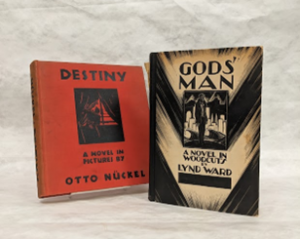
Within the Archives and Special Collections Center, there are two wordless novels. They are dark stories that trace the tragic lives of their protagonist. The second is by Lynd Ward and is a 1930 fifth printing of God’s Man. This wordless novel tells the story of a man who sells his soul for a magic paintbrush which resembles the decorative clock hand. There are 139 wood engravings to tell this Faustian story about an artist “who signs a contract with a masked figure in exchange for fame and fortune. He gains success but soon becomes disillusioned when he discovers the extent to which money, in the guise of his mistress, has corrupted every facet of society. When he assaults her, he is thrown into jail. He eventually escapes, is chased from the city by an angry mob, and jumps into an abyss to avoid his captors. A woman, living alone in the woods, discovers his body and nurses him back to health. The artist discovers happiness in her simple country life. The woman gives birth to their child, and they seem totally content until a masked figure appears and commands the artist to follow him to the summit of a cliff. When the figure removes his mask, revealing himself as the embodiment of Death, the artist recoils and falls off the edge of the cliff to his death”.1
The second is by Otto Nückel and is a 1930 printing of Destiny. There are over 200 lead-cut prints that tells the story of a woman in Western civilization during the 19th century. This story
“traces the tragic life of an impoverished woman who is constantly victimized not only by men but by a culture that offers little opportunity for women to survive. The heroine’s drunken father and overworked mother die early in her life, leaving her alone to survive. She works for a farmer in a village where she is seduced by a traveling salesman, resulting in an unwanted pregnancy. After imprisonment for the murder of her unwanted child, she works as a prostitute, forsakes a chance for a traditional relationship, murders a man with an ax during a drunken revelry, and is shot by the police as she jumps to her death from a window of an upper story room”.1
Both books were a ‘Gift of Otto Baum’ to the University. If you would like to view these books, please submit a Research Appointment Request and reference their catalog records which can be found here for God’s Man and here for Destiny.
References
- Beronä, D. A. (2008). Wordless Books : The Original Graphic Novels. Abrams.
- Postema, B. Chapter 4: Long-Length Wodless Books: Frans Masereel, Milt Gross, Lynd Ward, and Beyond. In The Cambridge history of the graphic novel(First paperback edition) 2018. Cambridge University Press.
- Lynd Ward as illustrator. Lynd Ward As Illustrator | Georgetown University Library. (2001, June 4). https://library.georgetown.edu/exhibition/lynd-ward-illustrator