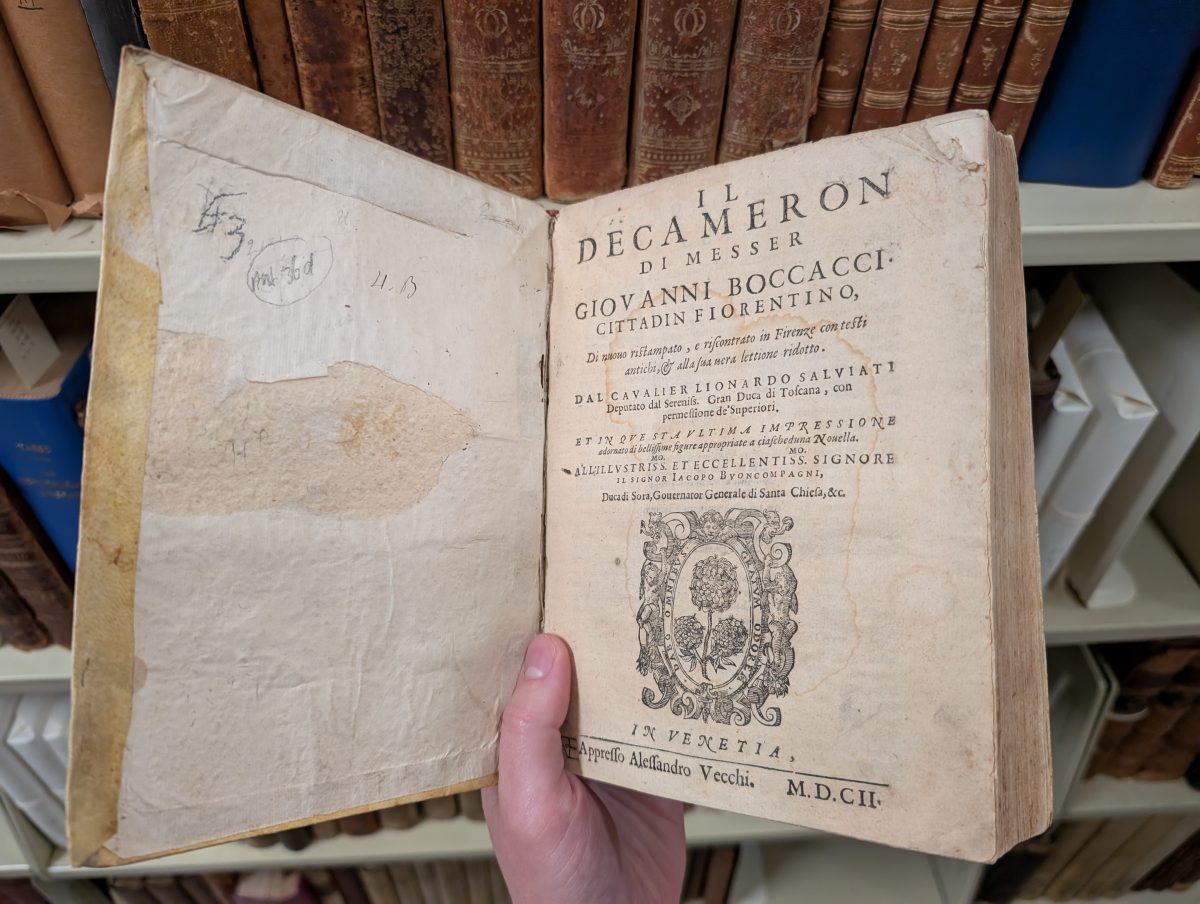
Recently, Walsh Library acquired this copy of Il Decameron by Giovanni Boccaccio under Lionardo Salviati published in Venice by Alessandro Vecchi in 1602.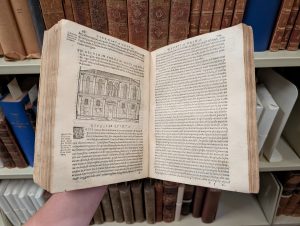
Giovanni Boccaccio (1313-1375) was an illegitimate son of a Tuscan merchant and French woman born in Paris who would go on to write his most famous work, Il Decameron, after his education in Certaldo and Naples. This work became one of the classics of world literature, and a model for later efforts in developing a distinctively Italian literary style because of his use of Italian over Latin and using everyday prose as opposed to poetry.
The recently acquired redaction of Giovanni Boccaccio’s Decameron by Lionardo Salviati is one of the most important and influential editions of this popular work. Boccaccio’s original work, containing ten tales from ten noble Florentine characters avoiding the plague in a countryside villa, was completed in 1353 following the Black Death epidemic of 1348. These tales range from the erotic to the tragic and were written in a vernacular Florentine language that reflects the spoken language of the time – a departure from the tradition of using Latin. The tales caused controversy due to their unflattering portrayal of nobles and clergy and in 1559 the Decameron was placed on the Index Librorum Prohibitorum (Index of Forbidden Books), a list published by the Catholic Church. This list of publications were texts deemed heretical or in contrary to Chrisitan morality. During the time of its ban, the Reformation was underway, and the Catholic Church was banning literature that portrayed the Church poorly.
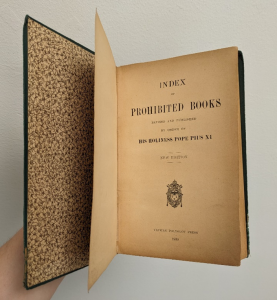
The Index of Forbidden Books was active from 1560 to 1966. An example can be seen in this 1930 edition titled Index of Prohibited Books. This copy lists many unrecognizable texts in Latin; however, there are a few authors readers will know, such as Jean-Jacques Rousseau. In addition to the full lists, the archives holds pamphlets that prohibit reading materials, often time coming from parishes as they directed parishioners on what was safe to read and what they should avoid. Hence the idea of book bans has been around for quite some time. The Decameron was so popular, however, it was difficult to ban even in a century before the internet and the rise of public libraries.
About five years later, in 1564 the Decameron was placed on a list the Catholic Church would consider allowing followers to read after suitable editing and revision of the text had taken place. One such revision that was sponsored took place in 1573 by Vincenzo Borghini. However, the redaction was deemed unsatisfactory and in 1582 Salviati produced his redacted edition with the addition of woodcuts to represent the stories which was dedicated to Giacomo Boncompagni, Duke of Sora and son of Pope Gregory XII.
Lionardo (Leonardo) Salviati (1540-1589) was born to an eminent Florentine family and is known for being an Italian scholar and academician. He studied under Piero Vettori, established himself in literary circles, and became involved in linguistics. Salviati’s revision began once he had entered the service of Giacomo Boncompagni who had obtained the authorization from the Catholic Church for Salviati to undertake the revision.
Salviati transformed the characters, turning the clergy into lay people while select lay people turned into persons of other faiths, and brought the tales in line with Christian morality but rarely cut out the erotic parts. Over the centuries Salviati’s work faced its own criticism. Salvati was accused of butchering Boccaccio’s work while others saw his efforts to respect the original work given the parameters he had to work within while revising. Regardless, without Lionardo Salviati the suppression of Boccaccio’s Il Decameron would have continued. Today, a truly unrevised text may not even exist as people themselves often edited their personal copies as they saw fit, so the original text may have been lost to time.
Since 1348, Il Decameron has been prohibited, redacted and censored, but ultimately went on to become one of the most influential books in world literature that has gone on to inspire authors such as Geoffry Chaucer and William Shakespeare.
References
- Bergin, T. G., & Speake, J. (Eds.). (1987). Salviati, Leonardo (1540 – 1589). In The Encyclopaedia of the Renaissance (1st ed.). Market House Books Ltd. https://search.credoreference.com/articles/Qm9va0FydGljbGU6MTM4MjI4Nw==?aid=237419
- Boccaccio, Giovanni. (2018). In P. Lagasse & Columbia University, The Columbia Encyclopedia (8th ed.). Columbia University Press. https://search.credoreference.com/articles/Qm9va0FydGljbGU6NjE3NzA2?summaryArticle=true&aid=237419