Should Hockey Really Be “For Everyone?”
Allison Bennett
Managing Editor
In February 2017, the National Hockey League (NHL) launched its “Hockey Is For Everyone” initiative, a program designed to promote diversity and inclusion across all genders, sexual orientations, ethnicities, and abilities. The initiative partnered with the You Can Play Project, whose mission is to combat homophobia in sports.
Six years later, the mission rings incredibly hollow.
In June 2023, Pride Month, the NHL announced a league-wide ban on themed warm-up jerseys following controversy surrounding Florida Panthers players Eric and Marc Staal, who refused to wear Pride-themed gear during warmups. NHL Commissioner Gary Bettman states that the rainbow jerseys had “become a distraction” and Pride Nights were being “undermined by the distraction in terms of which teams, which players.”
This explanation rang false to many fans. Prior to this, themed warm-up jerseys had never been an issue. There were no reports of players opting out of wearing other specialty jerseys, such as those celebrating Military Appreciation Night, Police Appreciation, or Indigenous heritage. Specialty jerseys were only deemed too “distracting” after controversy around Pride jerseys.
As the league prepared for the 2023-2024 season, the ban expanded further with the NHL announcing that players would no longer be allowed to use Pride Tape at any time.
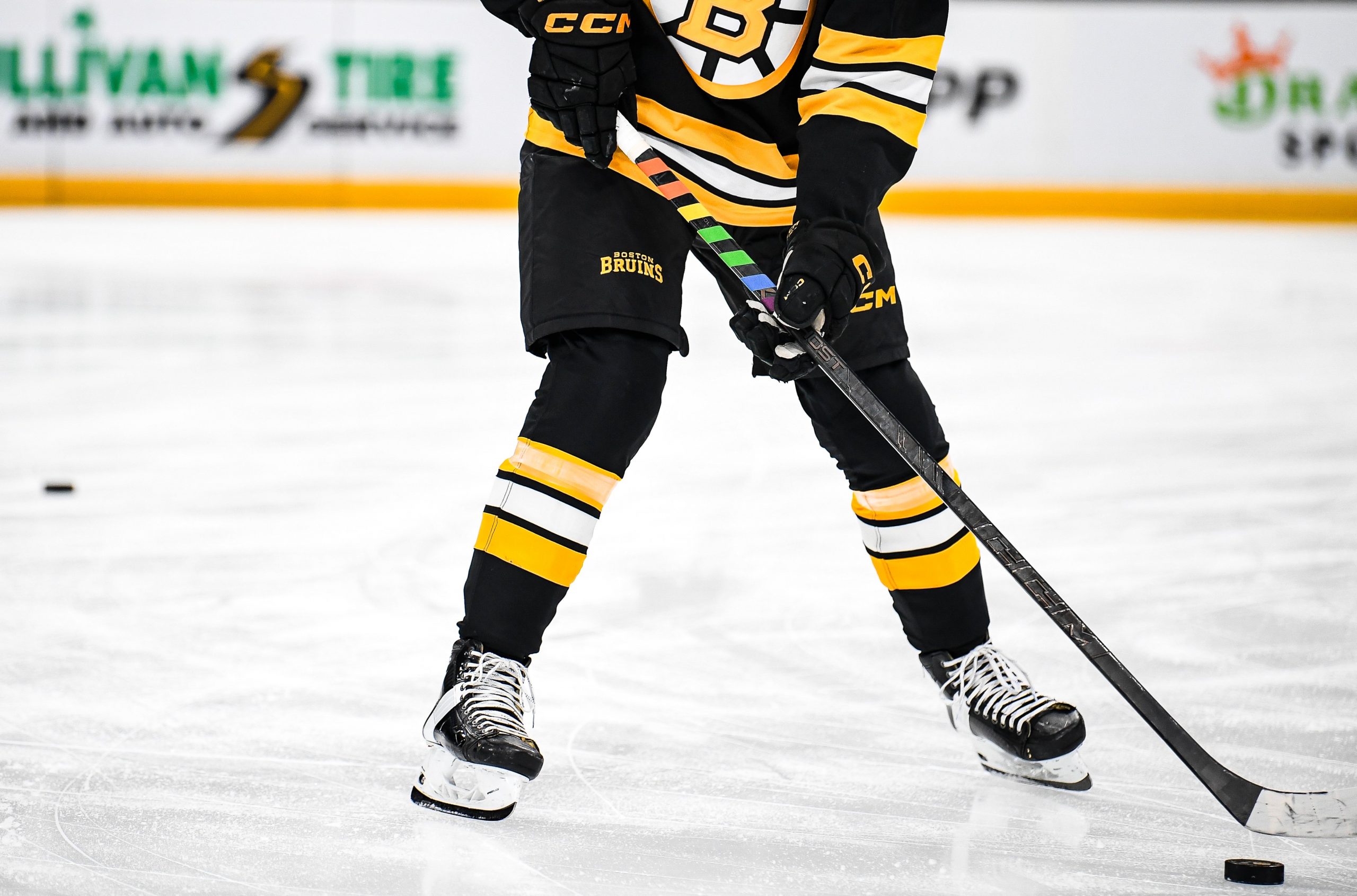
Pride Tape started as a Kickstarter campaign in 2015, intending to encourage LGBT+ youth to get involved in team sports. Instead of standard black or white stick tape, it features bright rainbow colors. It became a visible and symbolic part of NHL Pride Nights starting in 2016, when the Edmonton Oilers used it to support queer youth facing homophobia in hockey.
By October 2023, following intense backlash from fans and players alike, the NHL reversed its Pride Tape policy, announcing that “players will now have the option to voluntarily represent social causes with their stick tape throughout the season.” However, Pride Tape is only allowed during warmups, remaining banned during game time.
That reversal, however, did not extend to Pride jerseys. While teams remain free to sell Pride merch in their stores, the ban on wearing Pride jerseys during on-ice warmups is still in effect.
The disconnect between branding and action has only become more glaring. In late 2025, the Crave series Heated Rivalry, a romance centered on two male hockey players, surged in popularity, reigniting public criticism about whether the NHL and its franchises do enough to support queer fans and players. Commissioner Bettman was quick to respond by claiming, “Every team does a Pride Night.”
This statement simply is just not true.
The NHL is home to 32 teams and roughly 736 active players at a time. As the 2025-2026 season came to a close, only 30 teams held any form of Pride celebration. Of those, the Boston Bruins and Carolina Hurricanes rebranded theirs as Hockey Is For Everyone Night, while the Detroit Red Wings folded Pride into a broader “People of Hockey Night.” The Utah Mammoth and the Los Angeles Kings held no Pride or Hockey is For Everyone events at all.
Out of 736 active players, 123 across 19 teams participated in Pride Night celebrations by using Pride Tape. Just 16 percent of players engaged in even the most minimal, league-approved show of support.
This raises the question of rainbow-washing in the NHL. Rainbow washing refers to when companies show their support for the queer community by adding rainbow colors to their marketing materials during Pride Month, usually for financial gain, without actually doing substantive work that supports members of the community.
While many times pride-themed merch is seen as a cash grab and non-substantive activism, a lot of fans prefer the rainbow-washing to the outright neglect of queer pride initiatives. Rainbows plastered on merch and logos at least continues the conversation around human and constitutional rights of queer people, even if players and team only use rainbow-washing for the purposes of looking good to the media without demonstrating verbal or material support for the queer community, it is preferable to them completely opting out of pride initiates, and even moreso to them demonstrating support for anti-queer or discriminatory rhetoric or organizations.
Despite the league claiming Hockey is For Everyone, the NHL does not feel like a space where queer people are truly welcome. In a league of more than 700 players, not a single player has felt safe, comfortable, or supported enough to come out publicly. Sure, you can make the argument that maybe none of them are queer, but do you truly think that there is not at least one player out of over 700 that identifies as queer?
A Minnesota Wild Fan summarized the concern well: “The lack of openly queer players is concerning to me. Men’s professional sports are notoriously hyper-masculine environments, making it a dangerous place to be openly queer, for fear of being categorized as feminine or weaker, stereotypes of queer people originating from misogyny and homophobia.”
That discomfort appears to extend not only to players’ identities but even to discussion. On the talk show Tout le monde en parle, players of the Montreal Canadiens were asked to provide commentary on Heated Rivalry and the prospect of professional hockey players being or coming out as queer. Captain Nick Suzuki gave a response that could be described as awkward and rehearsed, though genuine, while his teammates’ body language only communicated disconcertingly blank shock and fear of having to address the existence of queerness within the sport.
A similar unease appeared in an early 2025 interview with, at the time, 18-year-old Macklin Celebrini of the San Jose Sharks. Celebrini has used Pride Tape in both his seasons in the NHL, saying, “I just wanted to show my support and tape my stick. That doesn’t really say a lot, but kind of supporting the cause.” Celebrini’s body language can be seen and described as uncomfortable, which is not uncommon in many of his interviews. His deliberate avoidance of naming the queer community directly is difficult to ignore.
The same pattern emerged in an interview with Boston Bruins defenseman and Team USA Olympian Charlie McAvoy. When asked during Boston’s Hockey Is For Everyone Night about Heated Rivalry and changing attitudes toward queer fans, McAvoy emphasized that “we’re all on the same team,” and that showing support was “the least that we can do” while referring to the queer community as “that community” rather than by direct name.
Yet, not even a month after this interview, McAvoy and his Team USA teammates appeared publicly in support of President Donald Trump and other political leaders whose policies have repeatedly harmed queer communities at the State of the Union Address.
So, which is it? Are we all on the same team, or is inclusion only acceptable when it’s quiet, noncommittal, and easy to market?
It is also important to acknowledge that public displays of support are not equally safe or accessible for every player. Some athletes face legitimate personal and political risks when associating themselves with queer advocacy. This is especially true for Russian players, many of whom maintain family ties to a country with some of the world’s most aggressive anti-gay laws, including legislation that criminalizes so-called “LGBT propaganda.” For these players, even symbolic gestures like Pride Tape can carry consequences far beyond the rink.
Recognizing this reality is not the same as excusing the league’s broader failures. The call for inclusion has never been about forcing individual players to participate in Pride initiatives against their will or at personal risk. Support should not be mandatory, but inclusion should not be an afterthought.
There are models within the league that demonstrate this distinction clearly. During the San Jose Sharks’ Pride Night, the only players who did not participate publicly by using Pride Tape were the team’s Russian players, along with Nick Leddy. Even so, several of those players were observed engaging with fans throughout warmups, tossing pucks to spectators holding Pride signs, acknowledging queer fans, and participating in the event in quieter, less visible ways.
That distinction matters. It shows that support does not need to be uniform to be genuine, and that opting out of a symbolic gesture does not require opting out of respect. What fans are asking for is not performative allyship from every individual athlete, but a league culture where Pride is treated as a meaningful part of the season rather than a liability to manage or minimize.
When teams rebrand Pride Nights, limit on-ice visibility, or quietly scale back celebrations, the message received by queer fans is not neutrality, but rather discomfort. It communicates that queer inclusion is acceptable only when it is subtle, controllable, and easy to ignore.
The unease surrounding queerness in hockey becomes even more troubling when placed alongside what the league has historically tolerated without question. At present, the NHL has zero openly queer active players, yet the league and its fanbase are no strangers to players who have been publicly accused of sexual assault or sexual misconduct. This is not a comparison meant to equate queerness with criminality, far from it, but rather to highlight who the league’s culture has consistently found ways to accommodate.
Public accusations do not automatically imply guilt, and due process matters; however, accusations are still meaningful indicators of harm, particularly when patterns emerge. In multiple cases across the league’s history, players facing serious allegations, and players even convicted of these allegations, have continued to play, been traded, signed, promoted, or quietly supported under the premise that their conduct was an “off-ice issue. Careers are protected, reputations are managed, and silence is encouraged in the pursuit of maintaining focus on the game.
Queerness, meanwhile, is treated as disruptive. Something that must be softened, downplayed, rebranded, or removed entirely to avoid controversy. Pride gear becomes a “distraction”, visibility becomes optional, and support becomes conditional.
This disparity reveals a deeper truth about the hockey environment– it is one that prioritizes conformity and power over vulnerability and honesty. A culture that reacts defensively to queerness while extending violence not only fails the queer community; it actively signals where safety does and does not exist. If the league were truly neutral, the existence of queer players would not feel more threatening than allegations of abuse. Yet time and time again, the NHL’s actions suggest it is more comfortable absorbing accusations of violence than confronting its own homophobia.
So, as a queer hockey fan, I don’t believe hockey should be “for everyone.”
The league should not be a place that protects sexual abusers, but the NHL continues to foster an environment where players accused of sexual abuse are treated as more acceptable, more manageable, and more welcome than queer players and treat Pride as something that must be rebranded, diluted, or hidden to avoid discomfort, while violence against women and marginalized people is minimized in the name of preserving the game’s image.
An inclusive league does not shy away from queerness while extending grace to harm. A league that truly believes Hockey is for Everyone would not need to be convinced that queer people belong; it would act as though they already do.
Image courtesy of Brian Babineau and the Boston Bruins.