Lionardo Salviati’s revision of Il Decameron by Giovanni Boccaccio

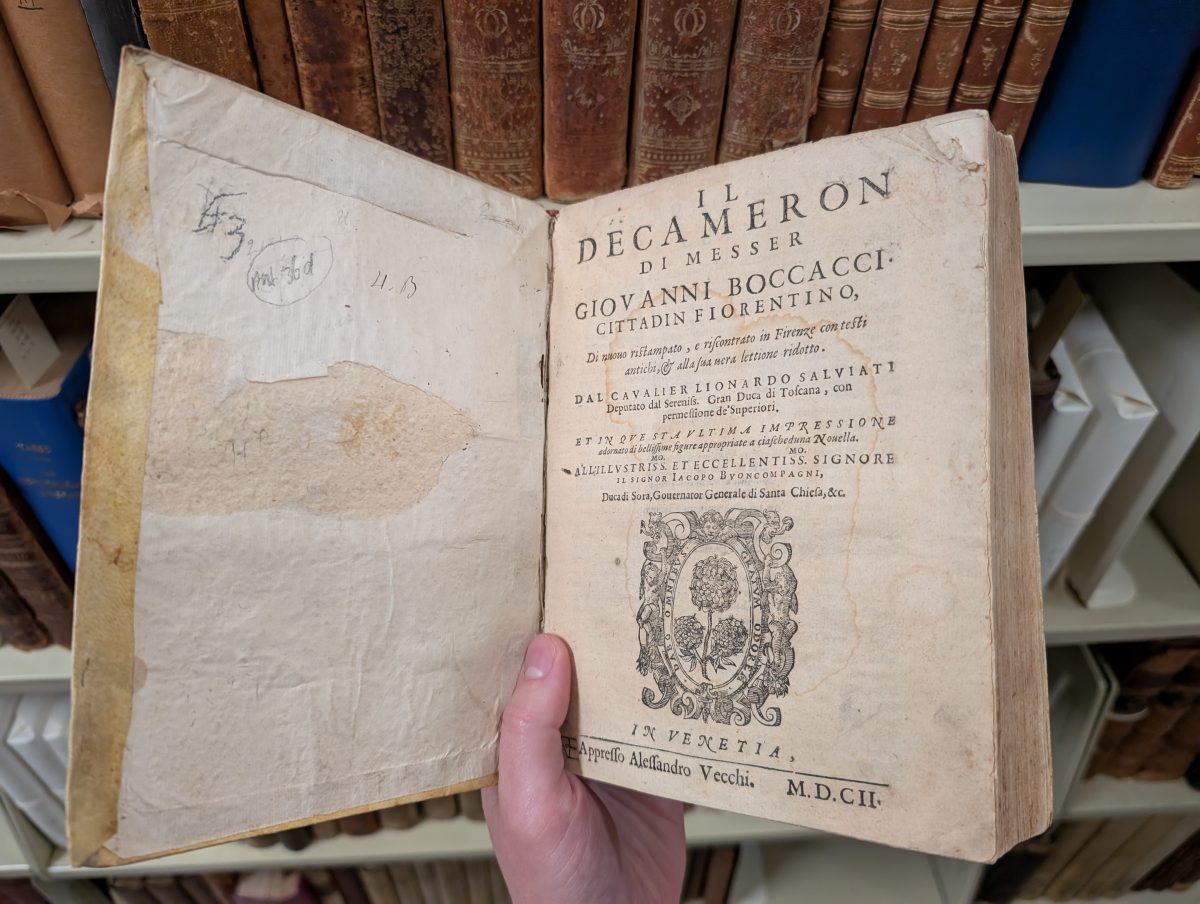
Recently, Walsh Library acquired this copy of Il Decameron by Giovanni Boccaccio under Lionardo Salviati published in Venice by Alessandro Vecchi in 1602.Woodcut from Il Decameron
Giovanni Boccaccio (1313-1375) was an illegitimate son of a Tuscan merchant and French woman born in Paris who would go on to write his most famous work, Il Decameron, after his education in Certaldo and Naples. This work became one of the classics of world literature, and a model for later efforts in developing a distinctively Italian literary style because of his use of Italian over Latin and using everyday prose as opposed to poetry.

The recently acquired redaction of Giovanni Boccaccio’s Decameron by Lionardo Salviati is one of the most important and influential editions of this popular work. Boccaccio’s original work, containing ten tales from ten noble Florentine characters avoiding the plague in a countryside villa, was completed in 1353 following the Black Death epidemic of 1348. These tales range from the erotic to the tragic and were written in a vernacular Florentine language that reflects the spoken language of the time – a departure from the tradition of using Latin. The tales caused controversy due to their unflattering portrayal of nobles and clergy and in 1559 the Decameron was placed on the Index Librorum Prohibitorum (Index of Forbidden Books), a list published by the Catholic Church. This list of publications were texts deemed heretical or in contrary to Chrisitan morality. During the time of its ban, the Reformation was underway, and the Catholic Church was banning literature that portrayed the Church poorly.
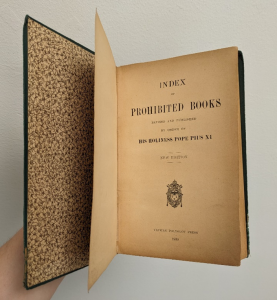
Image showing the title page of the Index of Prohibited Books

The Index of Forbidden Books was active from 1560 to 1966. An example can be seen in this 1930 edition titled Index of Prohibited Books. This copy lists many unrecognizable texts in Latin; however, there are a few authors readers will know, such as Jean-Jacques Rousseau. In addition to the full lists, the archives holds pamphlets that prohibit reading materials, often time coming from parishes as they directed parishioners on what was safe to read and what they should avoid. Hence the idea of book bans has been around for quite some time. The Decameron was so popular, however, it was difficult to ban even in a century before the internet and the rise of public libraries.

About five years later, in 1564 the Decameron was placed on a list the Catholic Church would consider allowing followers to read after suitable editing and revision of the text had taken place. One such revision that was sponsored took place in 1573 by Vincenzo Borghini. However, the redaction was deemed unsatisfactory and in 1582 Salviati produced his redacted edition with the addition of woodcuts to represent the stories which was dedicated to Giacomo Boncompagni, Duke of Sora and son of Pope Gregory XII.

Lionardo (Leonardo) Salviati (1540-1589) was born to an eminent Florentine family and is known for being an Italian scholar and academician. He studied under Piero Vettori, established himself in literary circles, and became involved in linguistics. Salviati’s revision began once he had entered the service of Giacomo Boncompagni who had obtained the authorization from the Catholic Church for Salviati to undertake the revision.

Salviati transformed the characters, turning the clergy into lay people while select lay people turned into persons of other faiths, and brought the tales in line with Christian morality but rarely cut out the erotic parts. Over the centuries Salviati’s work faced its own criticism. Salvati was accused of butchering Boccaccio’s work while others saw his efforts to respect the original work given the parameters he had to work within while revising. Regardless, without Lionardo Salviati the suppression of Boccaccio’s Il Decameron would have continued. Today, a truly unrevised text may not even exist as people themselves often edited their personal copies as they saw fit, so the original text may have been lost to time.

Since 1348, Il Decameron has been prohibited, redacted and censored, but ultimately went on to become one of the most influential books in world literature that has gone on to inspire authors such as Geoffry Chaucer and William Shakespeare.


References

  1. Bergin, T. G., & Speake, J. (Eds.). (1987). Salviati, Leonardo (1540 – 1589). In The Encyclopaedia of the Renaissance (1st ed.). Market House Books Ltd. https://search.credoreference.com/articles/Qm9va0FydGljbGU6MTM4MjI4Nw==?aid=237419
  2. Boccaccio, Giovanni. (2018). In P. Lagasse & Columbia University, The Columbia Encyclopedia (8th ed.). Columbia University Press. https://search.credoreference.com/articles/Qm9va0FydGljbGU6NjE3NzA2?summaryArticle=true&aid=237419
Wordless Novels

A wordless novel, also known as woodcut novels, is a graphic narrative genre of literature that uses sequences of textless images to tell a story often using woodcuts or other relief printing techniques. With roots in the German Expressionist movement that emphasized emotion and responses, the aggressive black and white images produced by woodcuts enjoyed a revival during the early 20th century.1 The content typically contains socialist themes, expressing struggles against capitalism, or stories with strong social messages such as frustration at social injustice.2

These novels developed alongside the silent cinema that displayed thematic elements from fantastic and realistic worlds capturing the already familiar with black and white visuals that told a story.1 Essentially, wordless novels became a personal and portable silent film.1 But much like silent films fell out of favor and were superseded by the “talkies”, wordless novels had also reached their peak around 1929-1931. They further fell out of favor during World War II in both Germany, where it was viewed as degenerative art, and in the United States because of the socialist views they contained.

The first book of this type was created by Frans Manereel (30 July 1889-3 January 1972) a Belgian painter and graphic artist who worked mainly in France and favored woodcuts as his primary mode of expression to his death in 1972.1 Over the course of his life, Manereel produced numerous illustrations and over fifty wordless novels.

Soon enough other artists followed such as Otto Nückel (6 September 1888-12 November 1955) a German painter, graphic designer, illustrator, and cartoonist. Unlike others, Nückel used lead instead of wood to create his woodless novels because of a lack of wood during World War I. Due to his use of lead, Nückel was able to create finer lines in addition to creating depth and focus on his illustrations.1

Lynd Ward (26 June 1905-28 June 1985), an American artist and novelist created a wordless book called Gods’ Man, which established his reputation as an illustrator. It was a sought-after book during the Great Depression, and is considered a precursor to the graphic novel.3 Where the graphic novel combines text and imagery much like comic strips. Ward’s artistic vision was inspired by illustrations such as those found in Gustave Doré’s Bible.3 Much like Nückel deviated from traditional woodcut so did Ward by using wood engraving which allowed him to create finer lines and more details.2 While there are other artists that followed, these three names are the most well-known when wordless novels are discussed.

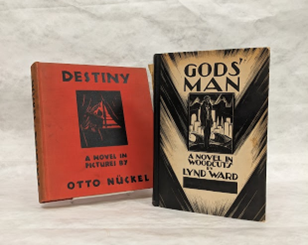
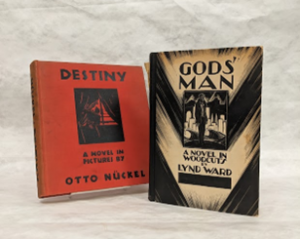
Image showing the red cover ot Destiny by Otto Nuckel and the black and white cover of God's Man by Lynd Ward

Within the Archives and Special Collections Center, there are two wordless novels. They are dark stories that trace the tragic lives of their protagonist. The second is by Lynd Ward and is a 1930 fifth printing of God’s Man. This wordless novel tells the story of a man who sells his soul for a magic paintbrush which resembles the decorative clock hand. There are 139 wood engravings to tell this Faustian story about an artist “who signs a contract with a masked figure in exchange for fame and fortune. He gains success but soon becomes disillusioned when he discovers the extent to which money, in the guise of his mistress, has corrupted every facet of society. When he assaults her, he is thrown into jail. He eventually escapes, is chased from the city by an angry mob, and jumps into an abyss to avoid his captors. A woman, living alone in the woods, discovers his body and nurses him back to health. The artist discovers happiness in her simple country life. The woman gives birth to their child, and they seem totally content until a masked figure appears and commands the artist to follow him to the summit of a cliff. When the figure removes his mask, revealing himself as the embodiment of Death, the artist recoils and falls off the edge of the cliff to his death”.1

The second is by Otto Nückel and is a 1930 printing of Destiny. There are over 200 lead-cut prints that tells the story of a woman in Western civilization during the 19th century. This story

“traces the tragic life of an impoverished woman who is constantly victimized not only by men but by a culture that offers little opportunity for women to survive. The heroine’s drunken father and overworked mother die early in her life, leaving her alone to survive. She works for a farmer in a village where she is seduced by a traveling salesman, resulting in an unwanted pregnancy. After imprisonment for the murder of her unwanted child, she works as a prostitute, forsakes a chance for a traditional relationship, murders a man with an ax during a drunken revelry, and is shot by the police as she jumps to her death from a window of an upper story room”.1

Both books were a ‘Gift of Otto Baum’ to the University. If you would like to view these books, please submit a Research Appointment Request and reference their catalog records which can be found here for God’s Man and here for Destiny.


References

  1. Beronä, D. A. (2008). Wordless Books : The Original Graphic Novels. Abrams.
  2. Postema, B. Chapter 4: Long-Length Wodless Books: Frans Masereel, Milt Gross, Lynd Ward, and Beyond. In The Cambridge history of the graphic novel(First paperback edition) 2018. Cambridge University Press.
  3. Lynd Ward as illustrator. Lynd Ward As Illustrator | Georgetown University Library. (2001, June 4). https://library.georgetown.edu/exhibition/lynd-ward-illustrator

Fascinating Facsimiles

Facsimiles have been around for centuries. They tend to be an exact copy of a book, manuscript, or other item of historical interest, appearing as close to the original as possible in terms of size, color, and condition. For works on paper, early facsimiles were produced by hand through drawings, rubbings, engravings, and lithographs. By the nineteenth and twentieth centuries, facsimiles were produced using far more complex techniques and equipment as photographic processes developed. In the case of a book or manuscript, facsimiles appear as numbered limited-edition reproductions that can range from a partial to full reproduction right down to the very holes in the pages. Facsimiles are important research and teaching tools that allow researchers and students to closely examine items that would otherwise be difficult or impossible to consult in person due to location, condition, and access policies.

Within the Archives and Special Collections, there are a few facsimile editions of manuscripts, besides the well-known Book of Kells, that the Seton Hall community and researchers alike can view:

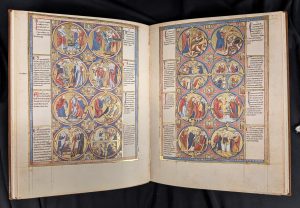
Bible Moralisée

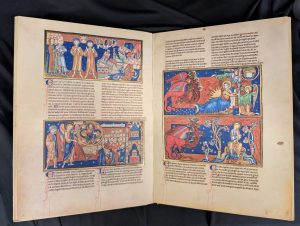
The original Bible Moralisée was likely made in 1220s and is held in the Österreichische Nationalbibliothek of Vienna under the shelfmark Codex Vindobonensis 2554, referred to as Vienna 2554. Bible Moralisée, while acknowledge as a title of this work, is French for moralized Bible which is a name given to a distinct genre of Bible that began to appear in the thirteenth century. These Bibles did not include the full text and instead contained illuminated, gothic styled images as a way to interpret and explain scripture, often focusing on teaching morality. Typically, they were for private educational use such as instruction for French kings. While the complete history of Vienna 2554 is unknown, it is said that it could have been commissioned by Blanche of Castille, wife of Louis VIII, mother of Louis IX, and regent of France (1226-1234).

The facsimile is a full-size color reproduction of the entire one hundred and thirty folio original manuscript with trimmed pages according to the original format. The leather binding, differs and is modelled on a contemporary binding found in the Austrian National Library.

Illuminated illustrations of the Bible Moralisée


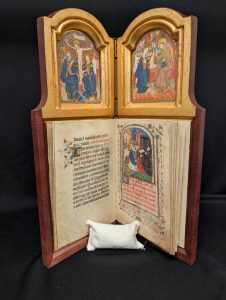
Buchaltärchen, Livre-autel (Book Altar of Philip the Good)Open Book Altar of Philip the Good showing illutstrations the diptych

The Book Altar of Philip the Good is a painted diptych on panel, depicting the Trinty and the Coronation of the Virgin, and a Christian prayer book, that depicts portraits of Philip, Duke of Burgundy throughout the miniatures, that have been united to create a portable altar. The diptychs open the same as a book with edge decorated to resemble the pages of a book.

The original was created around 1430 and made exactly according to the personal wishes of the commissioner, Philip the Good. He used this daily for quiet devotion and mediation. This 76-page book contains five miniatures in addition to the diptych.

The facsimile is full-size color reproduction of the entire original document, attempting to replicate the look and feel of the original. Pages are trimmed according to the original format. It is bound in brown kidskin leather on wooden panels, decorated with blind tooling. The binding reproduces that of the original.


The Leningrad Codex

The Leningrad Codex is the oldest complete manuscript of the Hebrew Bibles in the Hebrew language using Masoretic text and Tiberian vocalization. It is housed in the Saltykov-Shchedrin State Public Library in St. Petersburg, Russia.

The facsimile edition was published in 1998 and is the first complete facsimile edition with 990 folio pages in black and white including 16 full-page color plates.


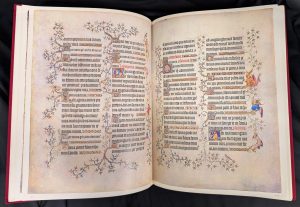
The Grandes Heures of Jean, Duke of Berry

The original Les Grandes Heures de Jean de Berry is a Book of Hours commissioned by Jean, Duke of Berry and is held by the Bibliothèque Nationale de France with the shelfmark ms. Lat. 919. This commissioned manuscript was painted by famous artists of the time and lavishly bound before being rebound and losing one image in 1930.

The facsimile within the collections is a partial facsimile of the original manuscript that does not reflect the format or look and feel of the original. The pages are represented on a larger white background but still conveys the grandeur of the original commissioned manuscript.

Illuminated pages of The Grandes Heures of Jean, Duke of Berry


The Trinity College Apocalypse

The original manuscript, named for its repository, Trinity College, was believed to have been made around 1255-1260 in southern England, featuring the pictorial biography of Saint John the Evangelist with illuminated scenes of the Apocalypses.

The facsimile is a full-size color reproduction of the entire original manuscript and attempts to replicate the look-and-feel and physical features with trimmed pages.

Illuminated illustrions of the Trinity College Apocalypse


Das Tierbuch des Petrus Candidus : Urb. lat. 276 : Geschrieben 1460, illuminiert im 16. Jahrhundert (The Book of Animals by Petrus Candidus, Codex Urbinus Latinus 276.)

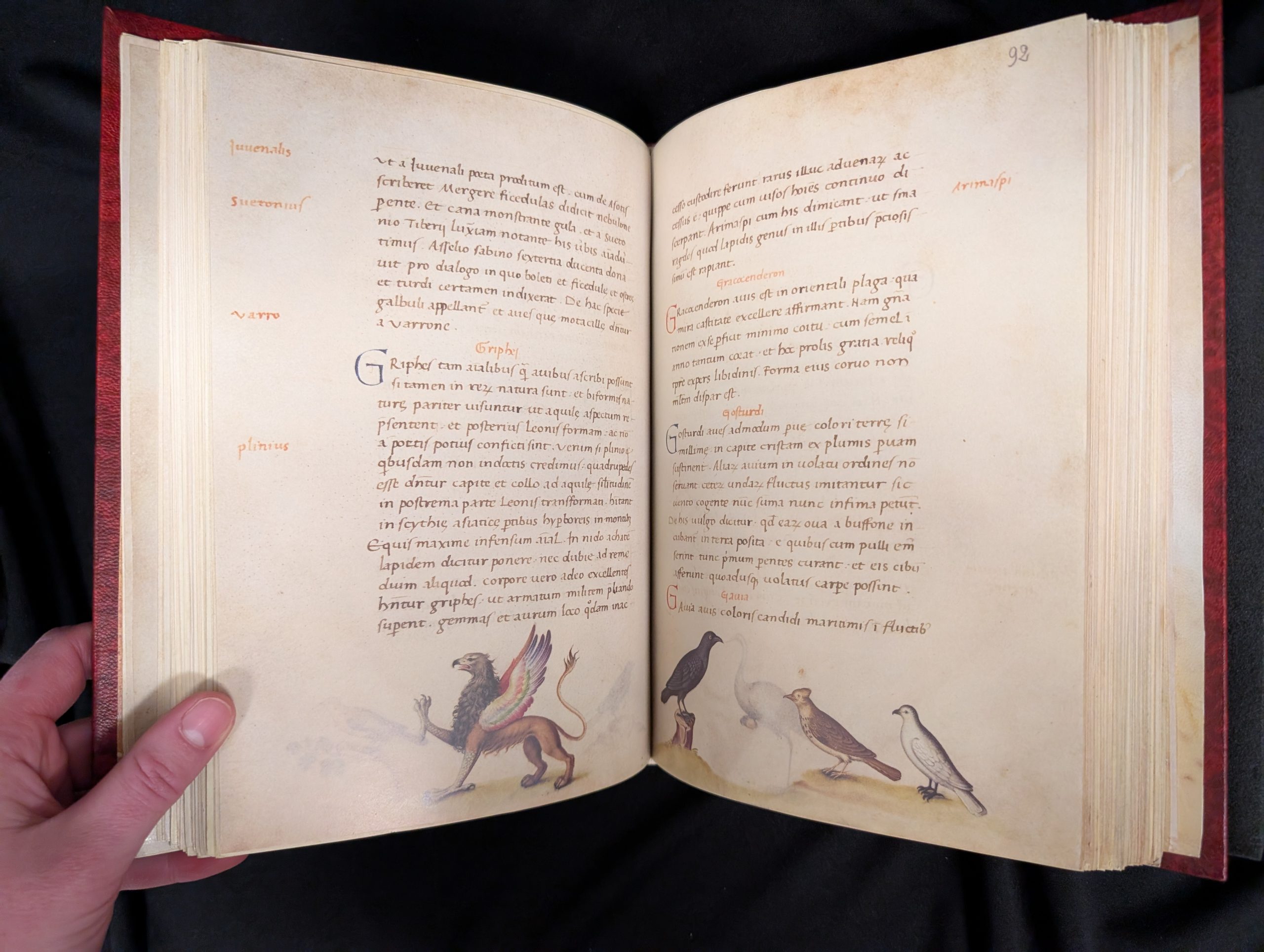
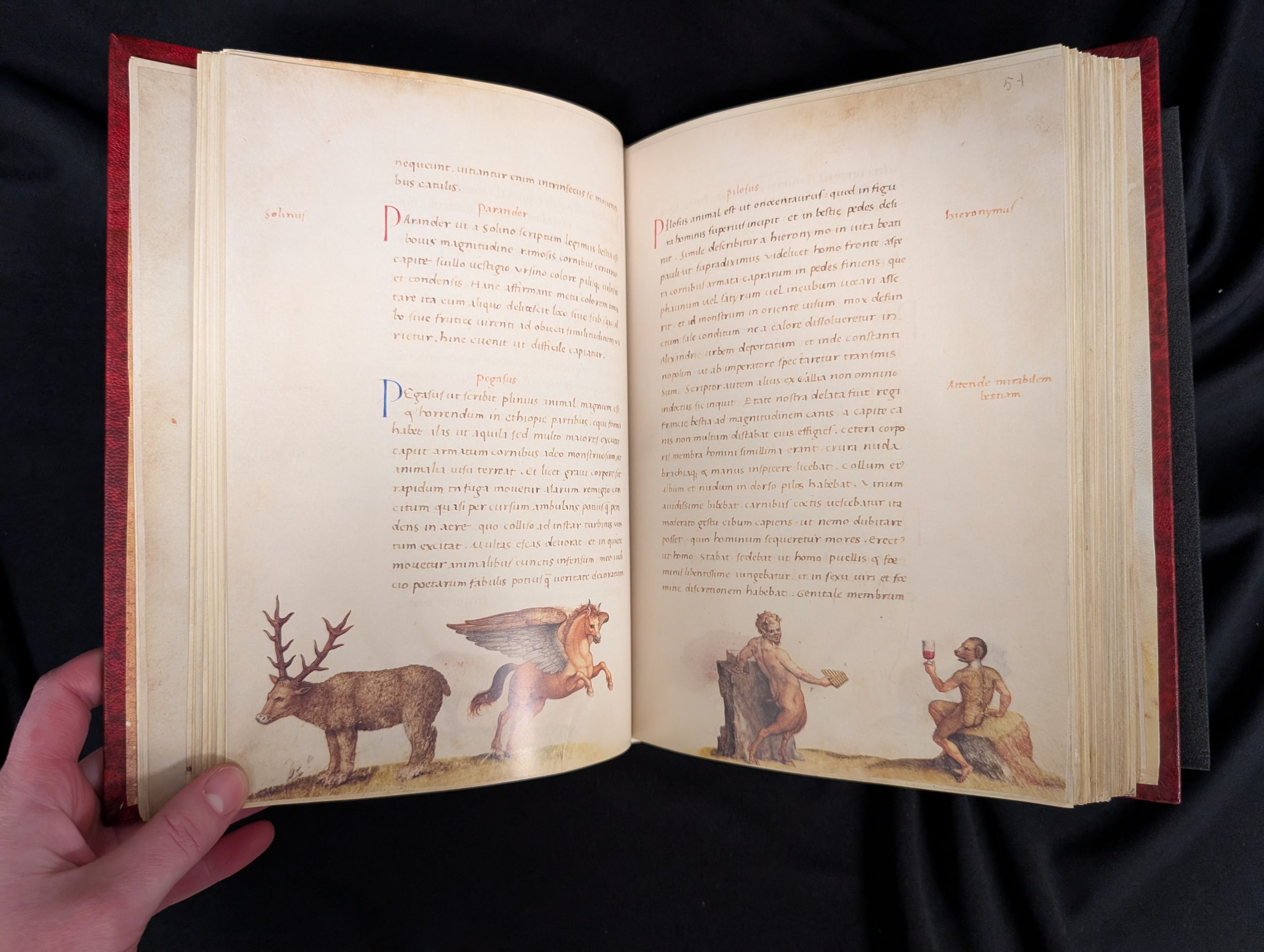
The original Animal Book of Pier Candido, or Pietro Candido Decembrio, was written in Italy around 1460 by Pietro Candido (around 1399-1477 in Milan), a humanist scholar, author, secretary to numerous Renaissance princes, even worked at the chancery of Pope Nicholas V.

His Latin text describes natural history and the life of animals which was appended by an anonymous master around 1550 with over 200 bas-de-page miniatures. In total the book contains depictions of 496 animals, birds, and insects, some of which have gold and silver highlights. But it was just the natural world, satyrs and hybrids as well as other mythological creatures like the Pegasus depicted!

The facsimile is an exact reproduction of the original document in terms of extent, color and size with as much detail as possible to match the original book in terms of scope, format, and colors.


Gradual of St. Katharinenthal

The Gradual of St. Katharinenthal is a liturgical book that contains chants and notations that were sung in Latin during High Mass. The original manuscript came from the St. Katharinenthal Abbey near Diessenhofen in Switzerland and was completed in about 1312.

The facsimile is a full-sized color reproduction of the entire original manuscript including details such as the size and trimmed pages. The facsimile is bound in nappa leather and decorated with corner fittings, a central rosette, and clasps.


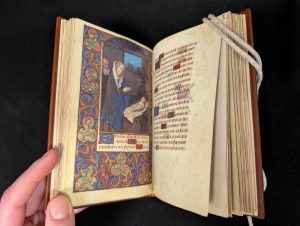
Bruges Hours Vat. Ross. 94Illuminated pages of the Bruges Hours

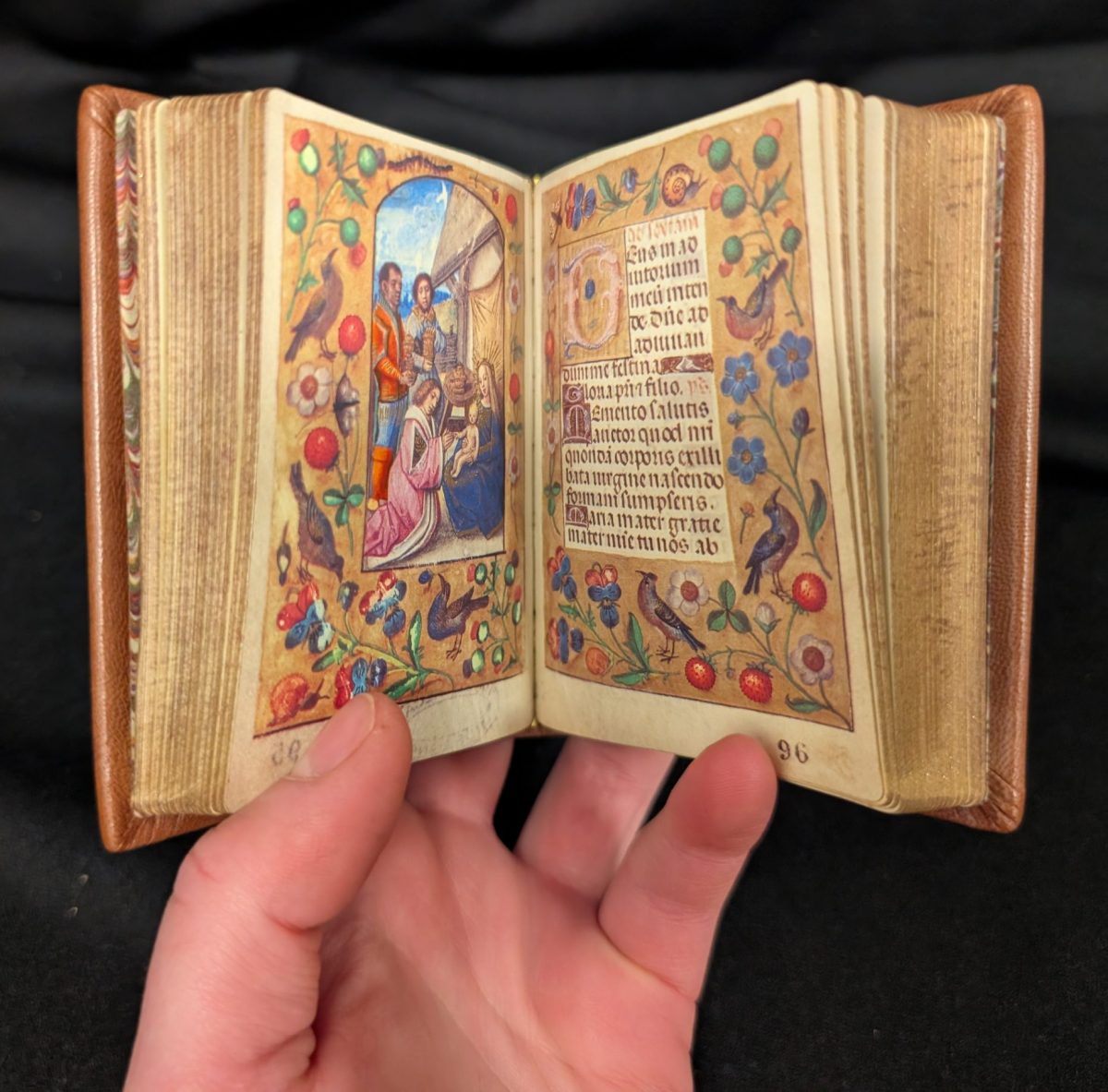
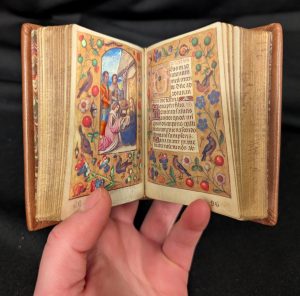
The Bruges Hours Vat. Ross. 94 is a Book of Hours that contains 39 full page illustrations, numerous golden miniatures, and realistic bordures that adorn the margins. The original located in the Vatican Library comes from Bruges near the end of the 15th century or beginning of the 16th century. It is believed there were three illuminators who worked on this text however, they remain unknown, adding an air of mystery to the creation to the Bruges Hours, as does the commissioner of this book.

The facsimile is an exact reproduction of the entire original document (extent, color and size) with as detailed as possible (scope, format, colors). The binding may not correspond to the original or current document binding.


A Vatican book of hours from the circle of Jean Bourdichon, Cod. Lat. Vat. 3781A full-page illuminated illustration from a Vatican book of hours from the circle of Jean Bourdichon

The original manuscript was created in France in the second half of the 15th century. It was crafted by master illuminator and court painter Jean Bourdichon with the assistance of his pupils for an unknown patron. The manuscript contains 17 full-page miniatures, borders, and over 1,200 ornate initials.

The facsimile is a full-size color reproduction of the entire original document, attempting to replicate the look-and-feel and physical features of the original document; pages are trimmed according to the original format. It is bound in red Morocco leather, decorated with gold tooling. The binding reproduces that of the original.


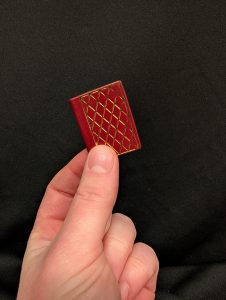
The red leather cover with gold inlay of the facsimile called Masses of Saint Francis of Assisi and Saint Anne

Masses of Saint Francis of Assisi and Saint Anne

The Masses of Saint Francis of Assisi and Saint Anne is the smallest facsimile in the Archives and Special Collections! Measuring 4 cm x 3 cm, this facsimile contains two missals, St. Francis of Assisi and Saint Anne. The original located at the Vatican, Vat. lat. 11254, was created in the 16th century by an unknown creator. This book features detailed miniatures with decorative elements on every page, detailed and written in gold ink. These small codices were intended to be carried on the person. As was this one, which would have been placed inside a small silver case that was suspended from a chain and worn around the neck.

The facsimile is a detailed reproduction of the entire document (size, format, color). The binding which is red leather with gold trim inside a silver slipcase (engraved with “A” on the front, “F” on the back) on a chain may not correspond to the original or current document binding.


If you would like to view these items for research, have them included as part of a class visit, or have further questions, please email archives@shu.edu

Spooky Stories, Returns!

Welcome to another season of Spooky Stories!

To get into the ~spooky season~ spirit, we wanted to share some stories and tales from the collections found within the The Monsignor Field Archives and Special Collections Center at Seton Hall University. Join Jacquelyn Deppe (Technical Services Archivist & Rare Books Specialist) over the next 10 days as she reads some selections and provides commentary on the works themselves and sometimes the history surrounding them!

To listen to other episodes please click the “Playlist” icon in the upper right hand corner of the video to see the full list of episodes or click here.

Spooky Stories — a mini series with Jackie and Martha

Happy Halloween! This year to get into the ~spooky season~ spirit, we wanted to share some various books, poems, periodicals found in Seton Hall’s Archives and Special Collections. Join Jackie Deppe (Technical Services Archivist & Rare Books Specialist) and Martha Slomczewski (Special Collections Assistant & Social Media Coordinator) over the next 11 days as they read these selections and provide colorful commentary on the works themselves and the history surrounding them. We will update this post each day with a new episode. Happy Halloween and happy listening!

To listen to other episodes please click the “Playlist” icon in the upper right hand corner of the video to see the full list of episodes or click here.

November Eve in Celtic Lore

November Eve

November Eve, or Samhain, celebrates the Moon, the end of the harvest season, and the beginning of winter. And like other holidays that celebrate the change of the seasons with great bonfires, fairs, and festivals, so does November Eve.

Like many Celtic holidays have a Christian counterpart celebrated on or around the same day, so does November Eve. It is known as All Saints’ Day and All Souls’ Day. All Saints’ Day is a day to celebrate all saints known and unknown while All Souls’ Day is to remember all others that have passed on. Typically, families will visit cemeteries and graves, bringing flowers, candles and prayers or blessings. Just like Halloween and the Day of the Dead, All Saints’ Day and All Souls’ Day remember the dead.

And like Halloween and the Day of the Dead, November Eve is the “one night of the year when the dead can leave their graves and dance in the moonlight on the hill” (Wilde, 80). However, it is said “mortals should stay at home and never dare to look on them” (Wilde, 80).

One such gives caution, states:

“It is esteemed a very wrong thing amongst the islanders to be about on November Eve, minding any business, for the fairies have their flitting then, and do not like to be seen or watched; and all the spirits come to meet them and help them. But mortal people should keep at home, or they will suffer for it; for the souls of the dead have power over all things on that one night of the year; and they hold a festival with the fairies, and drink red wine from the fairy cups, and dance to fairy music till the moon goes down” (Wilde, 78).

Being the 21st century staying home no longer applies! Kids, after carving their Jack-O’-the-Lantern into a frightful face, dress up to trick-or-treat and adults, also in costume, go off to parties to celebrate and bob for apples. Ever wonder how the Jack-O’-the-Lantern came to be? Or how apples and Halloween became a famous couple?

An Irish tale from Irish Fireside Stories contains an explanation for the Legend of the Jack o the Lantern. After having been excluded from heaven and having tricked the devil making Hell refuse to take him, it was decreed that Jack would walk the Earth with a lantern to light him on his nightly way until Judgement Day.

As for apples and Halloween, an old Celtic ritual has an explanation:

“The first day of November was dedicated to the spirit of fruits and seeds, from which, no doubt, originated the custom of eating nuts and apples on Hallow Eve. It was called La-mas-abhal, the day of apple fruit. This word, pronounced Lamabhool, was corrupted by English settlers into lamb’swool, which name was given to a drink made of apples, sugar and ale. So the apples are still eaten on All-Hallow’s Eve by the merry company in the farmhouse kitchen in Ireland, and the young Irish girls will peel one carefully, taking care to keep the skin whole, which, when cast over the shoulder upon the floor, will fall into the form of the initial letter of her future husband’s name. Or she will take nuts piled so plentifully upon the table and burn them on the grate-bar or the hearth and try to read her future in their ashes, while her companions are setting nuts in pairs together in the same place, naming them carefully, and watching to see whether they will burn pleasantly together or jump apart” (Blennerhassett, 233-234).

The article continues to mention further steps to be taken over the course of finding out information about one’s future husband and the role of apples in this process but as with all love fortune telling, spells, and the like, it is a lengthy process that requires far too much effort and too much typing for one blog post on a day of festivities. So, I’ll leave it here and wish you all a Happy Halloween!

Good luck bobbing for apples! And remember all spells cast on November Eve come true.


Reference

Blennerhassett, Sarah (1899 November). All-Hallow’s Eve. The Gael.

Wilde, & Wilde, W. R. (1919). Ancient legends, mystic charms & superstitions of ireland : with sketches of the irish past. Chatto & Windus.

For the online version, click here. Please note they may not be exactly the same.

St. John’s Eve and Midsummer in Celtic Lore

In Ireland, the holiday of Midsummer marks the middle of summer and comes just a few days after the Summer Solstice. Much of the celebration takes place the evening before on Midsummer’s Eve, also known as St. John’s Eve. As with many Celtic celebrations, great bonfires are lit, and fairs and festivals are held to celebrate. Just like May Day, St. John’s Eve has its own stories, customs, and superstitions.

“In ancient times the sacred fire was lighted with great ceremony on Midsummer Eve; and on that night all the people of the adjacent country kept fixed watch on the western promontory of Howth, and the moment the first flash was seen from that spot the fact of ignition was announced with wild cries and cheers repeated from village to village, when all the local fires began to blaze, and Ireland was circled by a cordon of flame rising up from every hill” (Wilde, 113).

It was also a time to worship the Goddess Áine.

“…Áine, who gave her name to Knockainy hill and village in the county Limerick. She ruled, and still rules, that district as fairy queen and banshee. In the second century of our era, she cut off the ear of Ailill Oluim, King of Munster. It was on this account he was called Oluim, from “o”, and ear, and “lom”, bare; bare of one ear” (Mahon, 137).

“Aynia, deemed the most powerful fairy in Ulster, and Áine, queen of South Munster, are perhaps the same person, the mysterious and awful goddess once adored as Anu, or Danu. Of the two, it is Áine who especially seems to carry on the traditions of the older Anu, worshipped, according to the “Choice of Names”, in Munster as a goddess of prosperity and abundance. Within living memory, she was propitiated by a magical ritual upon every Saint John’s Eve, to ensure fertility during the coming year. The villagers round her sidh of Cnoc Aine (Knockainy) carried burning bunches of hay or straw upon poles to the top of the hill, and thence dispersed among the fields, waving these torches over the crops and cattle. The fairy, or goddess was held to be friendly, and, indeed, more than friendly, to men” (Squire, 245).

Another tale tells the story of a St. John’s Night were a number of girls stayed late on the Hill to watch the clairs (torches) and join in the games when suddenly “Áine appeared among them, thanked them for the honour they had done her, but said she now wished them to go home, as they wanted the hill to themselves” (Rolleston, 128).

Since “fire is the holiest of all things” many customs and superstitions surround the bonfire and included carrying off a coal, jumping and leaping through the flames forward and backwards a certain number of times, and walking “three times round a fire on St. John’s Eve, and you will be safe from disease for all that year” (Wilde, 211). These customs and superstitions were not just limited to people but could include animals. Cattle were “driven through the half-extinguished bonfire, as a preventive against witchcraft” (W. R. Wilde, 40).

As Christianity spread and Midsummer became “christianized”, dedicated by the Church to honor St. John the Baptist, certain customs and superstitions survived (O’Súilleabháin, 322). “…Baal fires were kindled as part of the ritual of sun-worship, though now they are lit in honour of St. John. The great bonfire of the year is still made on St. John’s Eve, when all the people dance round it, and every young man takes a lighted brand from the pile to bring home with him for good luck to the house” (Wilde, 113). Whether Celtic or Christian, fire was still seen as a central part of the celebration, bringing good luck just like the fires of May Day did.


Reference

O’Súilleabháin Seán. (1942). A handbook of irish folklore.

No online version available.

Wilde, & Wilde, W. R. (1919). Ancient legends, mystic charms & superstitions of ireland : with sketches of the irish past. Chatto & Windus.

For the online version, click here. Please note they may not be exactly the same.

Putzi, S. (Ed.). (2008). To z world superstitions & folklore : 175 countries – spirit worship, curses, mystical characters, folk tales, burial and the dead, animals, food, marriage, good luck, and more. ProQuest Ebook Central https://ebookcentral.proquest.com

Wilde, W. R. (1852). Irish popular superstitions. J. McGlashan.

No online version available.

Mahon, M. P. (1919). Ireland’s fairy lore. T.J. Flynn.

For an online version, click here. Please note they may not be exactly the same.

Squire, C. (191AD). Celtic myth & legend, poetry & romance. Gresham Pub.

For the online version, click here. Please note they may not be exactly the same.

Rolleston, T. W. (1911). Myths & legends of the celtic race. G.G. Harrap.

For an online version, click here. Please note they may not be exactly the same.

May Day in Celtic Lore

May Day Eve and May Day

Lá Bealtaine in Irish, or “Belltaine or May Day took its name, i.e., bel-tene, lucky fire” is a celebration of summer (Joyce, 290). May Day Eve and May Day are traditionally celebrated with great bonfires along with fairs and festivals. This day also marks the occurrence of a shriek due to the Red Dragon of Britain being attacked by the White Dragon of the Saxons.

May Day marked “the great feast of Bel, or the Sun”, a time when the “Druids lit the Baal-Tinne, the holy, goodly fire of Baal, the Sun-god, and they drove the cattle on a path made between two fires, and singed them with the flame of a lighted torch, and sometimes they cut them to spill blood, and then burnt the blood as a sacred offering to the Sun-god” (Wilde, 102).

While the Druids saw Bel as a god, Reverend Michael P. Mahon describes Bel as being promiscuously written “Bial and Beal, and supposed to be the “Beel” in the Hebrew word Beelzebub, is a semitic word that would give the idea of a supreme god or a supreme demon” (Mahon, 195).

According to ancient Druid practices all domestic fires were extinguished and relit by the sacred fire taken from the temples and it was “sacrilege to have any fire kindled except from the holy alter flame” (Wilde, 102). It was said that while the sacred fire was burning “no other should be kindled in the country all round, on pain of death” (Joyce, 290).

However, St. Patrick was “determined to break down the power of the Druids; and, therefore, in defiance of their laws, he had a great fire lit on May Eve, when he celebrated the paschal mysteries; and henceforth Easter, or the Feast of the Resurrection, took place of the Baal festival” (Wilde, 102). Thus Christianity started to take root but still boasted similar traditions, customs, and superstitions, just without sacrifice and death. One such superstition talks about fires going out on May Day, stating that:

“If the fires go out on May morning it is considered very unlucky, and it cannot be re-kindled except by a lighted sod brought from the priest’s house. And the ashes of this blessed turf are afterwards sprinkled on the floor and the threshold of the house” (Wilde, 106).

Which is similar to the Druids practice of extinguishing domestic fires and only relighting them from the sacred fire, the holy alter flame, taken from the temples.

And where “Baal fires were originally used for human sacrifices and burnt-offerings of the first-fruits of the cattle”, they were being used “for purification from sin, and as a safeguard against power of the devil” (Wilde, 102). Even with Christianity established people have learned that May Day celebrations are “a survival of the ancient pagan rite” along with certain customs and superstitions (Mahon, 197).

Such as believing that fairies have great power during May Day and children, cattle, milk, and butter must be guarded from their influence. Other customs and superstitions say:

“It is not safe to go on the water the first Monday in May” (Wilde, 106)

“Finishing a cup of nettle soup on May 1 (May Day) prevents rheumatism for a year” (Putzi, 195).

“…the men, women, and children, for the same reason, pass through, or leap over, the sacred fires, and the cattle are driven through the flames of the burning straw on the 1st of May” (W. R. Wilde, 39)

“The fire was of the greatest importance in house in Ireland. People were unwilling to allow it to die out or to lend a fire-coal. They were especially careful of the fire on May Day” (O’Súilleabháin, 334)

“…spent coal must be put under the churn, and another under the cradle; the primroses must be scattered before the door, for the fairies cannot pass the flowers” (Wilde, 102)

“All herbs pulled on May Day Eve have a sacred healing power, if pulled in the name of the Holy Trinity; but if in the name of Satan, they work evil” (Wilde, 184)

While Christianity became more popular and practiced, old time Druid traditions can still be seen. May Day Eve and May Day, as with many other holidays that are celebrated, is a mix of traditions and customs, creating something that is unique and enjoyed by all.


Reference

Joyce, P. W. (1903). A social history of ancient ireland : treating of the government, military system, and law ; religion, learning, and art ; trades, industries, and commerce ; manners, customs, and domestic life, of the ancient irish people. Longmans, Green.

For the online version, click here. Please note they may not be exactly the same.

Wilde, & Wilde, W. R. (1919). Ancient legends, mystic charms & superstitions of ireland : with sketches of the irish past. Chatto & Windus.

For the online version, click here. Please note they may not be exactly the same.

Mahon, M. P. (1919). Ireland’s fairy lore. T.J. Flynn.

For an online version, click here. Please note they may not be exactly the same.

Putzi, S. (Ed.). (2008). To z world superstitions & folklore : 175 countries – spirit worship, curses, mystical characters, folk tales, burial and the dead, animals, food, marriage, good luck, and more. ProQuest Ebook Central https://ebookcentral.proquest.com

Wilde, W. R. (1852). Irish popular superstitions. J. McGlashan.

No online version available.

Squire, C. (191AD). Celtic myth & legend, poetry & romance. Gresham Pub.

For the online version, click here. Please note they may not be exactly the same.

O’Súilleabháin Seán. (1942). A handbook of irish folklore.

No online version available.

Object of the Week: “Far Away and Long Ago” by William Henry Hudson

William Henry Hudson
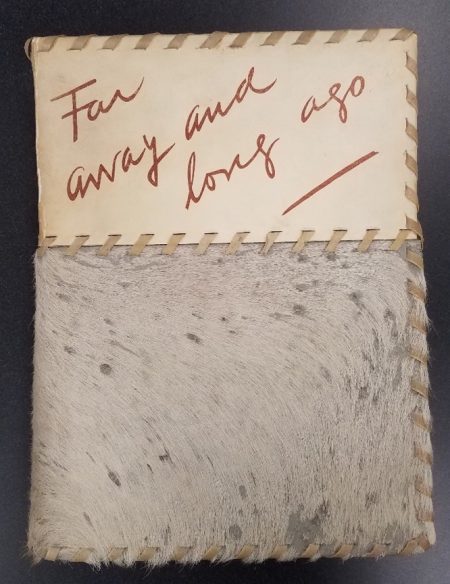
“Far Away and Long Ago”
Printed for members of the Limited Editions Club by Guillermo Kraft ltda., Buenos Aires:  1943.


FEBRUARY IS LIBRARY LOVER’S MONTH!

Library Lover’s Month is dedicated to the people who love whole buildings devoted to the reading, housing, organizing, categorizing, finding, studying, preserving and otherwise loving books.[1]  Libraries are sanctuaries, offering safe spaces for study, reflection and enjoyment.  Libraries indulge our desire to acquire knowledge – they are essentially ‘places of information.’[2]  When we think about libraries, we often think about a building brimming with shelves of books on all topics.   However, there is more to libraries than just books.  They are community hubs supported by librarians who fulfill multiple roles as information experts, subject matter specialists, program organizers, educators, community builders and partners in research. Seton Hall University contains a number of libraries across its three campuses including the Walsh Library, Interprofessional Health Sciences Library, Valente Italian Library, Turro Seminary Library and Law Library.  The Walsh Library also houses the Department of Archives and Special Collections and the Walsh Gallery which care for rare books, manuscripts, art and artifacts and hosts spaces for exhibitions, programs and displays.[3]

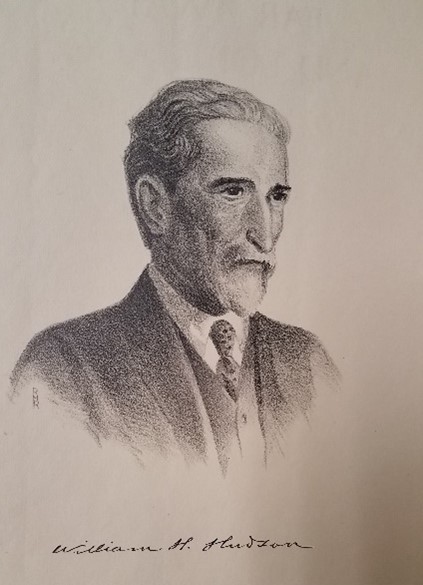
The book featured in this post, “Far Away and Long Ago” by William Henry Hudson, recollects the author’s early life, between the ages of four and twelve, which were spent in Argentina.  It is part of the Rare Book

Image of William Henry Hudson
Portrait of William Henry Hudson by Raúl Rosarivo from “Far Away and Long Ago”

Collection, housed in the Department of Archives and Special Collections. This limited-edition book had a run of just fifteen hundred copies and was designed by Alberto Kraft.  The volume in the Seton Hall Archives is signed by Kraft and illustrator Raúl Rosarivo.  This edition is bound in cowhide with undressed leather on the lower portion and features laced edges. [4]  The materials used in the binding reflect William Henry Hudson’s childhood, much of which was spent in the rugged pampas of Argentina, where his parents raised sheep, though the region is known for its free-ranging cattle.  These formative experiences in nature would profoundly impact his future.  As an adult, Hudson would achieve recognition as an author, naturalist, and ornithologist.  He was lauded for his exotic romances, especially “Green Mansions” which was published in 1904.  “Far Away and Long Ago” lovingly recounts his childhood — roaming the pampas at liberty, studying the plant and animal life, and observing both natural and human phenomena on the harsh frontier.  At age 15, he suffered an illness which would impact his health adversely for the remainder of his life.  Around this period of infirmity, he read Charles Darwin’s “Origin of Species” which reaffirmed his interest in the natural world.[5]

Illustration of a man by Raúl Rosarivo from “Far Away and Long Ago”
Illustration by Raúl Rosarivo from “Far Away and Long Ago”

Though William Henry Hudson may not be a household name today, he had many admirers in his time.  In 1934, renowned author Ernest Hemingway wrote a list of book recommendations to a young, aspiring writer. It included William Henry Hudson’s “Far Away and Long Ago” in addition to books by celebrated authors such as Stephen Crane, e.e. cummings, Leo Tolstoy, Emily Bronte, Fyodor Dostoyevsky and James Joyce.[6]  Hudson’s book was also among the objects auctioned from The Private Collection of President and Mrs. Ronald Reagan at Christie’s auction house in 2016.[7]  Praise for Hudson’s writing consistently mentions his palpable imagery, as was noted in this thoughtful review on amazon.com:

“This book was like knocking on an old friend’s door, being welcomed in and settling in front of a fire with a glass of something in one’s hand. The author then talks, gently and beautifully, weaving this picture of his early life. He brings his characters to life and describes the birds and other creatures so well, I felt as if I was there with him, every time I picked up the book to read. A gentle lovely story of a young boy’s steps from childhood.” – L.M. Gainsford[8]


The images and materials shown here are but a small part of the vast patrimony available to students, faculty and researchers.  For access to this or other objects in our collections, complete a research request form to set up an appointment or contact us at 973-761-9476. 


[1] http://www.librarysupport.net/librarylovers/, accessed 2/16/2021.

[2] http://www.ilovelibraries.org/what-libraries-do, accessed 2/16/2021.

[3] https://library.shu.edu/home accessed 2/16/2021, accessed 2/16/2021.

[4] http://eds.b.ebscohost.com/eds/detail/detail?vid=4&sid=b64ff686-5122-4343-b1c9-852f6588dd78%40sessionmgr103&bdata=JkF1dGhUeXBlPXNzbyZzaXRlPWVkcy1saXZl#AN=sth.ocn542094967&db=cat00991a, accessed 2/16/2021.

[5] https://www.britannica.com/biography/W-H-Hudson, accessed 2/16/2021.

[6] https://www.openculture.com/2013/05/ernest_hemingways_reading_list_for_a_young_writer_1934.html, accessed 2/16/2021.

[7] https://www.christies.com/lot/lot-limited-editions-club-hudson-wh-far-6018661/?lid=1&from=relatedlot&intobjectid=6018661, accessed 2/16/2021.

[8] https://www.amazon.com/Far-Away-Long-Ago-Childhood/dp/0907871747, accessed 2/16/2021.

Irish Superstitions and Rituals

From Friday the 13th and black cats to tossing salt over one’s left shoulder to ward off evil spirits, superstitions and rituals are rooted in a mixture of religion, mythology, and folklore. They have the power to ward off evil, bring good luck, cure sickness, even stop people from performing certain activities on certain days.

However, every culture is different and what is unlucky in one may be lucky in another. Instead of Friday the 13th, it is Tuesday the 13th that is thought to be unlucky in Chile, Colombia, Costa Rica, Cyprus, Ecuador, Greece, Mexico, and Serbia. For Italy, it is Friday the 17th.

Where a black cat can be thought to mean bad luck, in Ireland it may lead to fortune as “several of the great lake serpents and water-cows of our Irish Fairy Mythology are supposed to guard treasurers; in some instances black cats are similarly employed” (Wilde, 98).

Some of Ireland’s other superstitions and rituals revolve around fairies and goblins, stating,

“…if you cast the dust that is under your foot against the whirlwind at the instant that it passes you, “them that’s in it” (that is, if they have any human being along with them) are obliged to be released” (Wilde, 130).

Then there are those that involve fire, most notably on days of celebration such as May Day and St. John’s Eve or Midsummer’s Eve:

“If a man was to perform a long journey, he leaped backwards and forwards three times through the fire to render himself invulnerable” (Wilde, 49).

“When the fire has nearly expired, and the dancing, singing, and carousing are over, each individual present provides himself with a braune, or ember of the fire, to carry home with him, which, if it becomes extinguished before he reaches his house, it is an omen of impending misfortune” (Wilde, 49).

“Walking around a burning flame during St. John’s Eve or Midsummer’s Eve spares one from being sick the whole year” (Putzi, 196).

Other curious Irish rituals include keeping spiders in a bag to be worn as a pendant or necklace to cure fever. However, if the bag is opened it will cause back luck. To remove a sty on one’s eyelid, the person should point to the direction of a gooseberry thorn nine times while chanting “Away, away, away!”.

But if things still go awry, you find your milk has curdled, you can always blame the fairies!


Other superstitions and rituals can be found in:

Putzi, S. (Ed.). (2008). To z world superstitions & folklore : 175 countries – spirit worship, curses, mystical characters, folk tales, burial and the dead, animals, food, marriage, good luck, and more. ProQuest Ebook Central https://ebookcentral.proquest.com

Wilde, W. R. (1852). Irish popular superstitions. J. McGlashan.