Whose Games Are These? Neutrality and Unequal Consequences in Milan 2026
Avery Kachmarsky
Staff Writer
Before the end of 2016, the World Anti-Doping Agency (WADA) released a report stating that more than 1,000 Russian athletes were connected in some manner to positive drug tests, per Radio Free Europe. A Statista chart, based on the findings of the 2020 Anti-Doping Rule Violations (ADRVs) WADA Report, reveals that violations continued from 2013 to 2020, with a decreased, but still substantial, number of ADRVs. This data also predates recent cases, including Kamila Valieva, whose trimetazidine positive drug test, a banned substance that increases blood flow and is believed to increase endurance, reignited scrutiny per NBC Olympics.
In response, WADA requested a four-year ban on Russia and its athletes, with WADA President Witold Bańka stating that “The Panel has clearly upheld our findings that the Russian authorities brazenly and illegally manipulated the Moscow Laboratory data in an effort to cover up an institutionalized doping scheme,” according to WADA. However, the Court of Arbitration for Sport decided a two-year ban would be more appropriate. The scandal raised questions about systemic rule-breaking, accountability, and the willingness of global sporting bodies to confront Russia’s repeated violations.
So, what became of these bold statements from WADA, other than relaxed action from other international organizations? Valieva’s former coach, Eteri Tutberidze, making a reappearance at the Olympics for the Georgian figure skating team but was also reportedly at the “Milano Ice Skating Arena… giving advice to [Adeliia] Petrosian…,” the Russian ‘neutral athlete,’ per BBC News? Reports from February 19 reporting that the International Paralympic Committee will allow Russian and Belarusian athletes to compete under their flags, with their anthems, as stated by The Guardian? So far, not much.
Who are these ‘neutral athletes’ competing? Figure skater Petr Gumennik has been coached by Ilya Averbukh, who faces sanctions but is referred to as “Crimea’s ambassador for sport,” as stated by BBC News. Russia illegally annexed Crimea in 2014. Other athletes, including cross-country skier Savelii Korostelev, whose club, Central Sports Club of the Army, is connected to the Russian military, speed skater Kseniia Korzhova, who interacted with propaganda media from Nikita Nagorny, another sanctioned individual due to his participation in the Russian military, and cross-country skier Dariya Nepryaeva, who attended a camp supported by the state in Russian-occupied Crimea in 2022, per BBC and the International Olympic Committee. Together, these athletes and the institutions that regulate them raise the question of whether neutrality has any practical meaning.
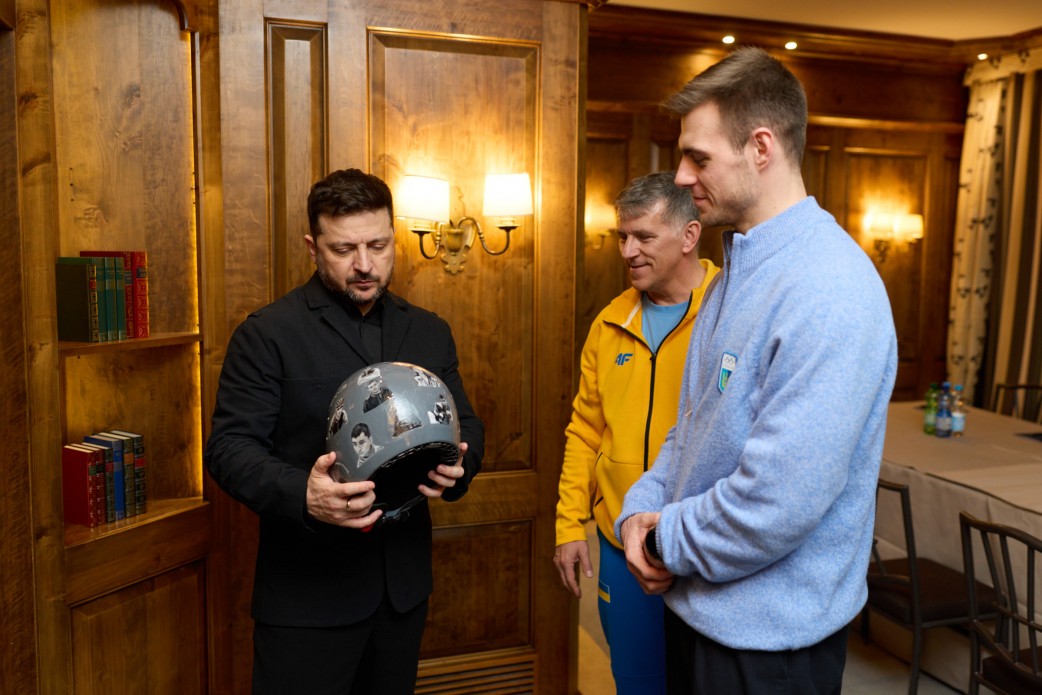
Despite this, the main controversy regarding Ukraine and Russia at the Olympics was Vladyslav Heraskevych’s helmet. The Ukrainian skeleton racer, who famously held up a “No War in Ukraine” sign at the 2022 Beijing Olympics, did not receive any type of punishment for that message from the IOC, according to The Associated Press. Fast forward four years, a helmet depicting the images of Ukrainian athletes who have been killed since Russia’s illegal invasion in 2022 is the object that forced the IOC to make a disciplinary decision. 22-year old Volodymyr Androschuk, track and field athlete, died while fighting in the Bakhmut area; 11-year-old Karyna Diachenko, rhythmic gymnast, died in Mariupol when a Russian air strike hit her family’s home; powerlifter Pavlo Ishchenko, who died on the front lines in 2025; 9-year-old Victoria Ivashko, who died in 2023 from a Russian air strike in Kyiv; and high jumper Roman Polishchuk, who died in March 2023 during combat, among others, per BBC News.
CAS, the organization that reduced the proposed ban on Russia for the nation’s violations and illegal attempts to hide evidence from their state-sponsored doping strategy, heard Herakeych’s appeal, but denied his request on February 13, deeming the helmet with images of killed Ukrainian athletes to be political messaging, as stated by The Associated Press. In his conversation with IOC President Kirsty Coventry, Heraskevych noted that a Russian flag was depicted on Italian snowboarder Roland Fischnaller’s helmet and that Ukrainian athletes had seen “Russian flags in the stands at Olympic venues,” also reported by The Associated Press. Do these inconsistent rulings stem from a change in which ‘violations’ are deemed worthy of discipline, or something else?
During Heraskevych’s appeal, both Ukrainian and international athletes and coaches threw their support behind the symbol. Gold medalist fencer Olga Kharlan backed the gesture as a memorial for those “who will never be able to compete again,” and previously, rightfully so, refused to shake Russian and ‘neutral athlete’ Anna Smirnova’s hand in 2023, per NPR. Ivo Steinbergs, Latvia’s skeleton coach, also supported calls for reinstating Heraskevych, per The New York Times, while other Ukrainian Olympians, including Oleksandr Usyk, a world famous gold medalist boxer, took to social media to share their support.
Image courtesy of Wikimedia Commons, licensed under Creative Commons Attribution CC BY 4.0 International