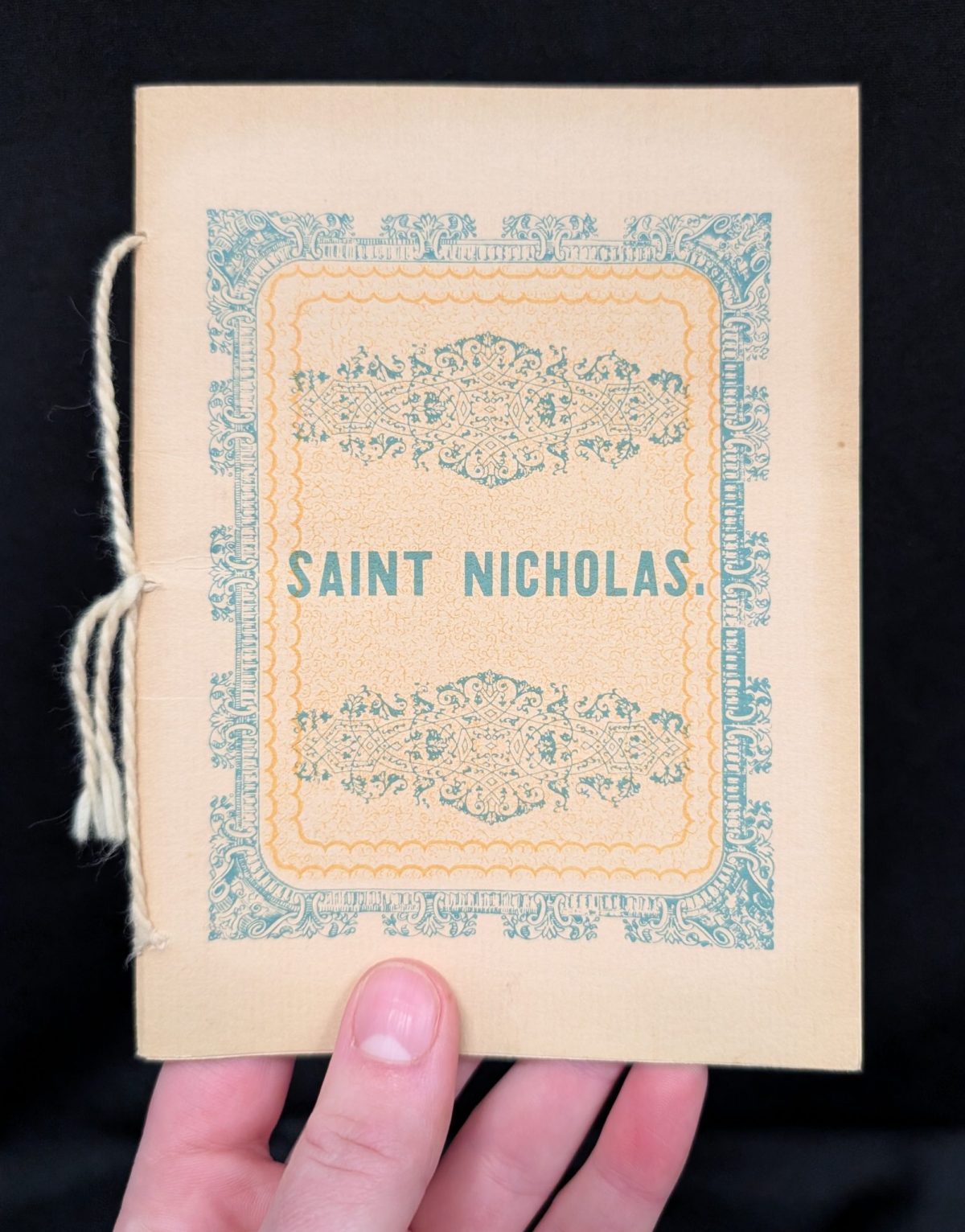
As Christmas approaches, old traditions are carried out while new ones are created. One tradition many know is the happy reciting of ‘Twas the Night Before Christmas’. But I bet you didn’t know it is actually called A Visit from St. Nicholas written by Clement C. Moore. This little booklet contains original cuts, designed and engraved by Boyd and was published in New York by Spalding & Shepard possibly around the 1960s. The inside cover states:
This is a Happy re-creation of the 1849 illustrated edition of which only two copies are known to exist. That from which this facsimile was reproduced remains behind locked doors in New York’s Fifth Avenue Library.
Measuring 16 cm with a rope tie to keep the pages together, it was probably issued as a Christmas card. In fact, the copy within the collections contains a small inscription on the last page, stating:
Love + Kisses,
Betty, Frank + Judie
Clemente Clarke Moore was a New York born American writer, scholar, even real estate developer who was a professor of Oriental and Greek Literature as well as Divinity and Biblical Learning at the General Theological Seminary of the Protestant Episcopal Church, in New York City. But Moore is best known for his poem A Visit from St. Nicholas.
This poem first appeared on December 23, 1823, in the Sentinel, which was the local newspaper of Troy, New York where it was published anonymously.
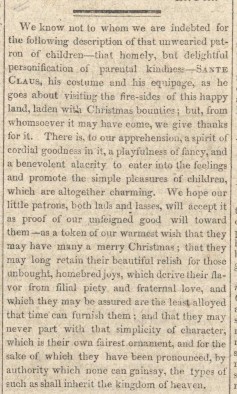
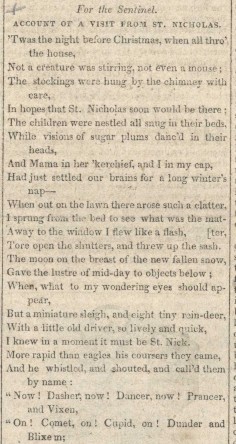
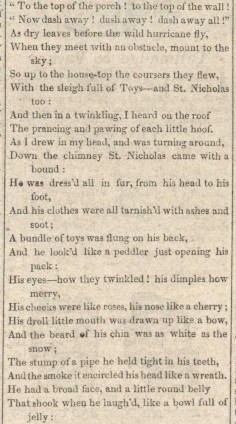
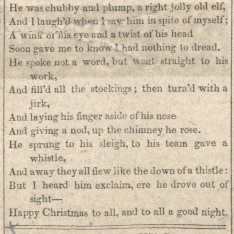
Thirteen years after it was published, Moore took credit for its authorship, though his claim has been disputed. Many believe the poem was instead penned by New York writer Henry Livingston.
This piece was unique as it offered a different take on Santa Claus, a figure who was, until up until this point, traditionally depicted as a thinner, a less jolly, horse-riding disciplinarian. He was a combination of stories about the British Father Christmas, the Dutch Sinterklaas, and the fourth-century bishop Saint Nicholas of Myra.
Father Christmas emerged around the 15th century as a symbol of merrymaking and good cheer, dressed in green robes to symbolize the spirit of Yule. Yule, also called Yuletide or Yulefest, is a winter festival historically observed by Germanic peoples with connections to the rebirth of the sun, and was associated with gods like Odin, who was said to lead the Wild Hunt, a ghostly procession through the sky. There are even connections to the Oak King, known as the Green Man, and the Holly King, known as the Red Man. And if you have ever had a Yule log, the tradition comes from this festival. While the Yule log, nowadays is more of a candle holder, the tradition goes that a large log is burned in the hearth to bring warmth and light. And was often kept burning for twelve days, symbolizing protection and prosperity.
Sinterklaas was inspired by Saint Nicholas of Myra. He is depicted wearing bishop’s red robes and mitre, carries a crosier, and rides a white horse. Saint Nicholas of Myra was a Christian bishop born in the 3rd century in Patara which is in modern day Turkey. He is known for his generosity, especially towards children and the poor. His Feast Day is December 6th and this is when children will leave their shoes out, on the stairs or in the hallways, for gifts to appear in.
The poem ultimately paints a Santa Claus that is a combination of these figures but in a different tone: it gave Santa eight reindeer, even named them; it described a Santa who could magically sneak in and out of homes via chimneys; and it created a recognizable cheerful, chubby icon that we know as Santa Claus today, that would be further cemented by companies like Coca Cola and become ever present in holiday cards, movies, television shows, and even malls.
Please listen to the following audio clip for a reading of A Visit from St. Nicholas written by Clement C. Moore.