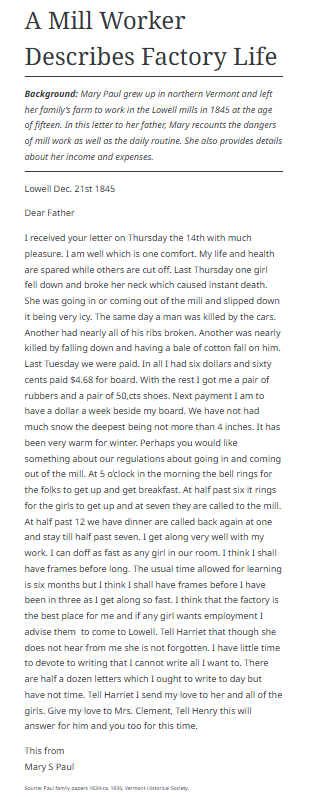
In December 1845, Mary Paul wrote a letter to her father writing about her daily life working in the textile mills of Lowell, Massachusetts. She was a young teenage girl who left her home in Vermont for work. Her letters offer a firsthand account of the opportunities and hardships people experienced by the early industrial workers in the US. This document is important because it shows the true reality of early factory life during the Industrial Revolution while also showing how women navigated their social and economic roles. The letter also reveals how dangerous conditions became normalized and how workers balanced their independence with the hardships of factory discipline.
-
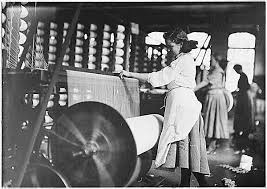
- A young woman operates a textile machine in a Lowell factory.
In the early 19th century, the US economy became industrial, after being agriculturally based for years. At this time, Lowell was one of the first major centers of textile manufacturing. They were employing many young, unmarried women who were referred to as “Lowell mill girls.” These women were from rural areas and were promised wages, independence, and a structured environment. However, as industrialization expanded, working conditions became more demanding, wages decreased, and hours remained long.[1] This explains why Paul’s experiences with low wages and long hours were not unusual since it was a part of a larger industrial system.
Paul’s letter reflects both the opportunities and dangers of this new industrial system. She expresses her feeling of independence by earning and managing her own expenses. She states that “the factory is the best place for [her] and … any girl [who] wants employment,” and advises them to come to Lowell.[2] This suggests that factory labor offered more opportunities than rural life. This reflects historians’ findings that limited job opportunities in rural areas led many young women to seek work in mills like Lowell.[3]
Aside from the opportunities, Paul’s description in the letter also highlights the dangerous conditions inside the mills. She talks about multiple workplace accidents, including deaths and serious injuries. She presents these events almost casually, which makes this even more striking. This could be because she is writing to her father and does not want to worry him too much. By talking about serious accidents in a calm way, it shows that these dangers were kind of normal in the mills. Her tone in the letter suggests that such incidents were normalized which shows the lack of safety regulations during this period.
A closer look at Paul’s choice of words and tone reveals how she presents her experience. When she describes the factory as “the best place for [her],” it shows a sense of optimism and independence. It also reflects how she frames her situation positively for her father.[4] Her calm descriptions of accidents and long hours suggest that she has become used to these harsh conditions. This combination of reassuring language and understated details shows how workers like Paul balanced honesty with the desire to present their experiences in a less concerning way to others.
To add on, Paul describes her long and exhausting daily routine that includes waking up early and working extended hours. She emphasizes that she has very little free time for herself. This supports historians’ arguments that industrialization imposed strict discipline on workers’ time schedules, which negatively impacted their lifestyle.[5] Her experience was very similar to many other mill workers at this time.
During this time period, there was emerging worker resistance. Although Paul does not directly protest her conditions in the letter, she makes observations about the low wages, strict rules, and demanding labor that reflect bigger concerns shared by many workers. She mentions low wages and describes long, exhausting hours, which suggests she was not fully satisfied with her situation. Scholar Thomas Dublin suggests that these frustrations amongst them encouraged collective action through strikes and protests.[6] Similarly, organizations like the Lowell Female Labor Reform Association formed to demand better conditions, showing that women were active participants in early labor movements.[7]
This leads us to one of the most important aspects of this letter, which is gender roles during industrialization. The Lowell system was initially showcased as a respectable environment for young women. However, Paul’s letter suggests that behind this image there was a reality of hard labor and limited freedom. Her experience demonstrates how industrialization both expanded opportunities for women and exposed them to exploitation.
Overall, Paul’s letter is a valuable historical source because it provides a personal perspective on industrialization that cannot be shown by statistics or any official reports. Her letter reveals the true factory life which offers both opportunity and hardship. Through her letter, we learn about the early stages of American industrial labor, the role of women in the workforce, and the start of labor reform movements.
For a visual understanding of factory life similar to what Mary Paul describes, watch the video below:
Bibliography
Dublin, Thomas. “Women, Work, and Protest in the Early Lowell Mills.” Labor History 16, no. 1 (1975): 99. https://doi.org/10.1080/00236567508584324.
Early, Frances H. “A Reappraisal of the New England Labour-Reform Movement of the 1840s: The Lowell Female Labor Reform Association and the New England Workingmen’s Association.” Social History / Histoire Sociale 13, no. 25 (1980): 33–54. https://hssh.journals.yorku.ca/index.php/hssh/article/view/39053.
Paul, Mary. “A Mill Worker Describes Factory Life.” December 21, 1845. Who Built America? American Social History Project. https://www.whobuiltamerica.org/item/a-mill-worker-describes-factory-life.
Wolfe, Allis Rosenberg, and H. E. Back. “Letters of a Lowell Mill Girl and Friends.” Labor History 17, no. 1 (1976): 96. https://doi.org/10.1080/00236567608584372.
[1] Dublin, “Women, Work, and Protest in the Early Lowell Mills.”
[2] Paul, “A Mill Worker Describes Factory Life.”
[3] Wolfe and Back, “Letters of a Lowell Mill Girl and Friends.”
[4] Paul, “A Mill Worker Describes Factory Life.”
[5] Dublin, “Women, Work, and Protest in the Early Lowell Mills.”
[6] Dublin, “Women, Work, and Protest in the Early Lowell Mills.”
[7] Early, “A Reappraisal of the New England Labour-Reform Movement of the 1840s.”