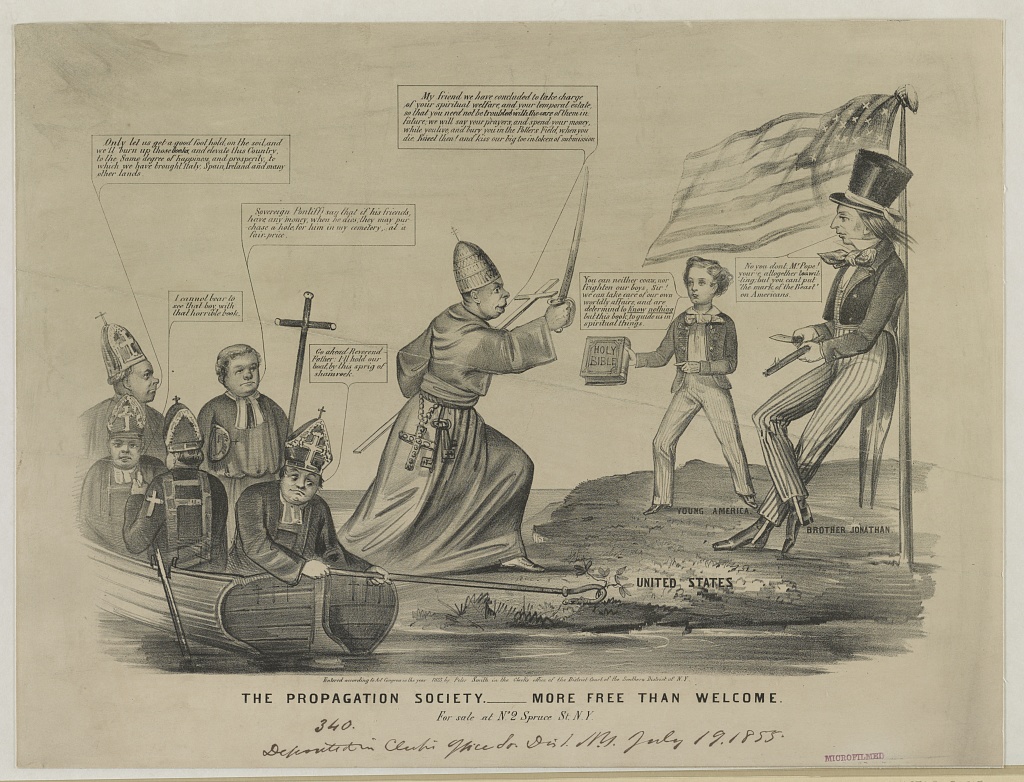
The Propagation Society—More Free Than Welcome (1855)
By Nicolas Zuniga
In 1855, as the United States grappled with massive demographic shifts, an anonymous painting titled “The Propagation Society—More Free Than Welcome” began to circulate in the American print market.¹ On the surface, the image depicts a chaotic struggle on a shoreline. However, to a nineteenth-century viewer, it was a clear manifestation of nativism, a political policy of growing the interests of native inhabitants against those of immigrants. This artwork provides a vital window into the Know-Nothing era, a period named after a secret society-turned-political party that flourished in the 1850s by capitalizing on fears regarding rising immigration and religious diversity.
To understand the imagery in this painting, we look at the radical changes of the 1840s and 1850s. Historian John Higham explains that this period represented the first major wave of American nativism, fueled by the arrival of Irish and German immigrants.² Unlike previous groups, many of these newcomers were Roman Catholic and at the time, many Americans feared these arrivals would never truly assimilate into American life.³ This is because the U.S. was mainly Protestant and often defined its own liberty in opposition to the so thought “tyranny” of the Pope, and these migrations created widespread panic.
This situation led to the rise of the American Party, a formal political organization known as the Know-Nothings because its members were originally instructed to say “I know nothing” when asked about their activities.⁴ This party was built on a brand of Americanism that said Catholicism was fundamentally incompatible with republican values. The name of this artwork refers to the Society for the Propagation of the Faith, which was a Catholic missionary group established to support the church’s growth. By labeling the arrival of these immigrants as an unwanted visitors the artist played into the theories that the U.S. was somehow being colonized by a religious power.
The artist uses many metaphors to drive this point across. The main focus is the shoreline, which acts as the nation’s literal and symbolic border. On the left, Catholic clergy and the Pope are depicted not as people seeking a better life or to coming to fulfill the American dream, but as an organized, military looking force. This supported the nativist claimed that Catholic immigration was a plan to weaken American institutions, a fear that sometimes turned violent, such as during the Philadelphia Nativist Riots or the 1854 “Bloody Monday” election riots in Louisville, where dozens of people were killed in clashes between nativists and Irish immigrants.
An important detail in the artwork is the Bible. During this time, the mid-1800s, a conflict known as the “Bible Wars” erupted over which version of scripture should be used in public schools, the Protestant King James Version or the Catholic Douay-Rheim. The Protestants viewed the Bible as a symbol of personal liberty, whereas they viewed the Catholic Church as an authoritarian leader that did not allow individual pursuit of their desires. It almost looks like a cartoon, the Americans hold the Bible like a shield, somehow showing that Protestantism is the foundation of American freedom against an invader.
While the story of the Civil War often centers itself from the history of the 1850s, this artwork shows that the decade was also defined by a problem of national identity. By utilizing this painting, a medium that was relatively cheap and easy to mass-produce, they ensured these nativist ideas reached a wide crowd. Today, the piece serves as a reminder to us that cycles of nativism are a recurring theme in our American history. While the specific groups targeted have constantly changed over the last 170 years. The rhetoric, portraying newcomers as a threat to core “American values: remains extremely similar till today. This painting captures the exact moment when religious fear was successfully transformed into a powerful political weapon.
-
“The Propagation Society—More Free Than Welcome,” lithograph (New York: 1855), Library of Congress, Popular Graphic Arts, https://www.loc.gov/resource/pga.04985/.
-
John Higham, Strangers in the Land: Patterns of American Nativism, 1860–1925 (New York: Atheneum, 1965), 4–11.
-
David E. Shi, America: A Narrative History, Brief 13th ed., vol. 1 (New York: W. W. Norton & Company, 2022), 432.
-
Tyler Anbinder, Nativism and Slavery: The Northern Know Nothings and the Politics of the 1850’s (New York: Oxford University Press, 1992), 20–22.
-
Katie Oxx, The Nativist Movement in America: Religious Conflict in the 19th Century (Oxford: Taylor & Francis Group, 2013), 55–60.