

At Seton Hall, faculty mentorship and undergraduate research allow students to discover unexpected pathways to reshape their goals and aspirations.
Kayla Wager came to Seton Hall to become a teacher. Instead, the second-semester senior is headed to a master’s program in data science and engineering, something she never would have considered were it not for professor John Saccoman’s introduction to the subject matter during Wager’s freshman year.
Senior Gabriella DeGuzman was interested in applying to medical school, and thanks to a research opportunity in neuroscience led by assistant professor Meghan Caulfield, DeGuzman became impassioned by the human brain as well as all that research can unlock in the medical field.
These examples exemplify the magic that can happen when a professor recognizes and nurtures the natural curiosity of students interested in the STEM fields — science, technology, engineering and math.
For decades, Seton Hall has supported faculty-mentored undergraduate research. From ensuring that students have access to funding and equipment, to opportunities for presenting research findings and publishing papers, to the dedicated connections formed between professors and students, the University sparks inspiration to guide students in discovering their greater purpose.
Learning how to Translate Data for the Public Good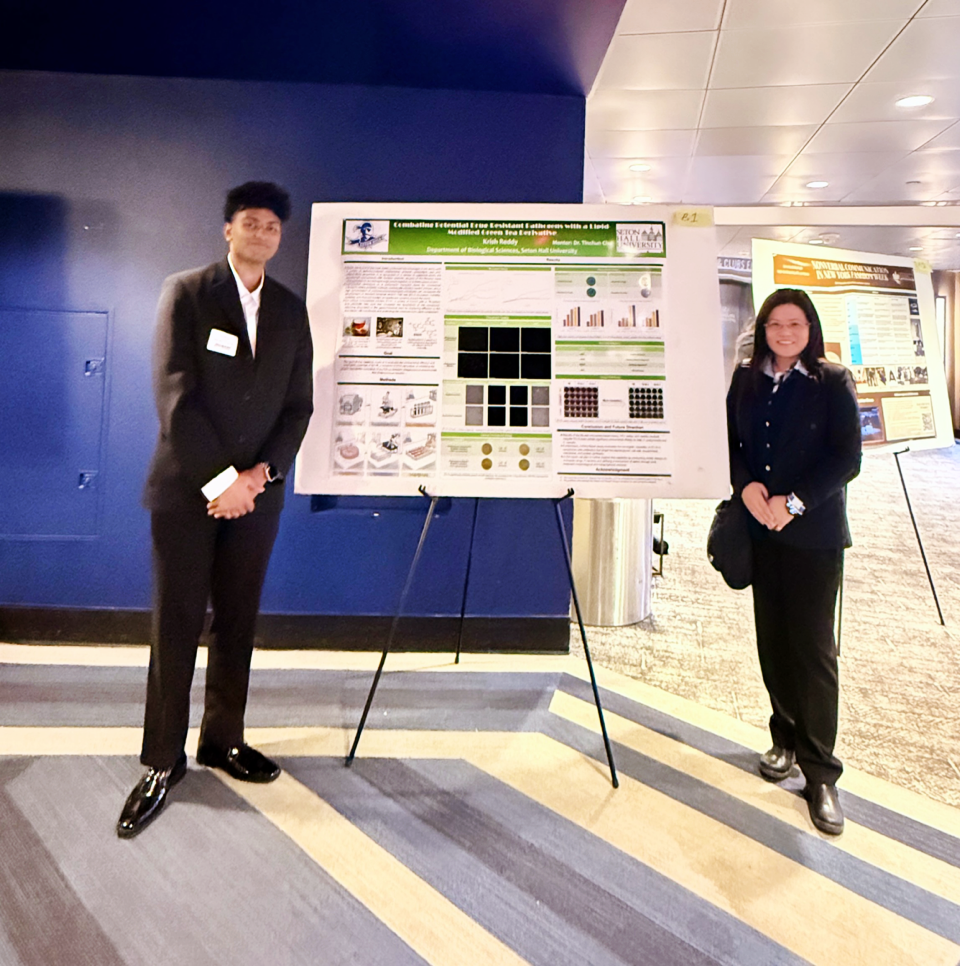
When biological sciences professor Tinchun Chu, director of graduate studies, mentors someone, she has in mind both technical training and teaching the student how to put that learning into use for the public good.
“I’m a firm believer that science is best learned through practice or active engagement,” she says. “Curiosity, critical thinking and well-planned experimentations or hands-on investigation are critical to meaningful discovery.”
Chu has applied this approach with junior Krish Reddy, an undergraduate pre-med student working in Chu’s lab who says the research work has inspired him to focus on how he might make a difference. “The first time we met, our focus wasn’t on technical skills, but instead an open discussion about how this research could contribute to public health,” Reddy explains.
Together, Chu and Reddy landed on a project that focuses on drug-resistant infections, particularly those caused by nosocomial pathogens that are predominant in healthcare settings. The professor/student team is testing formulas containing green tea to see if they are able to reduce colonies of bacteria. “Early on, Dr. Chu opened my eyes to the true responsibilities and nature of being a physician/scholar,” says Reddy. “At that point, I was committed to becoming a physician, but I had some tunnel vision regarding the precise obligations in a modern healthcare environment, relegating them to clinical practice only.”
Chu and Reddy meet weekly to interpret data, analyze results and consider next steps. Their work has been aided by Seton Hall’s commitment to undergraduate research, including the Dean’s STEM Connect Undergraduate Research Award that allows students to focus on projects full time over their summer breaks. “Dr. Chu has shown me that to truly care for your patients, it is paramount to remain engaged in scientific research and scholarship,” says Reddy.
Reddy says Chu has inspired him to work on something intellectually satisfying. “Exploring these alternative treatments feels innovative and meaningful,” he says. “We can discover treatments that are both effective and cost effective. That complements my goals as a future healthcare worker.”
Taking a Psychology and Neuroscience Foundation to Medical School
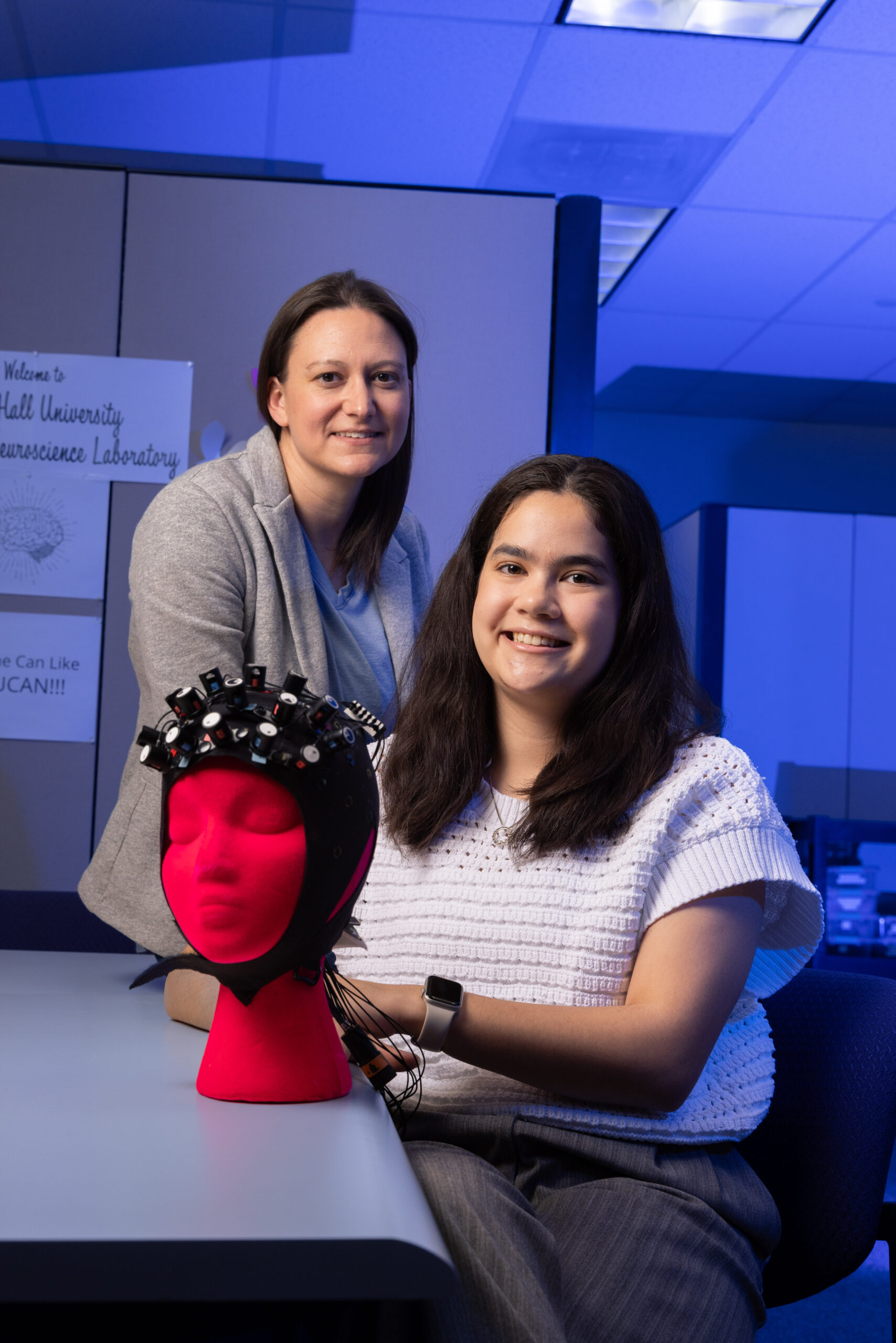 Gabriella (Ella) DeGuzman has always been ahead of the curve, beginning her college career at 15 at a nearby community college. And so she caught Meghan Caulfield’s eye when she took Caulfield’s cognitive neuroscience and neuroscience of art classes in her first year.
Knowing DeGuzman planned to attend medical school, Caulfield encouraged her to work as an experiential learning student in her cognition and neuroscience lab.
DeGuzman’s project measures the “startle response” in college students who have suffered concussions. “When a person has a concussion, the brain moves forward within the head, damaging areas of the prefrontal cortex,” says Caulfield. “That movement can put stress on the brainstem, too. Ella is researching whether there is long-term, residual damage in the brainstem using acoustic startle response.”
When she first arrived on campus, DeGuzman was interested in research, but didn’t know much about it. “Before I began at Seton Hall, I got my associate degree and worked a few different jobs,” she says. “Medicine and psychology stuck out for me, but it is the research that has taught me how they can work together and translate to better patient care.”
DeGuzman has worked on a couple of different projects with Caulfield, including one looking into how anxiety can impact the perception of images. “The work has given me an opportunity to explore my passion for the human brain,” says DeGuzman, “and see how research can be ingrained into my career.”
DeGuzman credits both Caulfield and the University for the inspiration. She was the recipient of the Dean’s STEM Connect Undergraduate Research Award and is appreciative of a supportive infrastructure while developing her thesis. “I’m surrounded by smart lab mates with the same passion for the human mind,” she says. “It’s such an uplifting environment and shows how far education can take you.”
A Surprising Career in Numbers
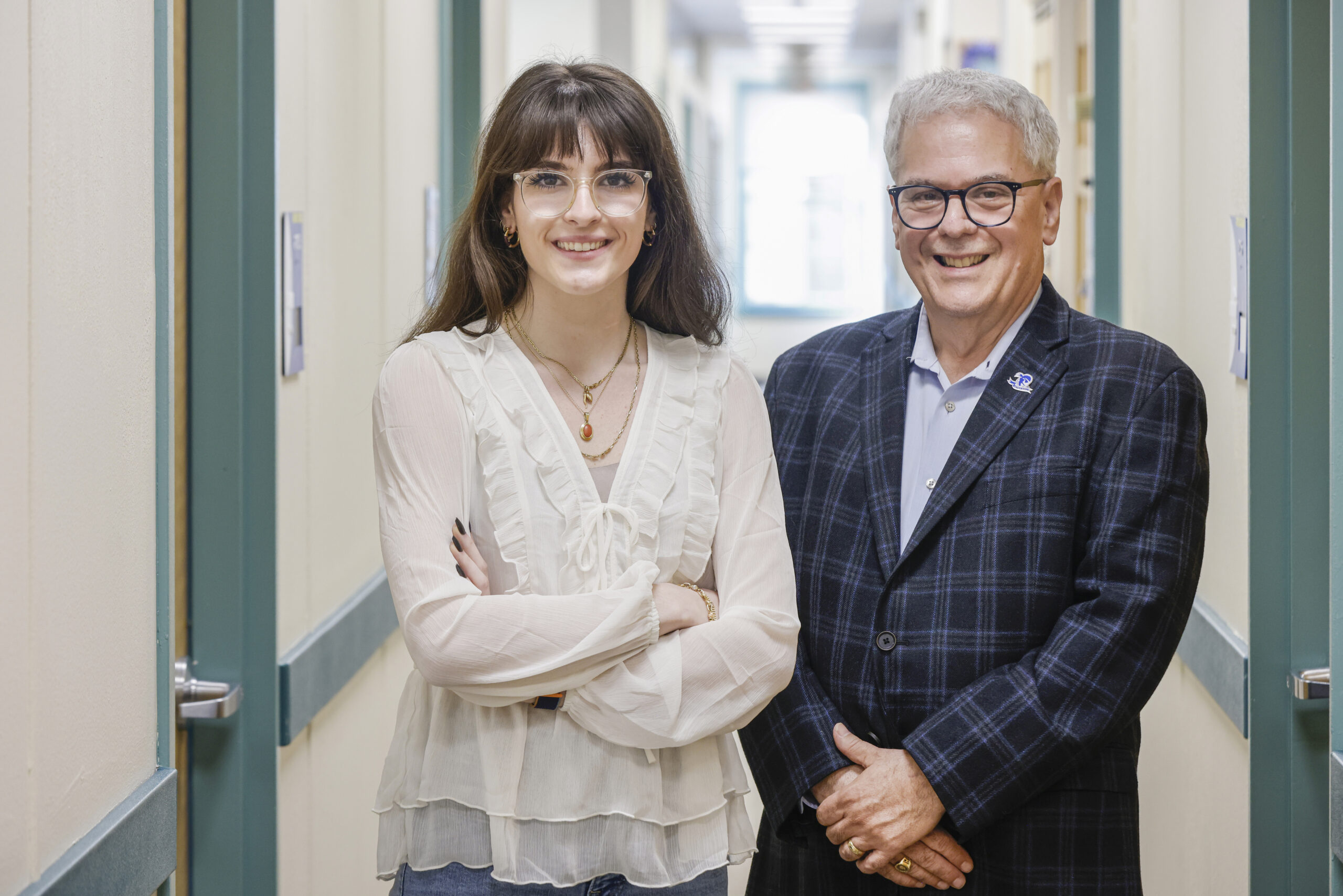 John Saccoman, the department chair, professor and program adviser for mathematics, estimates he has worked on about 30 research projects with undergraduate students over the years. “Once students take linear algebra and have enough background to work with models of networks, we can do computations based on those graphs,” he explains. “It inspires undergrads to look at a new problem and come up with a solution or formula.”
All honors students in the math program must take on a research project, and Saccoman likes to instill confidence in them by pointing out they are the experts on a particular topic. Kayla Wager made an impression on him her freshman year when taking his discrete mathematics class. Not only did Wager sit at the top of her class, but she took advantage of office hours and began looking toward a future research project. “Kayla is one of the hardest working students I’ve ever had, and has been extremely successful in her research,” says Saccoman.
Together, Saccoman and Wager applied for the Dean’s STEM Connect Undergraduate Research Award, which allowed them to begin work on their network modeling project last spring. The two met weekly to generate examples, apply matrices and produce a final paper based on their findings — they are awaiting word on possible publication in a professional journal.
Throughout this process, Wager has discovered an entire new field and interests. “I presented a paper at a research exposition my junior year and learned I enjoyed presenting and defending research,” she says. “I never thought I’d like research; but working with Dr. Saccoman has allowed me to see I have a mind for it. He has made me feel I am more than capable of doing the work.”
As she looks toward graduation and beginning the master’s in data science program, Wager intends to continue the line of research she began with Saccoman, an unexpected outcome for the student who fully intended to become a teacher. “I’m honestly shocked I’m going into data science,” says Wager. “I can’t thank Dr. Saccoman enough for inspiring me.”
Unlocking a Whole New World
Growing up in a low-income family and working full-time following high school graduation, Bob Copeland ’80 could not have imagined that one day he’d earn a Ph.D. and contribute to the discovery of five FDA-approved medicines. But that’s exactly where he sits today, and that’s only scratching the surface.
As a biotech entrepreneur, Copeland built a long résumé that includes adjunct professor at the University of Pennsylvania’s Perelman School of Medicine; venture partner at Atlas Venture and adviser for Google Venture; author of over 200 scientific publications and seven textbooks; and fellow of the American Association for the Advancement of Science and the Royal Society of Chemistry.
Copeland had always demonstrated an interest in science and medicine, which led him to his first full-time job as a lab technician. When that company offered tuition reimbursement, Copeland jumped at the chance to attend evening classes at Seton Hall, allowing him to make his way through his undergrad program in six years.
Copeland credits Seton Hall’s evening program for giving him a start. “Otherwise, I wouldn’t have been able to afford the opportunity,” he says. “Because of my family’s situation, the idea of full-time college was a non-starter. Along the way, I took some inspiring classes in chemistry and the sciences, but Seton Hall provided a broad liberal arts education, too,” he says. “At the time, I wondered why I needed [the humanities classes], but in retrospect, I can see how they broadened my world.”
The time he spent on his chemistry major also introduced Copeland to the research lab, which led him to pursue graduate studies. “My education sat at the intersection of biology and inorganic chemistry, and I found that exciting,” he says. “Within the first six months or so, I had accumulated enough data for publication. This opened my mind to the possibilities.”
Following graduate school at Princeton and a Chaim Weizmann Fellowship at Caltech, Copeland began a career in the pharmaceutical industry and built on from there.
Today, he looks back on his time at Seton Hall as making all the difference in his life’s trajectory. “The environment was affirming and a place where I could realize my full potential,” he says. “It opened doors to places I never imagined possible.”
Amanda Loudin is a Maryland-based freelance writer.





Comments are closed, but trackbacks and pingbacks are open.