Jennifer McCarthy shapes her students into compassionate, capable healthcare professionals through clinical simulation.
Having worked as a paramedic for over 35 years, Jennifer McCarthy has experienced life and death in many forms. She has resuscitated patients in cardiac arrest, responded to fatal car crashes and given lifesaving care to patients slipping into anaphylactic shock.
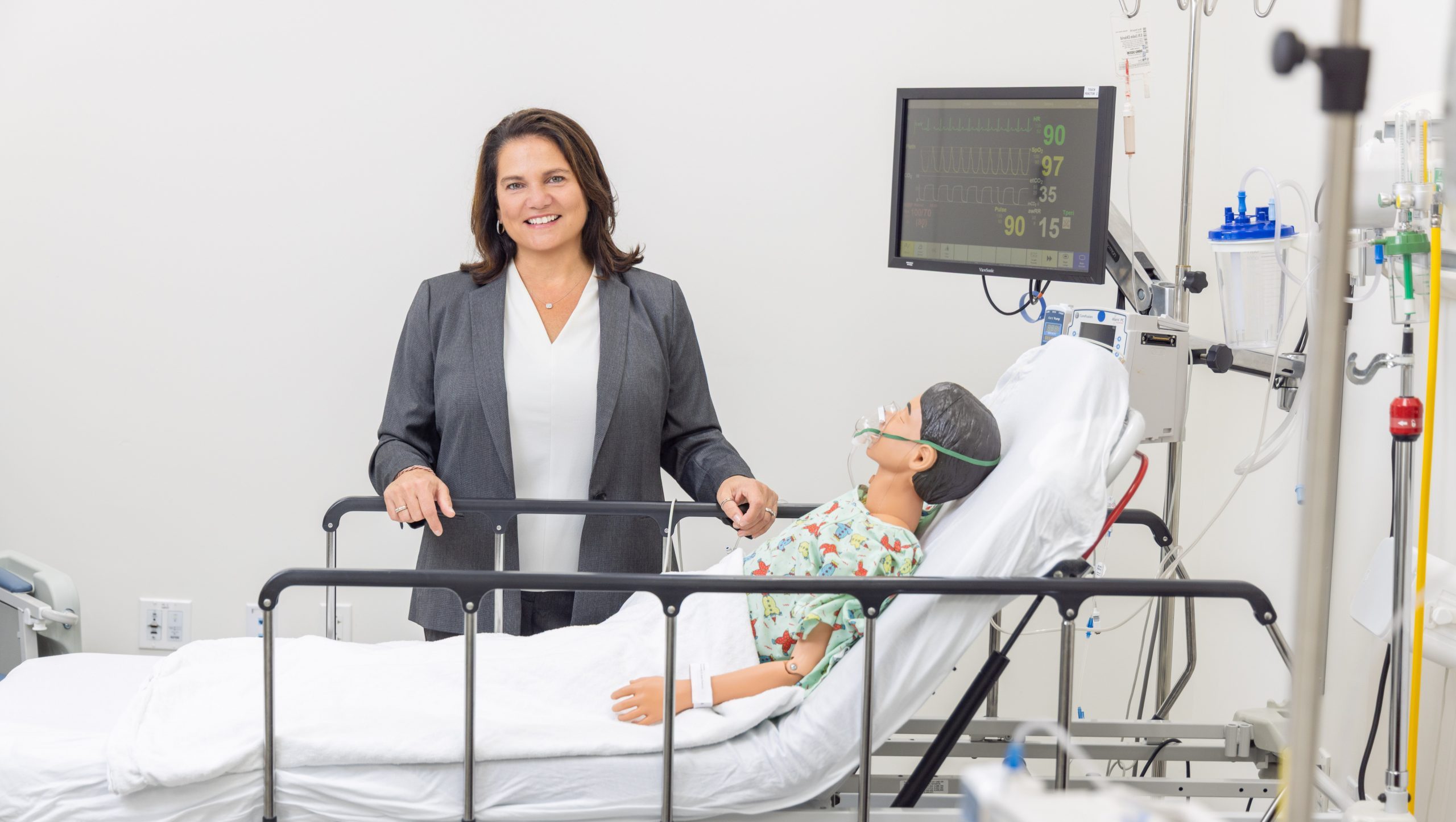
The vulnerability of life continues to influence McCarthy at Seton Hall, where she is the founding director of clinical simulation for the School of Health and Medical Sciences. Though she’s no longer working in emergency settings, she is charting new pathways in patient-centered healthcare education that emphasize the power of human connection, compassion and communication. Her work uses high-tech patient simulators alongside humans standing in as patients throughout the clinical simulation coursework to bring cases to life.
“Clinical simulation in health care is often viewed as some kind of alternate reality, a hypertechnology place. Yes, we do have impressive, immersive spaces at Seton Hall,” McCarthy says, referring to the University’s Interprofessional Health Sciences Campus in Nutley, New Jersey. “What distinguishes us, though, is what we are doing within this high-technology enriched environment.”
McCarthy’s commitment to human-centered health care permeates the simulation curricula throughout the school. She collaborates with the faculty and staff to design programming tailored for each clinical professional program: athletic training, occupational therapy, physician assistant, physical therapy and speech-language pathology. The programs incorporate professionally trained stand-in patients to portray different healthcare scenarios and be the voices of the high-tech patient simulators they use throughout clinical simulation coursework. McCarthy also co-developed a first-of-its-kind leadership simulation focused on conflict resolution for the school’s healthcare administration graduate students.
“It’s so important that we go beyond preparing our students to master a checklist of skills,” says McCarthy, who is one of only about 100 educators globally with advanced-level certification through the International Society for Simulation in Healthcare. “For simulation programming to be truly effective, students need experiences that push them to transform as healthcare practitioners.”
Transformation, she says, is a purposeful objective. “This is where human vulnerabilities are laid bare, and not only in terms of understanding patients’ life experiences. Here we are encouraging our students to lean into their own discomforts, whether that’s facing an unprecedented or even triggering situation, or having a difficult conversation,” she says. “They will grow into resilient, capable and confident professionals by tapping into their vulnerabilities and allowing themselves to transform. We are here to create that psychologically safe, trusting environment to bring that out of them.”
Dominique Adornetto, a student in the physical therapy doctoral program, attests to the impact of the clinical simulation programming. She values the hands-on skills training and appreciates the presentation of diverse scenarios, such as inpatient and outpatient settings, acute care, pediatric cases, medical device training and caregiver involvement.
She says she is grateful for McCarthy’s confidence building mentality and for being a calming presence before “nerve-wracking” simulations.
“Her lines ring in your ear when you need them,” Adornetto says. “She reminds us to just talk to someone like a human. That might sound basic, but connecting with our patients is the foundation.”
McCarthy recalls a time in her own life when a professor’s words deeply affected her, which ultimately led to her exploring a career in paramedicine and then expanding into healthcare simulation education. She credits her time working in emergency medical services for shaping her perspectives on the role of human connections in health care.
“All those patients’ faces — a mosaic of their faces that I see in my mind — inspire me to have the guts to talk to our students about these moments of human connection,” she says. “How these moments can ground you and give you the grit you’re going to need for whatever you’re going to face.”
Lori (Varga) Riley, M.A. ‘06, is a freelance writer living in New Jersey.