A tour through Seton Hall’s collection of sacred texts connects us to centuries of history, faith and culture.
Seton Hall’s collection of rare books and sacred texts is a window into history and ideas, say Sarah Ponichtera, assistant dean for special collections and the gallery, and Jacquelyn Deppe, technical services archivist, who curate and maintain this collection at the Seton Hall library.
Most of the collection’s 22,000 pieces showcase artifacts from Seton Hall constituents, often reflecting the school’s deep religious, Italian and Irish ties. But as the University’s schools’ curriculum expands, so does the diversity of the collection. There’s a Sufi Muslim devotional book from Tunisia, for instance, and a Jewish scroll from Morocco.
The oldest book dates to 1470, and much of the rare book collection arrived at the school by way of donation. New Jersey resident Bertha Margaret Frick, for example, a mathematics teacher turned librarian who passed away in 1975, and Rita M. Murphy, one of Seton Hall’s first female students, each donated collections that reflected their personal interests — math in Frick’s case, and Irish culture in Murphy’s.
A tour through the works demonstrates the evolution of printing and bookmaking, as well as providing a look into people’s experiences with books over the years.
“In the earlier periods, people might only encounter books on occasion, like in a church,” said Ponichtera. “Later on, they could pick up a personal-sized book and read it in their backyard. This collection teaches us how people related to ideas, whether formally or casually.”
Some books include writing in the margins, for instance, giving readers a look into the owner’s thoughts. Some are in good shape and can stand on their own on the library’s shelves, while others require custom boxes to preserve them. All are available to the student body, and these days, students can get up close and personal with the books and sacred texts through instructional sessions — a special departure for them from today’s digital-driven world.
“Students today have so much at their fingertips,” said Deppe. “That increases their excitement for encountering these physical objects,” she notes, some of which might have been touched by Bishop James Roosevelt Bayley, the founder of Seton Hall and the Immaculate Conception Seminary.
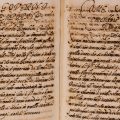
THE STUART BREVIARY
Seton Hall’s ancient breviary — the Church’s liturgical book of service — came to the school by way of Rome and then later, Fordham University. Its most notable owner was Cardinal Henry Stuart, who served as the Cardinal of York and used the nearly 100-year-old breviary to lead congregants in prayer with the canons, many of which were particular to the clergy of Saint Peter’s Basilica.
Bishop Bayley obtained the book from a bishop at New York’s Fordham University, who had likely brought the breviary overseas from Europe, as was standard practice in those days. Bayley handwrote an inscription at the front of the book detailing its journey to Seton Hall. “This is a good example of a sacred text that is not unique in its contents, but more its personal history and ties to Bishop Bayley,” noted Ponichtera.
INCUNABULA BIBLE
The Seton Hall library is in possession of six incunabula — books printed before the year 1500. The Bible in this collection, known as the Summa de potestate eccliesiastica, dates to 1473 and was authored by Augustinus de Ancona, also known as Augustinus Triuphus.
The copy matches another located in a university in Madrid, and that might have been enough information to satisfy most people. Deppe, however, noticed its unusual dropped initial capital letters and paragraph indicators illuminated in red and blue ink, and began an effort to track down its origins. Her investigation turned up a new finding: “Our copy has a handwritten ownership mark that can trace it to an abbey in Arras, France,” she said. “We’re not sure how it came into our collection, but it’s a unique copy.”
BIBLE FROM THE SEMINARY
The seminary library includes a rare and valuable collection assembled by Father Lawrence Porter, who served as its director until 2022. The seminary’s copy of the Clementine Bible, authorized by Pope Clement VIII in 1592, is one of the earliest in existence.
“It’s clear that Father Porter knows a lot about rare books and assembled an extraordinary collection focused on Catholic theology,” said Ponichtera. “This particular Bible is important because of its history and also its beautiful woodcuts, which are incredibly small and detailed.”
The Clementine Bible is an updated version of “The Vulgate,” the authoritative translation of the Bible into Latin, first prepared by Saint Jerome. Pope Sixtus V, who served from 1585 until 1590, took up the task of authorizing the Catholic Biblical translation in response to the Protestant Reformation, which produced several vernacular translations. The 250 woodcut engravings in this edition, published by a famous publishing house in Florence, are rich in detail and demonstrate the influence of the Renaissance at the time of publication.
Interestingly, Johannes Gutenberg, who invented the printing press and printed the first Bible, was Catholic. Yet his “new technology” had not yet received the Pope’s sanction, which led to the authorization of the Vulgate after his death.
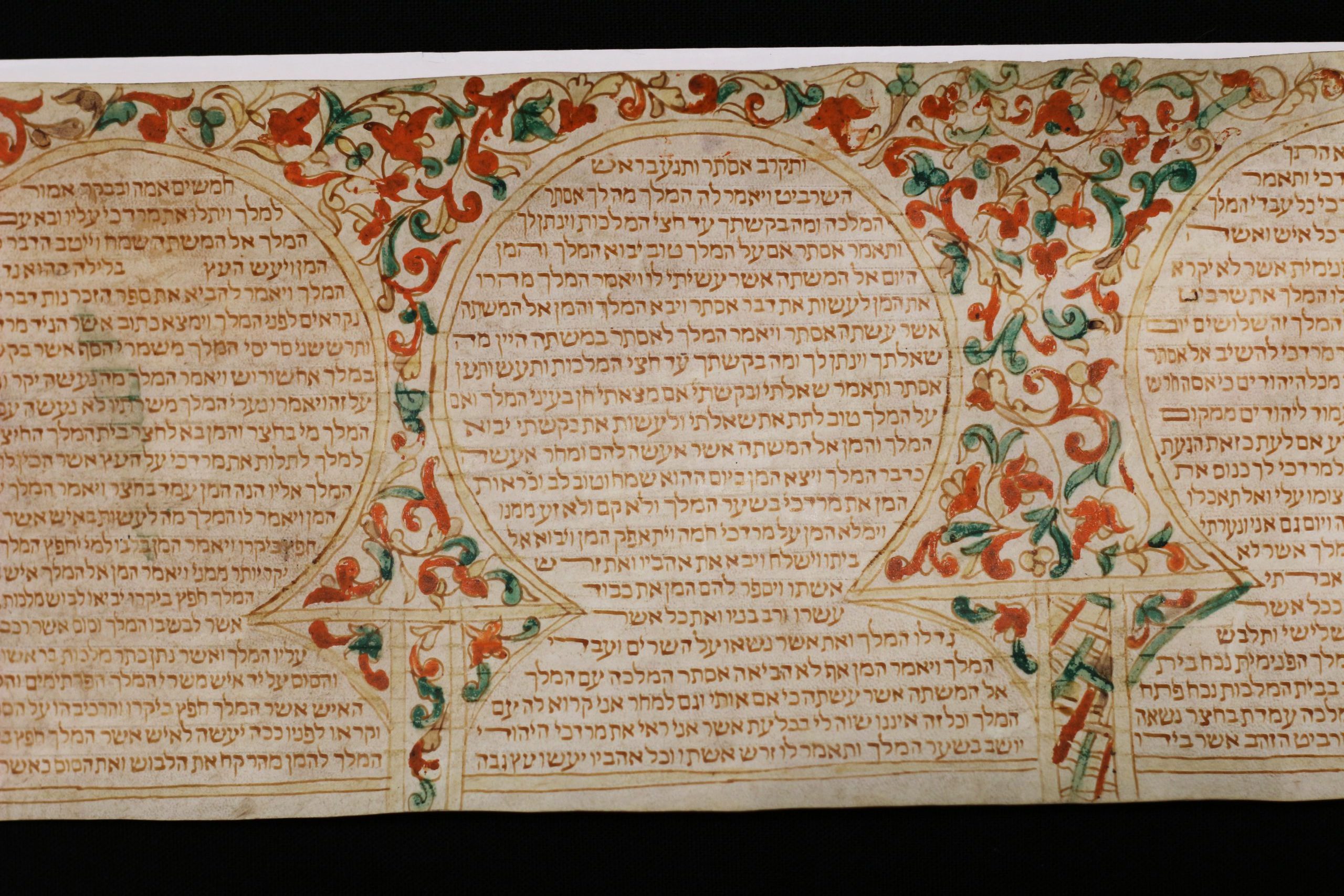
MOROCCAN SCROLL OF ESTHER
The library’s Moroccan scroll of Esther dates to the 19th century and exemplifies how the University’s collection shares artifacts from different religions and regions of the world.
Ponichtera obtained the scroll for the library from a private seller, after consulting with colleagues in Judaica libraries about what artifacts might be best suited to Seton Hall. “It’s a lovely text that tells the story of Esther, which is traditionally read on the Jewish holiday of Purim,” she said. “It contains beautiful Moroccan illustrations.”
The book of Esther is one of the writings that stands apart from the five books of Moses that comprise the Torah. But it is a central text that is read every year by Jewish communities around the world. This scroll also includes just one rod, and not two, as would be the case for a Torah scroll. The book of Esther is designed for one complete readthrough, while Torah scrolls are lengthy and read in sections at synagogues. So there is no need for the reader to find a specific place in the text.
In purchasing the scroll, Ponichtera had to take special steps to authenticate it. “Unfortunately, this is critical when buying Judaica because of the history of looting,” she said. “We wanted to ensure we bought from a seller who acquired this text ethically.”
TUNISIAN MANUSCRIPT
A Tunisian devotional book by a Sufi author also illustrates how the school is evolving to expose students to other religions and parts of the world. Ponichtera acquired the Muslim text from a rare books dealer in Fall 2024. At the time, little was known about its history.
After bringing the text back to Seton Hall, library staff digitized it and shared it with faculty, including assistant professor Youssef Yacoubi. Yacoubi recognized the author, Abd al-Jalil bin Muhammad bin Ahmad ibn Azzum al-Muradi al-Qayrawani, a Sufi writer and historian from the Tunisian city of Kairouan who died in 1553. “There is always more to learn from books like this, that have traveled a long way from home,” Ponichtera said. “These books provide an opportunity to connect with people across time and space.” The book even carries a faint scent of smoke, like a campfire, or perhaps something from the tanning process, transporting the reader to another world.
THE VALUE OF A COLLECTION
A rare book and sacred text collection on the level of Seton Hall’s is an important piece of enrichment for the student body. “People consider these experiences with rare books
from long ago time periods as something reserved for students at Harvard or Yale,” said Ponichtera. “But Seton Hall is giving its student body — some of whom are first generation students — a tier of education they might not be exposed to otherwise.”
The sacred texts also share some of Seton Hall’s history and evolution over time, as well as that of Catholicism itself. From the collections Bishop Bayley acquired in Europe to the donations of alumni and friends of the school in neighboring communities, the sacred texts serve as a timeline, and as the school evolves, so do its materials.
“When students come into the library and experience historic sacred texts firsthand, it can be transformational,” said Ponichtera.
“There can be an intimidation factor, but we try to make it friendly and remind them that these pieces are meant to be used,” she said. “We encourage people to look at the entire object and consider what it might have meant to those who first used it. These pieces can leave a big impression.
Amanda Loudin is a Maryland-based freelance writer.