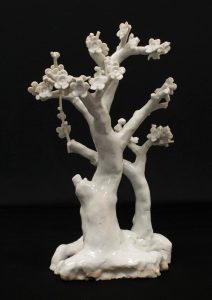
On September 23, the Walsh Gallery was delighted to receive a generous gift of 15 paintings, sculptures, and works on paper from the Gorun family.
The gallery team has spent the last few weeks unpacking, studying, researching, and cataloguing these objects, which encompass a wide range of time periods and geographies. The group includes a 2nd/3rd-century statue of Maitreya—a prophesied future Buddha—from the ancient kingdom of Gandahara, a 20th-century painting by noted German artist Erich Heckel, and five hand-painted illustrations from an early 17th-century botanical manuscript.
These artworks are rich teaching tools that add dimension and complexity to our current holdings related to world religions, the history of the book, and American and European art and culture. In fact, we have already used several of these objects in class sessions to teach students about 17th-century encounters with the New World and 19th-century painting.
Although all of the artworks are special, each member of the gallery staff has a favorite:
Emily Handlin, Gallery Director:
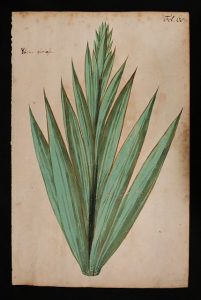
Botanical watercolors, 1618. Gouache on laid paper
These botanical paintings are from a manuscript created in 1618 in Saxony, Germany. The manuscript’s unknown artist painted flowers native to Europe, but also illustrated yucca, cacti, and other plants from the New World, which were all the rage in the gardens and greenhouses of wealthy Europeans at the time. One of the great things about working with museum collections is that the objects lead you to research topics that you would never have otherwise learned about, like 17th-century botany.
Laura Hapke, Registrar:
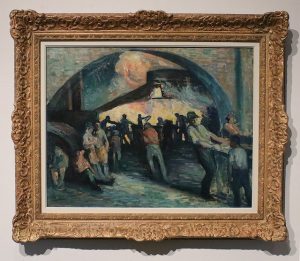
Maximilien Luce, The Foundry, c. 1896. Oil on canvas
My favorite piece from the Gorun donation is this painting of foundry workers by Maximilien Luce, in part because I had the pleasure of researching it for the catalog record. I liked learning about Luce–a French painter who lived 1858-1941 and was associated with the Anarchist movement. This painting and many of his other works show his interest in the experiences of working people and how the industrial revolution was impacting the world around him.
Kelly Martin, Gallery Adjunct:
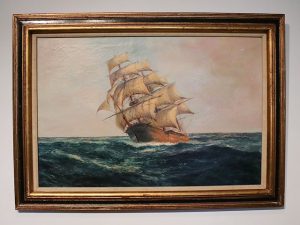
Montague Dawson, Square-Rigged Ship at Sea, 20th c. Oil on canvas
My favorite work is Square-rigged Ship at Sea by Montague Dawson. The painting is full of interesting contrasts that draw me in: the rich blue ocean contrasts against the soft pink sky, it’s dynamic yet serene, and simple yet masterfully detailed. I especially love the artist’s choice to set the scene at early sunset, which is conveyed only through the color of the sky and the subtle orange hues on the waves. This painting looks like it’s meant to hang above the fireplace of a classically dark wooden office, but it’s also delightfully pink!
John Walako, Gallery Assistant:
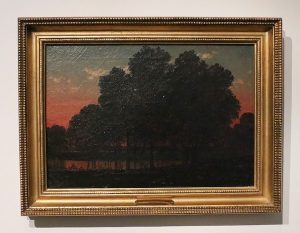
David Johnson, Evening, Geneseo New York, 1886. Oil on canvas
What I love about this piece is the way the artist uses light, dark, and color perfectly to create a mood, so much so it’s transformative. The way the sunset and the stillness and water are represented I can almost hear the crickets chirping.