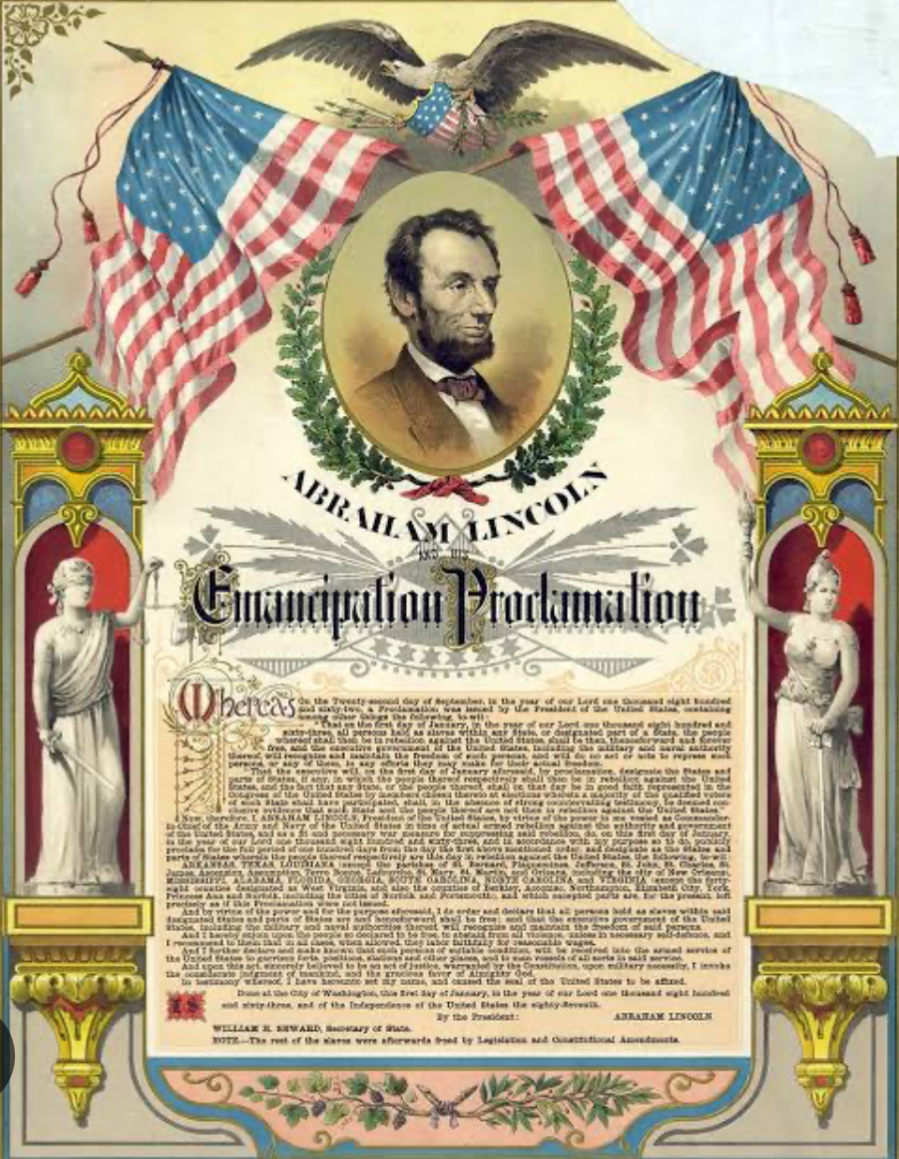
One of the most important documents in the history of the United States is the Emancipation Proclamation, issued by Abraham Lincoln on January 1, 1863. The Proclamation was issued during the Civil War (1861–1865), a conflict between the Union (the northern states loyal to the federal government) and the Confederacy (southern states that seceded to preserve slavery). It declared that “all persons held as slaves within the states or designated parts of states… shall be then, thenceforward, and forever free.”¹ However, this freedom applied only to areas in active rebellion against the Union, not to border states or already Union-controlled regions, meaning it did not immediately free all enslaved people. The Proclamation was issued not only as a statement of moral opposition to slavery, but also as a strategic war measure aimed at weakening the Confederacy.
To understand the Emancipation Proclamation, it is important to consider the broader context of the Civil War. At the start of the war, Lincoln’s primary goal was to preserve the Union rather than abolish slavery; however, as the conflict progressed, it became clear that slavery was central to the Southern economy and war effort.³ Enslaved labor sustained the South’s agricultural system, particularly the production of cotton, which was a major export used to finance the Confederacy and maintain its international influence.⁴ By targeting slavery, Lincoln aimed to disrupt this economic foundation and weaken the Confederacy’s ability to continue the war. At the same time, the Proclamation reframed the conflict as a fight for human freedom, discouraging European powers from supporting the Confederacy.
A close reading of the document reveals both legal and strategic tones. Rather than appealing emotionally, Lincoln grounded the Proclamation in constitutional authority. The phrase “by virtue of the power in me vested as Commander-in-Chief” emphasizes that emancipation was justified as a wartime military necessity.¹ This language reflects the political and legal constraints Lincoln faced, as he needed to ensure the Proclamation could withstand constitutional scrutiny.⁶ Additionally, the document’s formal and structured wording—more like a legal order than a speech—signals that it was intended to function as enforceable policy, not simply moral persuasion. This reinforces the idea that Lincoln was balancing ethical goals with the limits of presidential power during wartime.
Another significant aspect of the Proclamation was Lincoln’s decision to allow formerly enslaved people to enlist in the Union army. This policy had both symbolic and practical importance. It recognized Black Americans as active agents in securing their own freedom and strengthened the Union military. By the end of the war, nearly 180,000 Black soldiers had served in Union forces, demonstrating the lasting impact of this decision.⁷
The Emancipation Proclamation also highlights the tension between moral ideals and political realities. While Lincoln personally opposed slavery, he had to act within constitutional limits and maintain support from Northern states. The document reflects this balance, advancing emancipation as both a moral cause and a military strategy. Although it did not immediately abolish slavery everywhere, it fundamentally changed the federal government’s stance on the institution.
Ultimately, the Proclamation set the stage for the 13th Amendment (ratified in 1865), which permanently abolished slavery in the United States.⁸ Its significance lies not only in its immediate wartime effects but also in how it redefined the purpose of the Union. By linking the preservation of the nation to the abolition of slavery, the Emancipation Proclamation marked a turning point in American history and helped pave the way toward a more just society.