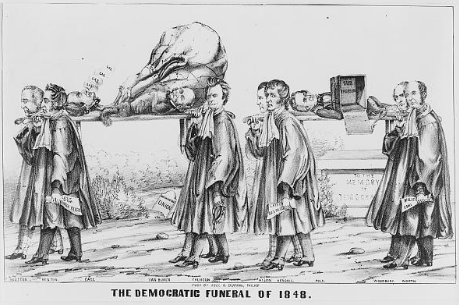
The Democratic Funeral of 1848 is a political cartoon that captures American politics
really well in the late 1840s. This image was created in 1848 and preserved by the
Library of Congress and shows the Democratic Party as a corpse being mourned and
buried. This was a creative way of showing that the party was falling apart (a “party
collapse,” meaning a breakdown of unity and shared goals). While we don’t know the
cartoonist’s identity, their message is clear and that is that the Democratic Party was
struggling to hold itself together during intense political conflict.1 More specifically, the
cartoon reveals that by 1848, conflict over whether slavery would expand into the
territories (new western lands gained after the Mexican-American War) was breaking
apart national parties and reshaping American politics.
To understand why this cartoon mattered, we must first know about the time this was
made. The United States had just expanded dramatically after the Mexican-American
War, gaining huge territories in the West. This sparked many debates about whether
slavery would or wouldn’t be allowed in these new territories (regions not yet states,
where laws still had to be decided). The Democratic Party had especially found itself
deeply divided over these issues. Historian Michael Holt explains that conflicts over
slavery were a major reason political parties in the 1850s started to break down, leaving
many Americans unsure who they could trust to lead the country.2
Looking closely at the cartoon you can see how the artist used exaggeration and
symbolism to make a point. The Democratic Party is shown dead, surrounded by
mourners and officials, suggesting chaos and collapse. The funeral itself acts as a
visual claim that the party has “died,” not just weakened. The exaggerated expressions
of the mourners suggest confusion and disorder rather than unity, showing how divided
the party had become. Details like banners or labels in the procession (such as
references to issues like “Free Soil,” if present) point to the specific conflict over
slavery’s expansion as the cause of this collapse. Political cartoons like this weren’t
made just for entertainment purposes, they also shaped how people understood political
events. As Mark Neely, Jr. points out, cartoons made complicated events or problems
easier to grasp and gave them an emotional feel for Americans.3 Even the small details
in the funeral procession, including banners to facial expressions, help show the idea
that the party was in deep trouble.
1The Democratic Funeral of 1848, Library of Congress, https://www.loc.gov/item/2008661510/.
2Holt, Michael F., The Political Crisis of the 1850s (New York: W. W. Norton & Company, 1978), 12–18.
3Neely, Mark E., Jr., The Boundaries of American Political Culture in the Civil War Era (Chapel Hill:
University of North Carolina Press, 2005), 45–50.
Sean Wilentz helps explain why the cartoon portrays the party as dead. He shows that
the Democratic Party was under real pressure during this time. Tensions over slavery
and the rise of new voters challenged traditional political alliances. The party’s struggles
in 1848 weren’t just temporary either. They reflected deeper problems in American
democracy that would only get worse over the next decade. 4
There’s also a small human component to this cartoon. It shows the anxiety people felt
as politics became more separated. The image shows more than just a party in crisis
mode. The cartoon shows a society struggling with difficult questions about power,
fairness, and the future (especially the expansion of slavery into new lands). The
cartoon’s mix of humor, drama, and exaggeration made it a powerful way for people to
process these issues and it still speaks to us today about how Americans have long
used media to shape opinions.
Overall, The Democratic Funeral of 1848 is more than a funny or shocking picture. It’s
an image of an important moment in U.S. history, showing the Democratic Party on the
verge of collapse and the nation struggling with questions of slavery and regional
division. For anyone exploring American politics in the 1840s, it is a memorable way to
understand the struggles of the era.
Here is the link to the cartoon:
Library of Congress – The Democratic Funeral of 1848.
https://www.loc.gov/item/2008661510/.
4Wilentz, Sean, The Rise of American Democracy: Jefferson to Lincoln (New York: W. W. Norton &
Company, 2005), 340–345.
The Democratic Funeral of 1848
18th Century