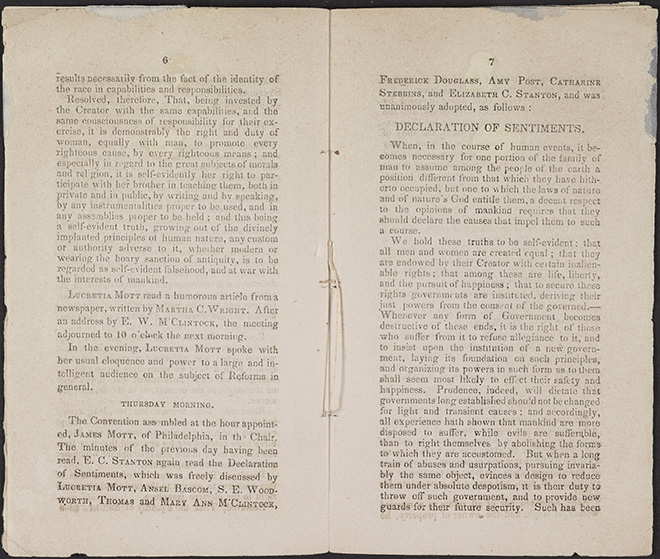
In July 1848, the Declaration of Sentiments was written by Elizabeth Cady Stanton and other women at the Seneca Falls Convention event in Seneca Falls, New York [1]. This historical document was created to address the unfairness women faced in society, as well as demand for equal rights and freedoms for women in the United States. For several years, women experienced discrimination and many injustices because of the limited rights given to them in the United States. Meanwhile, men were able to receive all the basic rights and freedoms the country had to offer, which gave them more power in society and over women. That’s why, the Declaration of Sentiments was extremely important for women at the time because it finally gave them the opportunity to openly speak out about the unfairness and limitations in women’s rights, as well as demand for change when it comes to equality for women. Overall, this historical piece has had a huge impact in American history, since it helped lay the foundation for the women’s rights movement, which over time helped push for the improvements in women’s rights today.
In Early America, before the Declaration of Sentiments was created, women had very few rights, especially if they were married or enslaved. In general, women were not allowed to vote, not allowed to hold office, not allowed to attend school or colleges, not allowed to become ministers, and not allowed to “sign contracts, file lawsuits, or testify in court” [2]. When it comes to married women, they were seen under the law as “civilly dead”, since their husband legally owns and controls all her properties, even the money she earns [3].
Footnotes:
[1] McMillen, Sally G. The Seneca Falls Convention and the Origins of the Women’s Rights Movement. (New York: Oxford University Press, 2008), 71.
[2] David E. Shi, Daina Ramey Berry, Joe Crespino, and Amy Murrell Taylor. America: A Narrative History, Brief 13th ed., vol. 1 (New York: W. W. Norton & Company, 2025), 115-197.
[3] Kerber, Linda K. “From the Declaration of Independence to the Declaration of Sentiments: The Legal Status of Women in the Early Republic, 1776–1848.” Human Rights 6, no. 2 (Winter 1977): 115.