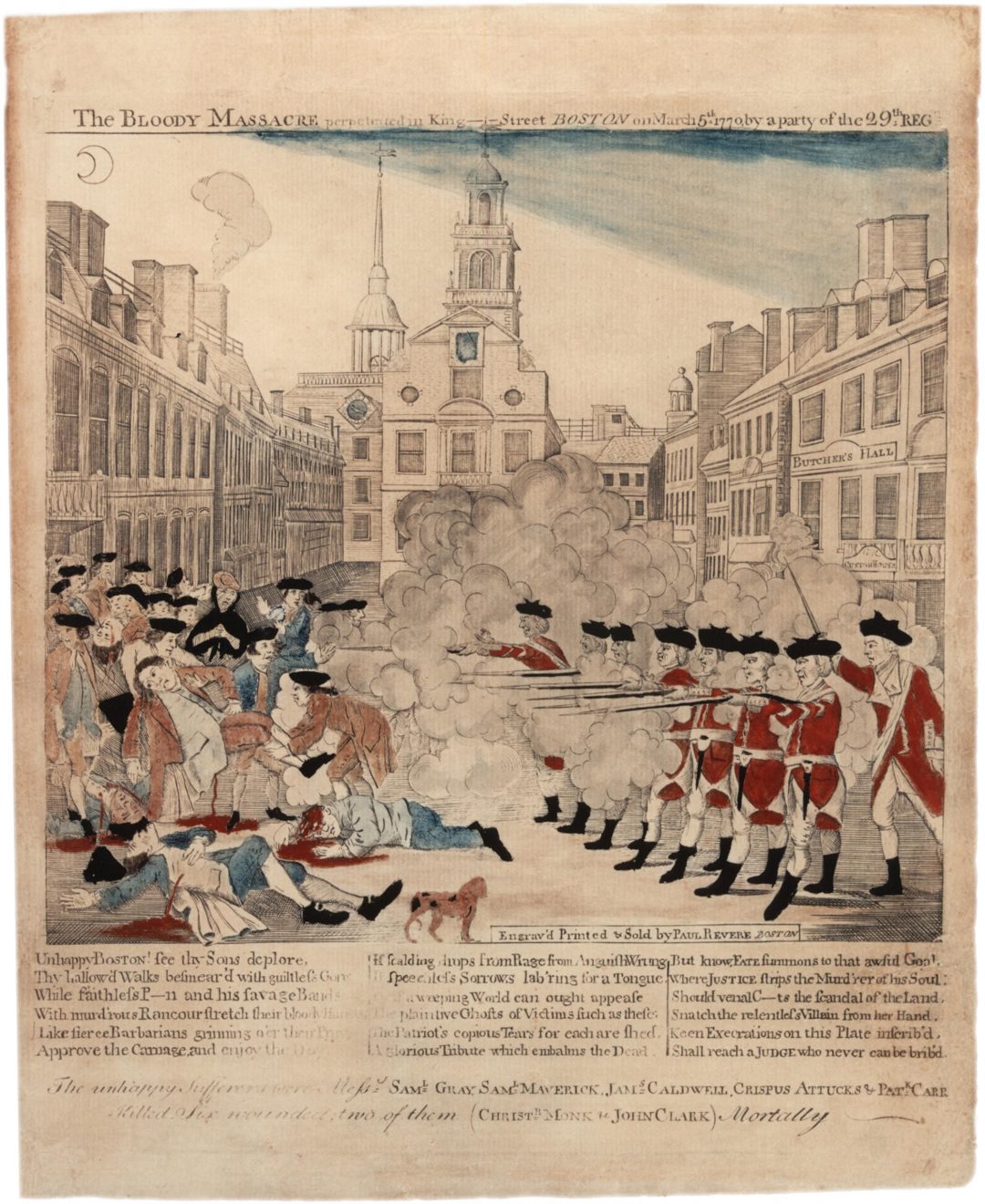
In 1770, silversmith and patriot Paul Revere created one of the most famous images of the American Revolution: his engraving of the Boston Massacre. Based on an earlier design by Henry Pelham, Revere’s print shows British soldiers firing in a perfectly organized line into a crowd of seemingly helpless colonists. Widely distributed throughout the colonies, this image was not simply a record of events; it was a carefully crafted piece of propaganda designed to influence colonial opinion against British rule.
The event depicted occurred on March 5, 1770, when tensions between Boston residents and British soldiers turned violent. British troops had been stationed in the city to enforce unpopular taxes, leading to frequent confrontations with civilians. According to historian Peter Messer, the incident began as “fighting…between townspeople and soldiers” in which “sticks, ice, and oaths flew from the crowd”[1] before the soldiers fired into the group. This description highlights the chaotic and mutual nature of the conflict; something that Revere’s image deliberately downplays.
To understand why Revere portrayed the event this way, it is important to consider the broader political climate. Many colonists feared increasing British control and viewed standing armies as a threat to their liberties. Revolutionary leaders sought to unite colonists through persuasive messaging. As Robert W. Smith explains, the Boston Massacre became “ample ammunition for their cause,” as radicals used the event to “inflame apathetic residents” and strengthen resistance to British authority.[2] Revere’s engraving functioned as part of this larger effort.
A closer look at the image reveals how deliberately it was constructed to send a message. The British soldiers are shown standing in a straight, disciplined line, firing simultaneously under the command of Captain Thomas Preston. This suggests a planned and deliberate attack. The shooting was likely confused and uncoordinated. Meanwhile, the colonists are depicted as passive and unarmed, reinforcing the idea that they were innocent victims. Even the setting—the Custom House—symbolizes British authority and oppression.
Revere also heightens the emotional impact of the scene. The victims are dramatically shown bleeding and collapsing, encouraging viewers to feel outrage and sympathy. These artistic choices simplify a complicated event into a clear moral narrative. However, historians emphasize that the meaning of the Boston Massacre was far from universally agreed upon. Neil Longley York notes that although legally the incident was not considered a massacre, it “remained just that in the local public mind, legal outcome notwithstanding”[3]. This highlights how public perception—shaped in part by images like Revere’s—often mattered more than factual accuracy.
In fact, the engraving itself played a major role in shaping that perception. By removing any suggestion that colonists provoked violence, Revere presents a one-sided interpretation that aligns with patriot interests. Messer explains that the event “turned into excellent propaganda for Boston’s patriots and was a serious blow to the credibility of the British government”[4]. Revere’s image helped ensure that this interpretation became the dominant narrative.
Ultimately, this engraving tells us less about what happened on March 5, 1770, and more about how colonists wanted the event to be understood. It reveals the growing importance of propaganda in the American Revolution and demonstrates how visual media could shape political beliefs. By presenting a simplified and emotionally powerful version of events, Revere transformed a chaotic street fight into a symbol of British oppression and colonial unity.
Today, the engraving remains significant not only as a historical artifact but also as an early example of how media can influence public opinion. Just as in the eighteenth century, the way events are presented can shape how they are remembered. Revere’s image stands as a powerful reminder that history is not only about what happened, but also about how it is said.
[1] Peter C. Messer. “The Creation of the Boston Massacre.” American Journal of Legal History 54, no. 4 (2014): 457–492.
[2] Robert W. Smith. “The Boston Massacre: A Study in Public Relations.” Public Relations Review 2, no. 1 (1976): 16–28.
[3] Neil L. York. “Rival Truths: Political Accommodation and the Boston Massacre.” The William and Mary Quarterly 50, no. 4 (1993): 663–688.
[4] Peter C. Messer. “The Creation of the Boston Massacre.” American Journal of Legal History 54, no. 4 (2014): 457–492.