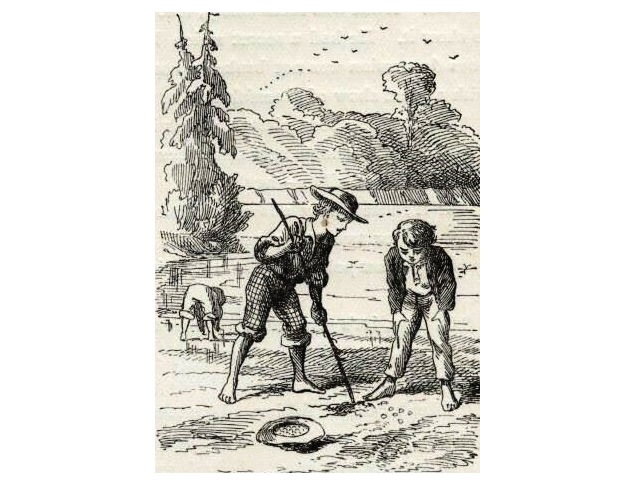
Mark Twain is widely recognized for his masterful authorship, most notably for what is often called “the great American novel,” The Adventures of Huckleberry Finn (1884). Yet before the publication of his most celebrated work, Twain laid essential groundwork with The Adventures of Tom Sawyer (1876). Although he is now held in high literary esteem, Twain’s early writings were not always granted such consideration. Categorized primarily as a humorist, his deeper artistic intentions were frequently overlooked. While a story centered on a mischievous child like Tom Sawyer may initially appear ill-equipped to address broader tensions in a rapidly developing America, Twain drew on his own experiences of poverty to capture the complexities of American life and culture. Contemporary critics reinforce this understanding, warning that “if, for the sake of contrast, we diminish the complexity of Tom Sawyer’s world–relegating it to the simplistic category of ‘All-American Boyhood’–we will find ourselves led seriously astray.” Thus, it is not only appropriate but necessary to consider literature and history together, as Twain himself did, and to recognize Tom Sawyer as a work that articulates shared American anxieties and frustrations.
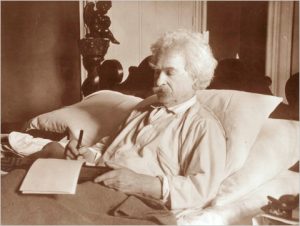
Figure 1. “Teaching Twain and Huckleberry Finn with The New York Times,” The New York Times Learning Network, December 9, 2010, https://archive.nytimes.com/learning.blogs.nytimes.com/2010/12/09/teaching-twain-and-huckleberry-finn-with-the-new-york-times/.
The time in which The Adventures of Tom Sawyer was published was a tumultuous period of American history, marked by violence against many marginalized groups who also appear as figures within Tom’s imagination. For example, “pirates and robbers and Indians. Such are the figures of Tom’s creation; and so long as they remain merely imaginary, governed by the “code” of play, they are clearly harmless,” yet, of course, this reflects a narrative shaped by white perpetrators. The Reconstruction era marked the end of the Civil War–but it did not bring peace, equality, or an end to racism. It was notably considered “one of the most challenging and significant periods in U.S. history,” as it prompted a national reevaluation of the meaning and rights of American citizenship. Not only did the Civil War cost countless lives in service of pride and the preservation of ownership, but it also left the American South in severe economic distress. While The Adventures of Tom Sawyer is set prior to the Civil War, the sociocultural tensions would later erupt into conflict that are already present in the fictional Missouri that Twain depicts. Tom’s imaginative play, shaped by the narratives and biases circulating in his environment, reveals an early form of “innocent” prejudice–one absorbed through immersion in a society steeped in racism and hierarchical thinking.
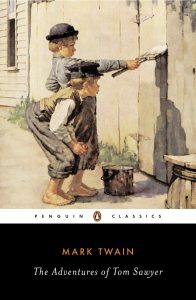
This image depicts two young boys painting a fence.
Figure 2. The Adventures of Tom Sawyer, National Endowment for the Arts, accessed April 26, 2026, https://www.arts.gov/initiatives/nea-big-read/adventures-tom-sawyer.
Therefore, the time in which the novel was written carries even greater significance than its setting. The social pressures that predated the Civil War pervade Twain’s narrative, shaping not only fictional Missouri but also the children who inhabit it. As critics note, what is most striking in Tom Sawyer “is the consistency with which the characters adhere to patterns of behavior set forth in the opening chapters of the text” as the children mimic the adults around them, bringing their beliefs and cultural gatekeeping into their world of play. In contrast to “the great American novel,” which is celebrated for its engagement with the American Dream and its critique of its failures, Tom Sawyer offers a more grounded portrait of everyday American life. The two texts may be read as foils, where Huckleberry Finn reaches toward a dream always slightly out of grasp and Tom Sawyer reflects the lived reality of the common person. Both children and adults are shaped–and constrained–by the social expectations of their communities. In the Antebellum South, where the defense of states’ rights and the preservation of slavery dominated political and cultural life, opposition was difficult, and conformity was expected. Twain’s novel captures these pressures through the most innocent forms of childhood play, demonstrating how historical implications hold an unexplainable weight on our society.
Footnotes:
[1] Alan Gribben, “The Importance of Mark Twain.” American Quarterly 37, no. 1 (1985), 30.
[2] Gribben, “The Importance of Mark Twain,” 44.
[3] Cynthia Griffen Wolff, “The Adventures of Tom Sawyer: A Nightmare Vision of American Boyhood.” The Massachusetts Review 21, no. 4 (1980), 637.
[4] Wolff, “The Adventures of Tom Sawyer: A Nightmare Vision of American Boyhood,” 646.
[5] David Emory Shi, America: A Narrative History, Brief 13th ed., vol. 1 (New York: W. W. Norton, 2023), 679.
[6] Shi, American: A Narrative History, 682.
[7] Forrest G., Robinson, “Social Play and Bad Faith in the Adventures of Tom Sawyer.” Nineteenth-Century Fiction 39, no. 1 (1984), 16.