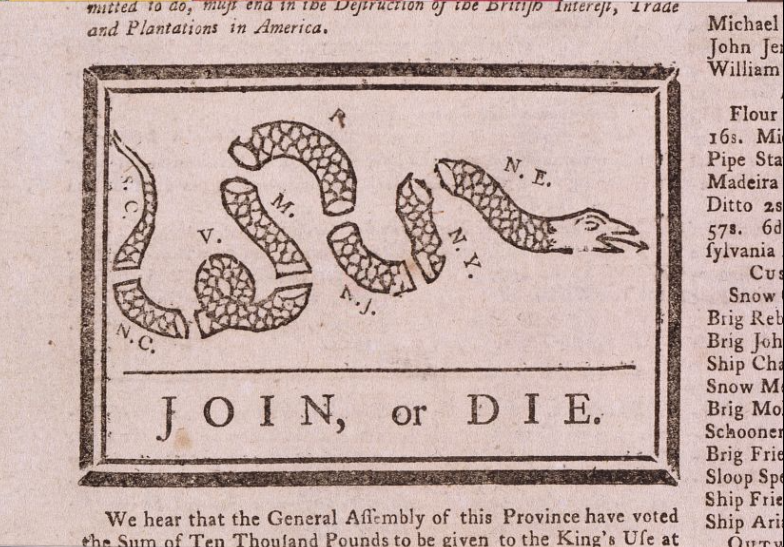
Benjamin Franklin’s “Join, or Die” was first printed in the Pennsylvania Gazette on
May 9, 1754. It shows a snake cut into pieces, and each piece stands for one of the British
colonies. Under the image are the words “Join, or Die.” The library of Congress describes it
as Franklin’s warning that the colonies needed to unite against the French and Native
forces during the early stage of the French and Indian War. At first glance, the cartoon
looks simple, but it came out of a very tense moment in colonial history. In 1754, Britain
and France were fighting for power in North America, especially in the Ohio Valley. At the
same time, British officials were worried about defense and about their relationship with
the Six Nations of the Iroquois. Roger Trask explains that the Albany Congress of 1754 met
during this crisis and focused on Indian relations and colonial defense. Franklin was one of
Pennsylvania’s commissioners there, and he strongly supported some kind of colonial
union. That background matters because it shows that this image was not random or just
meant to entertain readers. Franklin used it to push a political argument. What makes the
cartoon so effective is the way Franklin says a lot without using many words. Karen
Severud Cook points out that the image works almost like a map. The pieces of the snake
are labeled in geographic order, from New England down to South Carolina, so Franklin
turned the colonies into one body while also showing that they were cut apart. That visual
choice makes the message stronger. The broken snake suggests weakness and danger.
The short line under it makes the point even clearer; the colonies either act together or they
will fail separately. The image also tells us something about how politics worked in colonial
America. Franklin did not rely only on speeches or official meetings. He used a newspaper
image that ordinary readers could understand right away. Lester Olgon argues that
Franklin’s pictures worked like political arguments, not just illustrations. That idea fits this
cartoon well. A reader did not need long explanation to understand the warning. The image
was sharp, direct, and easy to remember. “Join, or Die” also helps us see that even before
the American Revolution, some colonists were already thinking in broader terms than just
their own colony. They were still separate governments, but Franklin was asking them to
think about common interests and common danger. Cook says the cartoon was soon
reprinted in other colonial newspapers, which means people outside Pennsylvania were
seeing it too. Franklin’s Albany Plan of Union did not pass, but the image stayed
meaningful because it showed a real problem in 1754. The colonies were divided even
though they were facing the same danger. For museum visitors today, this piece is
important because it shows an early moment when unity began to be imagined as
necessary in American political life. Because this image was created before the American
Revolution, it was not originally a call for independence from Britain. Instead, it was a
warning that the colonies needed to cooperate during a time of military danger and
political uncertainty. It also shows how newspaper could spread political ideas quickly to
ordinary readers.
Join or Die
1750-1764, 17th Century