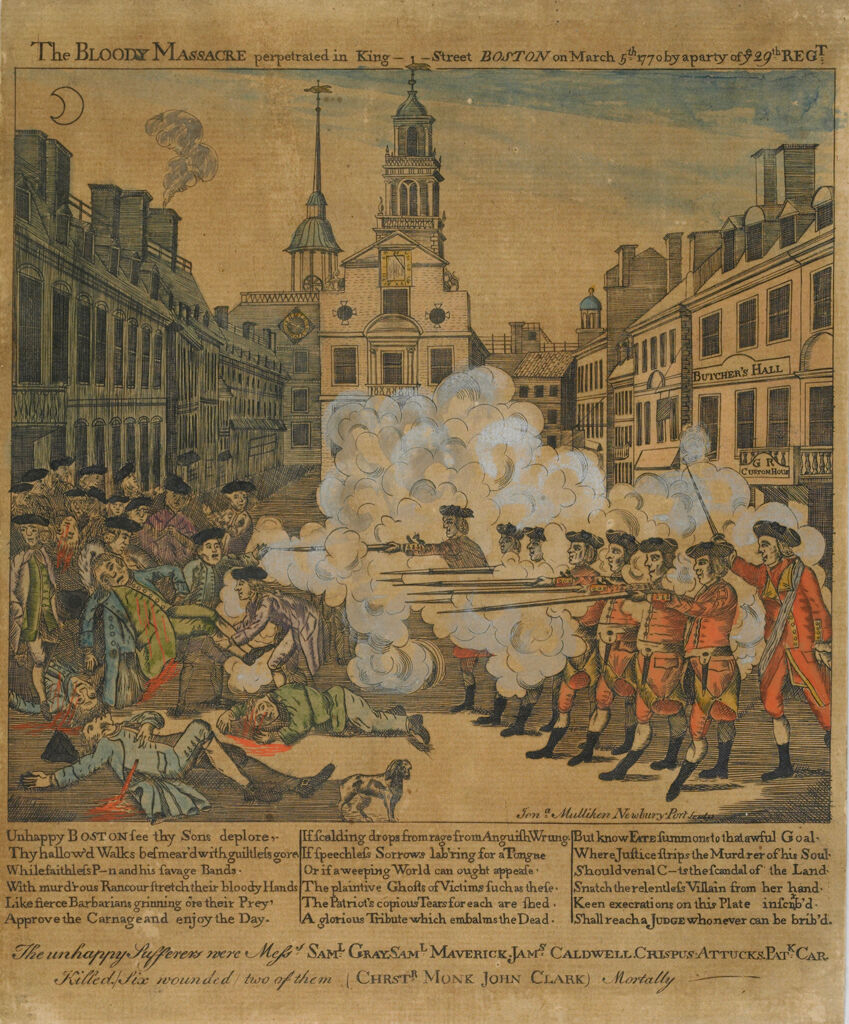
Paul Revere’s engraving of “The Bloody Massacre” in King-Street, Boston has been recognized as one of the most important illustrations during the American Revolution. The engraving was widely reproduced and circulated throughout the colonies in newspapers and prints, reaching audiences far beyond Boston. This broad distribution helped shape colonial opinion by presenting the event as a clear example of British brutality and injustice. It was created shortly after the events surrounding the Boston Massacre in 1770. This is where colonists were being shot by British Redcoats while many colonial men were shown on the ground either injured or dead because of the shooting. At first glance, the engraving appears to be a depiction of a group of soldiers purposely and systematically shooting at colonial men. However, Revere’s purpose for creating this image was to stir and mobilize public opinion toward the British and their actions, not simply to record or document a particular historical event. The engraving’s aggressive representation of the British soldiers, along with the engraving’s representation of the colonists as victims has led to it being interpreted as one of the most effective forms of anti-British propaganda[1].
To completely appreciate this engraving, one must analyze its history and context. In the late 1760s, taxes like the Townshend Acts and British soldiers in Boston heightened friction between Great Britain and the Colonies, making the two sides more likely to fight. The textbook “According to America: A Narrative History” states that the colonists saw the British Authority as oppressive because soldiers enforced imperial laws on civilians. This caused mistrust and hatred between the colonists and British Soldiers[2]. In turn, this caused British soldiers and colonial men to fight.
Colonists and British forces clashed in Boston on March 5, 1770, when a mob attacked British troops. After tossing objects and yelling insults at British troops, some of them fired into the crowd, killing five male colonists, including Crispus Attucks, sparking countrywide outrage. The event was a violent confrontation with disturbance, but colonial leaders called it a Massacre to rally public sympathy for rebellion against British rule. In the aftermath, the victims were honored in a large public funeral attended by thousands of colonists, which helped spread outrage and strengthen resistance to British rule[3].
The engraved artwork created by Paul Revere serves to contrast the colonists with the British soldiers. Revere also includes additional visual details that reinforce his message. Captain Thomas Preston is shown standing behind his men, appearing to give the order to fire, which suggests that the violence was intentional. The colonists are scattered across the foreground rather than organized, making them appear vulnerable and unthreatening. One figure, likely Crispus Attucks, is prominently shown lying at the front of the scene, drawing the viewer’s attention to the human cost of the event. In the background, the building labeled the “Custom House” places responsibility directly on British authority. Revere depicts the British soldiers as firing simultaneously from a straight line representing military discipline and control of the event. However, historians indicate that the troops fired as a reaction to the disarray of the scene[4]. In contrast, the colonists are illustrated as innocent victims suffering in fear with painful, exaggerated facial expressions to evoke criticism toward the British troops. Revere includes a steeple of a protestant church in the background, which may suggest a higher moral authority (this is an interpretation based on the image itself).
The title of the engraving additionally affects the meaning of the image. By naming the incident a “bloody massacre,” Revere has eliminated all hints of uncertainty and labeled this incident as an outright act of violence. This clearly portrays his view on the nature of the incident[5]. Furthermore, combined with the dramatic imagery of the engraving, these two factors produced a very effective means of persuasion. In support of this view, historian Alfred F. Young argues that these portrayals helped to transform the Boston Massacre into a lasting symbol of British oppression and colonial resistance[6].
The engraving also exposes how the revolutionary events were shaped by how they were understood and remembered. According to Serena Zabin, the relationships between British troops and residents of Boston were much more complex than Patriot propaganda represented and contained both conflict and cooperation[7]. In view of this, however, representations such as in Revere’s engraving oversimplified those realities to present a clear political message. It should also be noted that broader narratives of the revolutionary period indicate that events such as the Boston Massacre served as a spark for colonists to come together and oppose British rule[8].
Finally, Revere’s engraving shows how media can influence people’s perceptions of violence. It shows how the colonists used visuals and words to foster public comprehension of current events to obtain political support. Today’s consumers may see from the engraving that event presentation and content are equally important.
[1] Alfred F. Young, The Shoemaker and the Tea Party: Memory and the American Revolution (Boston: Beacon Press, 1999).
[2] David Shi et al., America: A Narrative History, 13th ed. (New York: W.W. Norton, 2025).
[3] Serena R. Zabin, The Boston Massacre: A Family History (Boston: Houghton Mifflin Harcourt, 2020).
[4] Zabin, The Boston Massacre.
[5] Young, The Shoemaker and the Tea Party.
[6] Young, The Shoemaker and the Tea Party.
[7] Zabin, The Boston Massacre.
[8] Robert Middlekauff, The Glorious Cause: The American Revolution, 1763–1789 (New York: Oxford University Press, 2005).