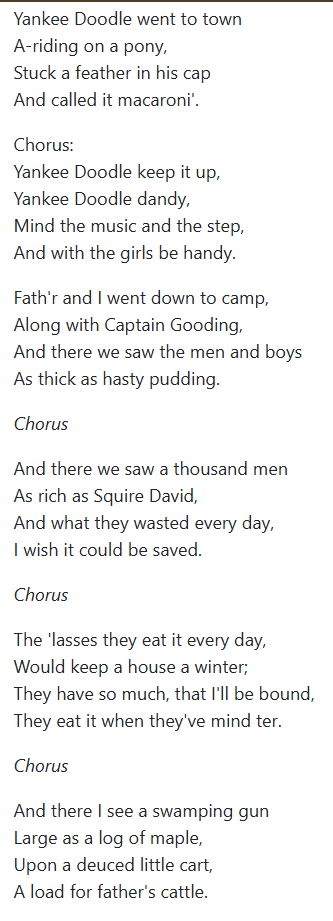
Although the tune of Yankee Doodle was established earlier on, this version of lyrics was made and published in 1755. It was written by Dr. Richard Shuckburgh, who was a British army surgeon and physician at the time.[1] The purpose of him releasing these verses was to mock the American colonists. Dr. Shuckburgh, along with many other British officials/people, saw the colonists as inferior to them.
-
- Depiction for the French and Indian War – from https://www.history.com/articles/french-and-indian-war
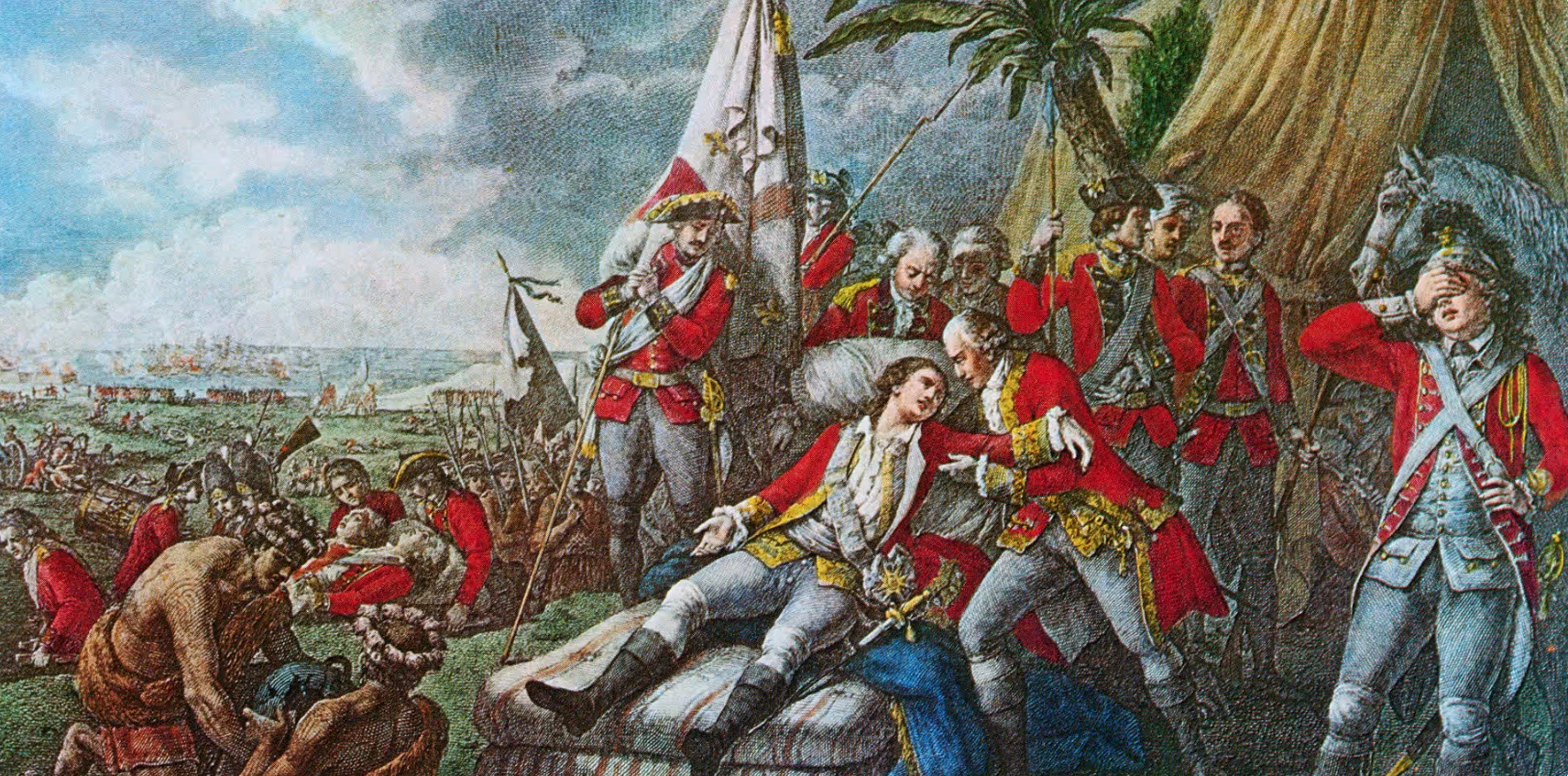
The French and Indian War, the North American section of the Seven Years’ War, ran from 1754-1763. These battles were between the British, with American colonists alongside them, and the French, with Native American allies.[2] The British troops were an established bunch; they were trained, professional, and nicely uniformed (typically called the Redcoats). The colonist’s contribution to the British’s side consists mostly of local militias and volunteers fighting. Because of this, they were looked at as the weaker link and inadequate compared to the superior British. The Yankee Doodle tune was meant to make a comical mockery of their unkept, unprofessional colonial soldiers. George Washington having to surrender his Virginia militia due to French forces pushing them back from Fort Necessity in July of 1954, served as a confirmation to the British government who believed that the American forces were not skilled enough to handle this war.[3] These American colonists were still under the control of the British during this time.
This song, although known as a child friendly, happy go lucky tune, is filled with symbolism and plays on words, using clever words to make fun of the colonists. Starting off strong with the title of this tune “Yankee Doodle.” The Americans were referred to using the words doodle and dandy, with the implications that they are foolish and jerks.[1] It is derogatory from the start, using the word pony instead of, for example, stallion or horse, making them appear more juvenile. The context behind the line “Stuck a feather in his cap/ And called it macaroni’” is that they were trying to make fun of the colonial fashion sense. This meant that putting a feather in your cap was a cheap, embarrassing attempt at looking like the high-class British folk.[4] Saying that they were “as thick as hasty pudding” was a clever way to claim them as a hastily rushed together, big, unorganized group with no structure to it.
The French and Indian War, which was the spark for the Yankee Doodle song, served the colonists well as training, because they later fought in the American Revolution, showing the British they are stronger than the British originally thought. The disrespect obviously shown to the colonists in these Yankee Doodle verses influenced the resentment built up, leading to the Revolution. The start of this revolution in 1775, the Battle of Lexington and Concord, ended with a successful ambush from the patriots, and retreat of the British troops.[5] The organization and skill shown during this battle was shocking for the British because of their low respect view of the patriots, but they proved how much they underestimated the Patriots.[5] In the thick of this success, the patriots sang Yankee Doodle as a sign of strength and patriotism, taking back that song which was originally used to mock them. This battle lit the spark the colonists needed to fight for freedom. Although this song started as a diss towards the colonial militiamen, it turned into a symbol of American pride and a patriot anthem during the American Revolution. This song turned into an ugly reminder to the British of their losses during the American Revolution.[6] It marks the evolution of colonists under the thumb or control of Britain, who turned into the strong, independent America they fought so hard for.
[1] “Yankee Doodle the Story behind the Song.” The Trump Kennedy Center. Accessed April 23, 2026. https://www.kennedy-center.org/education/resources-for-educators/classroom-resources/media-and-interactives/media/music/story-behind-the-song/the-story-behind-the-song/yankee-doodle/.
[2] William M. Fowler Jr. Empires at War: The French and Indian War and the Struggle for North America, 1754-1763. New York. Walker and Company. 2005
[3] Mary K. Geiter and W.A. Speck. Colonial America From Jamestown to Yorktown. Palgrave Macmillan. 2002. 157
[4] Waters, Michael. “The Macaroni in ‘Yankee Doodle’ Is Not What You Think .” Atlas Obscura, August 24, 2016. Accessed April 23, 2026. https://www.atlasobscura.com/articles/the-macaroni-in-yankee-doodle-is-not-what-you-think.
[5] John Hamilton. 2014. Battles of Lexington and Concord. Abdo & Daughters. EBSCOhost.
[6] Adams, Lori. “Here’s the Meaning behind the Lyrics of Yankee Doodle Dandy.” Ashland Source – Ashland County Ohio News & Info, July 3, 2021. Accessed April 23, 2026. https://www.ashlandsource.com/2021/07/03/heres-the-meaning-behind-the-lyrics-of-yankee-doodle-dandy/.
The source: “Yankee Doodle – Lyrics.” ScoutSongs.com. Accessed April 23, 2026. https://www.scoutsongs.com/lyrics/yankeedoodle.html.