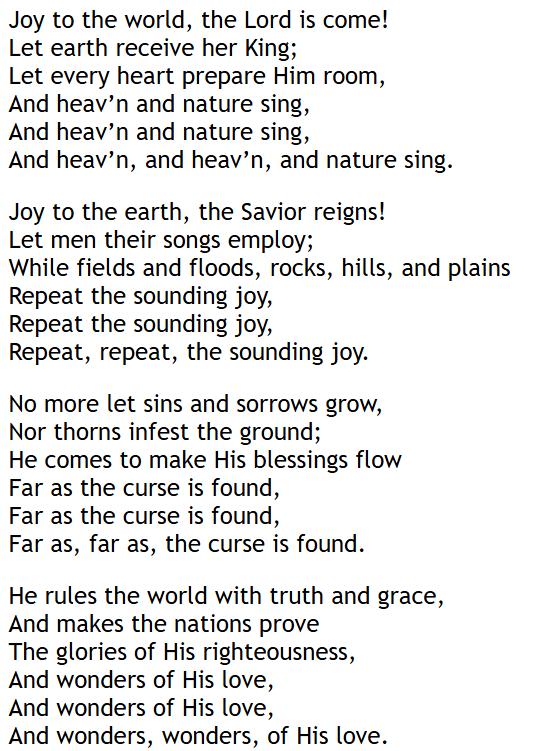
“Joy to the World”[1] is a song with the lyrics written by Isaac Watts in 1719. Isaac was from England and attended the King Edward VI School in Southampton. The song is inspired by the Bible verse “Luke 2:10” and eventually became a Christmas song. He wrote it for his Christian faith and to rejoice in Jesus’s birth story. This is congruent with the ideals that during the eighteenth century “‘Western’ music referred quite specifically to music of the Catholic Church’s Western or Latin rites as opposed to its Eastern ones.[2]” “Joy to the World” is a part of these songs that referred to Catholic views since Catholicism is a branch of Christianity. In the 18th century Catholics were a minority in colonial life in America so expressing their views through music could have been a way for them to celebrate their religion without being judged. During this time, “the struggle among Catholics for a sense of identity as English citizens, as well as for a nationalism that recognized a role for Catholics, represented their greatest challenge. This challenge would be no less difficult for those Catholics who chose to emigrate to the colonies.”[3] Catholics in both Britian and America were struggling due to persecution and exclusion from society but music could be a unifying force between them. Watts was taking the stories from the Bible and making them into songs which could make them easier and more enjoyable. “Dr. Watts’ work was seen as a human interpretation of divine songs, as opposed to the translation of the psalms the church had enjoyed previously.”[4] His work not being an exact copy of the psalms could make it more accessible and possibly could have even helped spread Catholicism more and help them expand their views. This piece shows how religion became a prominent part of society during the 18th century. A lot of people had not been able to have religious freedom before but now they were able to express their beliefs in new ways like through songs.
When looking closer at the lyrics, the lyrics “Let earth receive her King”[5]. This can tell us that Watts and other Christians valued God as a king figure. This is important for the Christians who lived in Britian or immigrated from there because it shows they did not view the proclaimed kings as their true king. Most of them opposed naming a human as having full control over them and bowing down to them, but for Jesus they would. Another important quote from the song would be, “Let men their songs employ.”[6] This line is important because it is saying to let the people sing their songs and express themselves through music. This was showing the new importance music would have and how it was going to become integrated into their religion. One last line from the song that is important is, “He rules the world with truth and grace.”[7] This could have been Watts being critical to other leaders’ approaches such as the Kings in Britian and it could be used in context to the presidents in the U.S. as well. Because, unlike them, God rules the world with effortless care. In their eyes, he holds true power and does not have malicious intent as many of the human leaders did.
Overall, this song is a reflection of religion growing and new forms of expression. Music had been used by other minorities like slaves as well to express their feelings and the music industry would only continue to grow as time went on. Watts’ song is still sung as a Christmas Carol and in churches to this day. This shows the influence he had for his song to be written in the 18th century and still be present and popular in the 21st century. Music continues to be an influential work of art for religions.
[1] Timeless Truths, “Joy to the World,” https://library.timelesstruths.org/music/Joy_to_the_World/, accessed April 27, 2026.
[2] University of California Press, Journal of the American Musicological Society, https://go.gale.com/ps/i.do?id=GALE%7CA877167196&v=2.1&it=r&sid=ebsco&aty=shibboleth&u=setonhallu&p=AONE, accessed April 27,2026.
[3] U.S. Catholic Historian, Catholic University Press of America, https://www.jstor.org/stable/25154580?seq=1, accessed April 27, 2026.
[4] Alabama State University, Religions, https://research.ebsco.com/c/dq7v4l/viewer/pdf/gxrlkvhxpr, accessed April 27, 2026.
[5] Timeless Truths, “Joy to the World,” https://library.timelesstruths.org/music/Joy_to_the_World/, accessed April 27, 2026.
[6] Ibid., 5
[7] Ibid., 5