Historical Source Analysis – The “Golden Spike” Ceremony

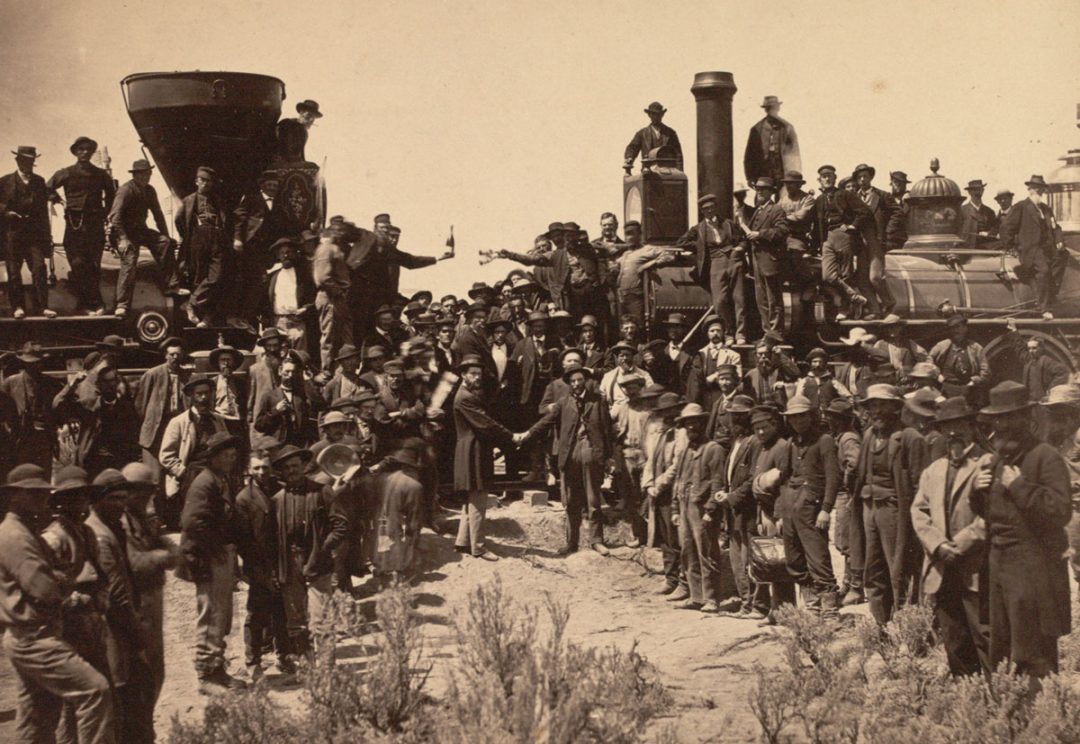
On May 10th, 1869, in Promontory Summit, Utah, a photograph of the “Golden Spike Ceremony” was taken.[1] This monumental achievement marked by a golden spike driven into the ground, celebrated the completion of the first transcontinental railroad in the history of the United States. At first glance, the photograph shows a gathering of railroad officials, workers, and civilians celebrating a triumphant moment of national pride and engineering progress. However, upon closer analysis, this photograph not only symbolizes the country’s achievement, but also racist exclusion of key contributors, selfish economic driven desires, and the railroad’s consequences on nature.
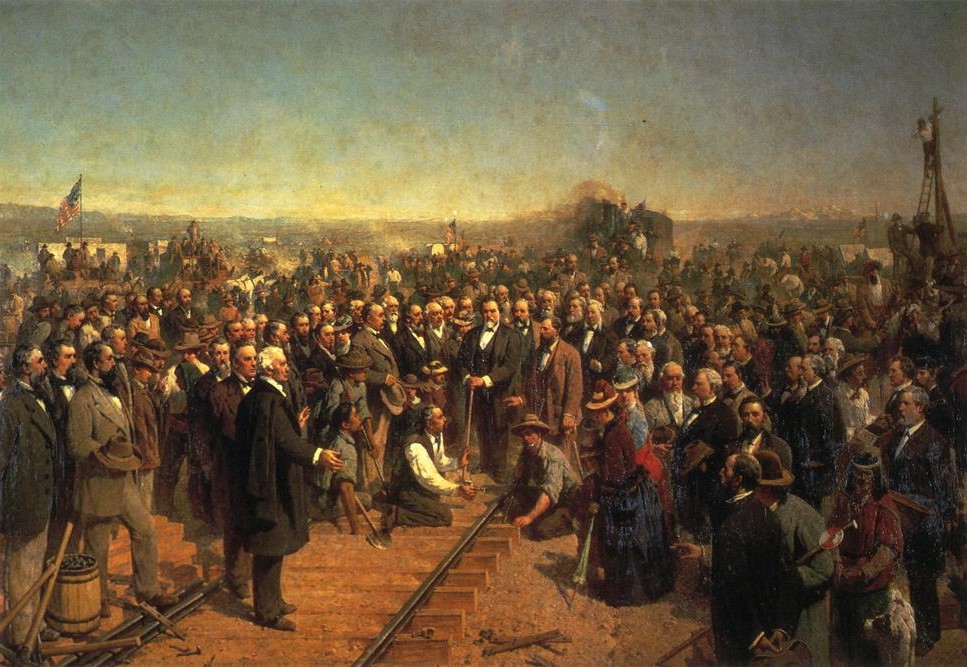 For some background information, the transcontinental railroad was constructed from 1863 to 1869 by the Central Pacific Railroad and the Union Pacific Railroad. Essentially, the railroad connected the East and West coasts, reducing travel times and encouraging trade and exports/imports, migration, and great economic expansion opportunities. Additionally, during this time period, the nation was also recovering from the losses of the Civil War, so this project also played a key role as a beacon of hope, unity, and strength for a recovering and pained nation.
Analyzing the contents of this photograph, one can observe how it was carefully curated to highlight a tremendous sense of achievement. Railroad executives and white workers dominate the image, raising their hats or bottles in eager celebration. The locomotives face each other, symbolizing the connection and completion between the East and the West. However, what this photograph doesn’t show is the very backbone of the railroad construction: the Chinese laborers who made up a large portion of the Central Pacific workforce and performed the most dangerous and physically demanding work.
As Gordon H. Chang and Shelley Fisher Fishkin explain in The Chinese and the Iron Road, Chinese workers were essential to the construction of the railroad, yet they were often excluded from public recognition[2]. Their absence exposes a biased narrative, one that centers powerful white figures while ignoring marginalized groups. This suggests that the image was not just simply documenting history but inaccurately shaping how history would be remembered.
Alongside to issues of representation, another key aspect that appears to be lacking in this photo is the economic motivations and incentives behind the railroad. According to Xavier Duran’s The First U.S. Transcontinental Railroad: Expected Profits and Government Intervention, the transcontinental railroad was heavily supported by government subsidies and primarily driven by the pursuit of profit and economic advancements[3]. The very executives and investors photographed are the ones who were directly benefiting financially and politically from its completion. This new perspective challenges the idea that the railroad was purely a national achievement, instead highlighting its role as a major business investment and economic success.
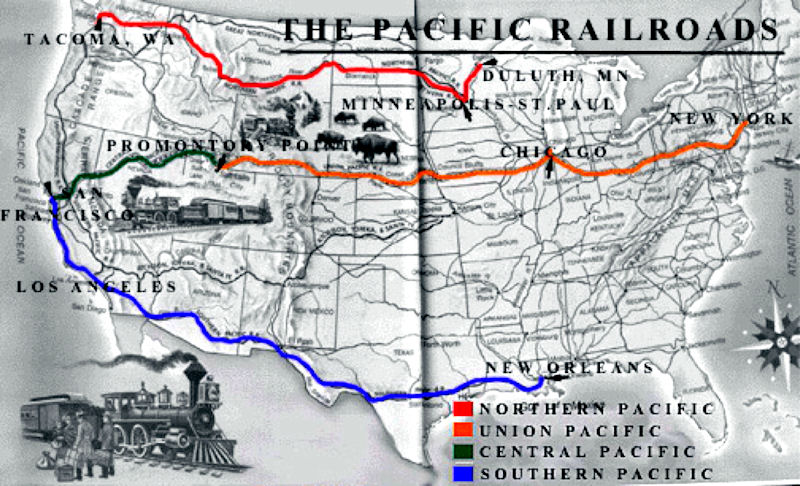
Furthermore, an often-overlooked facet to the railroad’s creation is its relationship with nature and its surrounding environment. The scholarly article, A Natural History the Early American Railroad, by David Schley, argues that the railroad was seen as a symbol of human control over nature; that early Americans viewed railroads as a method to reshape geography and restore “natural” trade patterns[4]. The celebration captured in the photograph reflects this very mindset, presenting the railroad as a tangible triumph over distance and isolation, even at the significant expense of human and environmental costs.
In conclusion, the “Golden Spike” historical photograph is more than a simple record of a historic event. It reflects not only a national uniting achievement, but also underneath it exposes the inequalities and damaging, narrowminded beliefs of the 19th century. By analyzing both what is and is not shown on the surface of this photograph, one can gain a deeper understanding of the complex nature behind this iconic moment in American history.

Work Cited
Chang, Gordon H.; Fishkin, Shelley Fisher. The Chinese And The Iron Road: Building The Transcontinental Railroad. Stanford, California. Stanford University Press, 2019. https://research.ebsco.com/plink/0d538e64-addb-3219-b4f8-3e98888d10f8
Duran, Xavier. The First U.S. Transcontinental Railroad: Expected Profits and Government Intervention. The Journal of Economic History 73, no. 1 (2013): 177–200. http://www.jstor.org/stable/41811504
Schley, David. A Natural History of the Early American Railroad. Early American Studies: An Interdisciplinary Journal 13, no. 2 (2015): 443-466. https://muse.jhu.edu/article/579819
The “Golden Spike” Ceremony. The Gilder Lehrman Institute of American History. https://www.gilderlehrman.org/history-resources/spotlight-primary-source/official-photograph-golden-spike-ceremony-1869
[1] The “Golden Spike” Ceremony. The Gilder Lehrman Institute of American History.
[2] Gordon H. Chang; Shelley Fisher Fishkin. The Chinese And The Iron Road: Building The Transcontinental Railroad. Stanford, California. Stanford University Press, 2019.
[3] Xavier Duran. The First U.S. Transcontinental Railroad: Expected Profits and Government Intervention. The Journal of Economic History 73, no. 1 (2013): 177–200.
[4] David Schley. A Natural History of the Early American Railroad. Early American Studies: An Interdisciplinary Journal 13, no. 2 (2015): 443-466.