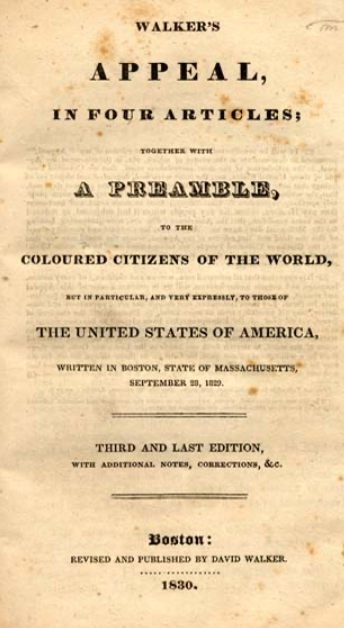
David Walker’s Appeal to the Coloured Citizens of the World is seen as one of the most powerful antislavery texts written in the United States. David Walker was a free Black man born in Wilmington, North Carolina. He first published the pamphlet in Boston in 1829, and it was revised in 1830.[1] It was written at a time when slavery was spreading to the West, and the cotton economy was making the South rich. American democracy was expanding, but mostly for white men. This contradiction is exactly what the Appeal is about. A scholar, Thabiti Asukile, explained that he was born to an enslaved father and a free mother, and that he “grew up to despise the system of slavery that the American government allowed in America.”[2] Asukile also highlights that the pamphlet was seen by white readers as “subversive, seditious, and incendiary.”[3] Their reaction to the pamphlet shows it was not just a political essay, but it was seen as a threat to society. The Appeal was a small, printed pamphlet that was easy to carry and hide. It circulated through Black communities in the North and was secretly distributed in the South. For readers at the time, encountering this pamphlet was forbidden because they were engaging with a call to think differently about freedom. The source can be found here, https://docsouth.unc.edu/nc/walker/walker.html. 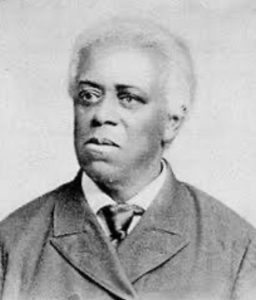
Why it was seen as a threat can be seen in how the United States looked in 1829. In the American South, slavery was a foundation for the economy and social hierarchy. The textbook, “America: A Narrative History” by David Shi, Daina Berry, Joseph Crespino, and Amy Taylor, described how enslaved people were controlled in the South through slave codes, surveillance, and aggression, with society “dominated by an elite group of enslavers and merchants.”[4] At the same time, the country was entering the Jacksonian era, which was an expansion of democracy, but the textbook makes clear that it was only an expansion and triumph for white men. African Americans, women, and Indigenous people were “denied political and civil rights.”[5] This gap in democracy was exactly what Walker was responding to.
Historian Ian Finseth argues that Walker came out of a “rich social and discursive world” and described the pamphlet as a “scorching denunciation of slavery and hypocrisy.”[6] In the South, copies were secretly given out, and Finseth explained that it “ignited white paranoia” about slave rebellions.[7]his fear had already been intensified by events such as Gabriel’s Rebellion, Denmark Vesey’s Revolt, and many more, all of which scared the white South.[8] It was secretly distributed in the South, which increased fear among white people.
The Appeal is especially powerful not just because of its content but also because of the way Walker said it. The title was deliberate; he addressed “the Coloured Citizens of the World,” purposely trying to make the claim that Black people were citizens, not property, which the law denied. Melvil L. Rogers, a political theorist, argued that the title was not just a greeting but gave Black readers the place to be judges of Walker’s argument, giving them the position of the audience whose verdict mattered.[9] A Black writer writing to a Black audience was not socially acceptable at the time; it was seen as radical. The rest of the pamphlet enforces this position. Walker wrote with warnings and direct accusations. He asks if his readers will “be men, or obey the inhuman wretches” who enslave them, giving a rhetorical question that demands an answer.[10] This phrasing is powerful because it forces the readers into a moral choice. He contrasts dignity with submission, which makes staying neutral impossible. The choices made by Walker, such as capitalized words and repetition, display urgency. Finseth explains that Walker “talks back as few others had done, and none in print,” specifically how he called out Jefferson by name and held the founding fathers as the ones accountable for the gap between what they wanted and what happened.[11] Walker also said he wanted to awaken a “spirit of inquiry and investigation” in the “Republican Land of Liberty,” purposely using America’s own words against itself.[12] The phrase “Republican Land of Liberty” is ironic because Walker is calling out a nation that claims it’s built on freedom while denying it to millions. 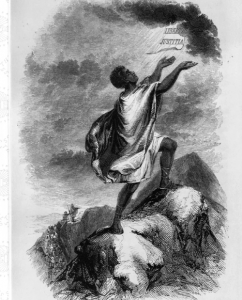
The Appeal has an emphasis on Black unity and racial pride, and Asukile points to this, explaining that Walker’s hope was that Black people would “govern ourselves.”[13] Finseth observes that the Appeal was full of tension as it rejected America and demanded that it become what it once claimed to be.[14] This tension is what makes this document historically significant. The Appeal is more than a protest. It is evidence that Black Americans were political thinkers who refused to be oppressed, using every tool available to them to make the nation confront its contradictions.
Footnotes:
1 “David Walker, 1785-1830. Walker’s Appeal, in Four Articles; Together With a Preamble, to the Coloured Citizens of the World, but in Particular, and Very Expressly, to Those of the United States of America, Written
in Boston, State of Massachusetts, September 28, 1829.,” n.d.,
https://docsouth.unc.edu/nc/walker/walker.html, Accessed April 2, 2026.
2 Asukile, Thabiti. “The All-Embracing Black Nationalist Theories of David Walker’s Appeal.” The Black Scholar
29, no. 4 (1999): 16.
3 Ibid.
4 Ramey Berry et al., America: A Narrative History, 13th ed. (New York: W. W. Norton & Company, 2025), 471.
5 Ibid., 318.
6 Finseth, Ian. “David Walker, Nature’s Nation, and Early African-American Separatism.” The Mississippi
Quarterly 54, no. 3 (2001): 337.
7 Ibid.
8 Ramey Berry et al., America: A Narrative History, 13th ed. (New York: W. W. Norton & Company, 2025), 493.
9 Rogers, Melvin L. “David Walker and the Political Power of the Appeal.” Political Theory 43,
no. 2 (2015): 208-209.
10 “David Walker, 1785-1830. Walker’s Appeal, in Four Articles; Together With a Preamble, to the Coloured
Citizens of the World, but in Particular, and Very Expressly, to Those of the United States of America, Written
in Boston, State of Massachusetts, September 28, 1829.,” n.d.,
https://docsouth.unc.edu/nc/walker/walker.html, Accessed April 2, 2026.
11 Finseth, Ian. “David Walker, Nature’s Nation, and Early African-American Separatism.” The Mississippi
Quarterly 54, no. 3 (2001): 337.
12 “David Walker, 1785-1830. Walker’s Appeal, in Four Articles; Together With a Preamble, to the Coloured
Citizens of the World, but in Particular, and Very Expressly, to Those of the United States of America, Written
in Boston, State of Massachusetts, September 28, 1829.,” n.d.,
https://docsouth.unc.edu/nc/walker/walker.html, Accessed April 2, 2026.
13 Asukile, Thabiti. “The All-Embracing Black Nationalist Theories of David Walker’s Appeal.” The Black
Scholar 29, no. 4 (1999): 16-17.
14 Finseth, Ian. “David Walker, Nature’s Nation, and Early African-American Separatism.” The Mississippi
Quarterly 54, no. 3 (2001): 338-339.