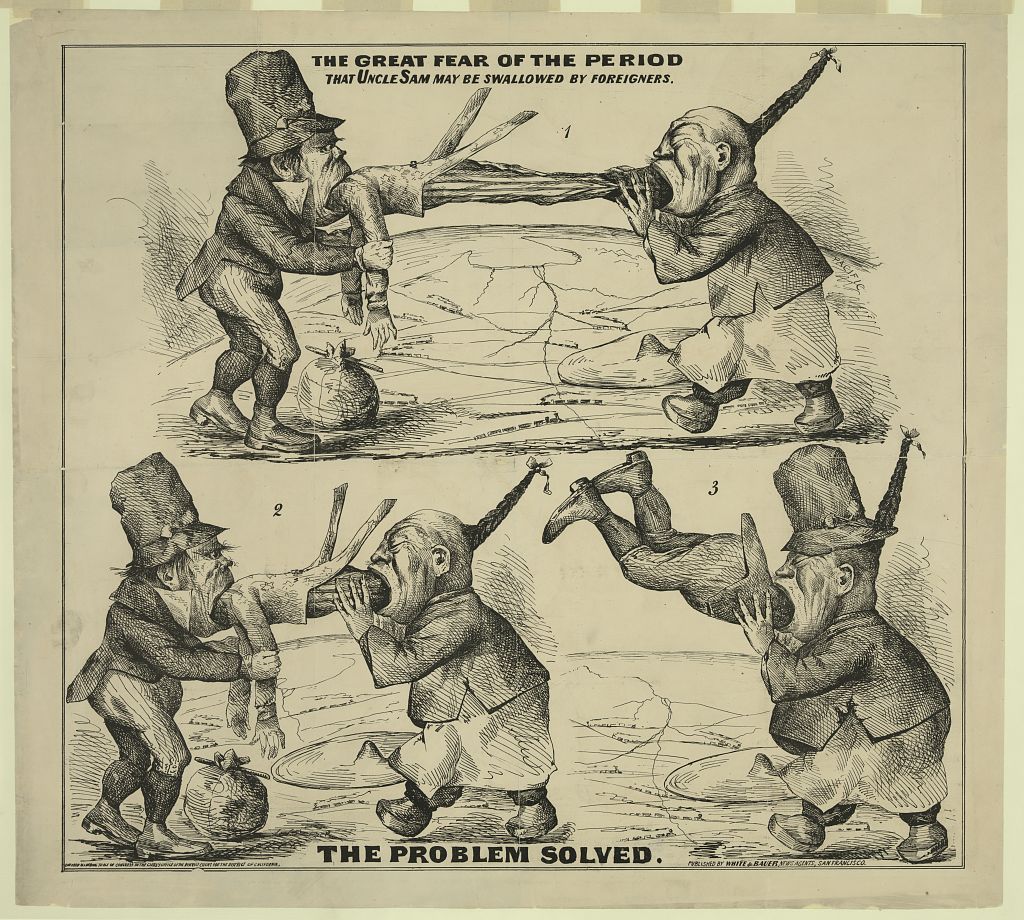
This political cartoon, published by a San Francisco Lithography firm called White and Bauer, between 1860 and 1869, captures the widespread fear and prejudice Americans had towards the waves of new immigrants entering the United States during the mid 1800s. The specific artist was not identified in the archival record as it was a mass produced cartoon and the date range listed corresponds to the years the firm was active. The exact publication year is unknown, but can be placed within the time frame of heightened immigration and labor tensions in America. The cartoon is titled “The Great Fear of the Period that Uncle Sam May be Swallowed by Foreigners” and depicts a caricature of Uncle Sam being entirely consumed by a caricature of an Irish man as well as a caricature of a Chinese man [4]. Uncle Sam is a personified version of the United States and is shown to be swallowed by foreigners who are depicted as animalistic and grotesque looking. The cartoon illustrates how people were fearful of the fact that Irish and Chinese immigrants were going to take over and drastically change the United States.
The exaggerated animal-like features of both the Irish and Chinese caricatures signals to viewers that these people were seen as uncivilized, which reinforces the racial hierarchies and fear that non-English immigrants would degrade American society. The act of Uncle Sam being physically swallowed by each of the caricatures transforms immigration into a visual metaphor for the loss of national identity and political control. The Irish figure is seen as large with an aggressive posture, indicating disorder and violence. This reflects the nativist fear that the Irish Catholic immigrants would bring instability and challenge the cultural dominance of Protestant Christians in America [1]. The final panel illustrates a Chinese man completely swallowing the Irish figure whilst standing over the map of America. This is likely linking immigration to territorial control of the country as well as the anxiety over labor competitions between the Irish and Chinese. The caption “problem solved” suggests that Chinese outcompeting the Irish for “American” jobs could resolve the economic tensions [4].
The significance of the cartoon’s messaging is highlighted by its historical context. During the mid 19th century to the early 20th century, the United States had received a large influx of immigrants coming from all parts of Europe and Asia. A large portion of those immigrants were the Irish and the Chinese who came to America for different reasons. The Irish had come to America in large numbers due to the Great Famine (1845-1852) and the Chinese had come to America due to economic opportunities such as the California Gold Rush and the construction of the transcontinental railroad [1]. These groups faced poor working conditions and discrimination, yet still played a crucial role in building the nation’s infrastructure. The Irish were described as “unsteady” and “unreliable” in getting the job done, while the Chinese were called the “Dregs of Asia” and were more harmless [1]. Even with these stereotypes, these immigrants were continuously employed by these companies to construct the railroad out west.
Despite the contributions made by these immigrants, they were portrayed as dangerous outsiders. Both the Irish and Chinese were depicted in racist terms as “dirty, diseased, and demented” with Americans fearing that they could corrupt society [2]. The Irish in particular had been seen as enemies of the English for decades and were targeted on both racial and ethnic grounds. The Irish were predominantly Catholics compared to the Protestant Majority residing in America [2]. The Chinese were of a completely different race and were often mocked based on their language, looks, and culture. The significance of this political cartoon is to portray the immigrants as uncivilized and dangerous to American society.
The fears of immigrants also had a major influence on future public policy of America.
Anti-Chinese sentiment directly contributed to the passing of the Chinese Exclusion Act of 1882, which banned the immigration of Chinese laborers to America and marked the first major federal restriction based on nationality [3]. In contrast, the Irish were not targeted by specific federal exclusion laws, but were targeted based on federal quotas. The Immigration Act of 1924 completely banned immigration of Asia and put these restrictive quotas on people entering the country from Europe including the Irish-whilst to a lesser degree [3].
Along with the public perception of these immigrants, the cartoon highlights the labor tension between Irish and Chinese. Irish and Chinese workers often competed for low wage jobs in manual labor and railroad construction leading to conflicts between them. This competition also brought resentment among native born workers, who believed that these immigrants were taking jobs from them as well as lowering wages.
- Ryan Dearinger, “Chinese Immigrants, the Landscape of Progress, and the Work of Building and Celebrating the Transcontinental Railroad,” California History 96, no. 2 (2019): 66–98, https://www.jstor.org/stable/26850805.
- Gregory B. Lee, “Dirty, Diseased and Demented: The Irish, the Chinese, and Racist Representation,” Transtext(e)s Transcultures跨文本跨文化, no. 12 (2018), https://doi.org/10.4000/transtexts.1011.
- John Higham, “American Immigration Policy in Historical Perspective,” Law and Contemporary Problems 21, no. 2 (1956): 213–35, https://doi.org/10.2307/1190500.
- The American Yawp Reader, “Anti-Immigrant Cartoon,” accessed April 23, 2026, https://www.americanyawp.com/reader/anti-immigrant-cartoon-2/