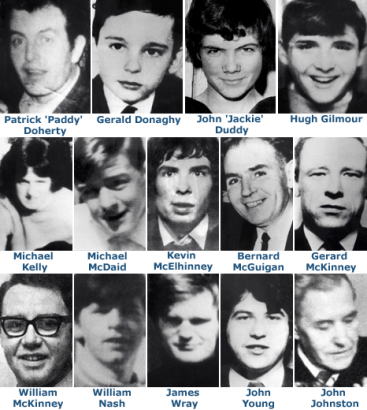
Pictured are the victims of the Bloody Sunday attacks.
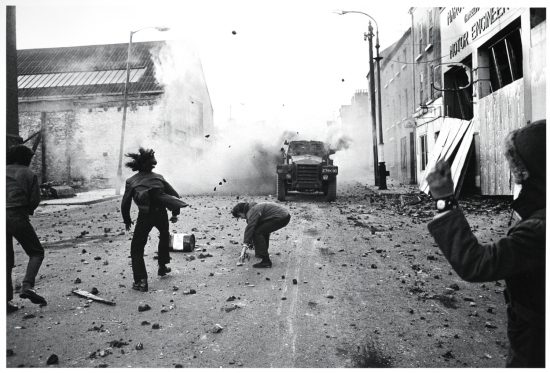
Chaos ensues on a street in Londonderry, (Derry).
The song “Sunday Bloody Sunday” by U2 in 1983 describes Bloody Sunday, a demonstration led by Roman Catholic civil rights supporters became violent that took place on Sunday, January 30, 1972. British paratroopers opened fire on the peaceful protestors, killing 13 of them and injuring 14 others (one person’s injury led to their death).
The imagery included in the song’s lyrics, like “Bodies strewn across the dead end street / But I won’t heed the battle call,” captures the horrors of Bloody Sunday.
It started as a peaceful, (but illegal), demonstration by about 10,000 people. Bloody Sunday was organized by the Northern Ireland Civil Rights Association opposing the British government’s policy of arresting suspected members of the IRA without a trial.
The British army sectioned much of the demonstrators’ course, so they were forced to change their course. In response, some of the marchers began throwing stones and projectiles at the soldiers. The British soldiers were instructed to arrest as many of the demonstrators as possible, and so, they fired rubber bullets and a water cannon.
After less than 30 minutes, 13 marchers lay dead. After the incident, an inquiry ordered by British Prime Minister Edward Heath concluded that the demonstrators had fired the first shot, yet, none of the dead possessed weapons. The Derry coroner referred to the death as “unadulterated murder” and for twenty years, nationalists campaigned for a new inquiry.
The new 5,000 page inquiry was released in 2010, 38 years after Bloody Sunday, which concluded that the first shot was fired by British soldiers. In 2010, British Prime Minister David Cameron apologized for the shootings before Parliament and promised to financially compensate the victims’ relatives.
“Bloody Sunday.” Encyclopædia Britannica, Encyclopædia Britannica, Inc., www.britannica.com/event/Bloody-Sunday-Northern-Ireland-1972.