Apr 27, 2026 | Department News
By Vyan Patel ‘28
On March 27, 2026, Japan Week hosted its annual luncheon, One Table. Endless Connections., at Ariyoshi Japanese Restaurant in South Orange. The event brought together 20 participants, including both students and faculty, to share experiences and foster meaningful connections across the university community. The luncheon provided a unique opportunity for students and faculty to engage in open conversation about life at Seton Hall, covering topics such as campus activities, study abroad opportunities, and cultural immersion. Many students enthusiastically shared their experiences learning new languages and discussed the possibilities and benefits of studying abroad. Faculty members offered valuable guidance and practical advice to support students as they navigated academic and personal growth during their university journey. Beyond the enriching dialogue, attendees enjoyed a delicious Japanese food, which added a cultural dimension to the gathering. The combination of thoughtful conversation and culinary experience made the luncheon both enjoyable and educational. As a participant, I am truly grateful for the opportunity to attend the Japan 2026 Luncheon at Ariyoshi. The event strengthened my appreciation for Japanese culture and deepened my interest in pursuing future study abroad experiences. It also highlighted the importance of community, mentorship, and the sharing of experiences in shaping a meaningful university experience. Japan Week’s annual luncheon continues to serve as a platform for connection, learning, and cultural appreciation, leaving participants inspired and better equipped for the opportunities ahead.
Apr 27, 2026 | Department News
By Jake Redila ‘28

Satoi Kobayashi and three assistants for the Mizuhiki Workshop.
On Thursday, March 26, 2026, students had the unique opportunity to participate in a traditional Japanese craft workshop led by Satoi Kobayashi and three assistants from New York City. The workshop introduced 35 students to the art of making Mizuhiki, decorative charms crafted from 3–4 colored, hardened, and twisted paper cords known as washi, woven using a technique called the Awaji knot. Mizuhiki are more than decorative items; they are deeply symbolic elements of Japanese culture dating back to the 7th century. The intricate weaving of the washi cords represents respect, gratitude, and prayer, while the act of tying the knots reflects human connection and intention. Each step of the process encourages mindfulness and careful attention, making the creation of a Mizuhiki both a meditative and meaningful experience. Participants embraced the challenge, learning how to shape and twist the cords into intricate knots. Even those with less-than-perfect motor skills found joy in the process, discovering the balance between the craft’s simplicity and its intricate design. Many students expressed excitement at creating their own charms for the first time, marking a personal connection to this centuries-old tradition. For enthusiasts of cultural keepsakes, the workshop offered a chance not only to appreciate the beauty of Mizuhiki but also to create a tangible symbol of intention and connection. From start to finish, each knot tied was a reminder of patience, care, and creativity. Students left with their handmade charms, treasures to be cherished for years to come. The workshop highlighted how traditional crafts can bridge cultures, inviting participants to explore history, artistry, and personal expression in one hands-on experience.
Apr 23, 2026 | Department News
By Tyler Hummel ‘26
On Tuesday, March 24, 2026, three presenters—Matt Barros, Toko Kobayashi, and Angel Leonor—shared insights on studying abroad in Japan and participating in the Japan Exchange and Teaching (JET) Program. Each speaker offered a unique perspective, giving students a well-rounded understanding of opportunities to live and work in Japan. Matt Barros spoke about his experience teaching English in Japan and outlined several pathways for those interested in similar work. He explained the structure and benefits of the JET Program, as well as alternative options such as private dispatch companies and employment at Eikaiwa (English conversation) schools. His talk provided practical guidance for students considering teaching careers abroad. Next, Toko Kobayashi offered a personal perspective on studying in Japan. She introduced her home institution, Rikkyo (St. Paul’s) University, and described what international students can expect from the academic and social environment. She also highlighted student life, explaining the differences between “circles,” which are more casual interest-based groups, and “Bukatsu,” which are formal, competitive clubs that require a higher level of commitment. Joining remotely from Japan via Zoom, finally, Angel Leonor shared his current experiences as a JET Program participant. He discussed daily life in Japanese schools, classroom responsibilities, and the rewards and challenges of teaching abroad, providing valuable real-time insight. The audience was highly engaged throughout the event, contributing to a lively and informative atmosphere. For students interested in studying or working in Japan, the presentation offered both practical advice and an inspiring glimpse into life abroad.
Apr 22, 2026 | Department News
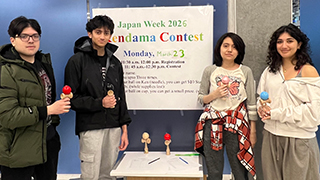
Japan Week Kendama Contest
By Matthew Basualdo ’27
On March 23, 2026, a Kendama Contest was held in the University Center to kick off Japan Week 2026. Students who participated had the opportunity to win a Starbucks gift card by successfully landing the ball on the spike at the top of the toy, and all participants received Pocky as a prize. Kendama is a traditional Japanese toy consisting of a handle (ken) with a spike, a crosspiece (sarado) with two cups, and a ball (tama) with a hole, all connected by a string. While simple in design, Kendama offers a wide range of challenges and is enjoyed by people of all ages. It promotes hand-eye coordination, concentration, and can even help relieve stress. Players can perform tricks ranging from basic catches to more advanced techniques involving balance, precision, and creativity. In recent years, Kendama has gained global popularity as a fun, screen-free activity that appeals not only to children but also to adults seeking engaging and mindful recreation. The Kendama Contest was a great success, with more than 100 students participating and enjoying this traditional yet timeless game. The event highlighted how a classic Japanese toy continues to resonate in today’s world, bringing people together through play and friendly competition.