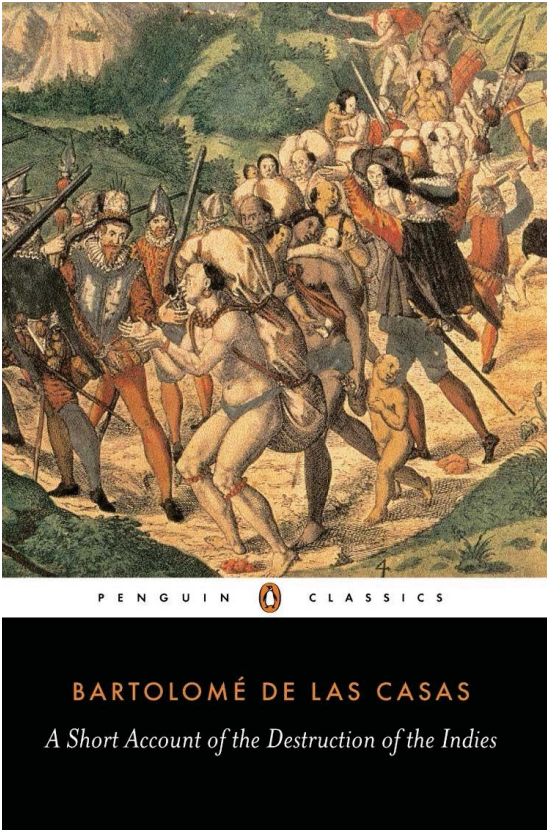
A Short Account of the Destruction of the Indies
In his A Short Account of the Destruction of the Indies, Bartolomé de las Casas detailed the horrific mistreatment of the Indigenous peoples by Spanish colonizers in the Americas. One of the most moving and emotionally charged letters in his account is the “Hispaniola” letter. Here, Las Casas describes the brutal treatment of the native population, and he provides a first-hand account of the atrocities committed by the Spanish. Through extremely graphic and vivid language, he captures the pain and suffering of the Indigenous peoples who faced unimaginable violence. In this letter, Las Casas critiques the Spanish colonial system, specifically the encomienda, and calls for urgent reform, revealing the moral and ethical contradictions in Spanish expansion. This essay will explore the significance of Las Casas’ “Hispaniola” letter and analyze how his experiences shaped his perspective and how his tone evokes an emotional response from his audience[1].
The letter “Hispaniola” was written during the initial stages of Spanish colonization in the Americas. In the sixteenth century, Spain wanted to conquer the Americas, motivated by economic and religious reasons. Spanish colonizers employed a brutal system known as the encomienda, which coerced Indigenous people into forced labor. They justified this by saying it was to convert them to Christianity. Las Casas originally benefited from the system, but he had a profound transformation and became an advocate for the rights of Indigenous peoples. The events described in the letter were part of a large pattern of violence across the colonies the Spanish established. Las Casas paints a picture of the merciless and senseless violence committed by the colonizers[2] [3]. For example, Las Casas writes that “the dogs hunted them down like wild animals,” a phrase that illustrates the extent of dehumanization the Indigenous people suffered[4].
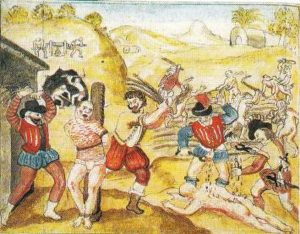
Picture from a Bartolomé de las Casas’ account about the Spanish atrocities in Mexico
Las Casas’ descriptions of the brutality in “Hispaniola” are both detailed and disturbing. He recounts the slaughter of pregnant women, children, and the elderly which emphasizes the lack of mercy shown by the Spanish. He uses language like “throttled,” “hunted down by dogs,” and “slaughtered in the most brutal manner.” Las Casas conveys the savagery of their actions and aimed to shock his audience into seeing the full extent of their violence. Not only did the Spanish torture the men of the Indigenous tribes, but they brought death to women and innocent babies as well[5]. The phrase “slaughtered in the most brutal manner” serves to underscore the indiscriminate and horrific nature of the violence[6].
The emotional tone of the letter also reveals Las Casas’ own moral outrage as it suggests the events were so horrific that words alone were not enough to convey the actual suffering. He utilizes hyperbole at times, describing acts that were so cruel they are hard to believe, but the exaggeration was to serve a purpose. He describes these events so violently that it forces readers to confront the unimaginable cruelty, and it makes them feel compelled to act. The letter was not just a historical account, but it was a call to actively reform. By portraying the atrocities so vividly, Las Casas sought to provoke a response, specifically from the Spanish Crown and Catholic Church, urging them to intervene and end the abuse[7].
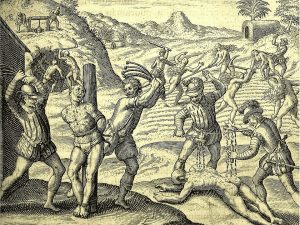
A reproduction of Theodori de Bry’s illustration for Las Casas 1598 book. It illustrates Las Casas’ extravagant depiction of the Spanish abuses to the American Indians (which helped create the Black Legend).
Moreover, Las Casas’ use of animals, for example with the dogs that were used to hunt down the natives who fled torture, is a powerful metaphor for the dehumanization of the Indigenous people. The animals were employed in the pursuit and execution of humans, which highlights how low the Spanish saw their victims. It emphasizes the systemic nature of the violence because they were not just weapons but symbols of the relentless cruelty of the Spanish colonizers.
The significance of the “Hispaniola” letter lies in its depiction of Spanish colonial violence and Las Casas’ transformation from a participant in the system to a critic of it. His account was one of the earliest and most influential works to bring attention to the plight of Indigenous peoples. Las Casas’ critique of the encomienda system, combined with his detailed eyewitness accounts, sparked debates over the ethics of colonization and the treatment of Indigenous peoples. The widespread impact of Las Casas’ writings was evident when the Spanish Crown, influenced by his arguments, enacted the New Laws of 1542, which sought to protect Indigenous peoples from the worst abuses of the encomienda system. His work, including the “Hispaniola” letter, eventually contributed to reforms in Spanish colonial policy, although not without considerable resistance[8].
Through his use of vivid, emotional language, Las Casas forces his readers to confront the brutality of colonization. The letter not only serves as a historical account but also as a call to action, urging reform and accountability for the atrocities committed. Las Casas’ work remains a crucial source for understanding the complexities and moral dilemmas of European expansion in the Americas.
References
[1] Bartholmé De Las Casas, “A Short Account of the Destruction of the Indies,” in Versions of Blackness, 1st ed., ed. Derek Hughes (Cambridge University Press, 2007), https://doi.org/10.1017/CBO9780511840890.008.
[2] Lawrence Clayton, “Bartolomé de Las Casas and the African Slave Trade,” History Compass 7, no. 6 (2009): 1526–41, https://doi.org/10.1111/j.1478-0542.2009.00639.x.
[3] David Thomas Orique, “The Life, Labor, and Legacy of Bartolomé de Las Casas,” Peace Review 26, no. 3 (2014): 325–33, https://doi.org/10.1080/10402659.2014.937988.
[4] De Las Casas, “A Short Account of the Destruction of the Indies.”
[5] De Las Casas, “A Short Account of the Destruction of the Indies.”
[6] De Las Casas, “A Short Account of the Destruction of the Indies.”
[7] Alexander Allen, Credibility and Incredulity: A Critique of Bartolomé de Las Casas‘s A Short Account of the Destruction of the Indies, n.d.
[8] De Las Casas, “A Short Account of the Destruction of the Indies.”