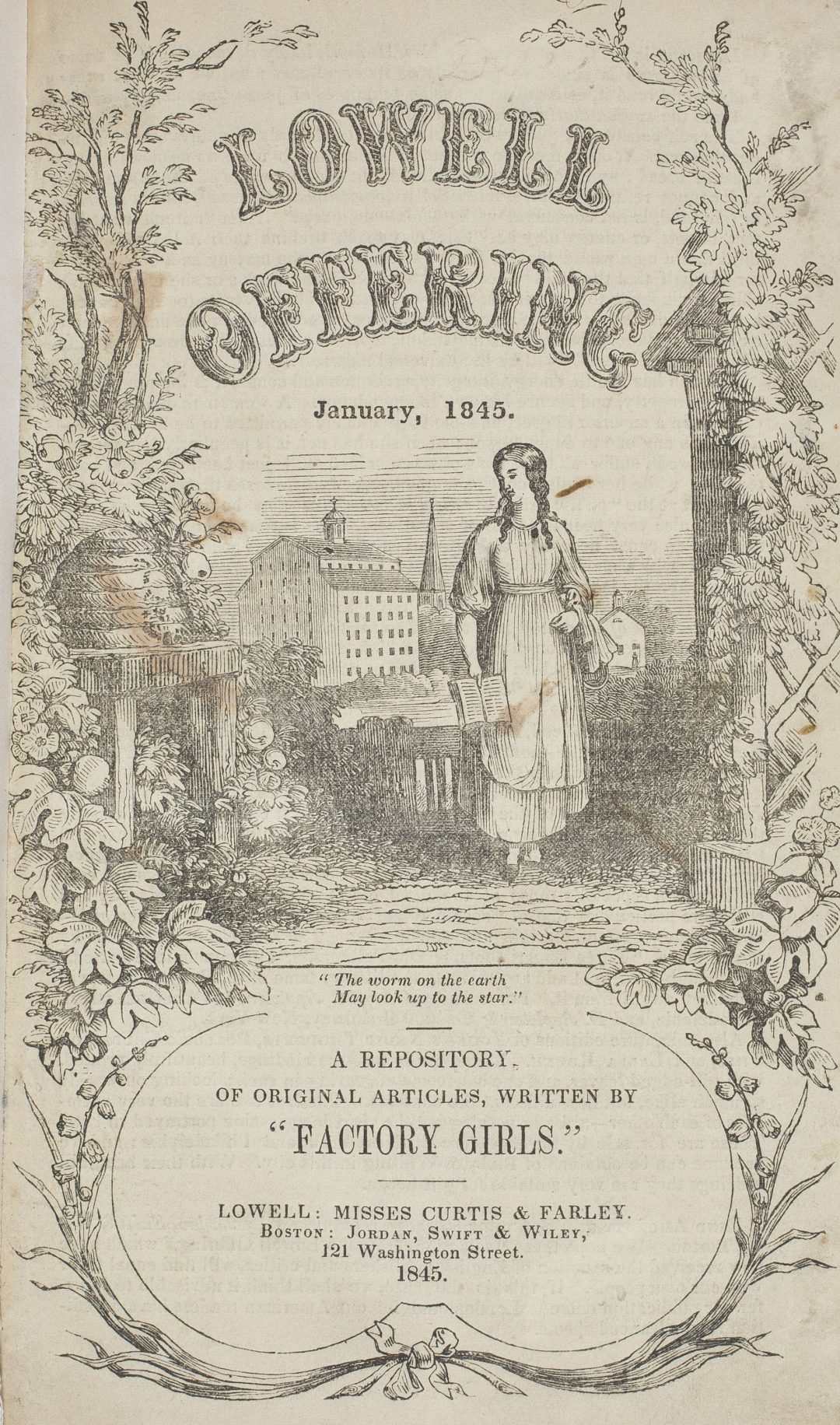
It is important for society to recognize the women who worked in textile factories, especially the women in Lowell, Massachusetts, during the 1840s. A historical source from the 1840s, The Lowell Offering, which was a magazine written by mill girls themselves, helps provide a straightforward and manageable source for readers to better understand what these women experienced during the early days of industrial working. This will also gather a better understanding and respect for those women who endured those changes of industrialization and how it affected them when it came to hard labor and society during such a quick economic change.¹
The Lowell Mill system was developed when American industrialization was still very new and unexplored. These factories were opening up, and Lowell became one of the centers for manufacturing. According to Thomas Dublin, a historian, the Lowell system was mostly made up of young, unmarried women from rural New England, whom they called “Mill girls.”² These girls left their homes to earn wages and, one day, soon earn even a sliver of independence that was extremely rare for women at the time.
A little bit of a back story to how all of this started was that in the 1800s, the United States was transitioning from an agrarian economy to an industrial economy. This big change, which they called the Market Revolution, then led to a rapid growth of factories, wage labor, and mass production. The Lowell Mills were also a part of this whole thing that grew and transformed. Caroline F. Ware, in The Early New England Cotton Manufacture, explains how the growth of the textile industry was closely tied to the increase in demand for cotton goods.³ This is also connected to the expansion of slavery in the South. This really important connection shows exactly how the different regions of the country were economically linked even though they developed in different ways.
Caroline F. Ware also reveals the important truth of the extremely taxing daily lives of these mill girls. We are aware and have read about how these women were facing extremely long work hours with strict conditions and constant tasks in a noisy and crowded factory. Even though this might have been a lot for them at the time, this was something that was highly competitive due to the wages and the fact that it gave them a chance to experience life outside of their homes. Unfortunately, although it was nice for them to branch out and work, they still had to follow strict rules like curfews and moral expectations that were set up by factory owners.
It was super important for these mill girls to stake their place in the role when early labor activism was taking place. Once the declining wages and increasing workloads were worsening over time, a lot of workers started to protest. Christopher H. Johnson’s research, “The Mill Girls of Lowell and the Rise of Female Labor Reform in America,” shows that Lowell mill girls were one of the first groups of female workers in the United States to organize and protest for better working conditions.⁴ Because of their activism, including petitions, strikes, and public appeals, they really shaped the culture of labor. This highlights the importance of showing readers that industrialization was not simple and had both negative and positive outcomes. All in all, The Lowell Offering is an important historical source, and it shows the experiences that women in earlier days had to go through during major change in the United States. It is so important to be able to read and examine the lives of these young women to really gain that deeper understanding of the transformations that took place. 
Footnotes:
1. The Lowell Offering, 1840s.
2. Thomas Dublin, Women at Work: The Transformation of Work and Community in Lowell, Massachusetts, 1826–1860 (New York: Columbia University Press, 1979).
3. Caroline F. Ware, The Early New England Cotton Manufacture: A Study in Industrial Beginnings (Boston: Houghton Mifflin, 1931).
4. Christopher H. Johnson, “The Mill Girls of Lowell and the Rise of Female Labor Reform in America,” Journal of American History 65, no. 2 (1978): 321–345.
Works Cited
Dublin, Thomas. Women at Work: The Transformation of Work and Community in Lowell, Massachusetts, 1826–1860. New York: Columbia University Press, 1979.
Johnson, Christopher H. “The Mill Girls of Lowell and the Rise of Female Labor Reform in America.” Journal of American History 65, no. 2 (1978): 321–345.
Ware, Caroline F. The Early New England Cotton Manufacture: A Study in Industrial Beginnings. Boston: Houghton Mifflin, 1931.
The Lowell Offering. 1840s.