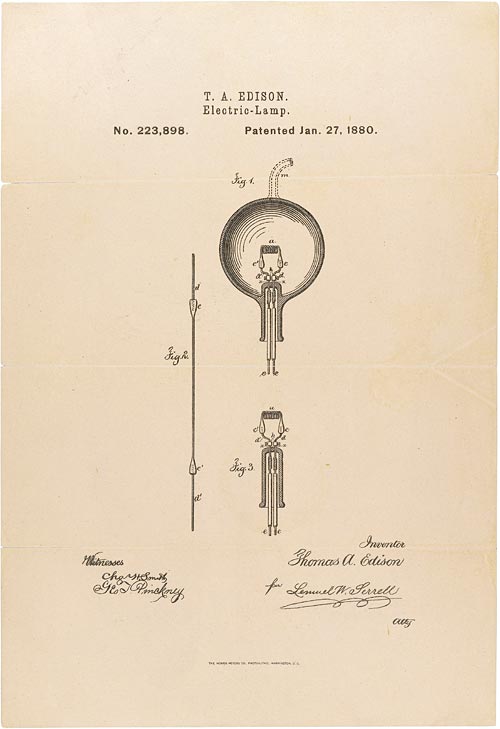
This piece is Thomas Edison’s Patent Application for the Light Bulb. The patent was approved on January 27,1880. Thomas Edison is an inventor credited with innovations in electricity, film, and sound recording devices. A common misconception is that the light bulb was discovered by Edison. This is a debated topic, but this patent specifically is for improvement of the lightbulb.¹ Edison’s light bulb was safer and more efficient than existing models. Edison is credited with 1,093 patented inventions. Prior to Edison’s bulb, much of the luminescence was provided by candles, gas lamps, or oil lamps. These provided inferior light output and posed a higher fire and burning risk. Edison’s bulb permitted businesses to remain open longer, factories to operate later, and increased worker productivity.² It also provided advances in medicine and healthcare and it provided the basis for advanced medical imaging.³ The bulb also permitted better lighting and allowed surgeons to operate under better conditions. Edison’s invention of the bulb helped turn cities into the lit up spectacle we still see today. The bulb therefore directly contributed to industrialization, permitting industry to function after hours. It also contributed to social life, allowing for people to interact after hours. It gave rise to urban life as we know it today. As Michael states in his analysis, “The first church, post office, and ship were illuminated in 1892. The first hotel, theater, and electric sign was in 1893,”.³
The historical context behind the creation of the light bulb comes from understanding the period of American History Edison lived during. Prior to Edison, inventors such as Humphrey Davy and Nikola Tesla experimented with lighting as well.⁴ The 1800s are known for the Industrial Revolution. During this time, the United States was undergoing rapid industrialization with larger significance for factories and demand for skilled laborers or workers. It was also known for innovation and inventions such as the steam engine, vulcanized rubber, and sewing machine.⁵ Furthermore, during this time period, railroad networks grew in complexity and expanded across the country. This connected various economic markets and allowed economic growth. Immigration increased as people arrived to work in industrial centers, leading to rapid urbanization.
From the patent itself, we can see how patents have evolved. Today, patents can be several pages long and carefully articulate the inventor’s work. Patents often involved highly detailed computerized drawings. Edison’s visual was a hand drawn annotated sketch. Patent numbers are sequential, and Edison’s Light Bulb’s patent number is 223,898. This gives us an idea of how many patented inventions existed prior to Edison’s. There are also two named witnesses to his patent, signed at the bottom left of the patent. His sketch describes a spiral filament encased by a larger glass bulb.
This patent is a glimpse into innovation and its role in American History. It shows us the value of technology and experimentation. Edison’s improved light bulb transformed industry, urban life, healthcare, and everyday living conditions. Edison’s patent is an important document and illustrates how innovation contributed to the modernization of the United States.
Footnotes:
1.Thomas A. Edison 1880. Patent Application for an Improvement in Electric Lamps. National Archives and Records Administration. Accessed April 3, 2026. https://www.archives.gov/milestone-documents/thomas-edisons-patent-application-for-the-light-bulb.
2.Peter Andrews. “Thomas Edison and the Invention of the Light Bulb.” School Librarian, Winter 2024, 57. Gale Literature Resource Center (accessed March 28, 2026). https://link.gale.com/apps/doc/A873614525/LitRC?u=setonhallu&sid=ebsco&xid=f2c912d9.
3.Michael E. Moran “The light bulb, cystoscopy, and Thomas Alva Edison.” Journal of Endourology 24, no. 9 (2010): 1395+. Gale Academic OneFile (accessed March 28, 2026). http://dx.doi.org/10.1089/end.2010.0420
4.David W. Ball “Fluorescent Lights: In the Past, I’ve Done Columns on Source Lamps and Light-Emitting Diodes (LEDs), but There’s One Kind of Light That Is Becoming More Popular in Our Everyday Lives–the Fluorescent Light. Here, We’ll Look at How These Lights Are Different, Spectroscopically, than the Old-Fashioned Incandescent Light Bulb.” Spectroscopy 27 (9): 24. EBSCOhost (accessed March 28, 2026). https://research.ebsco.com/c/dq7v4l/viewer/pdf/wj4n64d4uz
5.David E. Shi, Ramey Berry, Joseph Crespino, and Eric H. Murrell. 2025. America: A Narrative History. 13th ed. New York City: W. W. Norton & Company.