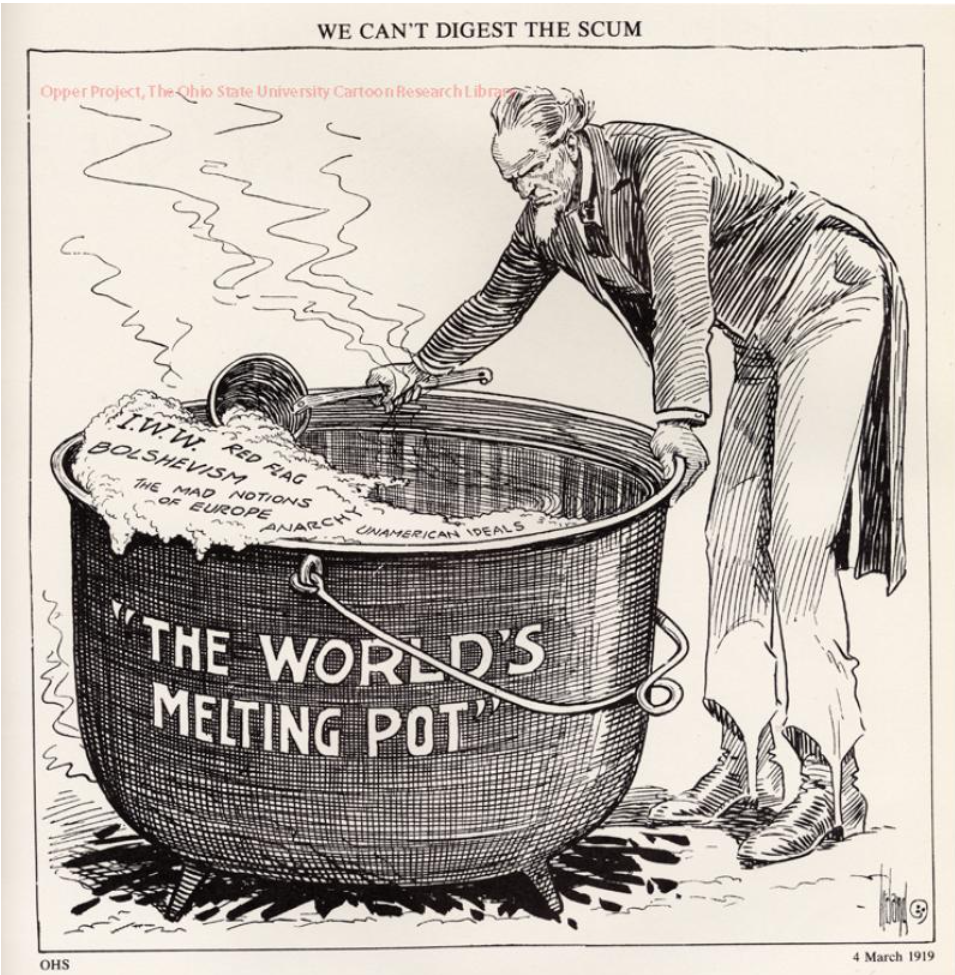
The “We Can’t Digest the Scum” political cartoon was created by Billy Ireland on March 4, 1919. There is a tall, slender man, known as Uncle Sam, who is a symbol of America. Uncle Sam is seen leaning over a giant sizzling pot with a ladle in his hand. The pot is labeled “The World’s Melting Pot” and Uncle Sam seems to be stirring around the “soup” that contributed to the Red Scare. The soup has many different phrases that include “I.W.W., Red Flag, Bolshevism, The Mad Notions of Europe, Anarchy, and Unamerican Ideals.” Uncle Sam seems to be using the ladle to try and skim off the “scum” since it is unwanted in America. By showing Uncle Sam skimming the “scum”, the cartoon suggests that the immigrants and their political beliefs are impurities that America should not and could not assimilate. This highlights the cartoon’s anti-immigration viewpoint, which presents radicals and foreigners as dangers that should be eliminated from the country rather than be integrated into the country. This political cartoon was created during the First Red Scare which lasted from 1917 to 1920. Many Americans feared communism, socialism, and radical unions following the end of World War I and the Bolshevik Revolution. After the war happened, a wave of labor strikes and bomb scares in the United States emerged.
When World War I ended, Americans in society looked forward to having peace and security. However, they got the opposite. Tensions rose between the years of 1919 and 1920 with the fears of immigrants, radicalism, and a Bolshevik revolution. Billy Ireland’s cartoon reflects and reinforces these anxieties. His point of view is clearly nativist. He views radical political ideas, and the immigrants linked with them as contaminants that America cannot “digest”. By depicting Uncle Sam skimming off the scum, Ireland believes that these individuals and ideas do not belong in the nation and must be removed. He also believes that not only is it difficult to assimilate these immigrants into society, but it is a danger and threat to the country’s identity by polluting American society. The cartoon’s theme, which supports the idea that such measures were necessary for national security, fits well with the current political environment of the First Red Scare.
During this time as well, a communist party was formed in the United States that wanted to overthrow the government. Although it seems like this would be part of the Red Scare, communism posed no real threat to America.[1] Attorney General A. Mitchell Palmer led the Palmer Raids during this period, which resulted in the detention of thousands of alleged radicals, many of whom were law-abiding immigrants. Without being given a chance to defend themselves, hundreds were deported. Instead of the peace and stability that Americans had anticipated for after World War I, they saw riots, strikes, inflation, and a general fear of foreign dangers. A lot of the panic faced by the Americans was driven by suspicion and anxiety rather than by real danger. Most of their hostility toward radicals was a disguise for their hostility toward immigrants.[2]
The cartoon highlights the extreme nativism of the time, which held that immigrants from Eastern and Southern Europe, like the Italians and Russians, were not completely American and posed a threat to the nation from within, by depicting radicals as dirty waste that America cannot “digest.” All things considered, “We Can’t Digest the Scum” is a potent illustration of how fear influenced popular thinking. The cartoon makes the argument that some groups did not belong in American culture at all, rather than encouraging togetherness. The prejudice, paranoia, and need for control that characterized the First Red Scare are clearly shown. These fears are reflected in this cartoon. Billy Ireland implies that immigrants with socialist or anarchist views would never fit in with American culture by depicting radical ideas as “scum” rising to the surface of the nation’s melting pot. Rather, they were contaminating it. Additionally, the foam rises to the top, suggesting that harmful concepts were emerging and needed to be eliminated. Uncle Sam’s straightforward act of skimming the pot represents censorship, deportations, and government efforts to “clean up” the nation. As Jennifer Keene writes, these anxieties inspired real government action, including monitoring, raids, and deportations of suspected radicals which completely reflects the cartoon’s image of Uncle Sam removing the “scum.”[3]The cartoon served as justification for the government’s drastic actions and promoted popular support for the expulsion of radicals, immigrants, and labor organizers. Despite the Red Scare calming down in the summer of 1920, Americans saw it as a call to fix society to make it “100% American” and an improvement in the efforts to keep immigrants out.[4] This was reflective in strict immigration laws in the early 1920s that limited the entry of immigrants from Eastern and Southern Europe.
This political cartoon was intended to increase public fear and encourage society and the government to take initiative to remove immigrants and radicals from society. Americans were panicked about everything happening in society and Billy Ireland portrays these fears as dangerous waste contaminating the American melting pot. This cartoon depicts clearly how fear and nationalism shaped America’s attitudes on issues of immigrants, radicals, and much more. It also depicts how fear shaped policy and normalized harsh responses towards people who were seen as threats to America’s society.
[1] David Colburn, “Governor Alfred E. Smith and the Red Scare, 1919-20.” Political Science Quarterly 88, no. 3 (1973): 423-424
[2] Mark Ellis, “J. Edgar Hoover and the ‘Red Summer’ of 1919,” Journal of American Studies 28, no.1 (April 1994): 39-42
[3] Jennifer Keene, “A Brutalizing War? The USA after the First World War,” Journal of Contemporary History 50, no.1 (January 2015): 82-86
[4] David E. Shi, America: A Narrative History, Brief Twelfth Edition, vol. 2 (New York: W. W. Norton, 2022), 924