 By Anna Sophia Lulkin
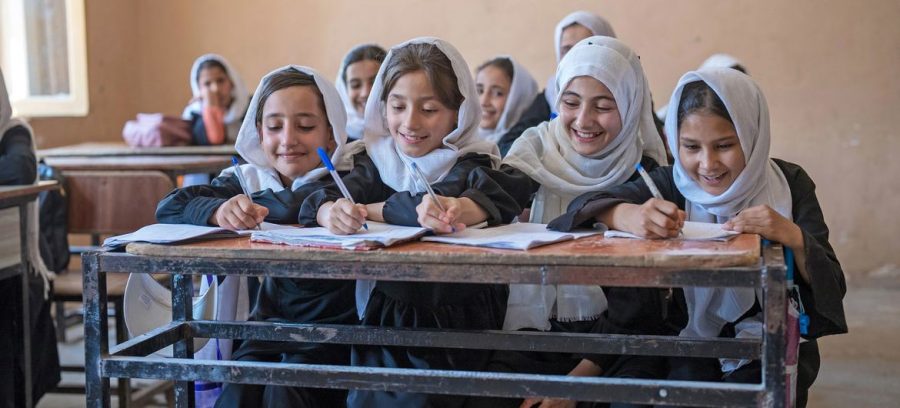
Last summer marked the four-year anniversary of the Taliban’s return to power in Afghanistan, a significant moment yet the start of an ongoing crisis for millions of Afghan women and girls. Since then, they have been systemically stripped of their rights, with one of the most devastating consequences being no access to a quality education. This is further deepening the immense gender inequality that has long plagued Afghanistan. Womens’ voices are being silenced, their identities being pushed into the shadows, and their presence being erased from public life – attempting to wipe their entire existence from society.
Despite the international community’s commitment to Gender Equality and Quality Education outlined in the United Nations’ Sustainable Development Goals, the Afghan government, currently under de facto control of the Taliban, continues to implement policies that repress females and deny them their right to learn.Since 1948, the Universal Declaration of Human Rights has declared that education is a fundamental right and not a privilege. Yet, as of 2022, the literacy rate among Afghan women and girls remains alarmingly low at only 22.6%, with rates in rural areas even lower. Depriving half of the country’s population the opportunity to write, read, and actively engage in society is not merely a longstanding cultural norm. It is a deliberate policy choice, one that demands immediate opposition and pushback.
Alhaj Mawlawi Habibullah Agha, Afghanistan’s Minister of Education, not only has the authority to address this humanitarian crisis, but the obligation to. This issue demands immediate action: first, by reinstating and empowering the Ministry of Women’s Affairs; and second, by substantially increasing investment into the Special Trust Fund for women’s education. Without these essential institutional and financial supports, Afghan girls will remain prohibited from entering classrooms and denied the ability to control their own futures.
When women are uneducated, they are unable to achieve economic independence and are left vulnerable to abuse, child marriage, premature childbearing and health issues – physical and mental. Many are susceptible to staying in situations of domestic abuse, forced to rely on the men in their lives, such as their husbands, fathers, or brothers for survival. A new ‘morality law’ imposed by the Taliban requires females to be accompanied by a male escort whenever they leave their homes; furthering intensifying their dependence. This law has resulted in a rise of suicide attempts among Afghan women and girls as well as disturbingly higher levels of domestic abuse. According to the Afghanistan Gender Country Profile 2024, 92% of Afghan women have experienced violence at least once, and 8% of Afghans report knowing a woman or girl who has attempted suicide.
The first option is reinstating the Ministry of Women’s Affairs, a vital institution that once provided necessary support for girls and women, is critical. It will offer a safe platform for advocacy of women’s rights and enable the creation of curriculum that uphold the rights women and girls have of a quality education.The second is to reallocate resources to the Special Trust Fund for women’s education in Afghanistan. This fund supports programs that teach literacy, numeracy, and income-generating skills, enabling women and benefiting entire communities. A strategic investment in this fund would target the regions that are most in need, promoting and fostering long-term advancements in public health, gender equality, and economic growth.
Critics may argue that reinstating the Ministry of Women’s Affairs or increasing funding into the Special Trust will face strong opposition from conservative factions or be viewed as simply a symbolic gesture. There are concerns of security threats for the women and educators, the possibility of misuse of funds, as well as restrictions and limitations on curriculum. While this is all valid, the consequences of not acting are much worse.
For this reason, my recommendation of a combined strategy, rebuilding the Ministry of Women’s Affairs while simultaneously strengthening the Special Trust fund, is the most efficient and effective plan of action. This approach maximizes both institutional support and financial flexibility, giving women and girls the opportunity to exercise their right to learn.
Some may claim that reform is unrealistic under Taliban control and contend that the international pressure has little to no influence on the country’s policies. Although these concerns are understandable, real change often starts with small steps forward. The road ahead will not be easy and resistance is inevitable, particularly in a repressive nation such as Afghanistan. However, working with religious leaders and policy makers that maintain significant influence in their society is monumental in order to portray a positive image of female education. This will illustrate the notion that education aligns with Islamic values and is beneficial to individuals as well as society as a whole.
Although strong opposition to these efforts is likely, the alternative is stagnation, which will not only hurt the Afghan women and girls now but future generations as well. Afghan girls were forced out of schools and into silence when the Taliban regained control of the country. The international community must prevent this from becoming normalized and immediately act. Afghanistan’s Ministry of Education has the capacity to help rebuild and reshape a better future for Afghan women and girls by reinstating the Ministry of Women’s Affairs, funding the Special Trust fund for women’s education, and working with religious leaders. Women and girls deserve the right to learn and the opportunity for freedom!
About the Author
Anna Sophia Lulkin had been a School of Diplomacy student who participated in the UN Field Seminar course in the Spring 2025 semester.