Overview
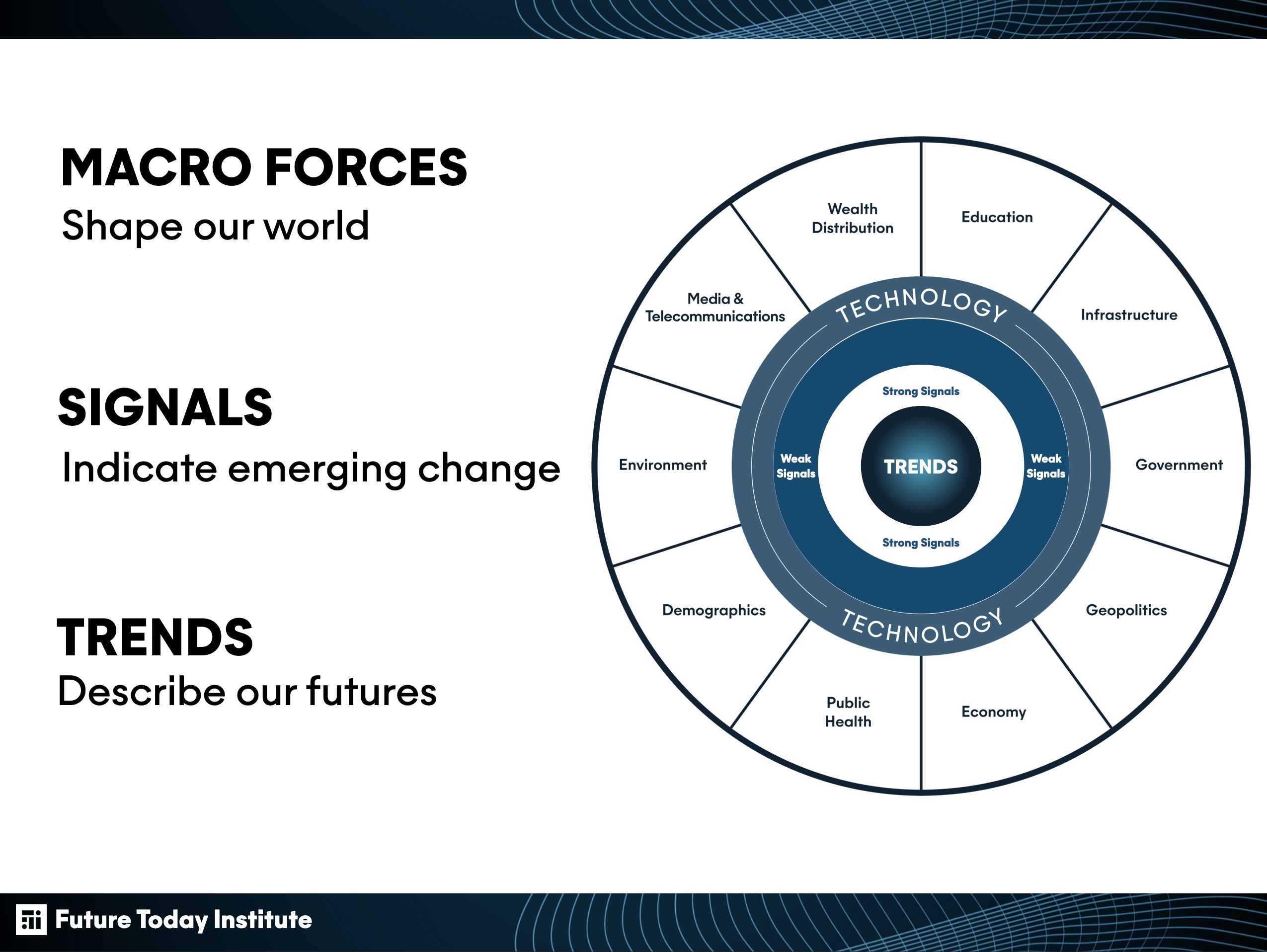
As described by the Future Today Institute, signals help proclaim emerging changes within a society. They can be seen through the impending trends which describe what the future has in store and through the macro-forces which construct our world by way of shifts. Each analysis will present a clearer picture and understanding of its relation to the topic of cybersecurity.
Education
Cybersecurity education should be implemented in classrooms at a young age, due to the growing number of children being introduced to the internet and digital devices as infants. Many kids are allowed to use smartphone devices and different applications as ways of distraction, while some children gain access to the internet in private and without parental permission; 86% of girls ages 12-17 state their parents have no knowledge of their online chat usage. Lower and higher levels of education must adapt to the growing numbers of young individuals working with technology with the aim to protect their overall safety online. Through the preventative efforts of teaching students about good cybersecurity practices, these kids are able to assess different risks and know what to do in the event of a problem.
As more and more schools begin to implement strategies to teach education in the classroom setting, more of their graduating students could develop a career in cybersecurity which can slowly bring a rise in the number of professionals in the field; it can also be a gateway to other jobs in STEM. Additionally, the education space could be better fixed to stop future attacks from happening in this industry. The one problem that involves a necessary fix before educating students on cybersecurity is educating the teachers, as most of them have no prior knowledge of the subject.
Infrastructure
Global infrastructure is greatly at risk for cyberattacks with cybersecurity efforts substantially needed in all industries. In the act of hacks becoming more sophisticated and complex, cybercriminals are looking to gain financial, political, and military gain. Each sector is highly targeted, but many experts are looking closer into the future of cyberattacks in these key areas: energy, transportation, public services, telecommunications, and critical manufacturing sectors. In a study completed by McKinsey & Company, key insights into the future of the cybersecurity market were looked at in closer detail, each of them contributing significantly to what the future of infrastructure will look like:
- 15% annual increase in costs related to cybercrime
- 85% of small and midsize enterprises intend to increase IT security spending until 2023
- 3.5 million cybersecurity positions open worldwide
- +21% forecast of compound annual growth for direct cyber insurance premiums until 2025
These trends signify a substantial change to the market, which in turn, greatly affects critical infrastructure. In order for those in infrastructure to respond to these changes, they must assess their business models in order to implement various encryptions to limit impending attacks as well as infrastructure scanning.
Government/Geopolitics
Although many government officials still lack an understanding of cybersecurity, they understand there is a need for implementation in different sectors of our economy. Many nations prepare for the wave of attacks and security breaches as they continuously are rising.
- Australia just developed a “federal cybercrime centre” costing AU $89 minion in order to prevent further scams, frauds, and data breaches from occurring to Australian citizens.
- Nigeria and other African countries worry about the potential for attacks as the Russian and Ukrainian fight persists. As many drones are utilized as weapons throughout the Horn of Africa, officials fear they can be easily compromised. These nations ultimately fear hybrid warfare.
Some nations view themselves on the side of cutting technology in order to tackle cybercrime, while others lack the necessary tools to use as a defense. typically, countries with more wealth have access to advance their operations, creating a power hierarchy in a sense in addition to political advantages. The top ten countries according to the National Cyber Power Index indicate how the wealthiest of countries are presented with the best resources to advance their cybersecurity efforts. These countries are listed below:
An important note when looking at this list is to consider cyber power in commerce and cyber-surveillance power, where China is the most powerful.
Economy
The economy is impacted heavily by cybersecurity, with cybercrime losing around $300 billion to $1 trillion in the world’s economy; that statistic makes up 0.4% to 1.4% of total GDP. As much of the economy is made up of small businesses, greater future attempts need to be made in order to lower the number of attacks happening. This will overall improve the economy but will take more time, if possible, to see the statics lower. One recent initiative directed towards smaller businesses was the recent action taken by Coro banks, which resulted in bringing $60 million in artificial intelligence-based cybersecurity to small businesses. Overall, the goal of this action was to increase company growth in the future while offering better solutions to other businesses. Although the negative consequences are apparent, the adoption of cybersecurity establishes new, high-paying job opportunities, although it is difficult to find individuals for those jobs.
Public Health
As healthcare is aimed at helping individuals, the cybersecurity measures taken by healthcare facilities can ultimately harm individuals, as their data is often leaked due to improper cybersecurity steps. The public health sector has greater improved with modern technology but needs to tackle fighting cyber attacks in order to remain afloat. “Researchers have found that the average healthcare organization spends about 5% of its IT budget on cybersecurity while the rest is devoted to the adoption of new technologies.” The recently introduced Healthcare Cybersecurity Act brings light to the issue of cybersecurity in the public health industry. Ultimately, it is up to the organization to make changes to its existing structure, but it must remain vigilant about these upcoming attacks.
Demographics
Much of our world is focusing on advancing diversity in many industries, as this also includes the cybersecurity industry. Those individuals which diverse backgrounds sometimes find it difficult to start in an industry where they feel underrepresented, so it is crucial to incorporate a workplace that is a safe and comfortable space. As statistics point out, the global population accounts for roughly 50% of women while the cybersecurity industry is represented by 11% of women in the United States. In roles of a director or above, women are only seen filling 4% of those positions. For a future increase in diversity, especially amongst women in cybersecurity, greater training efforts need to be produced in classrooms, whether it be in higher levels of education or lower levels of education. Additionally, more women must become elected to high-level positions in order to indicate representation in the cybersecurity industry.
Environment
Typically, cybersecurity attacks are viewed as creating harm that can be detrimental to our well-being online, but many individuals do not think of the physical repercussions it can cause to the overall environment. Cybercrime can leave an impact, especially on the infrastructure level. This can be seen through the water and energy sector, as hackers are able to infiltrate these areas often, ultimately leading to greater problems within our economy and environment. In a potential future hack to our water system, a hack could put unwanted material in it or result in producing water that was never filtered. Ultimately, this could lead to pollution and a public health crisis if the water was unsuitable for drinking. As many individuals in the United States rely on these industries, it would be difficult for these possible attacks not to harm individuals at an alarming rate. With the 153,000 public drinking water infrastructure systems, 80% of United States citizens receive water from them. This is similar to the 75% of citizens that rely on the 16,000 public wastewater districts as wastewater services. It is highly possible for a situation to occur in these infrastructures, so making individuals educated on the possibility of these attacks show the importance of cybersecurity for our overall environment as well as people’s health.
Media & Telecommunications
As many are recently concerned with false narratives or “fake news” being spread, especially through online/social media platforms, the importance of factual information is vital. For cybersecurity, the importance comes with the message actually being placed in the news, as so many sources do not view it as significant enough information to tell. As stated, “for most individuals, cybersecurity comes once a year when someone on TV tells them to change their passwords, use a VPN in a coffee shop, or to be careful opening emails with attachments,” exposing a simple message which does not resonate with most people. As the Russian and Ukrainian conflict picked up, many employers, governments, and schools urged individuals to focus on the individual impact on keeping themselves safe, which appeared to be a one-time occurrence for some of those institutions. In order to change this lack of awareness of cybersecurity, more individuals should be mandated to learn about it in training for jobs or educational settings.
Wealth Distribution
The dependency of our world on technology partnered with the imminent rise in cybercrime ultimately affects the wealth distribution in a nation. With inequalities amongst individuals accelerated by the Covid-19 pandemic, the topic becomes more and more prevalent. In one’s understanding of cybersecurity, individuals are able to view the overall high costs of cybersecurity measures taken by the government, along with the high costs associated with attacks. As the middle class, a group slowly becoming smaller as the rich get richer and the poor become poorer, ends up becoming targeted by hackers, their ability to survive becomes a great issue socioeconomic issue. This is directly correlated to ransomware attacks.