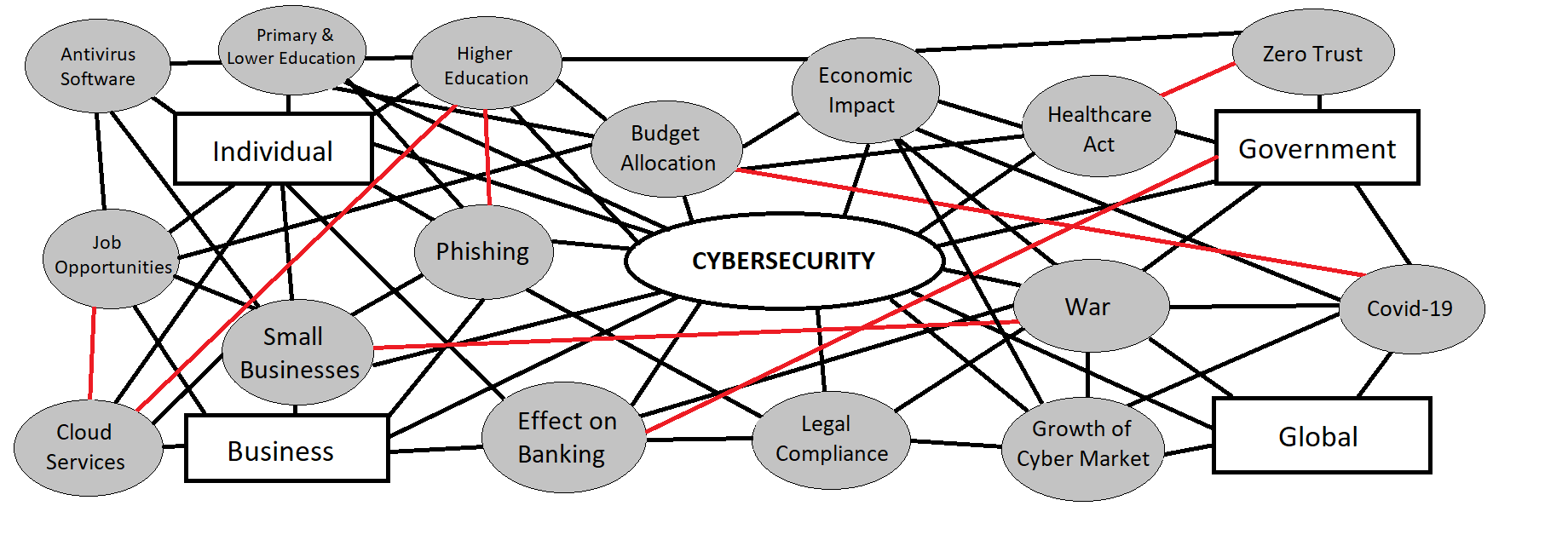
In order to project trends, the fringe sketch is vital. The intent behind this sketch is directed toward understanding the overall concepts that surround cybersecurity and learning about future emerging trends in the field. The fringe sketch is depicted as a web that is meant to connect or “weave” each concept to indicate that each part of cybersecurity works together; the sharp, black lines signal direct or primary connections while the red lines signify secondary connections. With technology being one of the key drivers of society, cybersecurity along with cyber-attacks continue to advance at a tremendous rate and will only continue to grow into the future. The impacts of cybersecurity have a firm hold on every area of the world, regardless of it being on the individual, governmental, business, or global level. Each aspect of cybersecurity is easily connected to another sector, further illustrating the level of complexity of cybersecurity as well as cybercriminals. As our global society becomes more and more digitally engrossed, it is important to look into preventative measures to protect our digital privacy. The environment we live in challenges us to focus on learning the preventative measures needed to secure our data from hackers and the rest of the outside world.
Having cybersecurity and all of its elements be so crucial to our everyday lives, whether you chose to recognize that or not, has caused massive disruption to so many industries across the globe and has provoked many questions for the future. Starting from the individual scale, inquiring about the future helps individuals see what could potentially lie ahead for network security: How could everyday people focus on maintaining their sense of privacy? Is having actual privacy even attainable? How will antivirus software prevent hacks and attacks from taking place in the future? Why should people care about cybersecurity? How can the world get people to understand the need for taking cybersecurity measures? How will education systems implement cybersecurity and data privacy into their curriculum? How can the education systems even protect themselves against data breaches? What can prevent individuals from falling victim to the growing number of phishing attacks? Why should more and more people look into getting jobs in cybersecurity and technology? In what ways can individuals hold companies and government agencies accountable for securing their information against hackers?
The questions provoked on the individual side help provoke thought in terms of our government. Especially with the new administration coming into office, the talks surrounding cybersecurity have been made more public, as President Biden aims to put cybersecurity at the top of his concerns as depicted when he signed into law the Cyber Incident Reporting for Critical Infrastructure Act. Why should the government be held accountable for protecting its citizens against nationwide and worldwide hackers? Does the government truly understand how to stop attacks or data breaches, or even cyber warfare? What repercussions would take place for cybercriminals? Will zero trust be crucial to stopping cyber-attacks in the future? Will the Healthcare Act be a pivotal component to the future of cybersecurity? What kind of economic impact could all of this pose in a few years? What will be the government’s response to the economic turmoil to a future network security problem? How can certain budgets be allocated to help individuals learn more about this issue?
Businesses are on the opposite side of the government as they tend to focus more on maintaining profits and driving sales for their company. How can the government or individuals change this mindset in the future? How does this point of view negatively impact the employees of a business? What could different industries do to further stop phishing attacks within their sectors? In the future, what impact will cloud services play in all of this, if it does not do so already? What could be potential outcomes to the banking sectors if cybersecurity is not taken seriously? As small businesses continue to be targeted, how can budgets be properly allocated to help small business owners achieve the funds needed to protect themselves along with their data? How can we address the issue of workers within the cybersecurity industries as job opportunities continue to increase? With factors like the recent pandemic and the great resignation of workers, how can more and more businesses have network security?
On the global scale, other problems arise. Why should individuals see the war between Ukraine and Russia as a cybersecurity wake-up call? How will the future of war look? What factor has Covid-19 played in all of these aspects? What will the growth of the cyber market look like in years to come? How much will these industries grow and dominate? Which governments will implement strategies that focus on cybersecurity? What are the international legal implications of tracking cybercriminals? Will legal impacts even be helpful considering the difficulties tracing online hackers?
These are just a fraction of the questions that could be posed regarding the future of cybersecurity.