
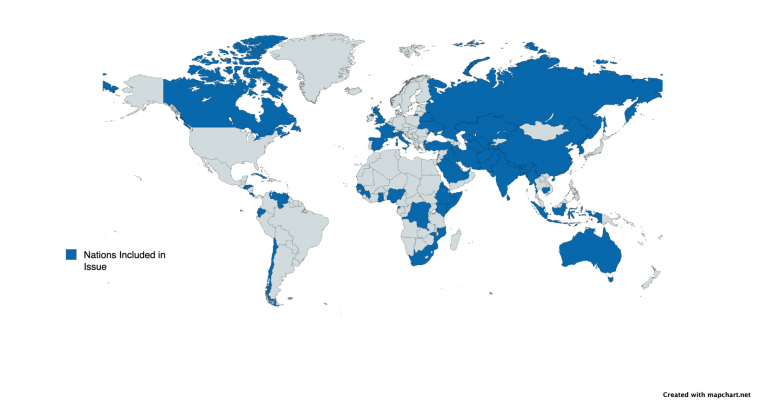
East Asia & the Pacific
Australia: Australian trade in jeopardy as Middle East ‘war risk’ costs surge
ABC News (Australia)
Australian exporters are struggling to get products into the Gulf and further into Europe as the war in the Middle East continues. They are facing increased costs due to emergency freight surcharges. Economists say surging shipping costs will be passed onto consumers, pushing inflation further and raising the risk of higher interest rates.
Cambodia: Cambodia protests Thailand’s ‘illegal’ constructions around Preah Vihear and contested areas
Khmer Times (Cambodia)
Phnom Penh lodges a formal objection to the ‘unlawful’ development activities of Thai forces in border areas, warning the activities defy international rulings and risk deepening the long-running feud between the two neighbors.
China: China and US begin fresh round of trade talks in Paris
South China Morning Post (Hong Kong)
Senior officials from China and the United States have started a new round of trade talks in Paris, as the two sides seek to pave the way for US President Donald Trump’s expected visit to Beijing later this month.
Indonesia: Indonesia delays D8 summit as Mideast war rages on
The Jakarta Post (Indonesia)
Jakarta decided to postpone the summit of eight Muslim-majority developing countries grouped under the D8 Organization for Economic Cooperation, which was scheduled to be held in mid-April, due to the ongoing conflict in the Middle East.
Myanmar: Mideast war risks dramatically deepening Myanmar crisis: UN expert
Myanmar Now (Burma)
Myanmar’s spiraling rights and humanitarian crises risk getting “much worse” as global attention focuses on the Middle East war and aid dwindles further, the top United Nations expert on the Asian country warned.
North Korea: Russia shares technical standards with North Korea, a boon for cooperation
NK News (South Korea)
North Korea has acquired access to a Russian database of international technical standards that covers everything from programming languages, railway systems and cement to Vietnamese noodles, a potential boon for economic and military cooperation between the two sides.
Singapore: Singapore’s energy is secure despite disruptions from Middle East conflict: Tan See Leng
The Straits Times (Singapore)
Singapore’s energy supply is secure despite Middle East conflict-related price increases, with “four lines of defence” including diverse natural gas sources. Singapore and Japan agreed to deeper collaboration in areas such as cross-border electricity imports and low-carbon technologies. Singapore diversifies its energy portfolio, investing in solar energy, while exploring nuclear energy options to enhance resilience.
South Korea: Seoul under pressure as Trump calls for naval support in Hormuz
The Korea Herald (South Korea)
South Korea faces growing pressure to contribute naval forces to safeguard shipping through the Strait of Hormuz after US President Donald Trump called on major oil-importing countries to help keep the vital energy corridor open, placing Seoul at the center of a widening geopolitical test.
Europe & Eurasia
Belarus: ICC prosecutor opens probe into Belarus over deportations into Lithuania
Al Jazeera (Qatar)
Prosecutors at the International Criminal Court (ICC) have opened an investigation into Belarus over the suspected forced deportation of government opponents. The ICC prosecutor’s office said on Thursday that it had found “a reasonable basis to believe crimes within the jurisdiction of the Court have been committed.”
Europe: European leaders reject military involvement in Strait of Hormuz
Al Jazeera (Qatar)
Leaders and officials from the Germany, Greece, the Netherlands, and other countries stated there would be no consideration of involvement of their respective militaries in the Strait of Hormuz, while countries like Lithuania and Estonia emphasizes the need for greater clarity about the US’s goals in the region before their governments would offer military support.
France: France threatens to block funds for India over climate inaction
France24 (France)
France’s ecological transition minister Monique Barbut said that the European Union should take a firmer stance against climate inaction and favor a “more transactional” approach in negotiations with emerging economies, highlighting a planned package of 500 million euros to be sent to India under the EU’s larger climate goals.
Italy: Italy ruling tells millions with Italian roots they have lost the right to citizenship
CNN (United States)
On Thursday the Constitutional Court said it would rule in favor of the government and its controversial 2025 law that restricted citizenship for those born abroad. The law, which was issued last March via emergency decree, had been challenged by four judges, who questioned its constitutionality.
Russia/Kenya: Kenya and Russia agree no Kenyans will be recruited for Ukraine war
Al Jazeera (Qatar)
Russia has agreed to stop recruiting Kenyan citizens to fight with its army in Ukraine, Kenya’s foreign minister has said. More than 1,780 citizens from 36 African countries are believed to be fighting alongside Russian soldiers in Ukraine, according to Ukraine’s estimates in February.
Spain: Spain’s King Felipe VI acknowledges that there were ‘many abuses’ in the colonization of America
El Pais (Spain)
Spain’s King Felipe VI acknowledged on Monday morning, during a visit to the exhibition Half the World: Women in Indigenous Mexico, organized jointly by the Spanish Ministry of Foreign Affairs and the Mexican Ministry of Culture, that “there was much abuse” during the colonization of the Americas by the Spanish conquistadors.
Turkey/Iran: Iran “not taking responsibility” for missile fire on Turkey
France24 (France)
Turkish Foreign Minister Hakan Fidan said he had spoken with his Iranian counterpart Abbas Araghchi after NATO defense systems on Friday shot down another ballistic missile from Iran, the third in nine days, and the country still claims no involvement in the attacks.
Ukraine/United States: Sean Penn Skipped Oscars to Meet President Zelenskyy in Ukraine
Variety (United States)
The Ukrainian leader posted a photo of them together on X, thanking the actor and activist. Penn had previously made comments about the importance of film activism highlighting modern conflict, and had previously worked on documentary work about his encounters with Zelenskyy.
United Kingdom: UK plans to send minesweeping drones to reopen strait of Hormuz
The Guardian (United Kingdom)
Ministers are drawing up plans to send minesweeping drones to the Strait of Hormuz amid concerns in Whitehall that complying with Donald Trump’s demand to send ships could escalate the crisis.
Near East
Iran: Iran’s new supreme leader vows to block Strait of Hormuz in first statement
BBC (United Kingdom)
Iran will continue blocking the Strait of Hormuz, the world’s busiest oil shipping channel, according to a statement attributed to Iran’s new Supreme Leader Mojtaba Khamenei. His message was broadcast on Iranian state TV, but Khamenei did not appear in person. His message was instead read out by a newsreader.
Iran: U.S. at Fault in Strike on School in Iran, Preliminary Inquiry Says
New York Times (United States)
An ongoing military investigation has determined that the United States is responsible for a deadly Tomahawk missile strike on an Iranian elementary school, according to U.S. officials and others familiar with the preliminary findings. The Feb. 28 strike on the Shajarah Tayyebeh elementary school building was the result of a targeting mistake by the U.S. military, which was conducting strikes on an adjacent Iranian base of which the school building was formerly a part, the preliminary investigation found. Officers at U.S. Central Command created the target coordinates for the strike using outdated data provided by the Defense Intelligence Agency, people briefed on the investigation said.
Iran: Iran-linked group says it hacked US company in retaliation for Minab school bombing
The Guardian (United Kingdom)
An Iran-linked group said it hacked a US medical company, causing “global disruption” to its systems, in retaliation for the bombing of the Minab school in Iran, in an attack seen as widening the Middle East into the cyber realm. Handala, a hacker group, claimed responsibility for the attack on Wednesday on the Stryker Corporation, which makes medical devices and is based in Michigan. It affected thousands of employees using the company’s Microsoft systems.
Iraq: All 6 U.S. crew members killed after refueling plane crashes in Iraq
NBC (United States)
All six U.S. crew members have been confirmed dead after their military refueling plane crashed in Iraq while taking part in Iran war operations, the U.S. military said Friday. U.S. Central Command said in a post on X early Friday that the KC-135 plane went down at approximately 2 p.m. ET Thursday in western Iraq, with four crew members initially confirmed dead. That statement said “rescue efforts continue.” In a subsequent post, CENTCOM confirmed that all six crew members “are now confirmed deceased.”
Lebanon: UN warns of widening crisis as Israeli attacks displace 816,000 in Lebanon
Al Jazeera (Qatar)
Lebanon faces “a moment of grave peril” as Israel continues to launch deadly attacks across the country, forcibly displacing hundreds of thousands of people, the United Nations humanitarian chief has warned. Speaking to the UN Security Council in New York on Wednesday, Tom Fletcher said “mass displacement is accelerating” across Lebanon as a result of the Israeli attacks.
Saudi Arabia: Saudi Arabia cuts oil output 20% to 8 million bpd amid Iran war, sources say
Reuters (United Kingdom)
Top oil exporter Saudi Arabia has cut oil production by some 2 million barrels per day to around 8 million bpd after reducing output from two major offshore fields amid the Iran war, two sources told Reuters. Middle East Gulf oil producers have had to shut vast volumes of production due to the blocking of the Strait of Hormuz, a narrow waterway between Iran and Oman, since the U.S. and Israel began airstrikes on Iran on February 28. Iran has said the world should prepare for oil prices at $200 a barrel.
United Arab Emirates: Tourists, expats and influencers detained in UAE over digital content showing Iran war impacts, activist says
CBS (United States)
A growing number of social media users, including foreigners, are facing charges in the United Arab Emirates under the Gulf state’s broad cybercrime laws for sharing or possessing digital content that depicts or comments on the impact of ongoing Iranian attacks, the advocacy group Detained in Dubai has warned. The arrests highlight the strict regulations around online content in the UAE, which has expressly forbidden anyone from taking or sharing imagery that shows Iranian drone or missile impacts or efforts to intercept the weapons.
Sub-Saharan Africa
DR Congo: UN aid worker killed in drone strike in Goma
Al Jazeera (Qatar)
A French UNICEF employee, Karine Buisset, and two civilians were killed when a “combat drone” hit a residential building in the city of Goma. M23 rebels, who currently control the city, blamed the Congolese government for the attack, while the Congolese military recently reported downing two Rwandan drones in the same region.
DR Congo: Over 200 killed in massive landslide at Rubaya coltan mine
Al Jazeera (Qatar)
A landslide triggered by heavy rains has killed more than 200 people, including approximately 70 children, at the strategic Rubaya coltan mine in eastern DRC. While miners have recovered over 200 bodies, the M23 rebels who control the site have disputed the death toll, claiming the collapse was caused by “bombings” rather than rain.
Ethiopia: Heavy rainfall and landslides kill at least 64 in Gamo Zone
Al Jazeera (Qatar)
Torrential rains in southern Ethiopia’s Gamo Zone have resulted in at least 64 confirmed deaths, with 128 people reported missing. Most victims were found buried in mud, and regional authorities have urged residents in highland and flood-prone areas to evacuate as the rainy season continues. Scientists warn that human-driven climate change is increasing the severity of such extreme weather events in East Africa, following a similar 2024 disaster that killed over 250 people in the same region.
Equatorial Guinea: Vision 2030 strategy launched to eradicate malaria
The Independent (Uganda)
Equatorial Guinea has unveiled an ambitious $116 million roadmap, Vision 2030, to eliminate malaria within five years. The strategy utilizes next-generation R21/Matrix-M vaccines, drone-based mosquito detection, and potentially genetically modified mosquitoes to interrupt transmission. The plan aims to build on a 75% reduction in malaria prevalence achieved on Bioko Island over the last two decades.
Eritrea: Government denounces Ethiopian claims of troop presence
Ahram Online (Egypt)
Eritrea has rejected accusations from Ethiopia that its troops are present on Ethiopian soil, calling the claims “false and fabricated”. Relations between the two countries remain tense, with Addis Ababa demanding a full withdrawal of Eritrean forces and accusing Asmara of supporting insurgents in the Amhara region.
Eritrea: Satirical cartoonist “Cobra” released after 15 years without charge
allAfrica (South Africa)
Satirical artist Biniam Solomon, known as Cobra, has been released from an Eritrean prison after being detained since 2011. Solomon was held for 15 years without trial or official charge, and the authorities provided no explanation for his release or his decade-and-a-half-long imprisonment.
Ghana: Sliding-scale gold royalty hike sparks industry backlash
DW News (Germany)
Ghana has introduced a new “sliding-scale” royalty system for gold mining, raising rates from a flat 5% to up to 12% when prices exceed $4,500 per ounce. While the government argues the move will recover billions in lost revenue, mining giants like Newmont and Gold Fields warn it could deter future investment and make Ghana less competitive compared to neighboring countries.
Guinea: Ruling junta dissolves 40 political parties, including major opposition
Al Jazeera (Qatar)
The Guinean government has issued a decree dissolving 40 political parties, including the three main opposition groups: UFDG, RPG, and UFR. The move, which strips the parties of their legal status and assets, has been condemned by critics as the final step toward establishing a one-party state under President Mamady Doumbouya.
Mozambique: Minister denies that new telecom rules will restrict internet use
allAfrica (South Africa)
Minister of Communications Américo Muchanga has stated that new telecommunications regulations are intended to fight cybercrime and guarantee state security, not restrict internet use. However, civil society groups and the national Ombudsman have criticized the laws as unconstitutional, warning they could allow for arbitrary internet shutdowns under the guise of national security.
Nigeria: New insurgency corridor emerges in the northwest and central borders
DW News (Germany)
Sahelian militant groups like JNIM and IS Sahel are establishing a presence in the “Kebbi-Kainji-Borgu triangle” bordering Niger and Benin. Experts warn this new corridor allows jihadis to collaborate with local bandits and use ungoverned forest reserves, such as Kainji Lake National Park, as operational bases to stage cross-border attacks.
Senegal: Parliament approves bill doubling prison terms for same-sex acts
Daily Nation (Kenya)
Senegalese lawmakers passed a bill that doubles the maximum prison term for same-sex sexual acts to 10 years and criminalizes the promotion of homosexuality. The legislation, which fulfills a campaign promise by the current government, specifies that “acts against nature” include homosexuality, bisexuality, and “transsexuality”.
Somalia: Government warns against reported Israeli military base in Somaliland
Al Jazeera (Qatar)
Somalia has issued a warning that its territory cannot be used for “external confrontations” following reports that Israel plans to establish a military base in the breakaway region of Somaliland. Mogadishu maintains that the Federal Government is the only legal authority to enter into international security arrangements, while Somaliland officials state they are pursuing a strategic relationship with Israel.
South Africa: Middle East conflict threatens energy security and inflation
The Independent (Uganda)
Strategic researchers warn that the escalating US-Israel-Iran war and the effective closure of the Strait of Hormuz will severely impact the South African economy. With 20 percent of the world’s oil passing through the strait and Qatar halting LNG shipments, South Africa faces a spike in fuel prices and general inflation, potentially requiring a complete reassessment of the national budget.
West Africa: Regional shipping lines risk losing routes to European markets
allAfrica (South Africa)
The maritime industry warns that Nigeria and West Africa risk losing major shipping lines as the Middle East crisis drives up operational costs. Shipping firms face massive War Risk Insurance surcharges, between $3,000 and $4,000 per container, due to the closure of the Strait of Hormuz and risks in the Red Sea.
South & Central Asia
Afghanistan: Afghanistan accuses Pakistan of air attacks on homes in Kabul, Kandahar
Al Jazeera (Qatar)
Afghanistan’s Taliban government has accused Pakistan of targeting civilian homes in overnight air attacks, killing four people in the capital and two in the east, as fighting between the two neighbors entered its third week, overshadowed by the United States-Israel war on Iran igniting the Middle East.
Bangladesh: How much crude oil is in stock, how long can petrol and octane production continue?
Prothom Alo (Bangladesh)
The ongoing war situation in the Middle East along with rising tensions in the Strait of Hormuz has created uncertainty over the movement of crude oil tankers. The situation has become more uncertain after a vessel carrying crude oil from Saudi Arabia’s Ras Tanura terminal was forced to halt its journey.
Bhutan: Government says key election pledges impractical, unveils alternative measures
Kuensel (Bhutan)
At the 25th Meet-the-Press session, the government acknowledged several campaign pledges made during the election that cannot be implemented as originally proposed. This includes the health sector, development of domestic airports, and education loans. With, Health Minister Tandin Wangchuk said the government’s pledge to place a doctor in every gewog was not feasible given the country’s human resources and logistical constraints. Instead, the Ministry of Health has turned into an alternative approach aimed at strengthening primary healthcare services in remote communities.
India: How Israel-US war on Iran puts $50bn in Indian remittances at risk
Al Jazeera (Qatar)
As the United States-Israeli war on Iran completes it has triggered a global energy crisis, but one country could face a double whammy if the conflict intensifies: India, the world’s fourth-largest economy, depends on the Gulf for its energy needs and also for remittances sent by a vast workforce resident in the Middle East.
Kazakhstan: What is the purpose of the ongoing constitutional reforms in Central Asia?
Radio Azattyq (Kazakhstan)
In recent years, Kazakhstan, Kyrgyzstan, and Uzbekistan, and before that, Tajikistan, have held referendums on constitutional changes. The Central Asian countries’ authorities have explained this as a political necessity. Analysts say that these changes were primarily intended to strengthen the position of those who initiated the initiative.
Nepal: Challenges of Nepal’s new leadership
The Kathmandu Post (Nepal)
The uprisings in South Asia have produced interesting results. Nepal’s Gen Z uprising has paved the way for ousting old politicians from power and electorally decimating them. This has revealed how the people have lost faith in their promise of ‘naya Nepal’ that neither delievred on political stability nor on a polity free of corruption. With Balendra Shah as the new Prime Minister, will be faced with many challenges in balancing the interest of India and China while also moving in the direction of Nepal developing its own aspirations under its new leadership.
Nepal: Nepal’s new prime minister is a 35-year-old former rapper
The Economist (United Kingdom)
Balendra Shah, popularly known as Balen will be Nepal’s next prime minister. Balen, as mayor since 2022, has proven to have a decent track record having dealt with Kathmandu’s sanitation issues and evicted illegal businesses from central areas. With Balen joining the RSP, a four-year old party that has appealed heavily to the youth of Nepal. He promises to wipe out corruption and focus on governances and seeks to make a “bridge” between India and China. He has also promised to create 1.2 million jobs and double GDP. However, there are concerns that he might fail to meet the outsize expectations of cleaning up the corrupt system of Nepal’s government and his governing style, which is viewed as aggressive.
Pakistan: Pakistani airstrikes cause civilian casualties in Kabul, Taliban and UN say
Reuters News (United Kingdom)
Pakistan bombed the fuel depot of private airline Kam Air near Afghanistan’s airport of Kandahar, the ruling Taliban said on Friday, stepping up the neighbors’ worst conflict in years, despite China’s efforts to mediate.
Sri Lanka: Sri Lanka holds talks with Russia on fuel purchase
Daily Mirror (United Kingdom)
Minister of Foreign Affairs Vijitha Herath held discussions with the Ambassador of Russia to Sri Lanka, Levan S. Dzhagaryan, on the possibility of purchasing Russian fuel. Ambassador Dzhagaryan agreed to immediately convey Sri Lanka’s request to the Russian government and assured that he would coordinate with the relevant Russian institutions to facilitate the necessary arrangements.
Tajikistan: From the gathering of militants to regime change. “New threats” to Tajikistan
Ozodi (Tajikistan)
Tajik authorities say that after the defeat of the Islamic State (IS) terrorist group in Iraq and Syria, militants have gathered in Afghanistan, posing a “serious threat” to the stability and security of the country. This point is made in the draft “Strategy for the Prevention of Extremism and Terrorism in Tajikistan until 2040.” in hopes of establishing stronger security and propaganda efforts. However, critics argue that the Tajik governments have slow and ineffective responses to these extremist threats.
Turkmenistan: Officers in Turkmenistan are being offered to serve in their regions to stop layoffs
Turkmen News (Netherlands)
Turkmenistan’s Defense Minister, Begench Gundogdyev is attempting to stop the mass layoff of officers and is offering them the opportunity to transfer to their home region and return to duty there. However, this measure has not had much of an effect since many officers due to financial security.
Uzbekistan: How war in Middle East could affect Uzbekistan’s economy
Gazeta News (Uzbekistan)
The escalation of the conflict in the Middle East has already led to an increase in global prices for energy and safe-haven assets. Economist Mirkomil Holboev examines what the crisis could mean for Uzbekistan’s economy, including trade, logistics and gold prices.
Western Hemisphere
Canada: Canada secures renewed market access with China to boost exports and strengthen economic collaboration
Global Affairs Canada (Canada)
On March 1st, Canada and China mutually repealed tariffs that were limiting markets in both nations. China has reduced tariffs on Canadian canola seed, canola meal, peas, lobster, and crab and Canada has lifted surtaxes on electric vehicles, steel, and aluminum products. Canada has embarked on these deals to diversify trade partnerships and secure new growth opportunities.
Canada: Trump threat to blow up trade deal puts Canada’s auto town on the spot
The Washington Post (United States)
On March 8th, several businesses in the auto- industry established in Canada have begun to report lower levels of business and large employee layoffs. These dips come from the rising tensions between the U.S. and Canada, largely due to the tariffs and the threat of blocking the new Detroit-Windsor bridge. With the review of the USMCA coming soon, Canadians in the auto-industry worry that these statistics will only get worse and their businesses will take larger hits.
Chile: Chile’s Kast sworn in as president in biggest right-wing shift in decades
Reuters (United Kingdom)
On March 11th, Jose Antonio Kast was sworn in as Chile’s president, ushering in the country’s sharpest shift to the right in decades. Recently, alarmed by rising insecurity, voters across Latin America have backed a broader conservative turn. In Kast’s first address to the country, he described Venezuela as riddled with organized crime and weak finances and painted his administration as an emergency government aiming to fix those problems.
Costa Rica: Costa Rica Accuses China-Linked Group of Cyber Espionage Attack on ICE
The Tico Times (Costa Rica)
On March 12th, the Costa Rican Electricity Institute reported a security attack, with 9 gigabytes of internal emails pulled from a server in the Institute. A preliminary investigation links the attack to an international hacking group who focuses on espionage and is linked to China. Marco Acuna, the Institute’s president, calls the attack a crime both in international law and Costa Rican law.
Costa Rica: Costa Rica Rejects U.S. Bid to Extradite Caribbean Drug Boss
The Tico Times (Costa Rica)
On March 9th, Costa Rica rejected the U.S.’s request to extradite Gilberth Hernan Bell Fernandez, a notorious drug trafficker known by the name “Macho Coca”. The court rejected the appeal since the crimes brought forward by the U.S. were carried out before the nation’s constitution allowed extradition for certain drug crimes. The U.S. must now file a local case in order to get their crimes tried in court.
Cuba: Protestors in Cuba attack Communist party in rare riot over blackouts
Reuters (United Kingdom)
On March 14th, anti-government protestors attacked a Communist party office in central Cuba, according to a state-run newspaper. This marks a rare outburst of dissent incited by blackouts that have been exacerbated by a U.S. oil blockade. Social media videos showed a large fire and people throwing rocks through the windows of a building amidst shouts of “liberty”.
Ecuador: US and Ecuador forces launch operation to fight drug trafficking
BBC (United Kingdom)
On March 4th, join operations by Ecuadorean and U.S. forces were carried out in order to target drug trafficking. The U.S. embassy in Quito announced that, with the help of their Ecuadorean counterparts and European international police agency Europol, they had dismantled a large drug-trafficking network linked to the Los Lobos gang.
El Salvador: El Salvador’s mass arrest policy may have led to crimes against humanity, study shows
The Guardian (United Kingdom)
On March 11th, a legal study has revealed that El Salvador’s president, Nayib Bukele, has possibly committed crimes against humanity due to his policies. Bukele is known for his tough crackdown on crime and gangs in El Salvador, carrying out mass incarcerations. Individuals caught in the round ups are sent to CECOT, a mass prison who has the source of controversy. Inmates report grim conditions and ill treatment inside the prison, with many lacking ties to gang members.
Honduras: Cuban doctors leave Honduras as Trump pushes to isolate the island
AP News (United States)
On March 4th, more than 150 Cuban medical staff boarded a plane to Cuba and departed from Honduras as their program with the nation was terminated. U.S. officials claim the Cuban brigade program was human trafficking and officials in Honduras explain that the government evaluated the program and decided it no longer fit their needs. Samuel Santos, president of the Honduran Medical Association, assured the public that this will not hamper Honduras medical growth in any way, shape, or form.
Trinidad and Tobago: Trinidad and Tobago extends state of emergency for another three months
Al Jazeera (Qatar)
On March 14th, Trinidad and Tobago moved to extend its state of emergency as part of a campaign to crack down on crime. This three-month extension, which passed by a margin of 26-12 in the country’s House of Representatives, grants expansive powers and restricts key civil liberties. Trinidad and Tobago has now been under a state of emergency for about 10 of the last 14 months, yet members of the opposition party say that in spite of the emergency state, the government has failed to bring violent crime under control.
Venezuela: US embassy in Venezuela reopens as Trump pushes for access to resources
Al Jazeera (Qatar)
On March 14th, United States said it has reopened its embassy in Venezuela in the capital of Caracas after a seven-year hiatus. The raising of the flag over the embassy is a ceremonial step that signals the resumption of diplomatic activities in Venezuela, as President Donald Trump deepens ties with the South American country’s new government.
Western Hemisphere: “Shield of the Americas” Annual Summit
Foreign Policy (United States)
On March 7th, Donald Trump met with 12 of Latin America’s far right-wing leaders to discuss the recently signed multilateral regional declaration, where Donald Trump in a speech expressed their joint commitment to use “lethal” military force against “narcoterrorism” in the region. The declaration in question details intelligence sharing, military cooperation, and defense partnerships taking place for the year to come.
The SHU World Review is produced by the Student Research Assistants of the DiploLab at the School of Diplomacy and International Relations at Seton Hall University. Some summaries may be copied from article text. Back issues are available in Seton Hall’s repository.